Mythological Cycle and Otherworld journeys · figure
Manannán mac Lir
A chariot-rider over the sea, a giver of strange gifts and a host whose tests change how visitors understand the world.
Also found as: Manannan · Manannán son of Ler · Manannan son of Lir · Manandán · Monann
Research reviewed 17 October 2026.
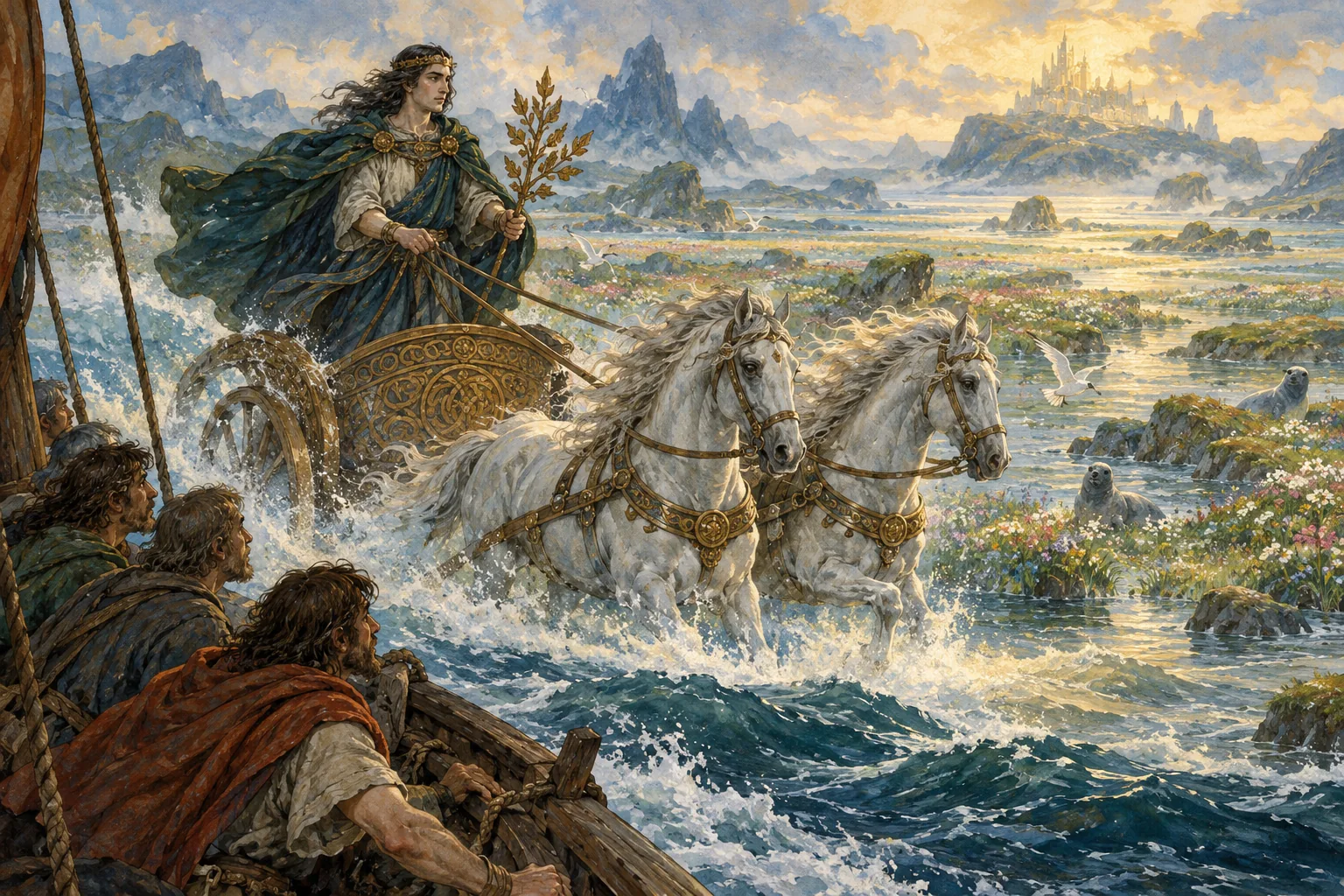
The sea seen from another world
Manannán mac Lir is one of the clearest connecting figures between Irish stories of the human world and the Otherworld. Yet the texts do not present a single orderly biography. He is encountered as a traveller, a disguised visitor, a ruler and a magician. Reading those appearances separately makes his range more interesting than assigning him one fixed job.
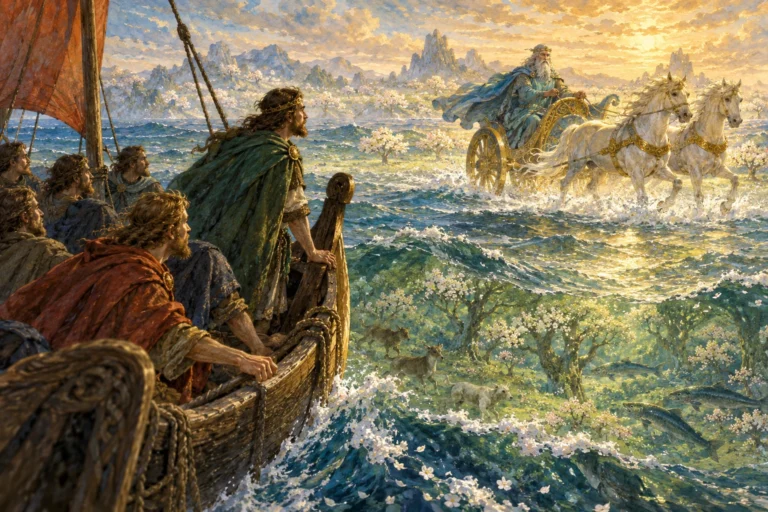
In The Voyage of Bran, he approaches the boat in a two-wheeled chariot. Bran sees a sea; Manannán sees a plain covered with flowers. Fish become the livestock of that other landscape, and woods lie beneath the little vessel’s course. His speech changes the significance of an ordinary view without requiring the sailors to change direction. The boundary between worlds is partly a boundary of perception. Meyer, §§32–48.
The same speech contains much more than a description of beauty. Manannán explains a world untouched by the fall of humankind, anticipates salvation, and predicts the birth of Mongán through his own union with Caintigern. Fiachna will acknowledge the child. This is the family relationship stated in that passage; it does not make every similarly named hero a relative. Meyer, §§49–59.
A guest who becomes a host
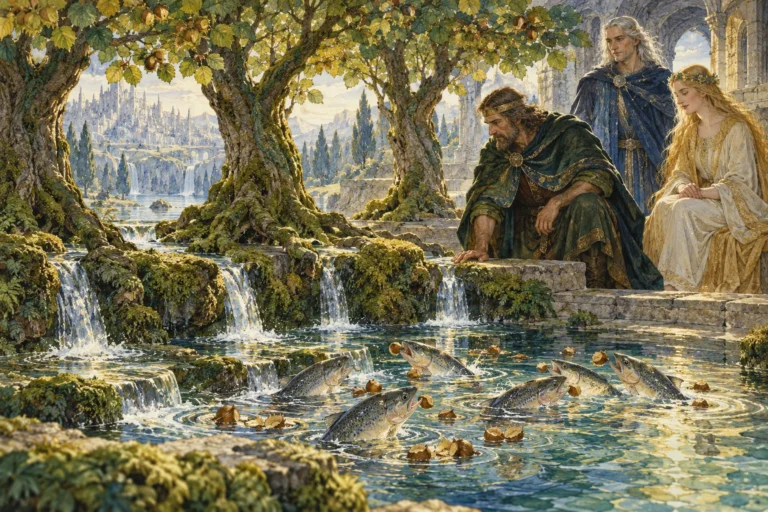
In Cormac’s adventure, Manannán first appears as a distinguished stranger carrying a musical branch. Cormac obtains it by promising three requests. Those requests remove his daughter, son and wife from Tara. When the king follows, mist separates him from his people and he enters a country of puzzling sights.
Only towards the end does his host identify himself as Manannán, king of the Land of Promise. Cormac recovers his family and receives a cup that breaks at falsehood and becomes whole at truth. The branch and cup will last only until Cormac’s death. Manannán’s generosity thus has conditions, just as his apparent cruelty has an explanation within the story. Stokes, “Cormac’s Cup”, pp. 211–216.
He also interprets the landscape. The fountain and its streams concern knowledge; apparently futile work expresses human habits. These explanations make him a teacher as well as a powerful host. They do not turn the adventure into a practical map of a hidden kingdom.
Gregory’s connected portrait
Lady Gregory gathers several appearances into the Manannán sequence of Gods and Fighting Men. Her “Manannán at Play” shows a mobile trickster using music, disguise and alarming performances. In her Dagda chapter he also advises Aengus’s claim to the Brú. These episodes broaden the picture beyond sea travel, but their placement in one book is Gregory’s literary arrangement. Book IV, chapters II and VIII–XIII.
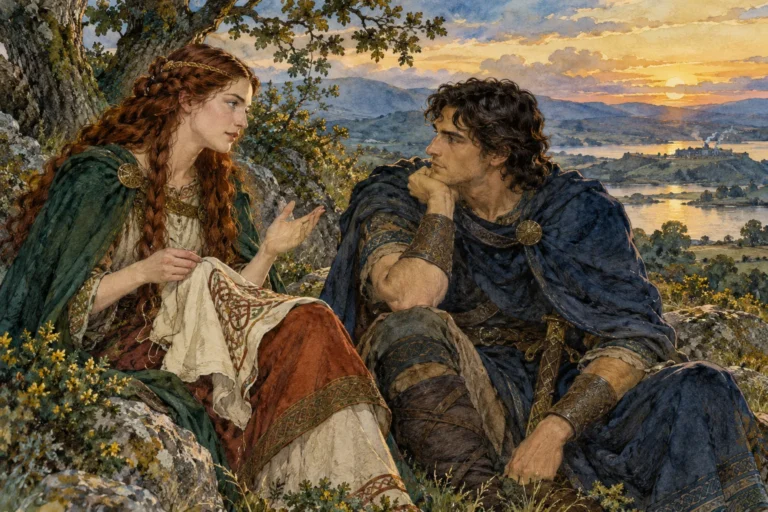
Her account of Bran omits much of his Christian and Mongán prophecy. Her introduction to Connla suggests that Manannán sent the woman who calls the prince away; she does not present that connection as certain. A reader following the links should therefore ask both where Manannán actually appears and where an editor supplies a connection.
The surviving stories offer a richly imagined supernatural figure. None of the sources examined here establishes a historical individual behind him. His name and family label also do not justify automatically making the father in The Children of Lir the same person as his own father in every tradition.
Versions and variations
The differences here are between distinct narratives and later arrangements, not competing chapters of one canonical life. In Bran, Manannán identifies himself immediately and speaks at length. In Cormac, his identity is withheld until the experiences have unfolded. Gregory connects the stories under his name and substantially shortens Bran’s speech. Meyer; Stokes; Gregory.
Even gifts need source labels. Stokes’s Cormac receives a branch with three golden apples; Gregory’s Cormac chapter gives it nine. Similar musical branches do not necessarily describe one object passed through every tale. Manx folklore, the early glossary traditions and the full range of Fand and Mongán material require separate treatment before this can become a comprehensive comparative profile.
Context and evidence
This guide follows the named translated accounts and links their story settings. It does not infer a universal ancient cult, fixed divine hierarchy or historical royal genealogy from a later literary compilation. Modern labels such as “sea god” can help orient readers, but they do not capture his moral instruction, artistry and changing appearances in these texts.
Sources for this entry
- Anonymous; edited and translated by Kuno Meyer; accompanying essays by Alfred Nutt, The Voyage of Bran, Son of Febal, to the Land of the Living: An Old Irish Saga. Volume I, London: David Nutt, 1895, pp. 2–34; Meyer’s English translation reproduced by Irish Sagas Online, University College Cork. Immram Brain, §§1–66; English column. Read source — Principal narrative. All 66 sections of the public-domain English translation read; the adjacent medieval Irish column uses a later edition and is not treated as Meyer’s text.. About this book
- Anonymous; edited and translated by Whitley Stokes, The Irish Ordeals, Cormac’s Adventure in the Land of Promise, and the Decision as to Cormac’s Sword. In Ernst Windisch and Whitley Stokes, eds, Irische Texte mit Übersetzungen und Wörterbuch, third series, part I; Leipzig: S. Hirzel, 1891, pp. 183–229. Introduction pp. 183–184; Cormac’s Cup, English pp. 211–216; assembly passage p. 217. Read source — Primary translated narrative for Manannán and the literary association of the Uisneach assembly with Mayday..
- Lady Gregory, Gods and Fighting Men: The Story of the Tuatha de Danaan and of the Fianna of Ireland. London: John Murray, 1905; first published 1904; Project Gutenberg 14465. Part I, Book IV, chapter II, The Dagda; chapters VIII–XIII; Notes III. Read source — Later literary adaptation compared with identified translations; not an independent oral witness.. About this book
Research coverage
Meyer’s Bran, Stokes’s Cormac and the specified Gregory passages examined. This is a narrative guide, not a complete survey of Irish, Scottish and Manx traditions. Glossary accounts, Manx collected folklore and the full Fand/Mongán textual traditions remain to be added.
The Myths · Irish collection · Editorial approach
Further Reading