Otherworld journeys · story
The Voyage of Bran
A silver branch draws Bran across a sea that Manannán sees as flowering land. When the voyagers return, their own lives have become ancient stories.
Also found as: Immram Brain · Immram Brain maic Febail · Bran son of Febal · Bran mac Febail
Research reviewed 17 October 2026.
Read the story
This original retelling follows Kuno Meyer’s 1895 translation of Immram Brain, §§1–66. The long poems are condensed, including their Christian and Mongán prophecies.
Bran, son of Febal, was walking alone near his stronghold when he heard music behind him. He turned to find the player, but the music remained behind his back. However often he looked, he could not discover its source. At last its sweetness overcame him, and he fell asleep.
When he woke, a branch lay beside him. It was silver, carrying white blossom so bright that flower and metal were difficult to tell apart. Bran took it home. Later, when the royal house was crowded, a woman in unfamiliar clothing appeared among the company. No one knew how she had entered.
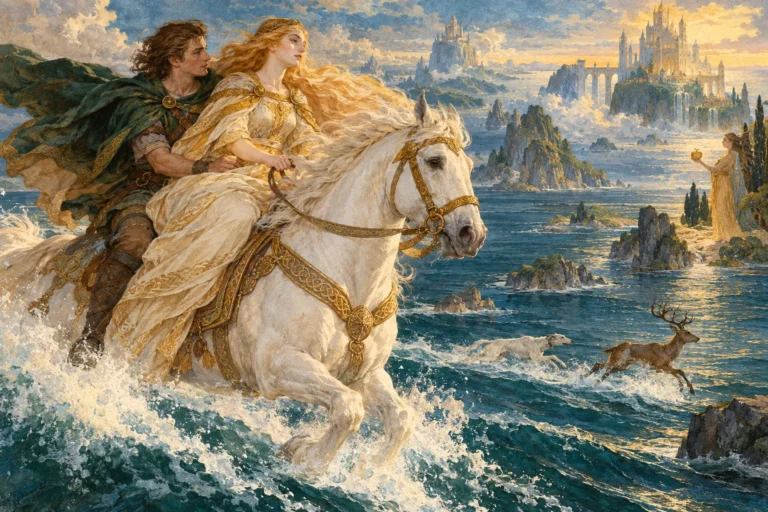
She sang of the country from which the branch had come: Emain, a place beyond the sea where there was neither sickness nor sorrow, where blossom fell and music continued without the threat of death. Chariots crossed shining plains. Birds sang together in the branches. Wine, colour and companionship filled a life untouched by the losses Bran knew.
Her song also reached beyond that invitation. It foretold a wondrous birth and a ruler who would heal human suffering. Then she addressed Bran directly. He must leave idleness behind and sail across the sea towards the Land of Women. When she departed, the silver branch sprang from his hand into hers; Bran had no strength to keep it.
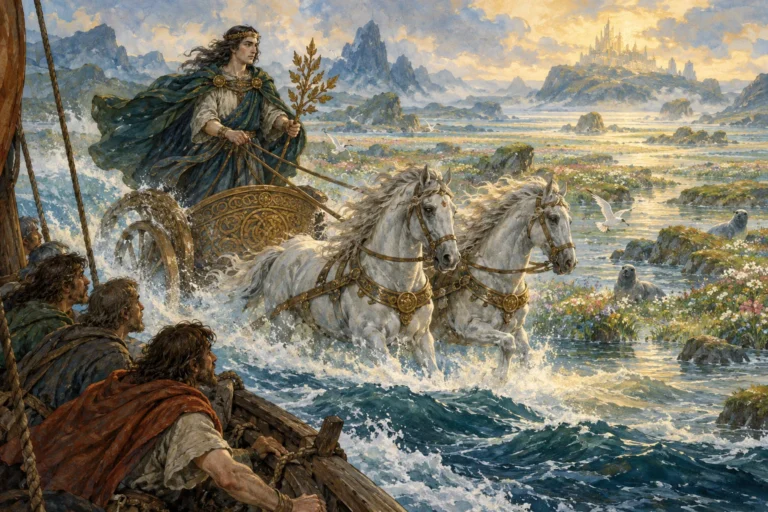
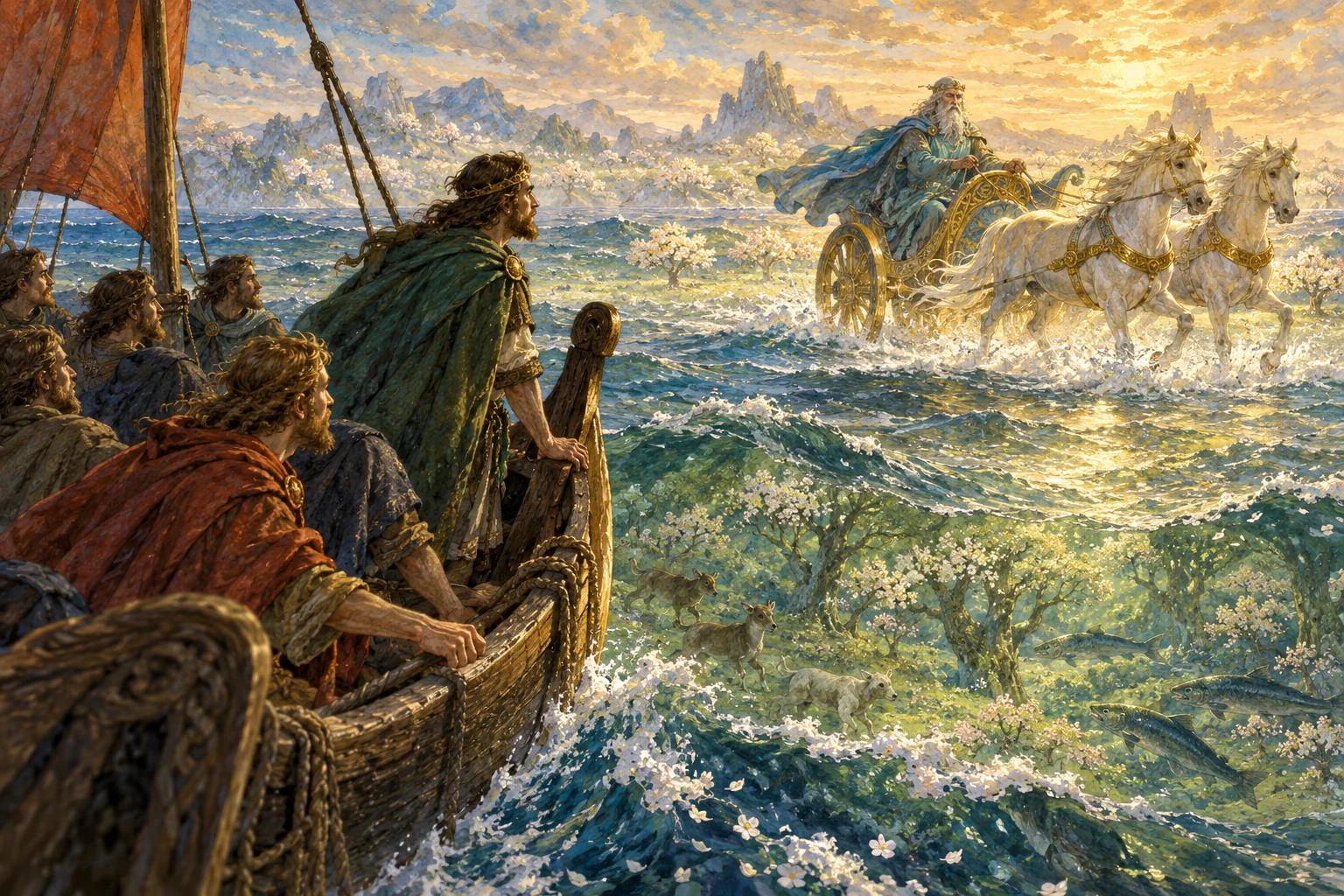
The next morning he set out with three companies of nine men, each company under one of his foster-brothers or companions. After two days and nights they saw a man approaching in a chariot. Its wheels travelled over the sea.
The rider was Manannán mac Lir. What Bran saw as water, he explained, was a flowering plain to him. Where the sailors watched salmon move through the waves, he saw calves and lambs. Beneath the little boat’s prow lay a wood heavy with blossom and fruit. Bran had not simply reached a strange part of the ocean: he was crossing a world that looked different to different eyes.
Manannán’s song spoke of a people untouched by the fall that had brought suffering to humankind, and of salvation still to come. He also foretold his own journey to a woman in Ireland and the birth of Mongán, whom Fiachna would acknowledge as his son. Then he directed Bran onwards. The Land of Women was near.
First they reached an island whose inhabitants did nothing but laugh. Bran sent a man ashore to speak with them. Immediately he joined their laughter. The boat circled the island, and his companions called repeatedly, but he would only stare at them and laugh. At last they sailed away, leaving him on the Island of Joy.
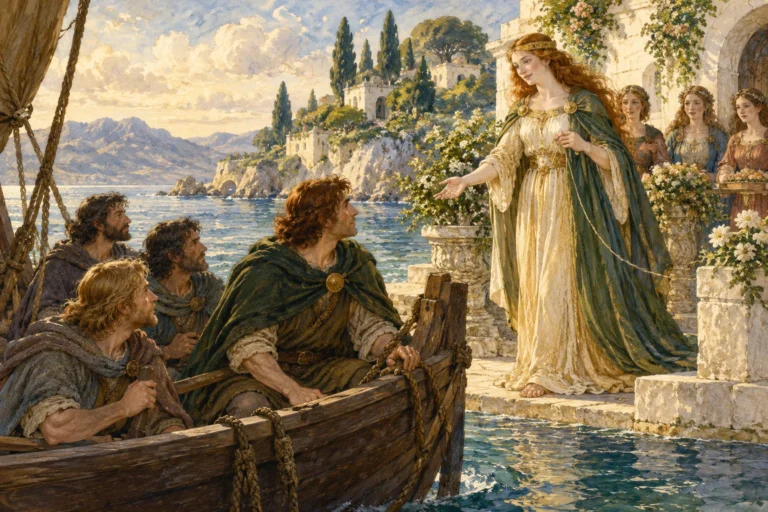
At the next country, the leader of the women welcomed Bran by name. He hesitated to land. She threw a ball of thread towards him, and it stuck to his palm. Keeping the thread’s end, she drew the whole boat into harbour.
Inside a great house, beds awaited the visiting men and their companions. Whatever food they wanted was supplied, and the dishes never emptied. They lived there in such abundance that the passage of time became almost impossible to measure. They thought they had stayed for one year. Many years had passed.
Then Nechtan, son of Collbran, became homesick. His relatives urged Bran to take him back to Ireland. The woman warned them that they would regret leaving; when they persisted, she told them to collect their lost companion from the Island of Joy and, above all, to let no one touch Irish ground.
At Srub Brain, people gathered by the shore. Bran called out his name. They did not recognise him. They knew the voyage of Bran, they answered, but only as an ancient story.
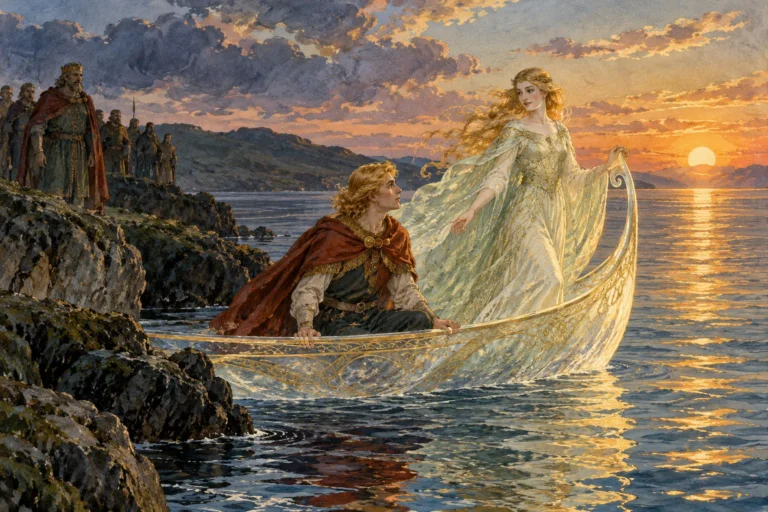
Nechtan leapt from the boat. The moment he touched the land he collapsed into ashes, as though the centuries he had escaped had found him all at once. Bran remained aboard. He told the gathering what had happened, recorded the verses in ogham, and said farewell. The boat went out again. The story does not tell where he travelled afterwards.
Versions and variations
Meyer’s translation and Gregory’s “His Call to Bran” preserve the same principal sequence: the branch, the invitation, Manannán’s chariot, the laughing island, the women’s hospitality and the fatal return. Gregory explicitly names Meyer in her authorities, alongside Standish Hayes O’Grady and d’Arbois de Jubainville. Their agreement therefore cannot be counted as two independent oral witnesses.
The most substantial difference is in the speeches. Meyer prints the woman’s prophecy of a saving birth (§§26–28) and Manannán’s account of humanity’s fall and future salvation (§§44–48). He also includes the extended prediction of Mongán’s birth, transformations and death (§§49–59). Gregory keeps the vivid contrast between sea and flowering land, but removes those passages from this chapter. Her shorter version consequently gives a different balance to the story’s religious and dynastic material.
The endings also differ in detail. In Meyer (§66), Bran both tells his adventures and writes the verses in ogham. Gregory has him recount the journey and disappear, without the writing. Neither account says he safely steps ashore or returns to ordinary life. Both identify Nechtan, not Bran, as the man reduced to ashes.
The thread is worth comparing with Máel Dúin’s voyage. In Bran it draws the arriving boat into harbour; in Stokes’s Máel Dúin it prevents a departing crew from escaping an island queen. That is a parallel episode in another tale, not an alternative manuscript of Bran. Likewise Oisín’s dangerous return is a comparison, not permission to import his horse or meeting with Patrick into Bran’s story. The manuscript forms and later oral retellings of Bran have not all been collated here.
Context and evidence
The text alternates prose with substantial verse speeches. Calling it a voyage captures its sea journey, but its central invitation and transformed perception also connect it with Otherworld adventure tales. The religious passages are part of the version translated by Meyer; removing them and calling what remains an untouched pagan original would be an editorial reconstruction. Read the complete translated text.
No archaeological identification of the islands or eyewitness voyage is established by these sources. The final claim that Bran recorded his story in ogham belongs to the narrative itself. The supernatural Emain described here should not automatically be mapped onto Emain Macha, and this Bran is neither Fionn’s hound nor the Welsh Brân.
Sources for this entry
- Anonymous; edited and translated by Kuno Meyer; accompanying essays by Alfred Nutt, The Voyage of Bran, Son of Febal, to the Land of the Living: An Old Irish Saga. Volume I, London: David Nutt, 1895, pp. 2–34; Meyer’s English translation reproduced by Irish Sagas Online, University College Cork. Immram Brain, §§1–66; English column. Read source — Principal narrative. All 66 sections of the public-domain English translation read; the adjacent medieval Irish column uses a later edition and is not treated as Meyer’s text.. About this book
- Lady Gregory, Gods and Fighting Men: The Story of the Tuatha de Danaan and of the Fianna of Ireland. London: John Murray, 1905; first published 1904; Project Gutenberg 14465. Part I, Book IV, chapter X, His Call to Bran; Notes III, Book Four. Read source — Later literary adaptation compared with identified translations; not an independent oral witness.. About this book
Research coverage
Complete Meyer English translation and complete Gregory Bran chapter compared. The later Irish edition printed alongside Meyer online is not treated as the same textual witness. Manuscript recensions, modern critical editions and collected oral versions remain to be collated; these two accounts do not exhaust the tradition.
The Myths · Irish collection · Editorial approach
Further Reading