The Four Branches of the Mabinogi · figure
Bendigeidfran
The giant king of the Second Branch tries to make peace, carries an army across a river and remains his companions' protector after death. His extraordinary strength cannot prevent his family's destruction.
Also found as: Brân the Blessed · Bran the Blessed · Bendigeid Vran · Brân fab Llŷr
Research reviewed 17 October 2026.
Bendigeidfran, also called Brân the Blessed, is the giant king at the centre of Branwen, Daughter of Llŷr. The Second Branch presents him as ruler of the Island of the Mighty, crowned in London. His story combines royal negotiation, immense bodily strength and a remarkable survival after death. It should be read as a connected narrative, rather than reduced to a list of supernatural powers. Guest/Edwards, pp. 39–60, supplies the principal account used here.
His family matters at every turn. Branwen and Manawydan are his siblings; Nisien and Efnisien are their maternal half-brothers. Nisien is described as a peacemaker, Efnisien as someone who creates discord even between friends. Bendigeidfran has a son, Caradog, whom he leaves to defend Britain when he crosses to Ireland. The different loyalties within this household help explain why a royal marriage becomes a disaster.
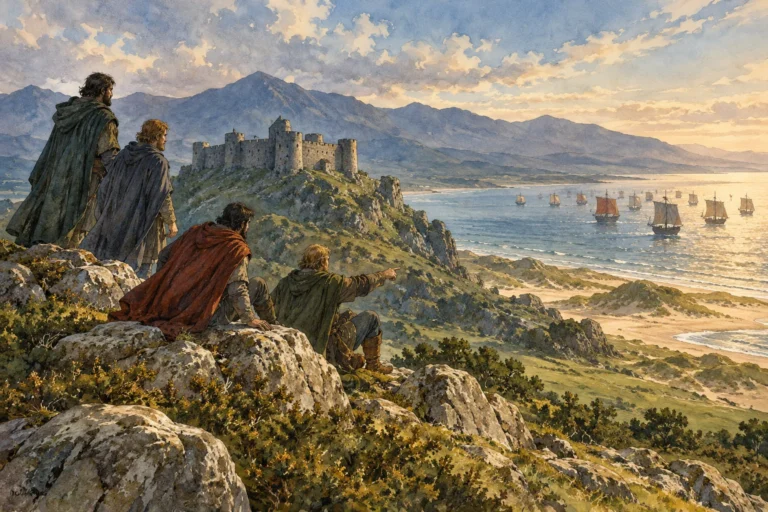
At first Bendigeidfran acts as a negotiator. From Harlech he receives Matholwch’s marriage embassy and agrees to an alliance through Branwen. After Efnisien mutilates the Irish king’s horses, he tries to repair the insult with replacement animals and treasure. He adds the cauldron that restores dead warriors to life without restoring their speech. His generosity averts an immediate rupture, but does not remove the resentment carried back to Ireland.
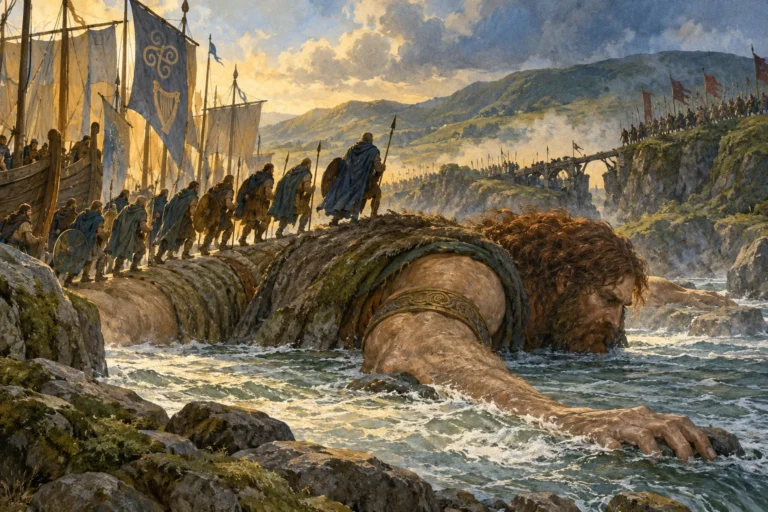
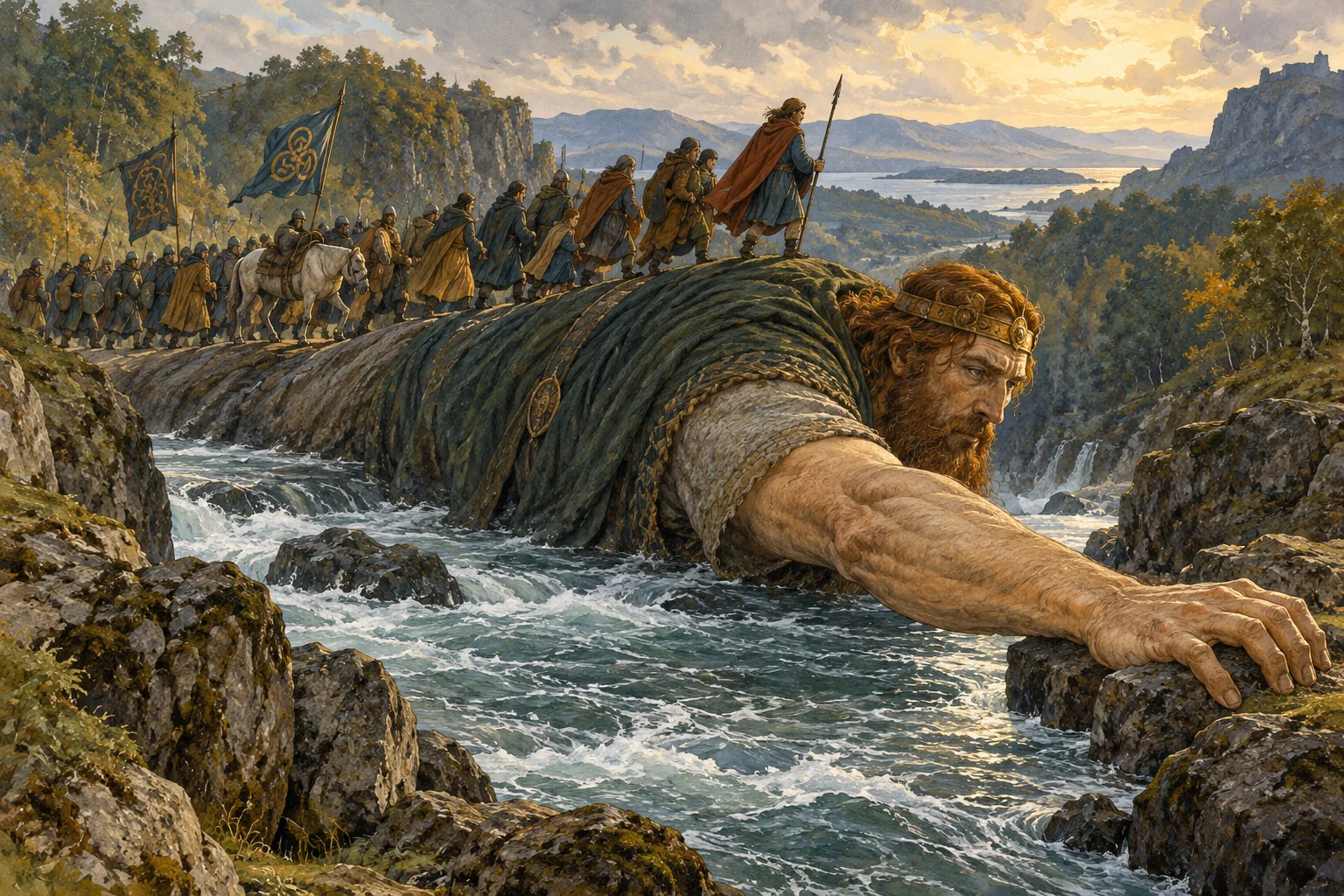
His giant body makes leadership visible. The wedding takes place in tents because no available house can contain him. When he later goes to rescue Branwen, Irish observers mistake his head for a mountain behind a moving forest of ship masts. At a broken river crossing he lays himself down as a bridge. The tale turns the obligation of a chief to support his people into something they can literally walk upon.
That strength has limits. Bendigeidfran cannot prevent Efnisien from killing Branwen’s child, Gwern, during the apparent reconciliation feast. He holds his sister back when she tries to follow her son into the fire and shields her as the fighting begins. He can protect her in that instant, but neither his size nor his kingship reverses the wider catastrophe. The cauldron he gave away now helps replenish the opposing army.
A poisoned wound in his foot makes his own survival impossible. His final instructions redirect the survivors towards home: they must cut off his head, feast with it and eventually bury it in London’s White Mount. The head continues to provide companionship during seven years at Harlech and eighty at Gwales. After the forbidden door at Gwales opens, grief returns and the journey resumes. Protection survives the king’s bodily death, but the losses remain real within the story.
The burial is described as safeguarding the island while the head remains hidden. This is a claim made by the tale, not evidence for an excavated protective relic. Likewise, Harlech’s surviving castle supplies a real place to explore the story’s geography without authenticating a giant’s residence. The Loth translation provides another historical presentation of the same Branch and useful checks on details.
Readers coming from the Irish collection should keep him distinct from the voyager in The Voyage of Bran. A shared name does not make a shared biography. Their stories can fruitfully be compared for marvellous journeys and altered experiences of time while preserving their different families, actions and textual histories.
Versions and variations
Guest’s “Bendigeid Vran” and Loth’s “Bendigeit Vran” are spellings in the editions consulted, not two different giants. The same applies to the shortened name Brân used in discussion. The comparison on the Branwen page records substantive differences, including what he carries during the sea crossing and how the cauldron’s Irish origin is expressed.
This guide concentrates on the Second Branch. Loth’s annotations also discuss other traditions associated with Brân, but those references have not been independently audited here. They are not silently combined with the Branch to create a single life story. Identifying him as a historical ruler or assigning him a fixed ancient religious office would require a separate argument and additional evidence.
Context and evidence
The principal evidence examined is literary: two historical translations of a medieval Welsh tale. The National Library of Wales’s manuscript description supports the surviving textual setting of the Four Branches. Neither a giant body nor the protective head is established as a historical or archaeological fact.
Sources for this entry
- Charlotte Guest, translator; Owen M. Edwards, editor, The Mabinogion, volume III: Branwen the Daughter of Llyr. London: T. Fisher Unwin, 1912; Project Gutenberg 19976. Guest's original three-volume collection was complete in 1849.. Pp. 39–60; Edwards's corrective notes to pp. 45 and 50.. Read source — Public-domain narrative basis; complete Second Branch read, with the embedded cauldron history and genealogical epilogue compressed. About this book
- Joseph Loth, translator, Les Mabinogion, tome I: « Branwen, fille de Llyr ». Paris: Fontemoing, 1913; revised from the 1889 edition.. Second Branch, pp. 119–150; complete narrative and relevant annotations.. Read source — Public-domain comparison translation; consulted for concrete differences in the cauldron's provenance and the sea crossing. About this book
- National Library of Wales, White Book of Rhydderch. Online; consulted 17 October 2026.. Peniarth MS 4 and the Red Book comparison.. Read source — Manuscript description; no direct collation.
Research coverage
A guide to Bendigeidfran in the Second Branch, not a complete dossier of every poetic, triadic, antiquarian or modern reference. No identity with an Irish Bran, historical British ruler or universally agreed deity is asserted.
The Myths · Welsh collection · Editorial approach
Further Reading