The Four Branches of the Mabinogi · story
Pwyll and Arawn
After offending an Otherworld king during a hunt, Pwyll exchanges appearances and kingdoms with him for a year. A single combat and an unexpected act of restraint turn the quarrel into friendship.
Also found as: Pwyll in Annwn · Pwyll, Prince of Dyfed · Pwyll Pendefig Dyfed
Research reviewed 17 October 2026.
Read the story
This original retelling follows the opening Arawn episode in Joseph Loth’s 1913 translation of “Pwyll, prince de Dyvet”. It ends before the First Branch turns to Rhiannon.
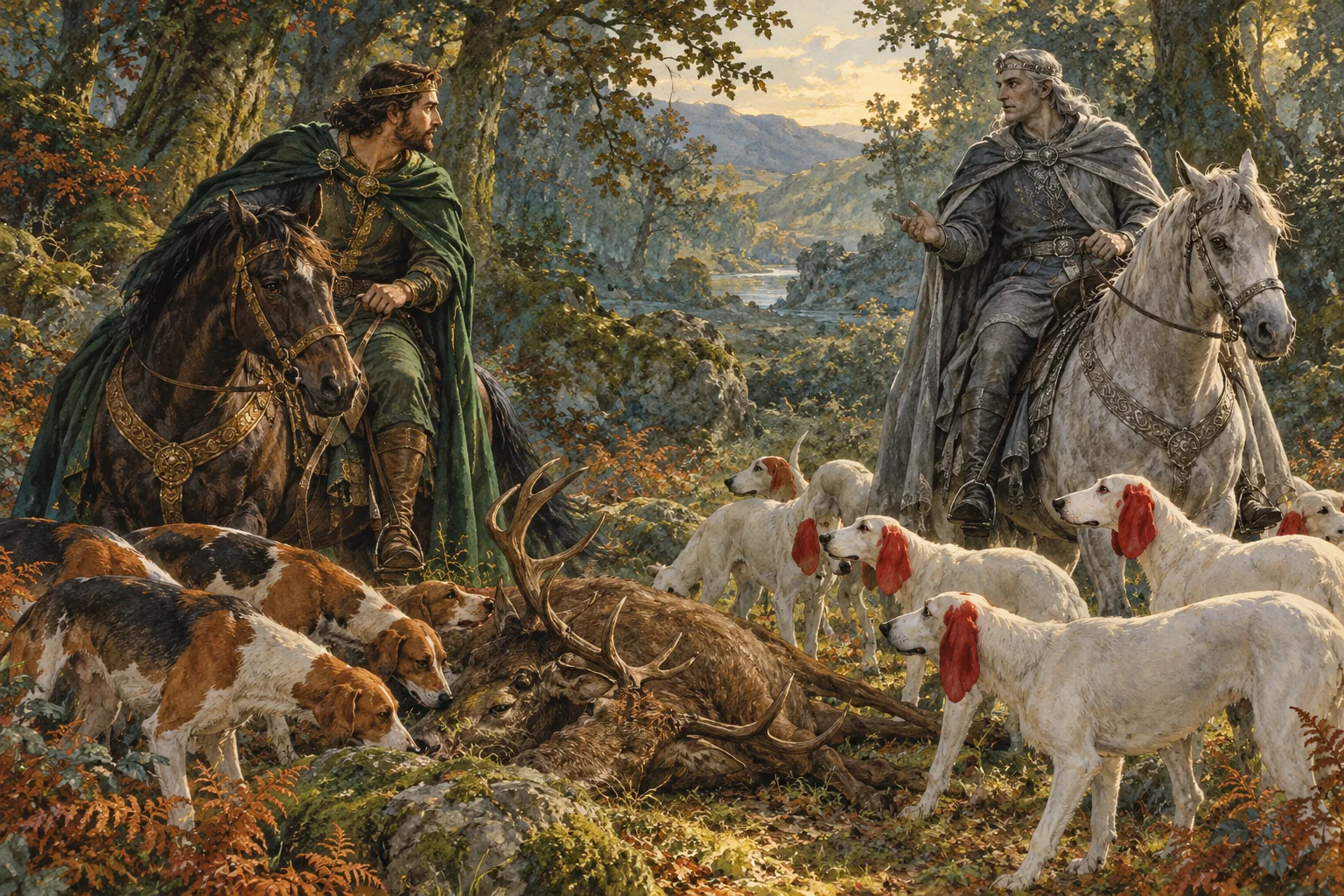
Pwyll, ruler of Dyfed, went hunting from his court at Arberth. In the woods of Glyn Cuch he followed his hounds until he lost his companions. Another pack was approaching through the trees. Its cry was unfamiliar, and when the dogs appeared he saw why they had caught his attention: their bodies shone white and their ears were brilliantly red.
They brought down a stag in a clearing. Pwyll rode forward, drove them from their kill and called his own hounds to feed. Then a rider arrived on a large grey horse, dressed in grey hunting clothes. He knew Pwyll’s name, but refused to greet him.
The offence, he explained, was not a matter of rank. Pwyll had taken another hunter’s quarry. Pwyll offered to make amends and asked who he was. The stranger was Arawn, a king of Annwn. He had an enemy there, another king named Hafgan, whose repeated attacks had become a torment. If Pwyll would deal with Hafgan, Arawn would accept that service as compensation.
His proposal was extraordinary. For a year they would exchange appearances and rule each other’s lands. Nobody in either household would recognise the substitution. At the year’s end, Pwyll would meet Hafgan at an appointed ford. He must strike him once, and only once. Whatever Hafgan begged afterwards, Pwyll must not strike again. Arawn’s own attempts had left the enemy ready to fight another day.
Pwyll agreed. Arawn gave him his appearance and guided him towards the court of Annwn. There attendants greeted him as their lord, removed his hunting clothes and dressed him for the feast. Everything was splendid: the furnishings, the food, the company and the music. Beside him sat the queen, whose conversation impressed him as much as her beauty.
She believed that the man beside her was her husband. When they went to bed, Pwyll turned away and said nothing until morning. In daylight he was courteous and companionable; at night he kept the same distance. He followed this rule throughout the year, although nobody had demanded it of him.
At last the day of the combat came. Pwyll rode to the ford with the nobles of Annwn. An announcement made the terms plain: the two kings would settle their dispute alone, while their followers stood aside. Pwyll’s first attack broke through Hafgan’s shield and armour and threw him from his horse.
Mortally wounded, Hafgan asked his opponent to finish him. Pwyll remembered Arawn’s warning. He would do no more. Hafgan called on his followers to carry him away, admitting that he could no longer protect them. Pwyll received the submission of those who accepted Arawn’s rule and ordered resistance overcome. By the following noon, the two kingdoms had been brought together.
He returned to Glyn Cuch, where Arawn was waiting. They welcomed one another warmly and recovered their own appearances. Their bargain was fulfilled, but Arawn had yet to discover everything that had happened in his absence.
Back in Annwn, he joined his wife. His affection that night astonished her. For a year, she told him, he had turned away in bed and scarcely spoken there, although he had been friendly during the day. Arawn understood. He explained the exchange and recognised in Pwyll a loyalty he had never required or expected. The queen agreed that he had found a remarkable friend.
Pwyll also returned to a surprise. When he asked his nobles how his government had compared with earlier years, they praised its generosity, courtesy and justice. He told them who had actually been ruling. They asked him to preserve the improvements, and he promised to do so as far as he could.
The two rulers continued exchanging horses, hounds, hawks and precious gifts. What had begun with a stolen stag had changed both their fortunes. Because of his successful year in Annwn, Pwyll acquired a new title: Chief of Annwn.
Versions and variations
The most consequential difference in the editions examined here concerns Arawn’s queen. Loth’s 1913 translation includes both Pwyll’s year of abstinence and the conversation in which Arawn learns of it after returning home. The 1912 Guest/Edwards volume, pp. 11–19, passes from the feast to the year’s activities without the bedroom scene, and also omits the queen’s later explanation. Those omissions alter the balance of the episode: readers of that presentation see the combat and good government, but lose an important reason for Arawn’s admiration. This page follows Loth for the complete sequence.
These are differences between published presentations of a medieval tale, not evidence that two separate communities told different oral versions. Nor does this comparison establish who first made every omission in the history of Guest’s editions. The finding applies to the specific 1912 volume linked here; it should not be expanded into a claim about every text carrying Guest’s name.
Loth himself explains in his 1913 preface that he substantially revised his 1889 work after new access to the White Book’s readings. He retained the Red Book as his principal basis while sometimes preferring the White Book. That is editorial comparison of manuscript witnesses. A full Welsh-language collation would be needed to attribute a particular reading securely to an individual manuscript.
The episode also invites comparison with Cormac’s visit to the Otherworld: both stories connect a ruler’s extraordinary encounter with judgements about conduct and kingship. This is a thematic reading, not evidence that Arawn and Cormac’s host are the same figure or that either surviving tale derives directly from the other.
Context and evidence
The First Branch survives in medieval Welsh manuscript tradition. The National Library of Wales identifies the White Book of Rhydderch as an early collection containing the Four Branches and points to the later Red Book of Hergest as another major witness. The surviving books establish a textual history; they do not document Pwyll’s reign as a historical event.
Within this episode, Annwn has courts, rival rulers, hunting and political obligations. Calling Arawn simply a devil or treating his land as a place of punishment would import a description the story does not supply. Pwyll’s later marriage and family belong to the rest of the First Branch and are outside this page’s narrative boundary.
Sources for this entry
- Joseph Loth, translator, Les Mabinogion, tome I: « Pwyll, prince de Dyvet ». Paris: Fontemoing, 1913; revised from Loth's 1889 translation.. Chapter pp. 81–117: opening episode, from the hunt in Glynn Cuch to the exchange of gifts with Arawn; the subsequent Rhiannon episode is outside this retelling.. Read source — Public-domain narrative basis, read in full for the bounded Arawn episode; translated here into an original English retelling. About this book
- Charlotte Guest, translator; Owen M. Edwards, editor, The Mabinogion, volume III: Pwyll Prince of Dyved. London: T. Fisher Unwin, 1912; Project Gutenberg 19976. Guest's collection first appeared in parts from 1838 and was complete in three volumes in 1849.. Pp. 11–19, opening Arawn episode; Edwards's introduction, pp. 7–8.. Read source — Comparison with a historical English presentation which omits the bedroom passages included by Loth. About this book
- Joseph Loth, Les Mabinogion, tome I: Préface. Paris: Fontemoing, 1913.. Preface, pp. 3–10, especially the relationship between the 1889 and 1913 editions and the Red and White Books.. Read source — Translator's explanation of his revised textual basis; not an independent oral account. About this book
- National Library of Wales, White Book of Rhydderch. Online; consulted 17 October 2026.. Peniarth MS 4 and the Red Book comparison.. Read source — Manuscript description; no direct collation.
Research coverage
Examined: the complete bounded Arawn episode in Loth 1913 and Guest/Edwards 1912, plus Loth's account of his editions. Not examined: a fresh collation of the Welsh manuscripts, every Guest printing, or all modern translations. The rest of the First Branch is not retold here.
The Myths · Welsh collection · Editorial approach
Further Reading