Medieval encounters with a hidden country · story
Elidyr and the golden ball
A runaway schoolboy is welcomed into a hidden country. A stolen golden ball closes the way back.
Also found as: Elidorus · Elidurus · Elidyr
Research reviewed 18 October 2026.

Read the story
Beneath the riverbank
This retelling follows Gerald of Wales’s account of Elidorus, known here as Elidyr, in Hoare’s English translation.
At twelve years old, Elidyr ran away from school to escape his teacher’s beatings. He hid beneath the hollow bank of a river. After two days without food, two small men appeared. They offered to lead him to a country where he could play and be happy.
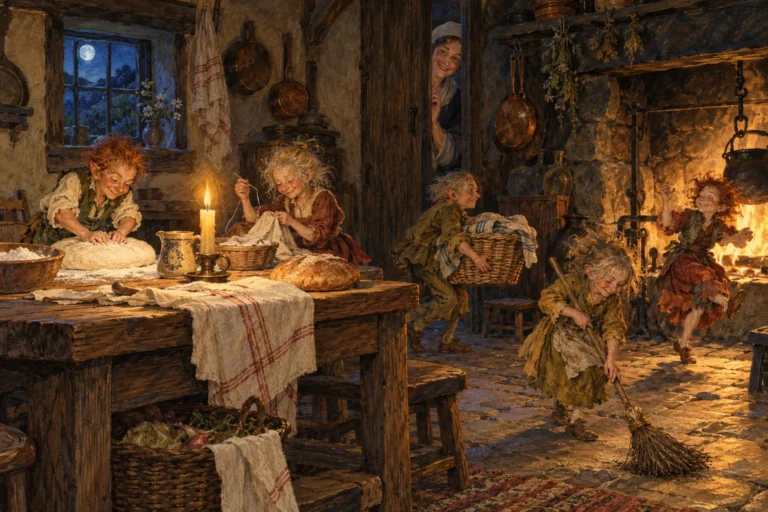
He followed them through a dark underground passage. Beyond it lay a beautiful country lit as if by a cloudy day. Its people were small but well proportioned, with long hair; even their horses and hounds were suited to their size. Their king welcomed the boy and made him a companion to his son.
The people ate milk dishes flavoured with saffron rather than flesh or fish. They valued truth and criticised the ambitions and unfaithfulness of human beings. Elidyr learnt their language and moved between their country and his own, at first accompanied, then alone.
The stolen ball
Only his mother knew where he went. When he described the gold in that country, she urged him to bring some home. One day, while playing with the prince, he took the golden ball they used in their game and fled.
Two of the small people pursued him. At his family’s threshold he stumbled; the ball fell and his pursuers recovered it. They left him with gestures of contempt.
For a year he tried to find the passage again, without success. Eventually he returned to learning and became a priest. Long afterwards, the account says, he still wept when he remembered the country he had lost.
Versions and variations
Gerald’s chain of testimony
Gerald says that Bishop David told him about Elidorus. The adult priest’s recollection reaches the reader through that bishop and Gerald’s writing, then through a modern-language translation. Gerald is not describing his own visit to the country.
Sikes’s later retelling
In British Goblins, Sikes quotes Hoare and explicitly places the scene in the Vale of Neath. This is a dependent retelling with a geographical framing, not a new medieval witness. Gerald’s chapter covers travel through the Neath, Swansea and Gower area, but the boy’s river is not named in the passage.
Related tales, not interchangeable versions
The stolen object and lost entrance differ from the dangerous dance in Rhys and Llewellyn. Elidyr has repeated visits and a moral breach; the dancers lose ordinary time. Sikes brings such narratives together under fairyland, but their mechanisms should remain distinct.
Context and evidence
The text is evidence for a medieval story and for Gerald’s interest in unusual testimony. It is not proof of an underground civilisation. His comments connecting reported words with Greek are medieval linguistic speculation, not an established origin for Welsh fairy beliefs.
No exact cave or riverbank is identified here. The Vale of Neath guide explains the later association without turning it into a verified location.
Sources for this entry
- Gerald of Wales; translated by Sir Richard Colt Hoare, The Itinerary of Archbishop Baldwin through Wales. Medieval Latin work, in Hoare’s English translation; Project Gutenberg transcription. Book I, chapter VIII, Elidorus passage. Read source — Earliest account examined here; Gerald reports what Bishop David told him about Elidorus. About this book
- Wirt Sikes, British Goblins: Welsh Folk-Lore, Fairy Mythology, Legends and Traditions. London, 1880. Book I, chapter VI, §I, pp.65–67. Read source — Dependent quotation of Hoare with an explicit Vale of Neath setting. About this book
Research coverage
The passages named below have been read and compared. This entry does not claim to include every oral performance, manuscript witness or modern adaptation; unexamined leads are identified separately.
The Myths · Welsh collection · Editorial approach
Further Reading