Local folklore · story
Rowli Pugh and the ellyllon
A struggling Glamorgan household leaves a candle burning for unseen helpers. Curiosity ends the visits, but not all of the good they have done.
Also found as: Rowli and the Ellyll
Research reviewed 17 October 2026.
Read the story
This retelling follows Wirt Sikes’s account in British Goblins (1880).
Nothing seemed to go right for Rowli Pugh. When other farmers had good crops, his failed. His roof leaked however much he repaired it, his walls stayed damp, and his wife was too unwell to manage her work. He began to think that leaving the country might be the only way to begin again.
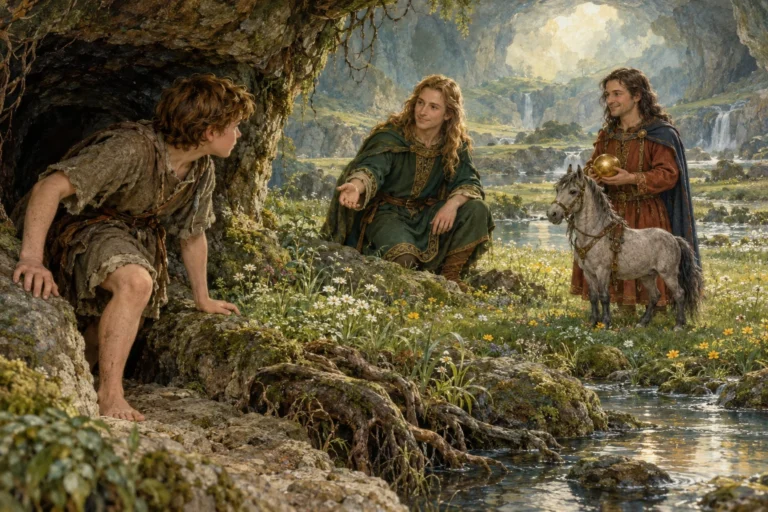
One day, while he sat worrying on a wall beside his cottage, a little man appeared. Before Rowli could explain his troubles, the stranger said that he already knew them. There was no need to go away. Rowli should tell his wife to leave a candle burning when she went to bed, and say nothing more about it. The little man vanished.
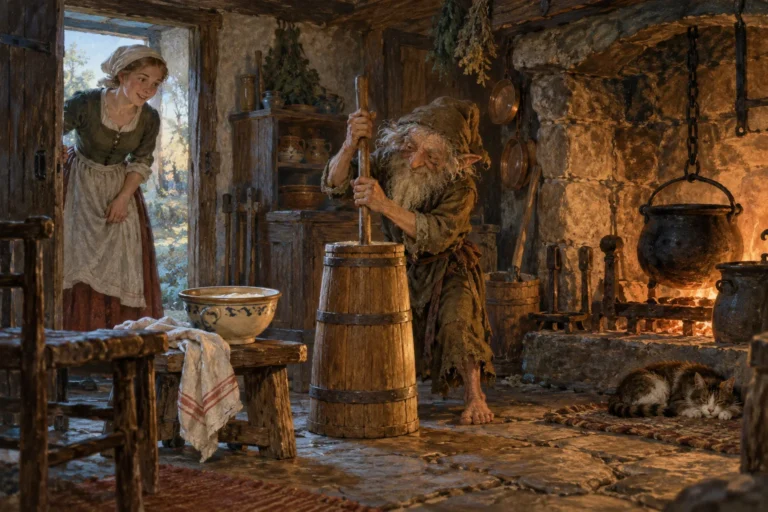
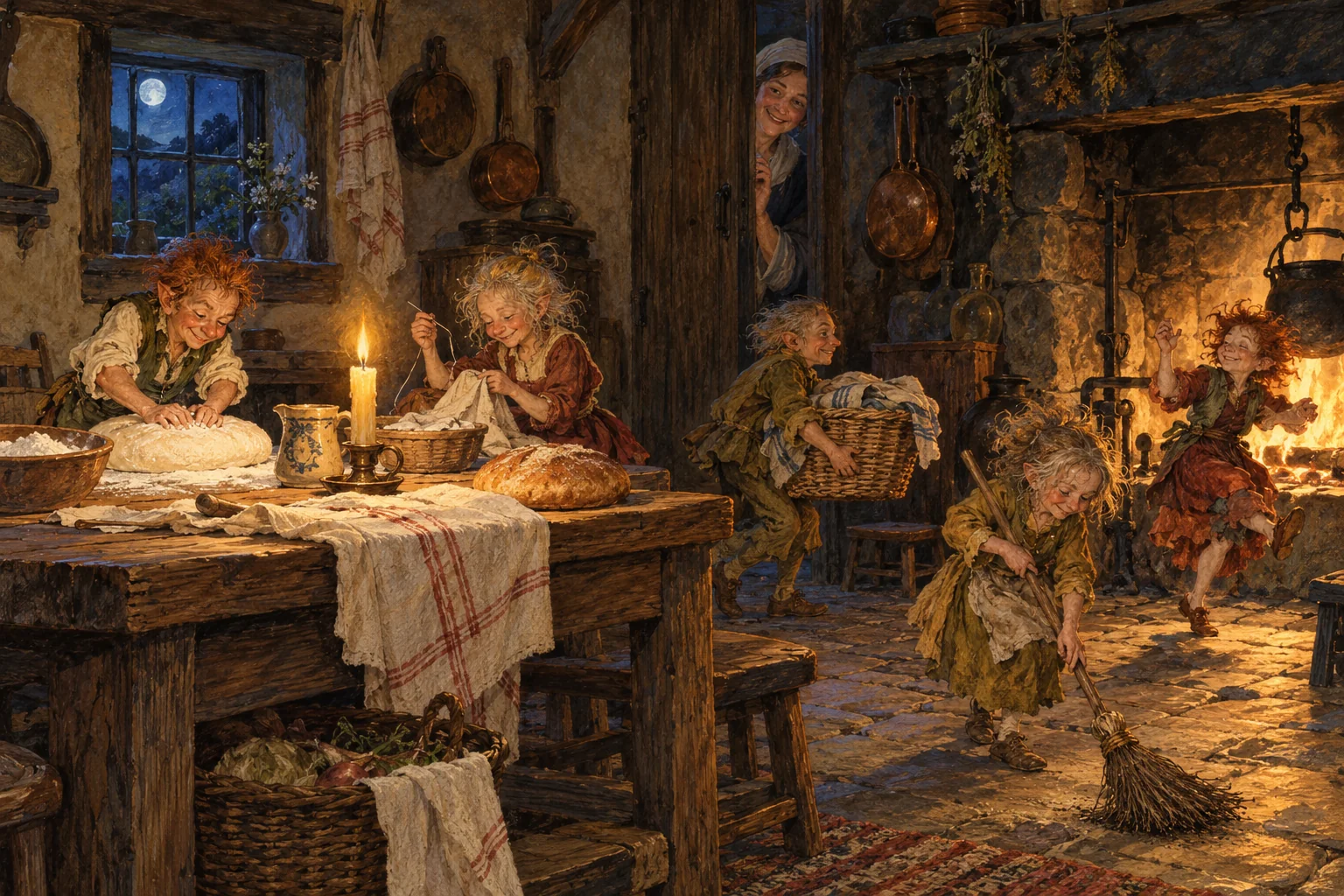
That evening Catti Jones swept the hearth, left the light and went to bed. During the night a company of fairies arrived and took up the household tasks. They baked and brewed, washed and mended, sometimes bringing materials and tools of their own. In the morning there was food, clean linen and repaired clothing.
The help continued. Rowli had better food and clothes, and more heart for his work. His farm prospered. The animals thrived, the crops improved and the barns were kept in order. For three years the nightly arrangement transformed the household.
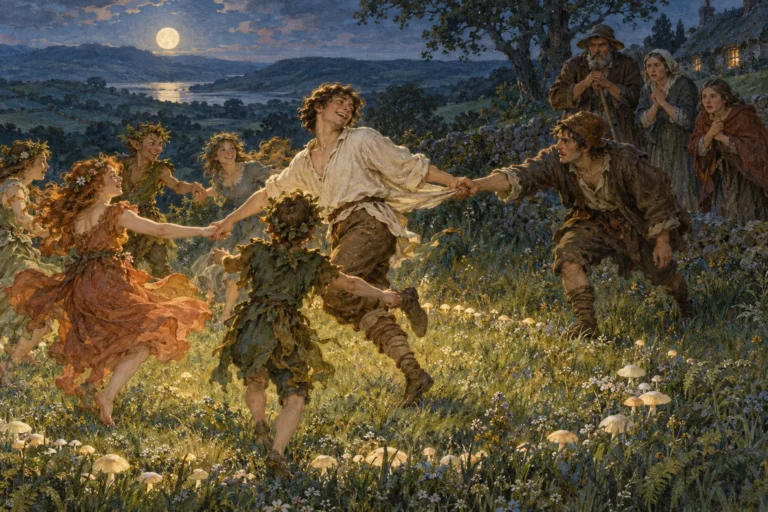
Then Catti wanted to see the workers. She rose while her husband slept and looked through a crack in the door. The room was full of little people, busy with their tasks and laughing and dancing while they worked. Their enjoyment was irresistible. Catti laughed too.
At the sound of her voice, the company disappeared. They never returned. But the family did not fall back into its former misery: Rowli was prosperous now, and the bad luck did not come back. The help had ended, while the life it had made possible continued.
Versions and variations
The telling Sikes prints
Sikes introduces this tale among material heard during a conversation at the Huntsman’s Rest in Peterstone-super-Ely, near Cardiff. The farm itself is only placed in Glamorganshire. The inn is a collecting location, not an identified home of Rowli Pugh.
Ellyllon and household helpers
Sikes calls these beings ellyllon, then observes that their domestic role overlaps his category of bwbach. The classification problem belongs to the source itself. It should not be resolved by silently replacing every name with “brownie”.
Similar stories, different endings
This examined version ends with the household still prosperous. The Brownie of Blednoch leaves after clothes are offered, and Habetrot’s aid continues after marriage. They are comparisons in supernatural labour, not extra versions of Rowli’s life. No second independently collected Rowli Pugh narrative has been established for this entry.
Context and evidence
The story links household wellbeing with the labour needed to maintain it. Catti’s illness is part of the family’s difficulty, and the magical assistance includes work often left invisible in accounts of a farm’s success. Her laughter ends the visits, but Sikes does not say that she plunges the household back into poverty.
Sikes’s scene of conversation is evidence for his presentation of the collecting encounter. It is not a birth record for Rowli or Catti. Their existence as historical individuals has not been demonstrated here; nor has the unnamed farm been identified.
Sources for this entry
- Wirt Sikes, British Goblins: Welsh Folk-Lore, Fairy Mythology, Legends and Traditions. London: Sampson Low, Marston, Searle & Rivington, 1880. Book I, chapter II, section III, pp.14–18. Read source — Complete Rowli Pugh narrative, collecting frame and classification comment. About this book
Research coverage
The complete Rowli Pugh passage and its surrounding source frame were examined. Only one collected narrative is established here; linked helper tales are labelled as parallels. A wider Welsh-language and oral-archive search remains open.
The Myths · Welsh collection · Editorial approach
Further Reading