Folklore and local legends · story
The Horned Women
Twelve mysterious spinners take possession of a house. A voice at a well teaches its mistress how to send them away, then keep them out.
Also found as: The Twelve Horned Women
Research reviewed 18 October 2026.
Read the story
This retelling follows Joseph Jacobs’s 1892 version, which credits Lady Wilde. The Blackstairs and Scottish accounts are compared separately below.
Everyone else in the house was asleep. Its mistress stayed beside the fire, carding wool, until a knock interrupted her work. The visitor announced herself as the Witch of the One Horn. Expecting a neighbour who needed help, the woman opened the door. A stranger with a horn on her forehead entered, sat down and began carding at a furious pace.
Another knock followed. This visitor had two horns and brought a spinning wheel. More women arrived, until twelve sat around the fire, the last bearing twelve horns. They carded, spun and wove, singing together while their hands flew. The mistress wanted to call for help, but their spell held her silent.
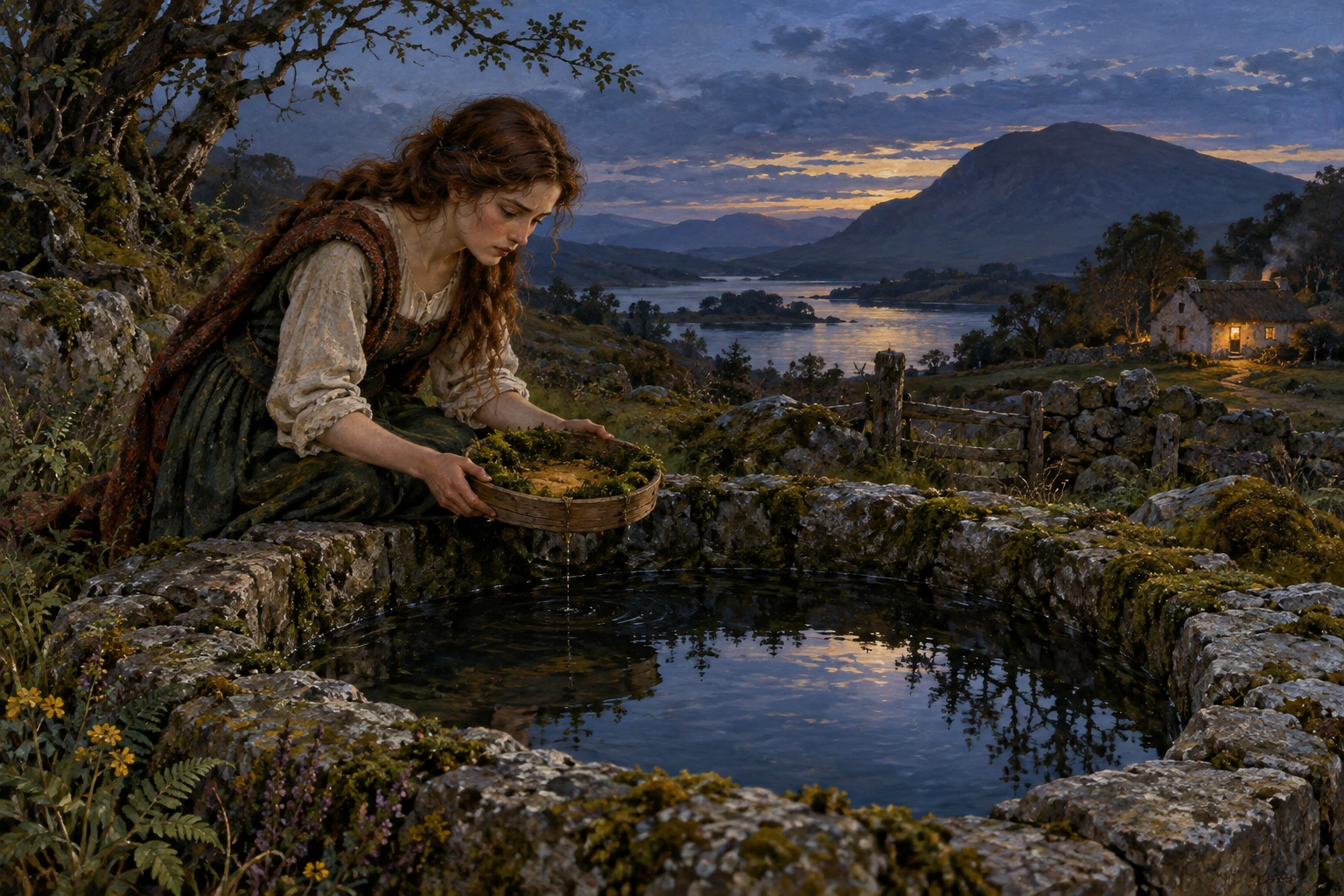
The visitors demanded a cake. When she looked for something in which to fetch water, they sent her to the well with a sieve. Every attempt to fill it failed. She sat down and wept. Then a voice from the well told her to bind yellow clay and moss together and line the sieve. This time the water stayed.
The voice gave another instruction. At the north corner of the house she must cry three times that the mountain of the Fenian women, and the sky above it, were on fire. She did so. The spinners rushed out in alarm and fled towards Slievenamon, leaving her a little time to defend the house.
With the well spirit’s guidance, she scattered the water in which her children’s feet had been washed outside the threshold. The visitors had made a cake from meal mixed with blood taken from the sleeping household. She broke it and placed pieces in the sleepers’ mouths, restoring them. She trapped the witches’ woven cloth half inside and half outside a locked chest, and secured the door with a crossbeam.
The women returned, furious at the deception. They called on the foot-water to open the door, but it had been scattered outside. The door could not move against the crossbeam. The cake could not help them because it had been broken and eaten. Each possible accomplice had been put beyond their reach.
At last the horned women departed, cursing the spirit of the well. One left a mantle behind. The narrator says the family kept it for five hundred years, a final claim within the tale rather than the history of an object we can now examine.
Versions and variations
Wilde and Jacobs: a traceable literary relationship
Wilde’s “The Horned Women” supplies the twelve visitors, their increasing number of horns, the sieve, Slievenamon and the household defences. Jacobs names Wilde as his source. Their close agreement therefore represents transmission through books, not two independent oral witnesses. Wilde presents the story as translated from Irish, but this passage does not identify a storyteller, recording date or surviving Irish transcript.
Kennedy: “The Black Stairs on Fire”
Kennedy’s earlier collection gives a related household invasion on All Hallows’ Eve. A widow and her granddaughter face witches and a devil, rather than a numbered company of horned women. Household objects answer the outsiders’ calls and help admit them. The girl escapes and cries that the Black Stairs are burning. While the visitors are away, the women empty the foot-water, loosen the spinning-wheel band, move the broom and cover the fire. When called again, the objects cannot help. There is no well spirit or clay-lined sieve in this telling.
Scottish spinning companies
Campbell’s notes to “The Smith and the Fairies” preserve a related departure trick. In Mrs MacTavish’s Craignish account, helpful fairies are working a woman’s wool when an envious neighbour cries that Dunvuilg is burning. They flee before quite finishing. John MacLean’s Kintyre version makes the housewife summon the fairies and then struggle to keep them occupied. She uses the fire cry herself. These are useful parallels to the escape device, but neither is simply Wilde’s twelve-witch story moved to Scotland.
Context and evidence
The terror begins in familiar work. Wool, a cake, washing water, a door and a hearth become participants in a contest over who controls the home. The heroine wins by changing the position or condition of things the intruders expect to obey them.
Wilde’s reference to Slievenamon gives the visitors a named destination. It does not locate the woman’s house or identify a particular well. The Blackstairs belong to Kennedy’s account and should not silently replace Slievenamon in Wilde’s. Claims that the story is a thousand years old, or that a mantle survived for five hundred years, require evidence beyond the narrative itself.
Sources for this entry
- Joseph Jacobs, Celtic Fairy Tales. 1892. “The Horned Women” and Notes and References, IV. Read source — Main retelling and acknowledged debt to Wilde. Read the linked notes for the source chain. About this book
- Lady Wilde, Ancient Legends, Mystic Charms & Superstitions of Ireland. First published 1887; consulted New Edition, Chatto & Windus, 1919. “The Horned Women”, pp. 10–12. Read source — Horned visitors, well helper and household defences. The narrator’s claims about the tale’s age are not established dates. About this book
- Joseph Jacobs, Celtic Fairy Tales: Notes and References. 1892. IV, “The Horned Women”. Read source — Identifies Wilde, Kennedy and Scottish comparisons; these references are not all independent tellings of the same episode. About this book
- Patrick Kennedy, Legendary Fictions of the Irish Celts. First published 1866; consulted 1891 edition transcription. “The Black Stairs on Fire”, chapter III, p. 164 onwards. Read source — An earlier printed parallel with a widow, granddaughter, speaking household objects and a different mountain. About this book
- J. F. Campbell, Popular Tales of the West Highlands, volume II. Consulted 1890 edition transcription. XXVIII, “The Smith and the Fairies”, pp. 57–65, including comparative notes. Read source — The MacEachern narrative sent by the Rev. Thomas Pattieson; Mrs MacTavish’s rescue and spinning accounts and John MacLean’s Kintyre variant. About this book
Research coverage
Wilde’s printed narrative, Jacobs’s retelling and notes, Kennedy’s Blackstairs passage, and the two named Scottish spinning accounts were compared. No claim is made to a complete survey of Irish-language oral recordings. Jacobs’s further reference to David Fitzgerald remains a lead for another comparison.
The Myths · Irish collection · Editorial approach
Further Reading