Islay fairy traditions · story
The Smith and the Fairies
An Islay smith enters a fairy hill to recover his son. The boy comes home with a silence that lasts a year and a day, and a remarkable skill at the forge.
Also found as: MacEachern and the fairies · The Islay smith
Research reviewed 18 October 2026.
Read the story
This retelling follows the account sent to J. F. Campbell by the Rev. Thomas Pattieson of Islay, printed as tale XXVIII in volume II of Popular Tales of the West Highlands.
MacEachern was a smith at Crossbrig. He and his only son had lived contentedly together, but when the boy was about thirteen or fourteen he began to change. He grew thin and weak, stayed in bed and ate far more than before. His father could find no explanation.
An old man offered one: the fairies had taken the real boy and left a substitute. To expose it, the father should carry empty eggshells across the room in pairs, pretending they were terribly heavy, then fill them with water and arrange them around the fire. The smith obeyed. The figure in the bed burst out laughing and declared that in eight hundred years it had never seen such a thing.
The old man said the son was being held in a green fairy hill called Brorra-cheill. Before seeking him, the father must remove the intruder. The tale now contains a violent changeling episode: the smith throws the apparent child into a fire, and the being escapes through the smoke-hole. This is the story’s supernatural claim, not a safe test of anyone’s identity or illness.
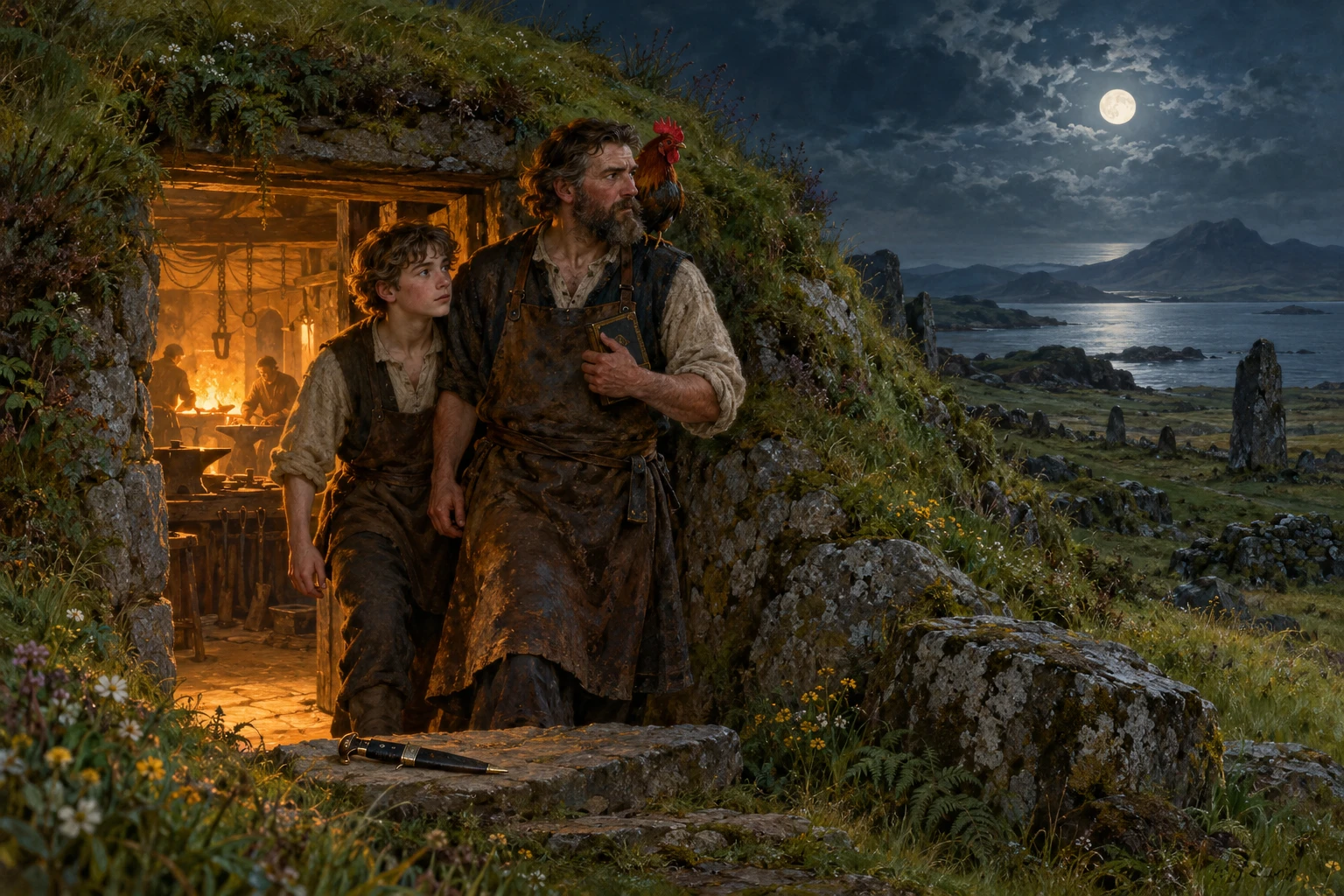
On a particular night the hill would open. The old man told the smith to take a Bible, a dirk and a cockerel. At the entrance he must put the blade across the threshold to prevent it closing, then go in without yielding to fear.
The night came. Light shone from the hill, and music and dancing sounded across the darkness. The smith secured the entrance and stepped into a spacious chamber. Far inside, his son was working at a forge. The father held his ground and demanded the boy’s return.
The assembled fairies laughed. Their noise woke the cockerel, which sprang onto the smith’s shoulders, beat its wings and crowed. In anger the fairies threw father and son out of the hill, flung the dirk after them and vanished into darkness.
Home again, the boy scarcely spoke and did no work for a year and a day. Then, watching his father finish a sword, he suddenly objected to the method. He took the tools and made a weapon finer than any the country had seen. From then on the two worked together, and the son’s exceptional skill brought them employment and prosperity.
The main account and related rescue traditions
A named supplier, but an unnamed original teller
Campbell credits Pattieson, then explicitly says he was not told from whom Pattieson obtained the narrative. The named smith, the boy’s delayed return to work and the sword-making ending belong to this account. Campbell remembered hearing of the famous Islay smith, but that recollection is not a second complete telling of the rescue.
A young woman rescued from dancing
In the accompanying notes, Mrs MacTavish describes a man rescuing a young woman from a fairy hill. He leaves a gun across the entrance, takes her by the hand and brings her beyond it. She explains that she was exhausted but unable to stop dancing. Campbell recalls similar incidents associated with Bencnock and Cnock-donn on Islay. This shares the secured entrance and determined rescuer, but has no smith, eggshell test or gifted sword-maker.
Changes in the protective objects
The MacEachern account combines a Bible, blade and crowing bird. The dancing-woman narrative uses a gun at the doorway. These objects serve overlapping purposes within the tales, but they should not be mixed into a single supposedly standard rescue ritual. Compare Tam Lin and the Welsh story of Rhys and Llewellyn for other forms of recovery from fairy company.
Belief, illness and the Islay landscape
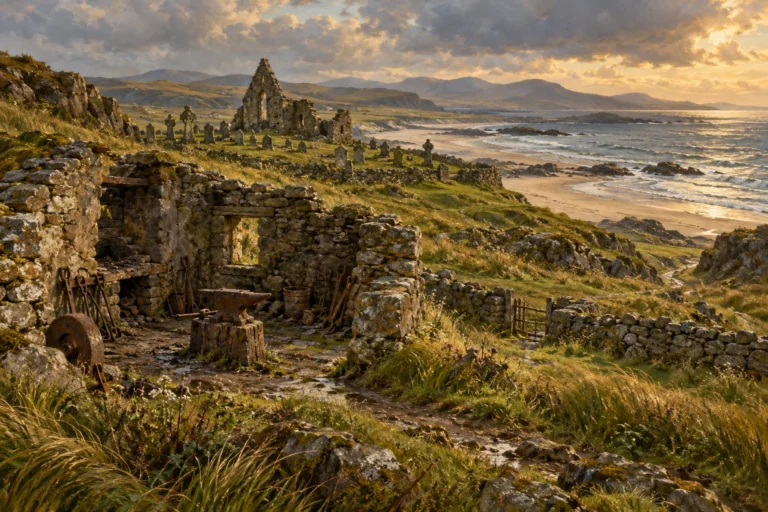
Campbell says walls associated with the smith survived near Kilchoman parish church at a place he spells Caonis gall. He also suggests that a real craftsman may have acquired a supernatural biography. This is an interesting historical possibility, not a demonstrated identification. The surviving text does not provide a dated record that verifies the rescue or the boy’s life.
The notes also preserve a more troubling view of changeling belief. Mrs MacTavish remembers people suspecting a delicate child of being a fairy substitute; with a good nurse, the child thrived. Campbell’s collection therefore contains both the marvellous story and evidence of ordinary human needs being misread through it.
The forge gives the ending its particular force. The lost son does not merely return unchanged. His silence is followed by an ability that makes sense of his time in the hidden workshop. This is a narrative explanation of exceptional craft, not proof that metalworking knowledge came from fairies.
Sources for this entry
- J. F. Campbell, Popular Tales of the West Highlands, volume II. Consulted 1890 edition transcription. XXVIII, “The Smith and the Fairies”, pp. 57–65, including comparative notes. Read source — The MacEachern narrative sent by the Rev. Thomas Pattieson; Mrs MacTavish’s rescue and spinning accounts and John MacLean’s Kintyre variant. About this book
Research coverage
The complete MacEachern narrative and Campbell’s associated notes were examined in the 1890 transcription. The rescue parallels are identified as separate accounts. The underlying oral telling, parish records and surviving weapon traditions have not been independently collated.
The Myths · Scottish collection · Editorial approach
Further Reading