Border ballads and fairy tradition · story
Tam Lin
Janet refuses to surrender her claim to Carterhaugh. When she discovers that her lover is a human captive among the fairies, she must hold him through terrifying changes to bring him back.
Also found as: Tamlin · Young Tamlane · Tom Line · Kertonha, or The Fairy Court
Research reviewed 17 October 2026.
Read the story
This retelling follows Child 39A, “Tam Lin”, stanzas 1–42, printed from the text Robert Burns supplied to Johnson’s Scots Musical Museum in 1792. The transformations follow this witness rather than a mixture of later versions.
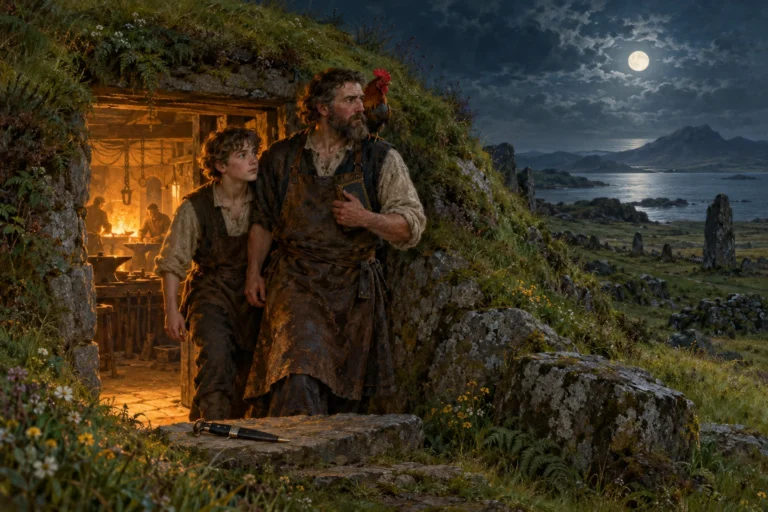
Young women were warned to keep away from Carterhaugh. Tam Lin was there, and anyone who passed through his ground might be made to leave something behind: a ring, a green mantle, or her virginity. The warning made the place sound as if it belonged entirely to him.
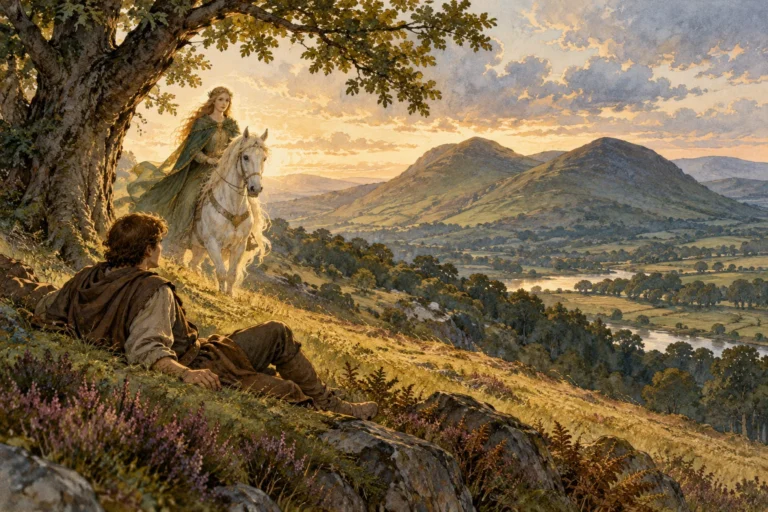
Janet thought otherwise. Her father had given her Carterhaugh. She pinned up her yellow hair, lifted her green skirt clear of her feet and went there as quickly as she could. At the well she found a horse standing, but no rider beside it.
She began to pluck roses. Almost at once Tam Lin appeared, demanding to know why she was breaking branches and taking flowers without his permission. Janet answered that the land was hers. She would come and go when she pleased, and she would not ask his leave.
When Janet returned to her father’s hall, the other women were occupied with their games. Her changed appearance attracted attention. An elderly knight feared that all the men of the household would be blamed for what had happened to her. Janet sharply told him that, whatever name she gave her child’s father, it would not be his.
Her own father spoke gently, but he too could see that she was pregnant. Janet accepted responsibility and refused to let any lord in his hall claim the child. She would not exchange the man she loved for one of them, even if her lover belonged to the fairy world.
She went back to Carterhaugh. Again the horse stood beside the well, and again Tam Lin appeared when she plucked the roses. He accused her of intending to end the pregnancy. Instead of answering his accusation, she asked him a question that had become more urgent than his demands: had he ever belonged to the Christian, human world?
He had. Roxburgh was his grandfather, he said, and had taken him into his household. On a bitter day, returning from a hunt, Tam Lin had fallen from his horse. The Queen of Fairies caught him and carried him away to live in the green hill.
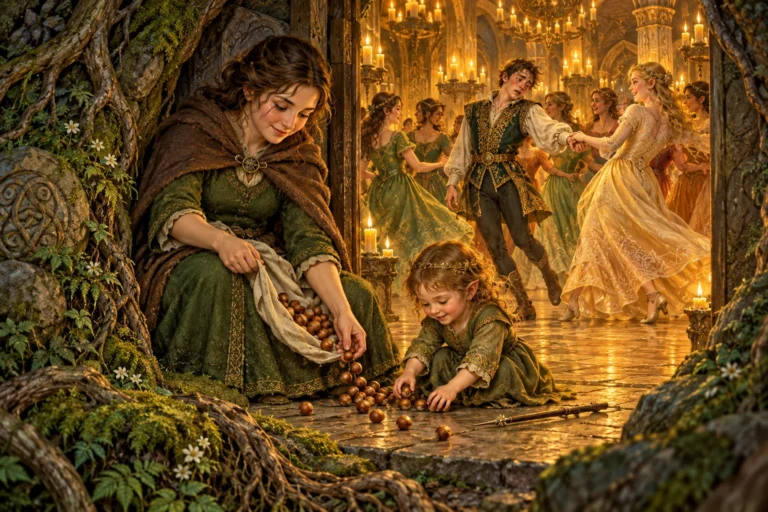
Fairyland could be pleasant, but its pleasures concealed a terrible obligation. Every seven years the fairies paid a tribute to hell. Tam Lin feared that his own strength and handsome appearance would make him the chosen payment.
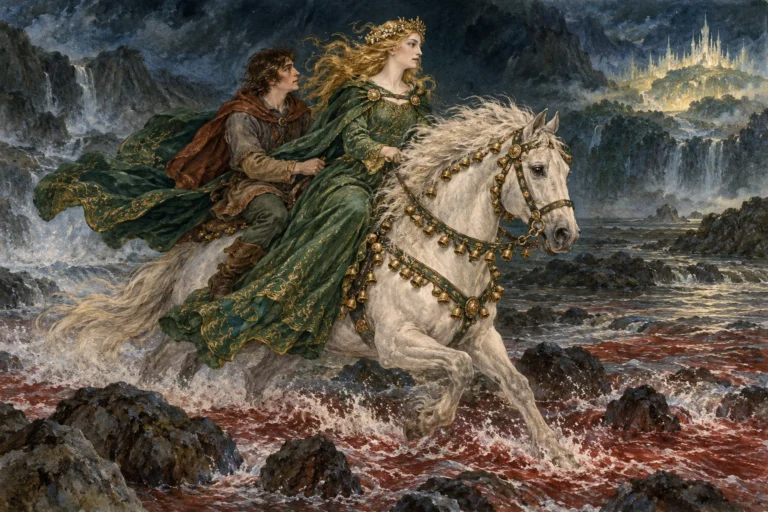
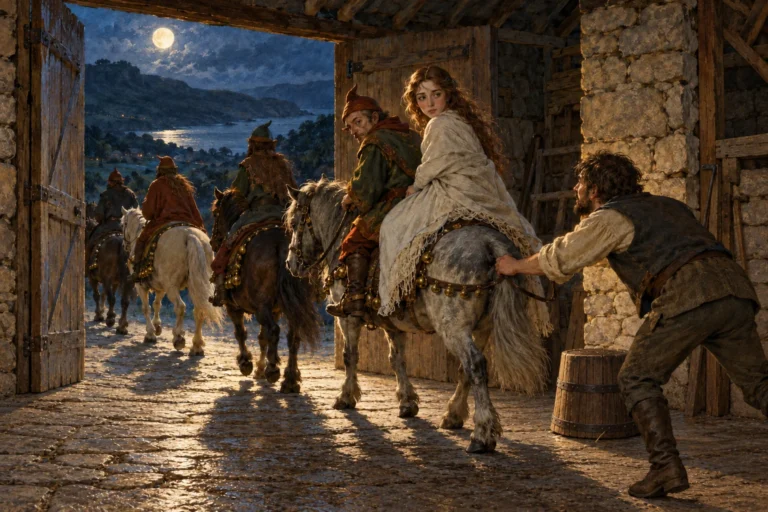
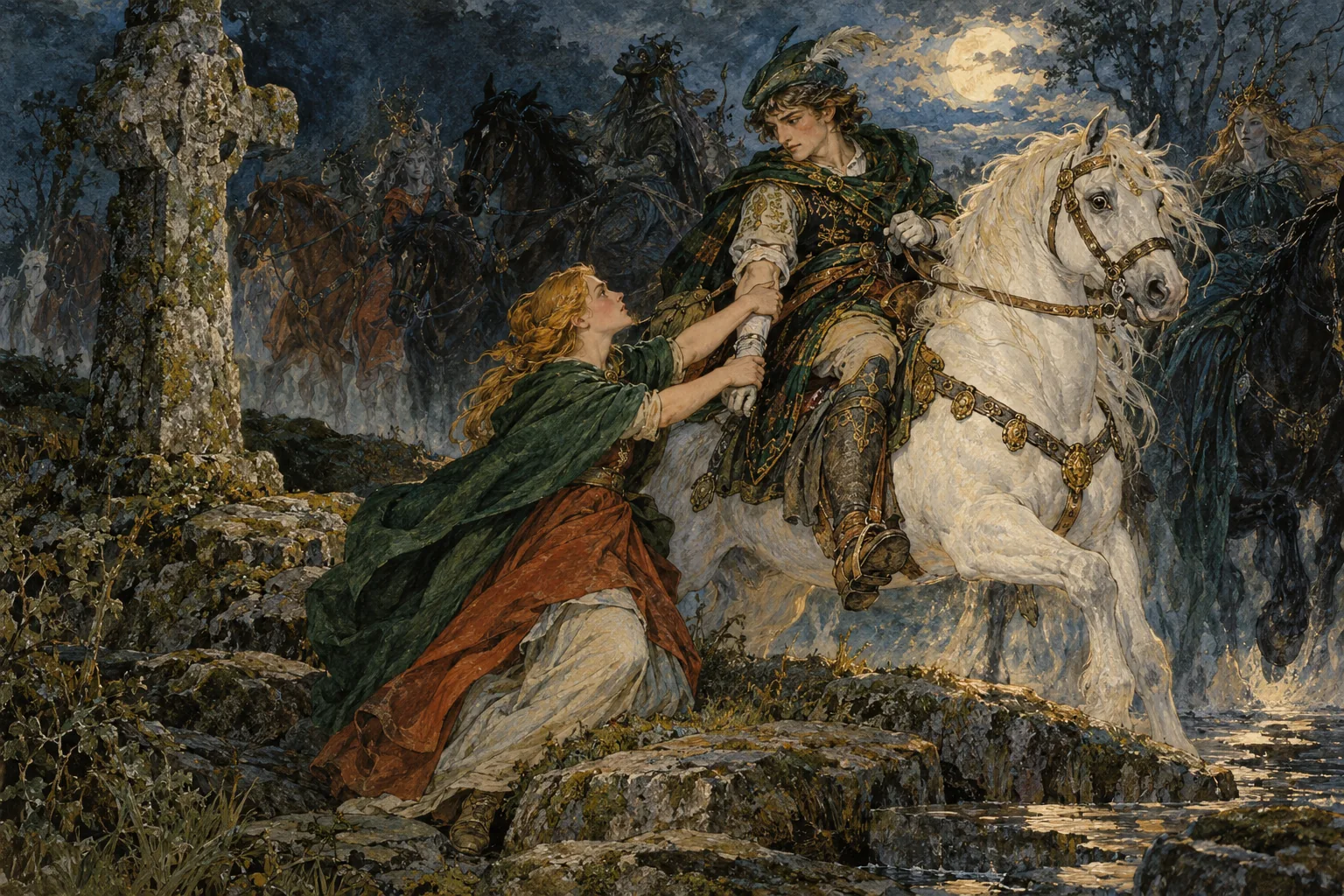
That night was Halloween. At midnight the fairy company would ride past Miles Cross, and Janet could rescue him if she dared. She must let the black horses pass, then the brown, and seize the rider of the white horse. His right hand would be gloved, his left bare; his cap and hair would help her recognise him.
Pulling him down would only begin the struggle. The fairies would change his shape within her arms. He would become a newt and a snake, a bear and a lion. She must remember who she held and refuse to release him. Even when he became a red-hot bar of iron, she must trust that he would not harm her.
Last of all he would become a burning coal. Then she must throw him into well water. His human shape would return, naked and vulnerable, and she must cover him with her green mantle.
Janet went through the dark to Miles Cross. When the bridles finally sounded, her fear gave way to recognition. She watched the black and brown horses pass, ran to the white one and pulled its rider down. She remembered his instructions and held through the trial until the man she had come for was hers to shelter.
The Fairy Queen spoke from the broom, praising the fine man Janet had won and then cursing the woman who had taken him. Had she known what was coming, she said, she would have removed Tam Lin’s grey eyes and replaced them with wood. Her anger could not undo Janet’s rescue. Beneath the green mantle, Tam Lin was human again.
Versions and variations
The Glenriddell text: Child 39B. B, dated 1791 in Child’s source list, resembles A closely through much of the opening. Child notes that Burns and Robert Riddell may have exchanged material or drawn on a common source; these similarities cannot simply be counted as independent confirmation. The rescue details differ. B tells Janet to watch for the third company, includes a greyhound among the transformations, and specifies both a container of milk and one of water. Its final threats include replacing Tam’s heart with stone as well as his eyes with wood.
Herd’s earlier printed fragment: Child 39C. “Kertonha, or, The Fairy Court”, from Herd’s 1769 collection, preserves ten stanzas. The young man calls himself a fairy in body and limb; the surviving passage does not explain his capture through a fall from a horse. The changes include a toad and an eel, then a dove and a swan. Janet is told to release him at the final bird forms, after which he will be a man. That differs materially from A’s instruction to hold him until the burning stage and use well water. The fragment cannot supply all the missing episodes by itself.
Scott’s editorial construction. In the 1806 introduction to “The Young Tamlane”, Scott explains that he combined printed texts, Glenriddell’s manuscript and oral recitals, removing material he had recognised as belonging to other ballads. His version is a significant part of the tradition’s printed history, but not the transcript of one performance. This page keeps A’s rescue sequence intact and records B and C separately, rather than creating an apparently ancient master version from whichever details are most dramatic.
Context and evidence
The ballad makes Janet an active claimant to land, the speaker who names her own lover, and the rescuer who confronts the fairy court. Its opening sexual threat and its unspoken first encounter also leave questions that a modern retelling should not resolve by inventing either a gentle courtship or an explicit assault. A’s text moves from the confrontation to the consequences without narrating that interval. Read Child 39A alongside its variants.
Carterhaugh belongs to the Border setting, while Child’s collection brings Scottish and English materials into a wider comparative study. Compare Thomas the Rhymer for another human relationship with a fairy queen, and consult the Scottish source register for the witnesses used here.
Sources for this entry
- Francis James Child, editor; A communicated by Robert Burns, B from the Glenriddell manuscript, C from David Herd, The English and Scottish Popular Ballads, volume I. Original volume issued 1882–1884; linked transcription reproduces the unaltered Dover reprint of 1965. No.39, Tam Lin: source list p.335; A, stanzas 1–42, pp.340–343; B, stanzas 1–41, pp.343–345; C, stanzas 1–10, p.345. Read source — Chosen narrative A; complete B and C examined for specific differences. Burns’s role is transmission, not an unsupported claim that he composed the whole ballad. About this book
- Walter Scott, collector and editor, Minstrelsy of the Scottish Border, volume II. Third edition, 1806, linked Project Gutenberg transcription; collection first appeared in 1802–1803. Introduction to The Young Tamlane, concluding paragraphs before the ballad. Read source — Scott explicitly describes collation of printed copies, Glenriddell’s manuscript and recitals; evidence of editorial method and reported local associations. About this book
Research coverage
Child 39A, B and C were read in full, with the headnote and Scott’s 1806 editorial statement. A is the chosen narrative. D–I, later Child additions, tunes and modern performances have not been exhaustively collated. Carterhaugh and Miles Cross are textual associations here, not verified locations of a supernatural event.
The Myths · Scottish collection · Editorial approach
Further Reading