Orkney sea folklore · story
The Goodman of Wastness
A man takes a seal-woman’s skin and refuses to return it. Years later, the youngest of their seven children reveals the hiding place, allowing her mother to choose the sea again.
Also found as: The Selkie Wife of Wastness · The Selkie Wife of Westness · The Good Man of Wastness
Research reviewed 17 October 2026.
Read the story
This retelling follows Walter Traill Dennison’s Wastness narrative, printed in The Scottish Antiquary VII (1893), pp.173–175, as transcribed by D. L. Ashliman. The original journal scan was located but could not be inspected during this research.
One day the goodman of Wastness walked down to the part of the shore uncovered by the ebbing tide. Ahead of him lay a flat rock, separated from the land by a shallow pool. On the far side the water was deep enough to offer an immediate way back to the sea.
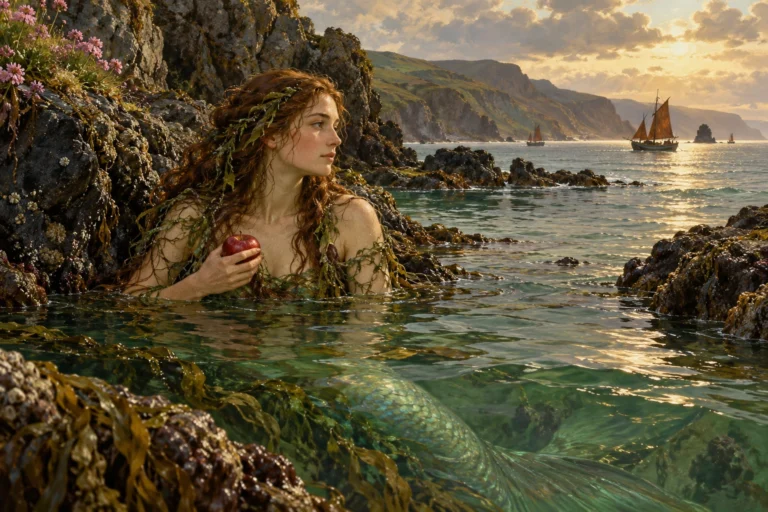
A group of people were playing on the rock. Some rested in the sun while others leapt and moved about, entirely at ease. They had left their seal skins nearby. Without those coverings they looked human, and for a little while the shore belonged to their pleasure.
The goodman watched without announcing himself. Then he hurried across the shallow water towards them. The startled company snatched up their skins and fled into the sea. He moved quickly enough to seize one covering before its owner could recover it.
Out in the water, the others turned to watch him. Among the seals he could see one figure that had not changed like the rest. He tucked the captured skin beneath his arm and started towards home. Before he had left the ebb, he heard weeping behind him.
A young woman followed with her hands stretched out in appeal. She begged him to return what he had taken. Without her own skin she could not live in the sea or remain among her people. She asked for mercy, but he would not surrender the means of keeping her there.
Her distress moved him, and her beauty made him want her for his wife. The result was not a free bargain. She could not return to her home, and the man who could release her refused. After pleading and persuasion, she accepted the choice that seemed less unbearable: she would go with him and live on land.
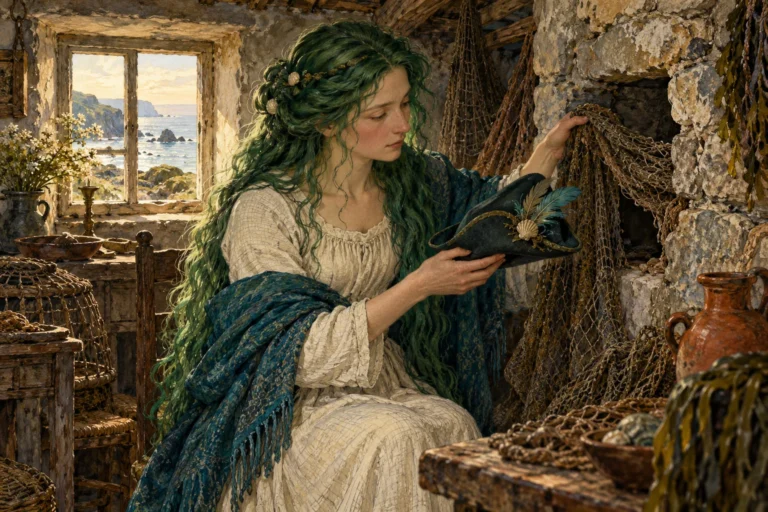
They established a household. She was capable, careful with their possessions and kind. In time she bore seven children, four sons and three daughters. Their father took pride in them and in the life he shared with their mother. From his side of the household, the marriage seemed a happy one.
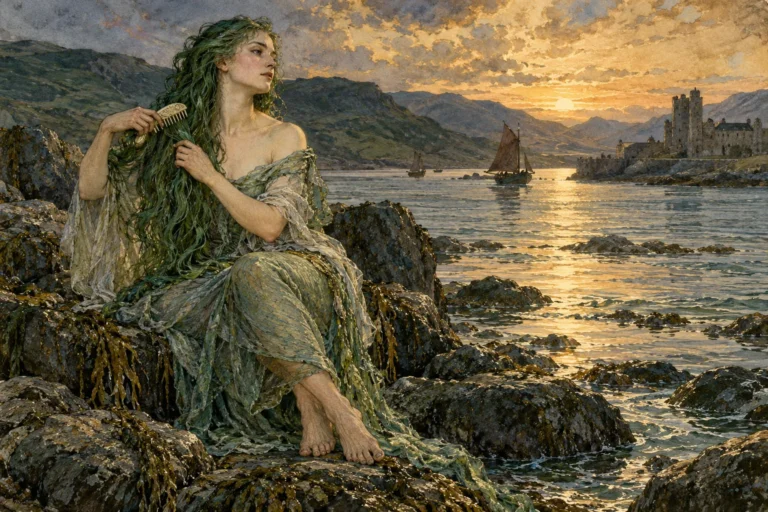
Yet the sea had not loosened its hold upon her. There were cheerful days, but there were also times when an unspoken weight settled upon her. She gazed across the water for long stretches. The songs she taught the children were strange to everyone else, as if a part of the home she had lost could still reach them through her voice.
One fine day the goodman took the three eldest boys fishing. Their mother sent three other children to gather shellfish along the ebb. Only the youngest girl remained in the house because her foot was sore.
Under cover of cleaning, the mother began another search. She looked throughout the rooms and their hiding places while the daylight slipped away. No sealskin appeared. At last the little girl asked what she was trying to find.
Her mother said she wanted a beautiful skin from which to make a shoe that would help the painful foot. The child remembered something. Once, when the family was out and her father believed her asleep, she had seen him take down a skin, examine it, fold it and put it back beneath the sloping roof above the bed.
The mother rushed to that hiding place. Her own skin was there. She said farewell to her little daughter and ran down to the shore. Putting on the covering she had sought for so long, she plunged into the sea with a cry of joy.
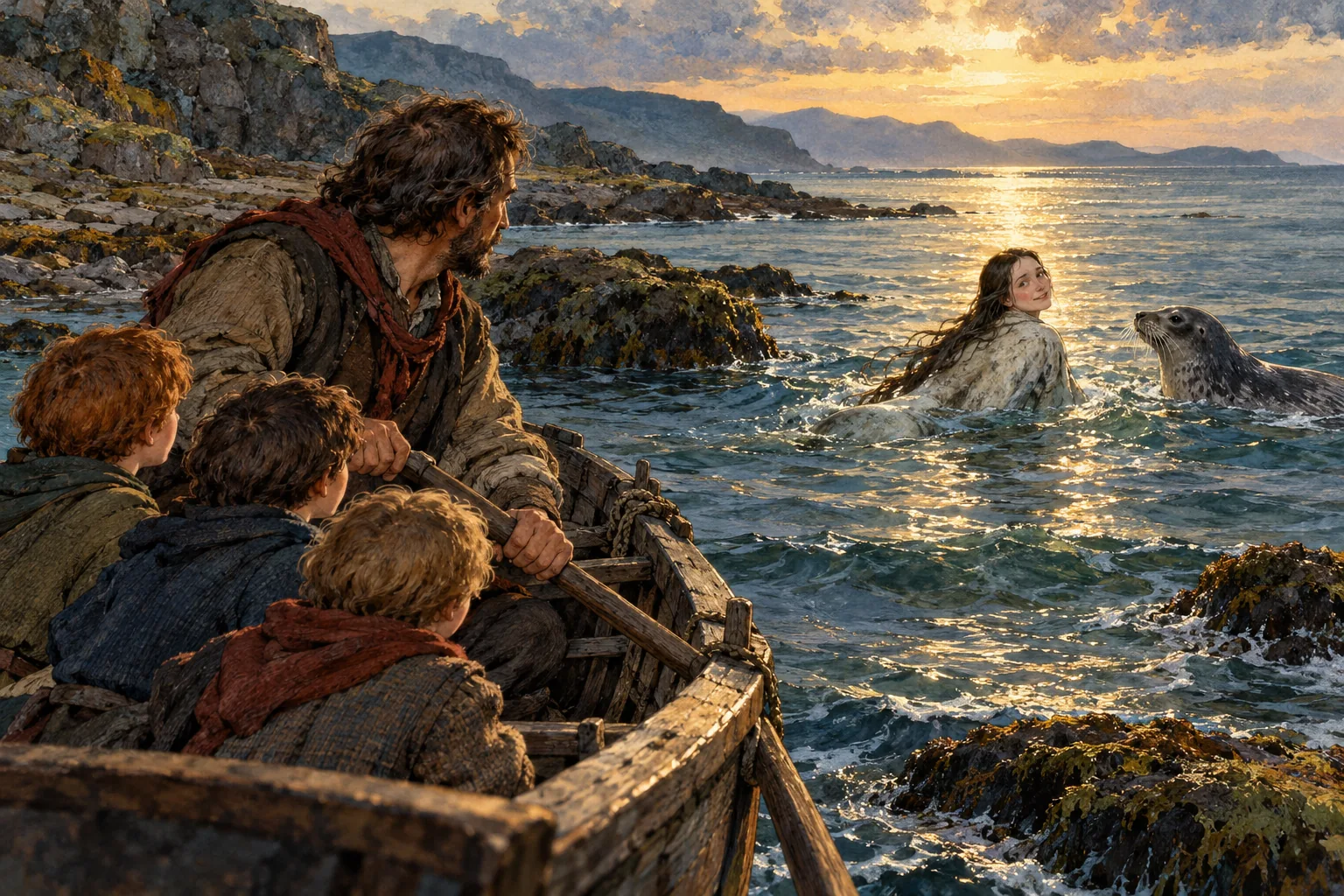
A male selkie came to greet her. The goodman, rowing home with his sons, saw the reunion from his boat. His wife uncovered her face and called to him. She had liked him, she said, and he had been good to her, but she loved her man of the sea better.
He often walked the shore afterwards, hoping for another glimpse. He never saw her again. The children and the years on land had been real parts of her life, but they had not made the stolen skin his to keep.
Versions and variations
Kennedy’s northern-island account. “The Silkie Wife” in Patrick Kennedy’s Legendary Fictions of the Irish Celts is explicitly credited to Captain F. W. L. Thomas. Despite the book’s Irish title, the account concerns Shetland and Orkney. Two women, rather than Dennison’s larger company, are playing beside the shore. The fisher takes one skin, and the resulting household has two children. Her escape follows a secret conversation and the male seal’s recovery of the garment. He explains the theft to the human husband and says that he bears no malice. The returning sea companion, rather than a daughter, enables her departure.
The Unst “Mermaid Wife”. The version in Folk-Lore and Legends: Scotland (1889), pp.86–88, locates the encounter on Unst in Shetland. A child discovers the skin beneath a corn stack and brings it to the mother. The husband follows her to the shore, where she declares that she has always loved her first husband better. Although the heading calls her a mermaid, the tale specifically gives her a sealskin and transformation into a seal. Its anthology appearance is a published parallel, not proof of a newly collected oral witness.
Dennison’s particular choices. Wastness has seven children, a deliberately organised search, the youngest daughter’s sore foot and the hiding place above the bed. The mother’s farewell occurs while her husband is returning by boat. These details belong to this account and should not be replaced with the corn stack or the male seal’s discovery merely because those episodes are familiar elsewhere. The common stolen-garment pattern permits comparison; it does not establish a single original tale or a proven route of transmission between the editions.
Context and evidence
Dennison’s narrator explicitly describes the woman’s consent as reluctant and constrained by the loss of her skin. The later descriptions of affection and domestic happiness do not remove that beginning. Reading her departure as a betrayal alone would give the goodman’s wishes priority over her repeated request to return home. The source text preserves both the family ties and the wish for freedom.
Compare The Lady of Gollerus in the Irish collection, where a sea-woman’s concealed cap governs her return, and the Selkie guide for stories that do not use a stolen skin. Wastness is retained as the printed name; this page does not attach an unverified modern map location to the encounter.
Sources for this entry
- Walter Traill Dennison; periodical edited by A. W. Cornelius Hallen, Orkney Folk-Lore.—II. Selkie Folk. The Scottish Antiquary; or, Northern Notes & Queries, volume VII (1893), item 495, pp.171–177; Edinburgh: T. and A. Constable. Goodman of Wastness narrative, pp.173–175, read through the D. L. Ashliman transcription headed The Goodman of Wastness. Read source — Chosen public-domain narrative. Original journal scan located but not successfully inspected; full article context is not claimed as examined. About this book
- Patrick Kennedy, collector/narrator; account credited to Captain F. W. L. Thomas, R.N., Legendary Fictions of the Irish Celts. First published London: Macmillan, 1866; linked Library Ireland text identifies the second edition, 1891. The Silkie Wife, complete story and opening attribution; first-edition pagination pp.122–124. Read source — Different northern-island seal-wife account; not a reprint of Dennison’s Wastness text and not proof of fully independent oral origins. About this book
- Compiler signing C. J. T., Folk-Lore and Legends: Scotland. London: W. W. Gibbings, 1889; public-domain text reproduced in D. L. Ashliman’s comparative transcription. The Mermaid Wife, pp.86–88; complete Unst narrative. Read source — Printed seal-wife parallel. The borrowed source behind this anthology version has not been independently traced here; it is not claimed as a new field record. About this book
Research coverage
The complete Wastness story was read in the university-hosted transcription, along with the complete Kennedy and Unst parallels. The original Dennison PDF was located but not successfully inspected; its broader opening discussion and any oral-teller note are not claimed as examined. The genealogy of the Unst anthology text, later Orkney retellings and named archival performances remain gaps.
The Myths · Scottish collection · Editorial approach
Further Reading