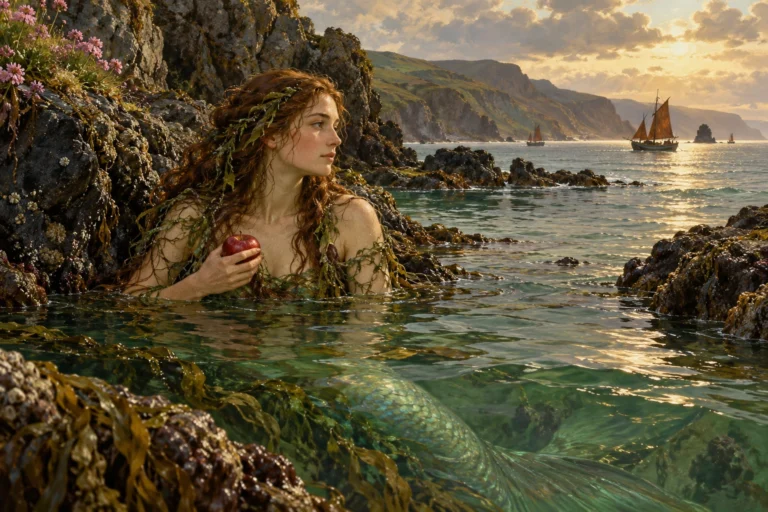
Manx coastal folklore · story
The Mermaid of Gob-ny-Ooyl
Apples bring a fishing family good fortune and begin a friendship across the shore. Before Evan leaves home, he plants a tree for the mermaid who waits below the cliffs.
Also found as: The mermaid and the apple tree · Evan Sayle
Research reviewed 18 October 2026.
Read the story
This retelling follows Sophia Morrison’s Manx Fairy Tales (1911). It keeps the uncertain ending of her account.
The Sayles lived at the bottom of Cornah gill. They fished and made their living with the help of a cow, a few sheep and lobster pots woven from osier. As the father grew older, he spent less time in the boat, and the family’s catches no longer seemed so fortunate.
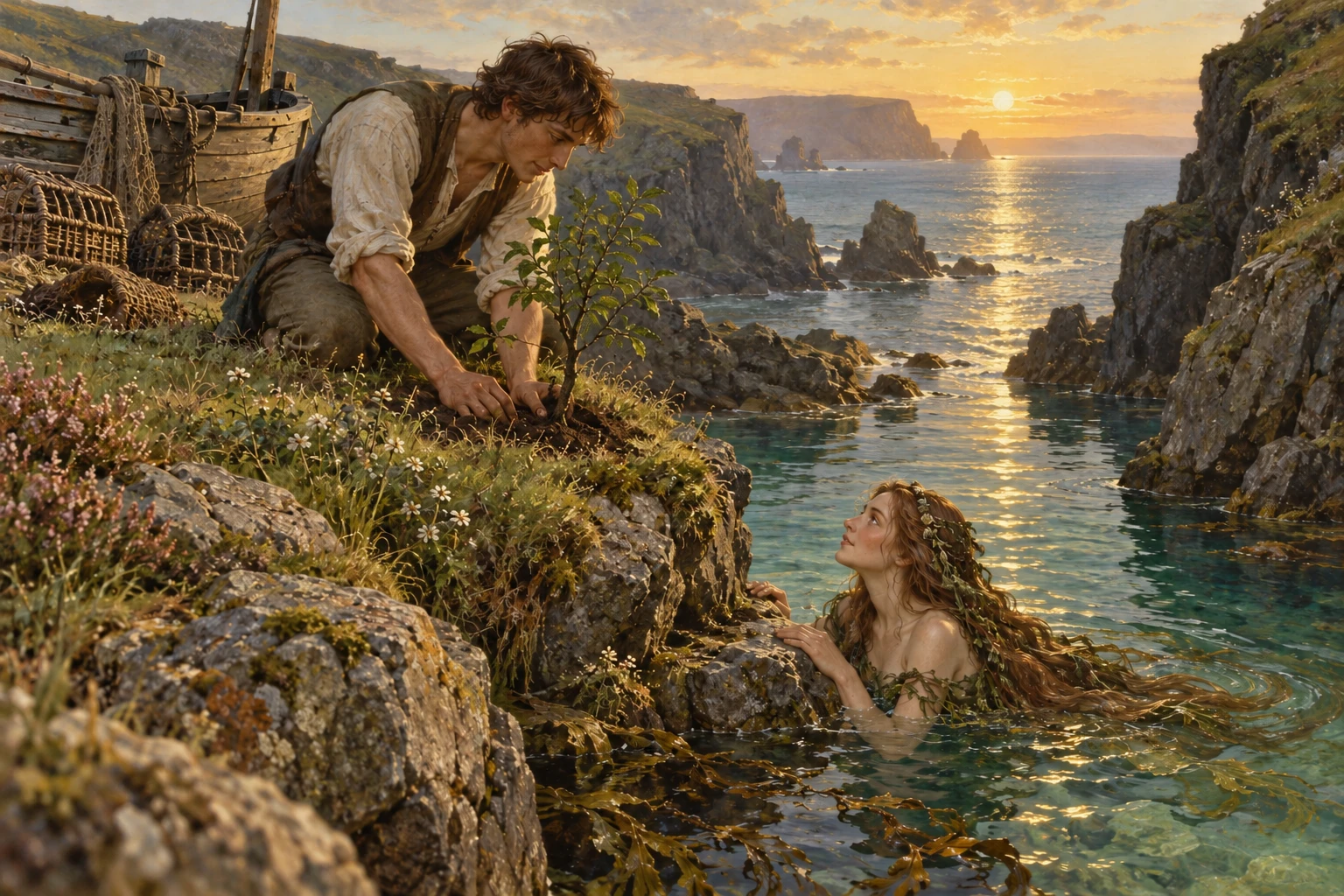
Young Evan sometimes stayed ashore making creels. He also climbed about the Bulgham cliffs in search of birds’ eggs. There he met a beautiful sea-woman who asked after his father. She was friendly, and Evan returned to speak with her.
When the father heard about the encounter, he recognised an old connection. He told Evan about the mermaid and the apples she loved. On a later fishing trip she rose beside the boat and accepted the fruit, calling the apples land eggs. Remembering such gifts, she promised good fortune to the family.
Evan grew fond of her company. But he spent so much time by the water that his family reproached him for idleness. Eventually he decided to go away on a foreign voyage. The mermaid was distressed when he told her.
He could not take an orchard to sea. Instead, he planted an apple tree on the brow above her haunt, where the fruit could fall into the water when it ripened. It was a gift meant to outlast his absence.
The family’s fishing luck continued after Evan left. The mermaid waited below the cliffs, singing sadly, but the little tree was slow to bear. At last she went away to look for him. Neither came back. The story leaves the apple tree above the creek as the remembered sign of their friendship.
The recorded story and other Manx mermaids
Morrison’s printed witness
The 1911 narrative names the Sayles, Evan, Cornah gill and the Bulgham cliffs. Apples and the tree shape the relationship. It does not say that the mermaid drags Evan under the water, that he steals her skin or that the family loses its luck when he departs. Those familiar motifs from other sea-being stories should not be supplied as a missing ending.
A collecting connection
Stephen Miller publishes a reference to Morrison’s letter of 28 September 1910 to Josephine Kermode. It records her hearing a Gob-ny-Ooyl mermaid and apple-tree story from the weaver J. R. Moore before his emigration. This supports a collecting connection, but does not preserve a full earlier wording for comparison.
Moore’s captured and courting mermaids
A. W. Moore’s 1891 collection prints a captured mermaid who refuses food and drink and is released, and a different mermaid whose rejected courtship ends in a man’s death. Moore attributes both to Waldron. They are contrasting Manx mermaid narratives, not alternative endings of Evan’s story. A further revenge narrative, attributed to William Collins’s note to his Ode to Liberty, has its own island-wide plot.
Reprints and independent variants
A later printing of Morrison’s tale does not, merely by appearing in another book or online, become another oral witness. No second complete independent telling of Evan and the apple tree has been established for this entry. The contrast between generosity here and danger in other mermaid accounts is real, but the stories remain distinct.
A gift across the shoreline
The apples matter because they come from the world the mermaid cannot easily enter. Evan’s tree transforms a repeated gift into something that might continue without him. The account therefore makes ordinary work, family expectations and departure as important as the supernatural encounter.
The named coast is a setting and a claim of local memory. It does not establish a historical mermaid, identify Evan in a family record, or verify a surviving tree. The place guide separates the locations named by Morrison from the precise creek and planting site, which have not been securely identified here.
Sources for this entry
- Sophia Morrison, Manx Fairy Tales. London: David Nutt, 1911. “The Mermaid of Gob-ny-Ooyl”. Read source — The Sayle family, Evan, apples and the mermaid’s departure. About this book
- A. W. Moore, The Folk-Lore of the Isle of Man. 1891. Chapter IV, “Mermaids”: “The Captured Mermaid”, “The Mermaid’s Courtship” and “The Mermaid’s Revenge”. Read source — Different mermaid narratives with printed attributions, used as comparisons rather than variants of Evan’s story. About this book
- Stephen Miller, J. R. Moore’s Notebook of Manx Folk Songs (circa 1910). Manx Notes 196, 2014. pp. 1–2; especially Morrison’s letter of 28 September 1910 and note 8. Read source — Published letter reference; original archival document not inspected.
Research coverage
Morrison’s full 1911 story and the three named mermaid narratives in Moore were examined. Miller’s published archival reference was checked; the original Morrison letter and J. R. Moore’s underlying telling have not been inspected. The mermaid stories in Moore are comparisons, not claimed variants of Gob-ny-Ooyl.
The Myths · Manx collection · Editorial approach
Further Reading