Irish literary folklore · story
The Soul Cages
A Clare fisherman befriends a merrow and discovers drowned sailors’ souls beneath his lobster-pots. Thomas Keightley admitted constructing this Irish-set story from a German waterman tale.
Also found as: Jack Dogherty and Coomara · Coomara’s Soul Cages · The Soul-Cages
Research reviewed 17 October 2026.
Read the story
An original retelling of the tale printed in Yeats’s anthology and in Keightley’s The Fairy Mythology. Keightley’s authorship admission is examined below: this is a literary tale set in Ireland, not an unqualified record of an Irish oral performance.
Jack Dogherty lived with his wife Biddy beside Dunbeg Bay in County Clare. He fished for a living, helped shipwrecked sailors when he could, and profited from the goods the sea washed ashore. Foreign spirits were among its more welcome offerings. But barrels and fishing boats did not satisfy all his curiosity. His grandfather had known a merrow, and Jack wanted to meet one himself.
Eventually he caught sight of a strange figure on an offshore rock, wearing a cocked hat. The creature disappeared before Jack could approach. On another rough day, the sea-person seemed to be dancing with delight at the weather. Jack’s chance came when they encountered one another in a cave.
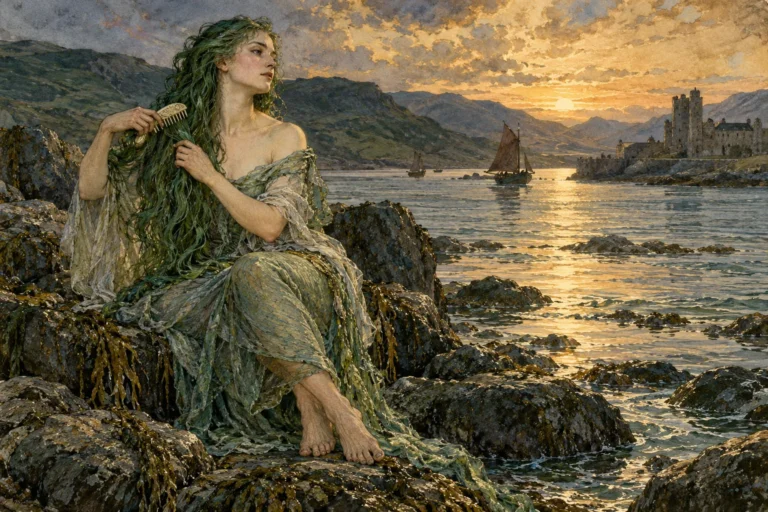
The merrow had green hair and teeth, small eyes, a red nose, short arms like fins and a fish’s tail. He recognised Jack’s family. Jack’s grandfather, he said, had been a splendid drinking companion, though the next generation had disappointed him. Soon the two were talking about the quality of the liquor that wrecks supplied.
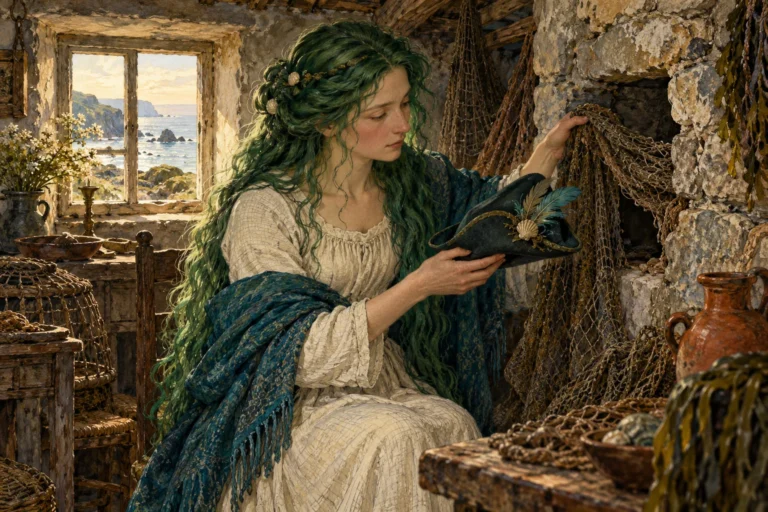
When they met again, the merrow brought two hats. One was for Jack: he was invited to dinner under the sea. Jack thought of drowning, and of what Biddy would say. His companion reminded him that his grandfather had made the journey often enough. Jack put on the hat, took hold of the merrow’s tail, and followed him into deep water.
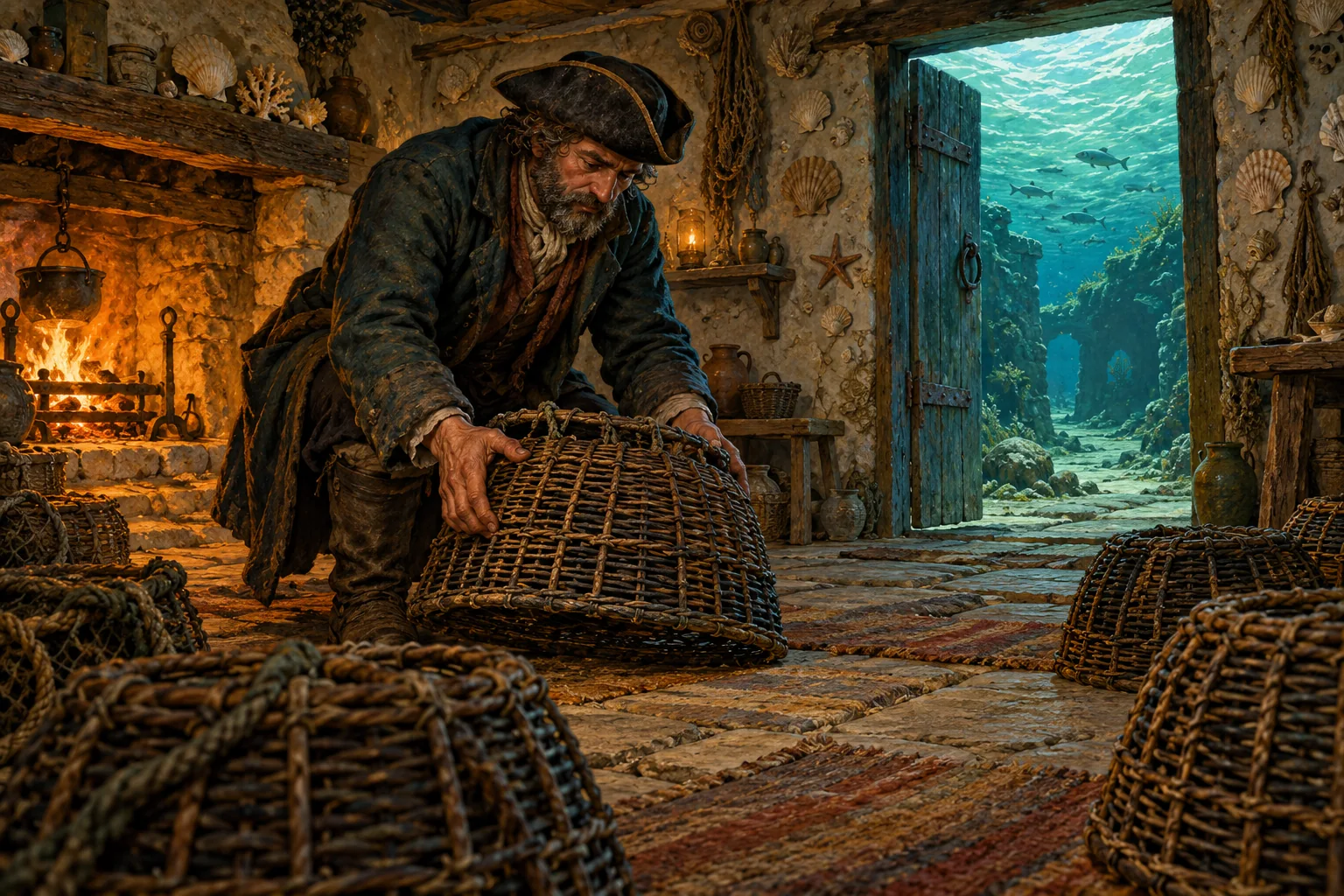
Down they went, much farther than Jack liked. Then, astonishingly, they emerged onto dry ground. The sea hung overhead, with fish moving through it as birds move through the sky. Before them stood a house roofed with oyster-shells.
Inside, young merrows prepared dinner. The furniture was rough, but the fire was warm and the cellar excellent. Their meal brought fish, shellfish and generous helpings of brandy. Jack finally learnt his host’s name: Coomara. He also discovered that wishing this old creature another fifty years was scarcely an ambitious toast.
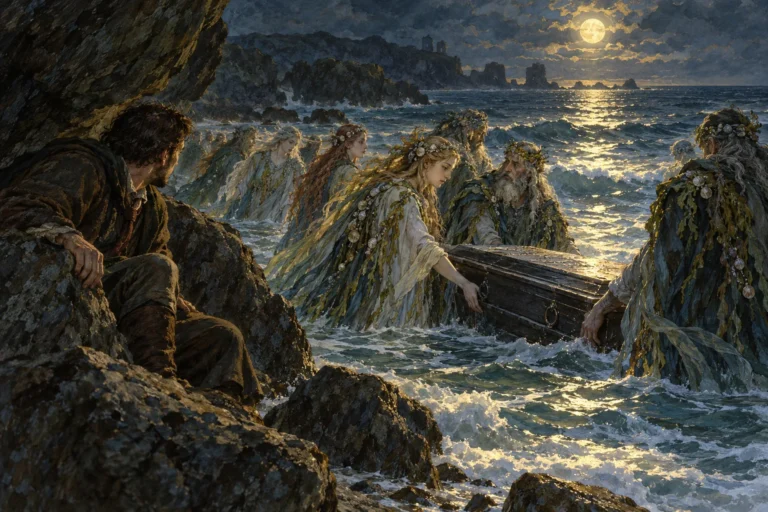
After dinner Coomara showed him his collection of curiosities. Against a wall stood objects like lobster-pots. These, his host explained, contained the souls of drowned sailors. When a storm came, he put the pots out. The homeless souls crept inside for shelter, and he brought them back to keep them warm. Coomara spoke as though he had provided excellent accommodation. Jack could only think of people held prisoner. Keightley, pp. 527–533.
He hid his distress. When it was time to go, Coomara turned the borrowed hat backwards, lifted Jack up and launched him into the water above. Jack shot to the surface. From the rock he threw back the hat, as instructed.
At home he could not forget the souls. He liked Coomara, who seemed unaware of doing harm, but he wanted those captives free. He decided to invite the merrow ashore, get him drunk, borrow the hat and visit the house alone. First he encouraged Biddy to make a devotional visit to Saint John’s Well near Ennis.
His first dinner was a failure. Jack drank so enthusiastically that he lost consciousness himself. Coomara went home.
For their next attempt Jack watered his own drink. His guest received strong brandy, followed by the potent homemade spirit Biddy’s brother had supplied. Coomara sang, laughed and finally collapsed. Jack took the hat and hurried to the water.
The house below was empty. He lifted each pot. Nothing visible escaped, but he thought he heard faint chirping sounds. Remembering that souls were invisible, he sent blessings after them and replaced the cages.
Then he found the flaw in his plan. The water was overhead, and Coomara was not there to lift him into it. Jack searched desperately for something to climb. At a lower patch of water a cod’s tail appeared. He seized it. The startled fish pulled him up, the hat touched the water, and Jack shot towards daylight, still hanging onto the cod.
Biddy had returned to find a creature snoring beneath her table. For a moment she thought Jack’s drinking had literally turned him into a beast. When the real Jack arrived, he had to explain everything. Angry at his secrecy, she nevertheless approved his kindness to the souls.
Coomara went home with a dreadful hangover. He never noticed the empty cages. For years Jack found opportunities to release more souls while preserving their friendship. Then one morning his usual signal brought no answer. He tried again, that day and the next. Without a hat he could not investigate. Whether Coomara had died or moved away, Jack never learnt. Keightley, pp. 533–536.
Versions and variations
The author identifies his source. In footnote 603, Keightley expressly says the story rests on the German legend printed on his p. 259, and that the material beyond it was invented. He also acknowledges details by another hand which he could no longer separate. This is stronger evidence than a modern resemblance between plots: it is the contributor’s own admission. The edition directly examined here is dated 1892; this page does not claim to have established when the admission first appeared. Keightley, concluding note to The Soul Cages.
What changes in the Irish setting? The Peasant and the Waterman is brief. An unnamed peasant visits a neighbour’s underwater palace and finds drowned people’s souls under overturned pots. He waits until the waterman is absent, returns and releases them. The Irish-set expansion supplies Jack and Biddy, Clare geography, wreck liquor, magical hats, a drinking contest and the cod that solves Jack’s escape. Coomara’s apparently benevolent explanation also makes the imprisonment morally stranger. The shared rescue is the kernel; the comic household adventure is the elaboration. The Peasant and the Waterman, pp. 259–260; The Soul Cages, pp. 527–536.
Did it subsequently enter oral circulation? The same note says Keightley later found it known on the coasts of Cork and Wicklow, with one informant specifying flower-pot-like containers. That is a report worth recording, but it supplies neither named tellers nor dated transcripts. It cannot by itself prove an old Irish source, or determine whether print, oral retelling, a related tradition or misunderstanding produced the reported resemblance. The small container difference is reported by Keightley, not independently checked here. Footnote 603.
Why does Croker get the credit? Yeats’s anthology prints the story under T. Crofton Croker’s name, reflecting the collection through which it circulated. That attribution does not cancel Keightley’s admission. Yeats and Keightley preserve the same recognisable adventure, not two independent oral versions. Yeats, The Soul Cages, pp. 61–75.
Context and evidence
Jack’s predicament depends on a friendship rather than a battle. Coomara offers hospitality, while his idea of caring for drowned sailors denies them freedom. Jack’s remedy preserves the friendship through deception. The Christian language of souls, pilgrimage and release is part of this particular literary construction; it does not establish a universal belief about merrows. Its invented elements are a reason to explain the source history, not to discard an engaging story. Compare The Lady of Gollerus for another cap that controls passage between worlds, and Flory Cantillon’s Funeral for another imagined relationship between sea-people and the dead.
Sources for this entry
- Thomas Keightley, acknowledging additional details by an unidentified collaborator, The Fairy Mythology, Illustrative of the Romance and Superstition of Various Countries. New edition, revised and greatly enlarged. London: George Bell & Sons; New York, 1892; Project Gutenberg transcription. Appendix, The Soul Cages, pp. 527–536; footnote 603 at the conclusion. Read source — Full public-domain tale and the author’s explicit admission of invention from a German tale; also his uncorroborated report of later Irish circulation About this book
- Thomas Keightley, The Fairy Mythology, Illustrative of the Romance and Superstition of Various Countries. New edition, revised and greatly enlarged. London: George Bell & Sons; New York, 1892. Nixes, The Peasant and the Waterman, pp. 259–260. Read source — Directly examined English account of the German source Keightley names for The Soul Cages About this book
- W. B. Yeats, editor; tale credited in the anthology to T. Crofton Croker, Fairy and Folk Tales of the Irish Peasantry. First published 1888; examined Project Gutenberg transcription bears the Walter Scott Publishing Company imprint. The Merrow, p. 61; The Soul Cages, pp. 61–75. Read source — Public-domain anthology reprint; its Croker credit must be read with Keightley’s authorship admission About this book
Research coverage
The complete tale was read in Keightley and Yeats, alongside the full German-source account in Keightley’s English version and his authorship note. A primary admission establishes literary construction; it does not establish the accuracy of the accompanying oral-circulation claim. The original German edition, Keightley–Grimm correspondence, earliest Croker printing, later collector reports and archival oral variants remain to be independently collated.
The Myths · Irish collection · Editorial approach
Further Reading