Irish coastal folklore · story
Flory Cantillon’s Funeral
A funeral on the Kerry shore passes into the care of sea-people. A curious watcher hears the reason for their duty. A related local record places the Cantillon cemetery beneath Ballyheigue Bay.
Also found as: Florence Cantillon’s Funeral · The Cantillon Sea Burial · The Cantillons of Ballyheigh
Research reviewed 17 October 2026.
Read the story
An original retelling of Croker’s published story, also reprinted by Yeats. The underwater cemetery and the sea-people’s work are events within the legend, not established archaeological or family history.
The Cantillons had a burial-place that their living relatives could no longer reach. It stood, the story said, on an island in Ballyheigh Bay, until the Atlantic broke over the land and took it. On clear days fishermen claimed to see the ruined chapel beneath their boats.
The family did not abandon its dead. When a Cantillon died, the mourners carried the coffin down to the shore and left it within reach of the tide. By morning it was gone. People said that the dead person’s ancestors had come to convey it to the old cemetery beneath the water.
Connor Crowe, a Clare man connected to the family by marriage, wanted to know what really happened. A missing coffin was one thing; a procession of ancestral undertakers was another. He intended to remain behind at the next funeral and watch.
His opportunity came with the death of Florence Cantillon, known as Flory. Connor went to Ardfert for the wake. Flory had enjoyed life, and the gathering honoured him with all the bustle his neighbours could provide. Mourners came from across the country between Dingle and Tarbert. Grief, company and the ordinary business of the living filled the house together.
At last the funeral procession set out. The lament was sung, and the coffin carried to the strand. There the company laid it down with a prayer and departed in small groups. When the others had gone, Connor settled on a large stone, partly hidden by an overhanging rock. He had brought whisky to help him through the vigil.
Evening passed gently at first. Connor whistled an air from his childhood, hoping its familiarity would steady him. Instead it brought memories of home, and of Dunmore’s gloomy castle. People talked about murdered prisoners crying below it. He had always told himself that the sound was only seawater working through cracks and hollows in the rocks. Sitting alone beside a coffin, he found that explanation less comforting than it had seemed in daylight. Croker, opening and Connor’s vigil.
The moon rose over a pale beach. Dark rocks stood around him; the black coffin lay unmoving against the stones. The water made a low, persistent sound. As the hours passed, Connor began turning it in his imagination into mourning. Shadows seemed to acquire bodies. He drank, waited, and wondered whether curiosity had brought him somewhere he ought not to be.
More than once he nodded towards sleep and shook himself awake. Each time he looked, the coffin remained exactly where the mourners had left it.
Long after midnight, he heard voices.
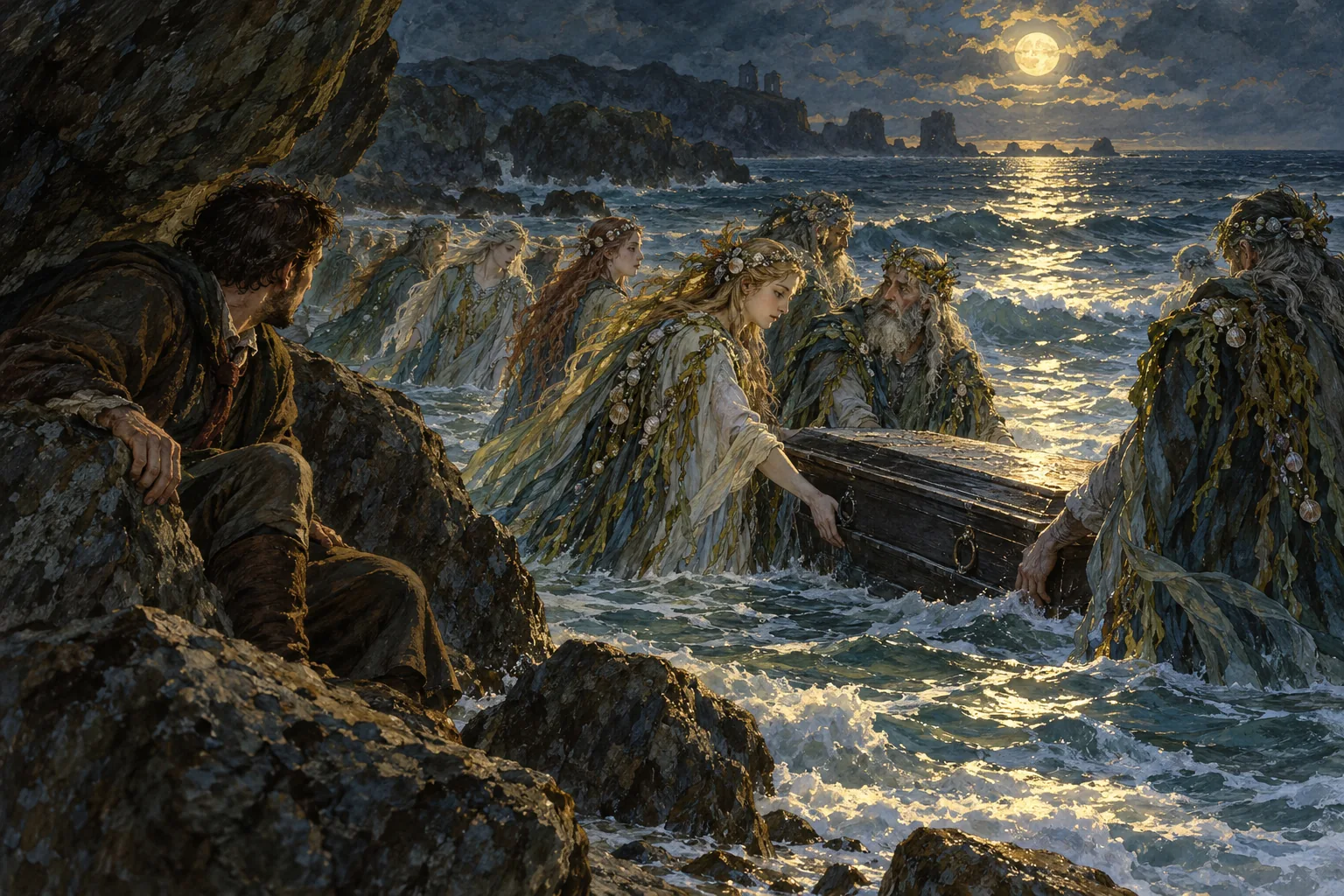
They came through the sound of the waves, grew stronger, and formed a lament unlike anything he had heard on land. As the singing approached the beach, figures rose from the water. They gathered around the coffin and prepared to send it out upon the tide.
Connor stayed still. One of the figures complained that this was what came of marrying people from the land. Another answered with the explanation he had waited to hear.
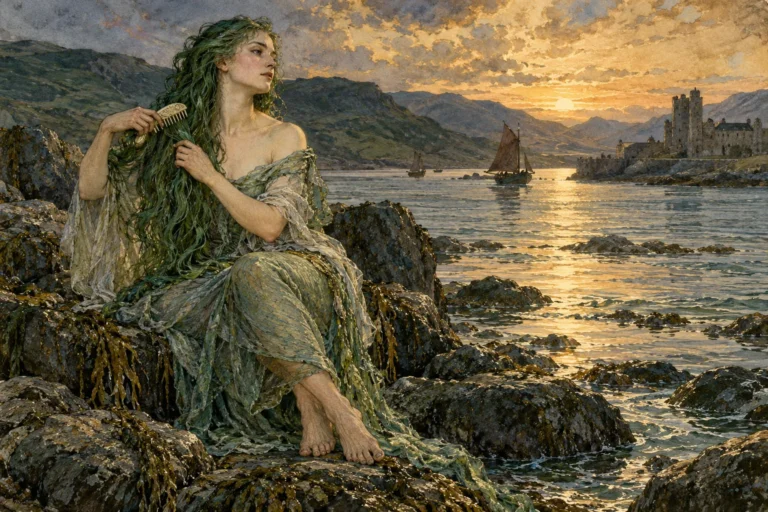
Their king’s daughter, Durfulla, had married a mortal. When she died, her husband buried her on the island. It was her father who ordered the waves to eat away its foundations and cover the cemetery. The funeral Connor was watching belonged to the long consequences of that marriage.
The sea-people had to carry the Cantillons to their submerged burial-place. But the duty had a limit. Once a mortal saw their work and heard their lament, their service would end.
A retreating wave lifted the coffin from the shore. The company turned to follow. Then one of them saw Connor.
He could neither speak nor move. The watcher had been discovered; the condition had been fulfilled. The figure announced that they were free of the task. Their eyes turned towards him, one after another. What he had meant as a private investigation had ended the family’s extraordinary privilege.
Their lament rose once more. On the next wave they followed Flory’s coffin out over the old cemetery, and coffin and bearers sank beneath the Atlantic. The voices faded until Connor could hear only water. After that funeral, the story says, no Cantillon was taken to the strand to await burial by the people of the sea. Croker, Durfulla’s story and conclusion.
Versions and variations
A different family in the same place. An annotation in a digitised Croker volume reports another version supplied by Mr Lynch of the King’s German Legion. It says the locality remains the same but the M’Ellicot family replaces the Cantillons. The indexed passage on printed p. 193 was examined; the complete scan and its imprint were not retrievable. Accordingly, this page records that specific reported difference without inventing the rest of Lynch’s account or assigning an unverified edition date. Croker, note on p. 193.
A local record gives a more specific departure point. The Schools’ Collection item Teampall Fé Thoinn attributes information to Thomas Bowler, aged eighty, of Glenderry. Its examined p. 387 places the cemetery beneath Ballyheigue Bay and connects it to the Cantillons. The procession goes from an old castle to a named red sandstone flag, Muchán na marbh. Croker leaves the coffin on the strand without that named stone. The archival text continues beyond the page examined, so its ending is not compared here. The Schools’ Collection, volume 0417, p. 387.
Reprinting preserves the literary episode. Yeats credits Croker and reproduces the familiar Connor Crowe, Durfulla and interrupted funeral sequence. That is a route by which the story reached more readers, not evidence of a new informant. The comparison must therefore distinguish a literary reprint, an editor’s report of another telling, and an identified local archival record. Yeats, pp. 75–79.
How much agreement is established? The examined records support a recurring connection between a named family, coastal burial and an inaccessible cemetery. They do not yet establish that every telling includes Durfulla, a sea-king’s order, or a witness who ends the service. Nor does the later archive entry by itself prove independence from printed books. Those are questions for a fuller comparison, not gaps to fill from the best-known version.
Context and evidence
The sea’s loss of land becomes a family story about keeping the dead together. Connor’s curiosity also exposes an obligation that the sea-people resent: the marvel is a privilege for one community and labour for another. The mourning heard on land and beneath the water joins them briefly before the link is broken. These are features of the published narrative, not evidence that the cemetery has been identified underwater. Compare The Soul Cages, where human concern for drowned souls also conflicts with a sea-person’s understanding, and The Lady of Gollerus, where marriage makes relatives on both sides of the shore.
Sources for this entry
- Thomas Crofton Croker, Fairy Legends and Traditions of the South of Ireland. Library Ireland transcription of the new and complete seventh edition, June 1906, edited by T. Wright. Flory Cantillon’s Funeral, complete story. Read source — Public-domain main account; funeral, Durfulla explanation and witnessed ending About this book
- W. B. Yeats, editor; tale credited to T. Crofton Croker, Fairy and Folk Tales of the Irish Peasantry. First published 1888; examined Project Gutenberg transcription bears the Walter Scott Publishing Company imprint. Flory Cantillon’s Funeral, pp. 75–79. Read source — Anthology reprint checked against Croker; not an independent collected variant About this book
- Thomas Crofton Croker, Fairy Legends and Traditions of the South of Ireland. University of Illinois digitised scan; imprint and date could not be verified in this research. Printed p. 193, closing paragraph of Flory Cantillon’s Funeral and opening annotation reporting Mr Lynch’s version. Read source — Primary editorial note examined through the search-indexed text of p. 193; full scan retrieval failed. Used only for the explicitly reported M’Ellicot/Cantillon name difference. About this book
- Thomas Bowler, informant, aged 80, Glenderry, County Kerry; Bouleenshere (C.) school collection, Teampall Fé Thoinn. National Folklore Collection, UCD, The Schools’ Collection; digitised by Dúchas. Volume 0417, p. 387 only; school roll 12865, teacher Mary A. Walsh; item continues on the following page, not examined here. Read source — Identified local record of the submerged cemetery and Cantillon funeral tradition; only the stated page is used for comparison
Research coverage
The full Croker narrative and its Yeats reprint were examined. The M’Ellicot substitution is known here only from Croker’s indexed editorial note on p. 193; that scan’s date remains unverified. The Dúchas comparison is deliberately confined to volume 0417, p. 387, not the unexamined continuation. No documentary identification of Flory or Connor, underwater archaeological survey, or complete genealogy was established.
The Myths · Irish collection · Editorial approach
Further Reading