Irish coastal folklore · figure
The Merrow
A guide to the sea-people of named Irish accounts: the cap of the Lady of Gollerus, Coomara’s underwater household and the mourners at Flory Cantillon’s funeral.
Also found as: Merrows · Irish merfolk · Sea-people
Research reviewed 17 October 2026.
Merrows are sea-people in the Irish tales gathered here. They may become spouses, neighbours, hosts or bearers of the dead. Their stories make the shore a meeting-place between households with different powers and obligations. The accounts do not supply one consistent anatomy, temperament or set of rules. This guide follows named texts so that a striking detail in one adventure does not silently become a law for every sea-person.
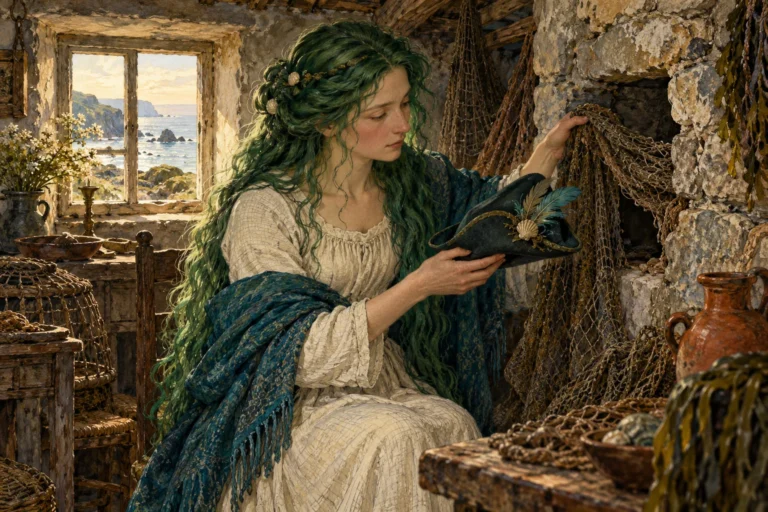
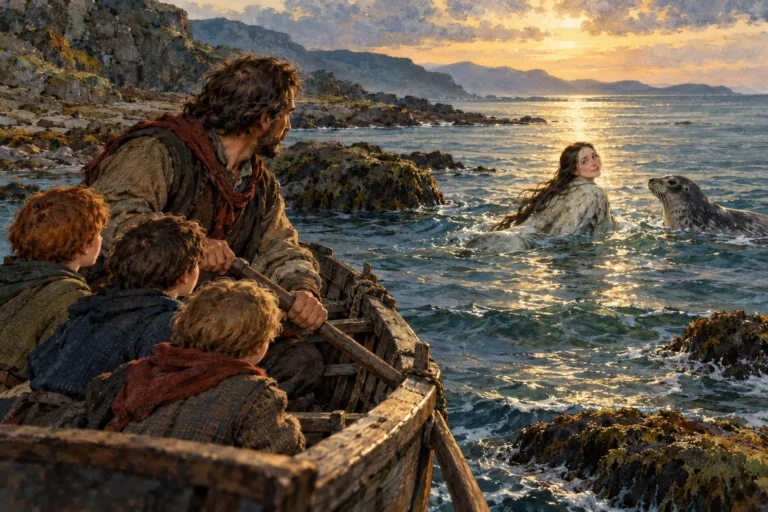
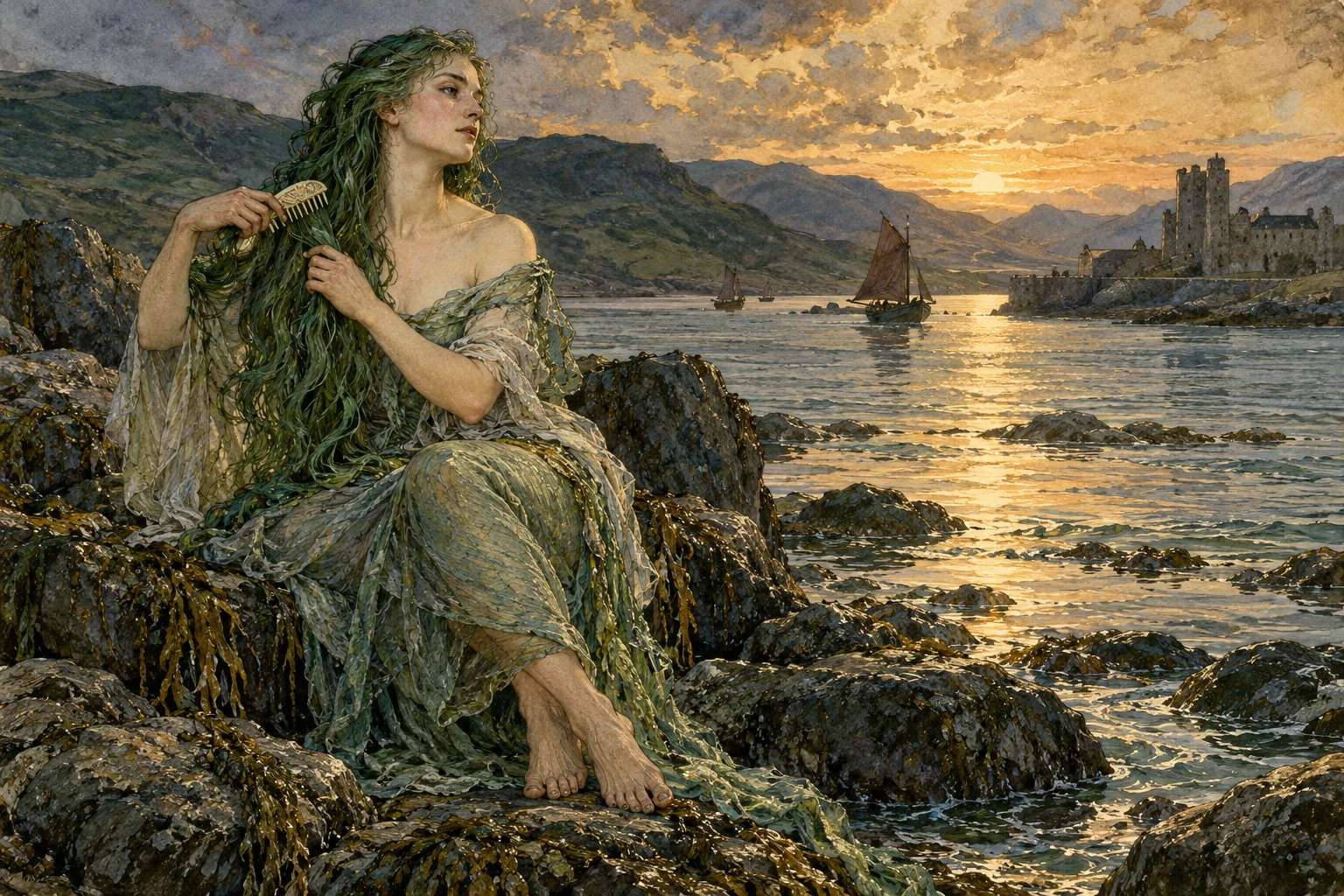
In The Lady of Gollerus, Croker introduces a woman combing green hair beside Smerwick harbour. Her fingers are lightly webbed, and an enchanted cap enables her to return underwater. Dick Fitzgerald steals it and keeps it through their marriage. The printed narrative gives her parents, siblings and a royal father; she understands household affection but initially does not understand Dick’s talk of money. When she finds the cap, the pull of her former home becomes irresistible. Her lost means of travel, rather than a stated fish-tail, drives the action. Croker, The Lady of Gollerus.
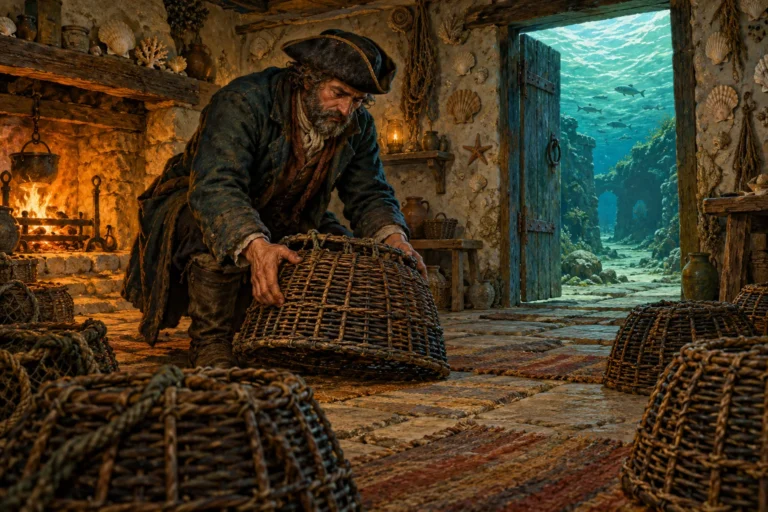
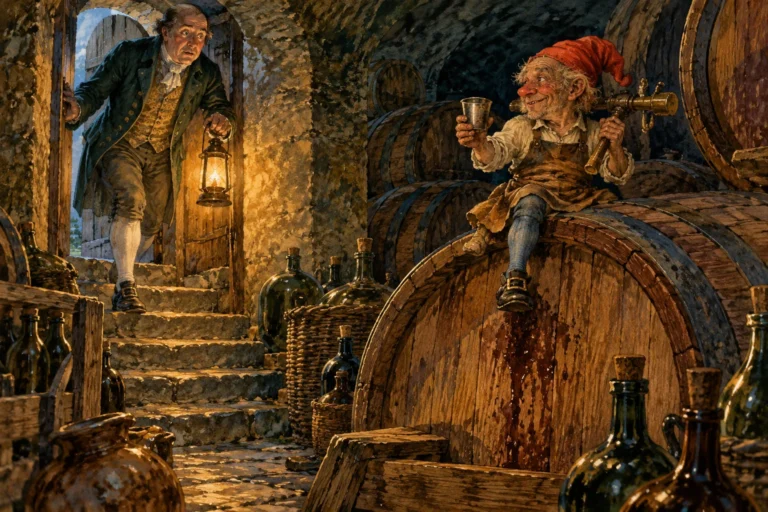
Coomara, the male merrow in The Soul Cages, is conspicuously less human in appearance: green hair and teeth, a red nose, fish-tail, scaled legs and fin-like arms. Yet he enjoys recognisable pleasures, including good company and brandy. He lends Jack Dogherty a cap, entertains him below the sea and accepts invitations in return. His household combines oyster-shell roofing and merrow cooks with an ordinary fire, rough furniture and a well-stocked cellar. He also confines drowned sailors’ souls, believing that he shelters them. Appearance alone therefore gives Jack no adequate guide to his neighbour’s intentions. Keightley, The Soul Cages, pp. 527–536.
That portrait needs an authorship warning attached to the source, rather than hidden away after a list of supposed beliefs. Keightley admitted building the story from a German waterman legend and inventing its elaborations, while acknowledging another contributor. Coomara is an important figure in merrow literature; his soul-cages are not automatically evidence that Irish fishing communities traditionally believed merrows imprisoned the drowned. The story page examines both the admission and his later, less securely documented claim about oral circulation. Keightley, footnote 603.
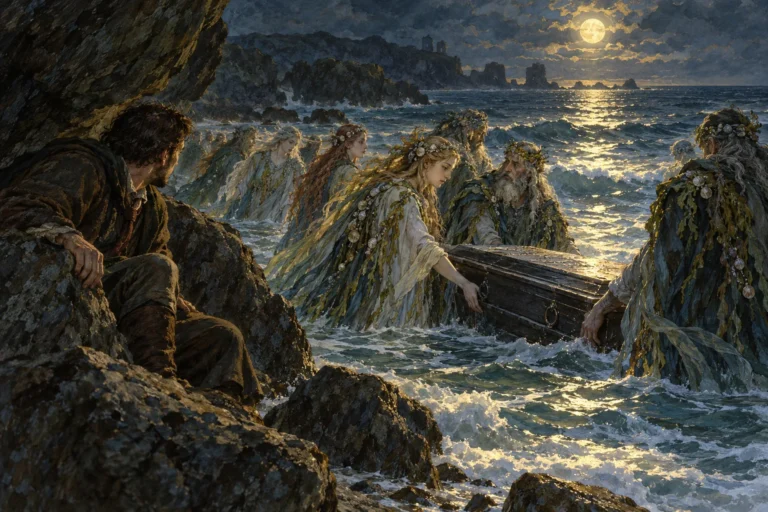
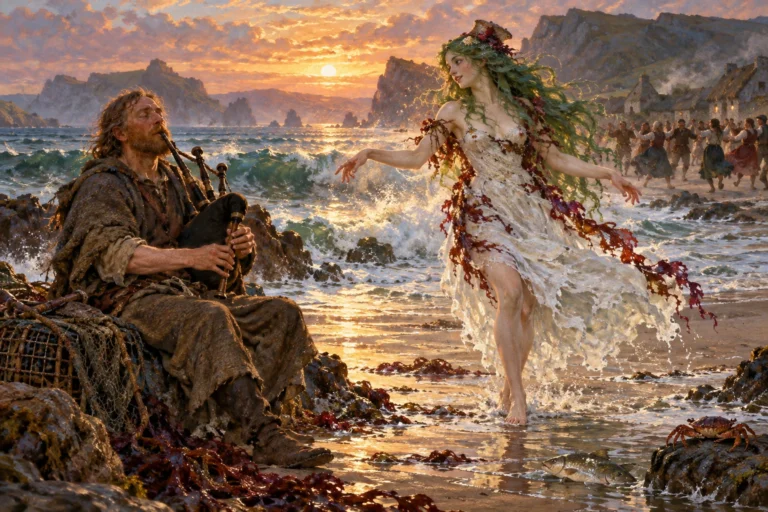
In Flory Cantillon’s Funeral, the sea-people appear collectively. They sing a lament and transport a coffin to a submerged cemetery. Their connection with the Cantillons follows the sea-king’s daughter Durfulla’s marriage to a mortal. Croker’s account does not pause to equip every mourner with Coomara’s body or the Gollerus woman’s cap. Their shared task and resentment matter more than their appearance. Croker, Flory Cantillon’s Funeral, final conversation.
Yeats’s introductory account offers a broader portrait: beautiful female merrows, grotesque males, storm associations and red feathered caps. It also includes transformation into small hornless cows. These are assertions in his editorial overview. They should be cited as such, not read back into every tale as descriptions that each narrator actually supplied. In particular, Croker’s Gollerus episode does not specify that the stolen cap is red. Yeats, The Merrow, p. 61.
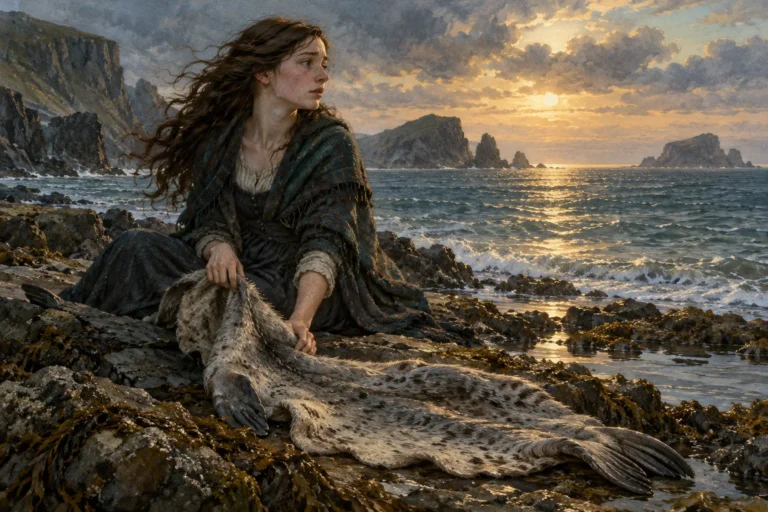
A useful comparison lies across the sea. Kennedy’s The Silkie Wife explicitly concerns Shetland and Orkney: stealing a sealskin prevents a woman’s departure, and recovering it restores her freedom. Keightley’s Shetland Mermaid Wife gives a related account. Those connections help us ask how stories distribute choice between spouses. They do not make a seal-wife an Irish merrow, erase the different locations, or prove that every resemblance came through the same route. The object, the teller’s setting and the documented source all deserve to remain visible. Keightley, pp. 169–171 and 370.
Versions and variations
The cap has different roles. In Gollerus it belongs to the sea-woman and is withheld to stop her leaving. In The Soul Cages, Coomara lends another cap to a human visitor and tells him how to use it for the return journey. The common object creates opposite situations: captivity in one story, hospitality and temporary access in another. Neither account by itself establishes what every merrow’s cap must do. Croker, Gollerus; Keightley, pp. 530–533.
The sea is not one kingdom in a continuous biography. Gollerus names a royal father but not his daughter; Flory Cantillon’s Funeral names Durfulla. No examined passage identifies them as the same woman. Coomara’s household belongs to a Clare setting, while the two marriage traditions attach to different Kerry bays. Joining the stories for browsing must not create genealogical connections their sources never make. Gollerus; Flory Cantillon.
Three kinds of evidence. Yeats’s general introduction is an editor’s synthesis, Croker’s stories are shaped published narratives, and the identified Schools’ Collection record on the Flory page is a particular recorded account. Keightley’s admission adds a fourth consideration: an invented expansion can circulate alongside collected material. Readers should compare what each passage actually says before deciding what it shows about a community’s beliefs. Repetition across books can reveal copying as readily as independent agreement. Yeats, p. 61; Keightley, footnote 603.
Context and evidence
These stories are most revealing when followed through their relationships: who may leave, who possesses the means of return, who cares for the dead and who is obliged to serve another family. That is an interpretation of the accounts, not a reconstruction of a single ancient sea religion. Begin with a story, then use its research panel for the specific edition and comparison. The Smerwick and Gallarus place guide separates one narrated coastal setting from the evidence for the surviving church, and the Irish directory connects this cluster to other traditions.
Sources for this entry
- Thomas Crofton Croker, Fairy Legends and Traditions of the South of Ireland. Library Ireland transcription of the new and complete seventh edition, June 1906, edited by T. Wright. The Lady of Gollerus, complete story. Read source — Public-domain published account; main retelling, geography and cap motif About this book
- Thomas Keightley, acknowledging additional details by an unidentified collaborator, The Fairy Mythology, Illustrative of the Romance and Superstition of Various Countries. New edition, revised and greatly enlarged. London: George Bell & Sons; New York, 1892; Project Gutenberg transcription. Appendix, The Soul Cages, pp. 527–536; footnote 603 at the conclusion. Read source — Full public-domain tale and the author’s explicit admission of invention from a German tale; also his uncorroborated report of later Irish circulation About this book
- W. B. Yeats, editor; tale credited in the anthology to T. Crofton Croker, Fairy and Folk Tales of the Irish Peasantry. First published 1888; examined Project Gutenberg transcription bears the Walter Scott Publishing Company imprint. The Merrow, p. 61; The Soul Cages, pp. 61–75. Read source — Public-domain anthology reprint; its Croker credit must be read with Keightley’s authorship admission About this book
- Thomas Crofton Croker, Fairy Legends and Traditions of the South of Ireland. Library Ireland transcription of the new and complete seventh edition, June 1906, edited by T. Wright. Flory Cantillon’s Funeral, complete story. Read source — Public-domain main account; funeral, Durfulla explanation and witnessed ending About this book
- Patrick Kennedy; account credited to Captain F. W. L. Thomas, R.N., Legendary Fictions of the Irish Celts. Second edition, 1891; Library Ireland transcription. The Silkie Wife, complete story and opening attribution. Read source — Public-domain comparative account explicitly placed in Shetland and Orkney, not an Irish version merely because it appears in this book About this book
- Thomas Keightley, The Fairy Mythology, Illustrative of the Romance and Superstition of Various Countries. New edition, revised and greatly enlarged. London: George Bell & Sons; New York, 1892; Project Gutenberg transcription. Shetland, The Mermaid Wife, pp. 169–171; Ireland, discussion of the merrow, p. 370. Read source — Public-domain comparative seal-wife account and Keightley’s explicit comparison with Gollerus About this book
Research coverage
A type guide built around three directly examined Irish-set published narratives and named northern-island comparisons. Yeats’s generalisations are attributed rather than universalised, and Keightley’s literary invention is disclosed. It does not claim to catalogue all Irish-language merfolk terms, every coastal oral record or the worldwide history of the stolen-garment motif.
The Myths · Irish collection · Editorial approach
Further Reading