Place · Scottish Borders
The Eildon Hills
The landscape of Thomas the Rhymer’s meeting with the Queen of Elfland also contains recorded archaeological remains. The ballad, the monument record and the later associations offer different kinds of evidence.
Also found as: Eildon Hill · Eildon Tree · Huntlie bank. Research reviewed 17 October 2026.
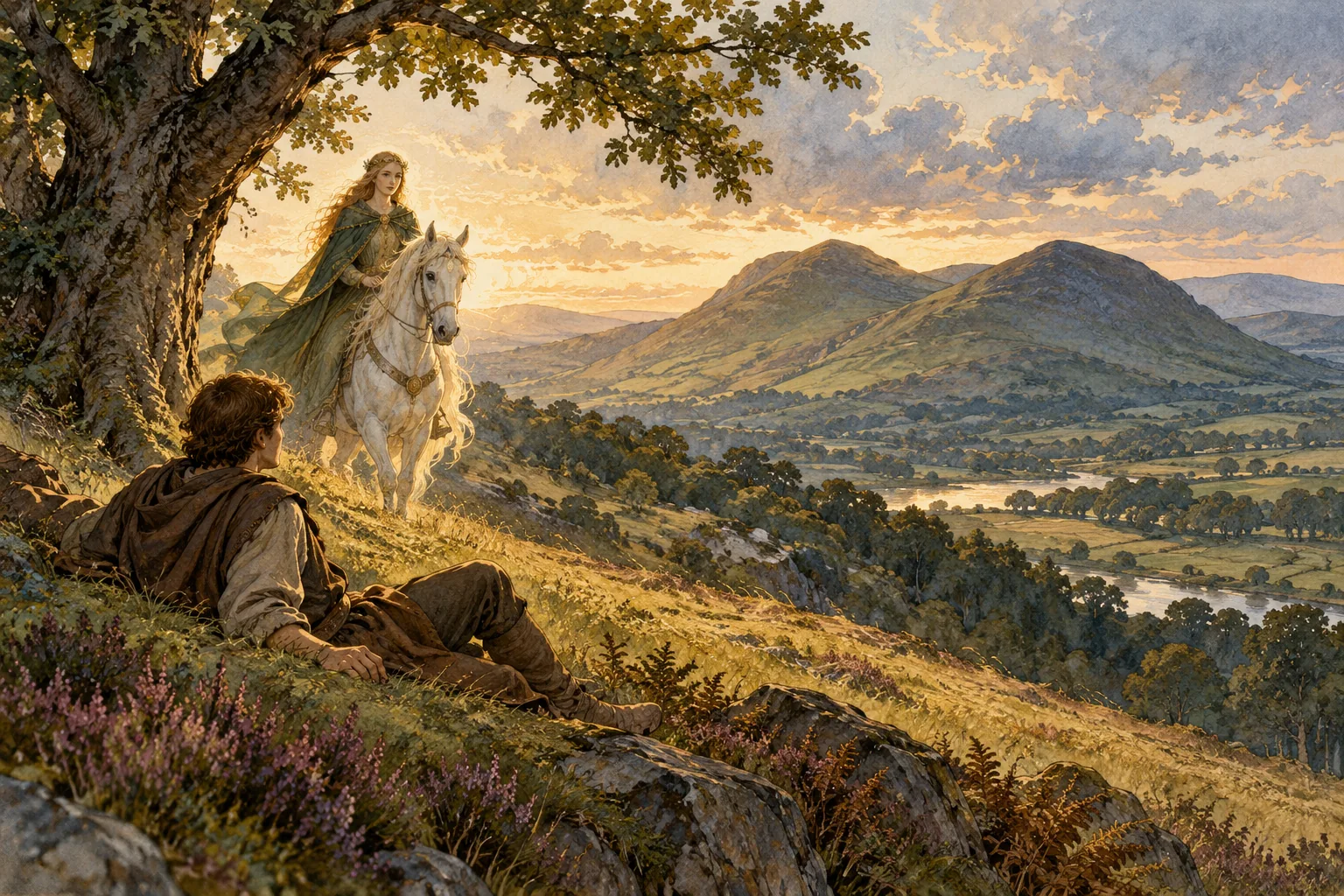
The Eildon Hills enter this library through Thomas the Rhymer. In two of Child’s printed witnesses, Thomas is lying on Huntlie bank when a splendid rider approaches the Eildon Tree. The meeting gives a named landscape an entrance into another world. Yet the place-name is not present in every version: Mrs Brown’s account begins on an unnamed grassy bank. Child 37A–C lets readers see that difference directly.
There is also a physical landscape with its own recorded past. Historic Environment Scotland’s SM2107 designation identifies Eildon Hill North as the site of a prehistoric fort and a Roman signal station in the Scottish Borders. Those categories concern surviving archaeological remains. They do not establish a chamber belonging to the fairy queen or explain the ballad’s supernatural journey.
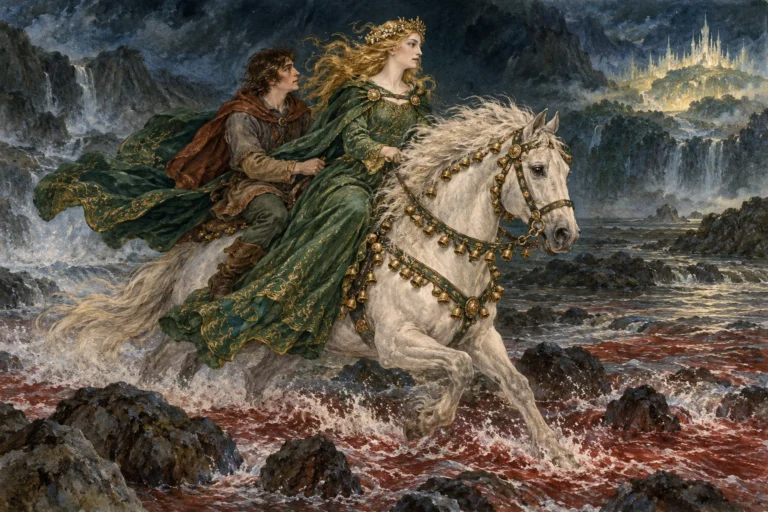
In the version used for our retelling, the Eildon Tree is the place where Thomas kisses the queen and becomes bound to accompany her. The roads she later reveals lead towards righteousness, wickedness and Elfland. Rivers of blood and a garden follow. These are elements of the narrative’s otherworld geography, not directions that can be translated into a marked route across the hills. The distinction allows the landscape to matter without pretending that every extraordinary stage has a corresponding feature on a map.
The name also connects story and historical enquiry. Child’s introduction, pp.318–319, discusses documentary references to Thomas Rymor of Ercildune and the difficulties of deriving a reliable lifespan from them. A historical person with a matching name does not authenticate the ballad’s seven-year absence. Equally, the survival of a legend does not mean the figure behind it must be wholly imaginary. The questions need separate evidence.
Edition history changes the way readers encounter this place. Scott’s version, printed by Child as C, includes the kiss and the apple that gives Thomas a truthful tongue. Mrs Brown’s A has a forbidden orchard and supplies no named Eildon setting. The Campbell manuscript B names the tree but tells the journey differently. A visitor arriving with one familiar retelling may therefore be carrying a particular editor’s arrangement as well as a local association.
The hills provide a useful starting point for the wider Scottish collection. Follow Thomas into the ballad witnesses, then compare Tam Lin, whose rescue takes place in the separately named landscape of Carterhaugh and Miles Cross. The source register keeps literary associations alongside their actual documentary limits. This page identifies a story landscape; it does not propose a walking route or locate a surviving fairy entrance.
Sources for this place
- Francis James Child, editor; witnesses include Mrs Brown of Falkland and Walter Scott, The English and Scottish Popular Ballads, volume I. Original volume issued 1882–1884; linked transcription reproduces the unaltered Dover reprint of 1965. No.37, Thomas Rymer: introduction pp.317–322; complete versions A–C; chosen narrative C, stanzas 1–20. Read source — Primary printed ballad texts and their source apparatus. C is Scott’s composite; A derives from Mrs Brown’s recollection sent to Alexander Fraser Tytler in April 1800. About this book
- Historic Environment Scotland, Eildon Hill North, fort & Roman signal station, SM2107. Official scheduled-monument record, consulted 17 October 2026. Designation title; local authority Scottish Borders; monument types and designation status. Read source — Evidence for the recorded physical monument, not the fairy journey.
Research coverage
Child’s relevant ballad witnesses and introduction were read. The HES designation record supplies the limited archaeological identification. No excavation report, modern oral-history survey, precise Eildon Tree site assessment or access survey has been completed here. Carterhaugh is linked as a different ballad landscape, not moved into the Eildon setting.
The Myths · Scottish collection · Editorial approach
Further Reading