Local folklore · story
Habetrot and the fairy spinners
A Selkirkshire girl receives help with an impossible spinning task. The fairy who saves her work also helps her escape a lifetime at the wheel.
Also found as: Habitrot · Habtrot
Research reviewed 17 October 2026.
Read the story
This retelling follows the Selkirkshire account attributed to Mr Wilkie in William Henderson’s 1879 collection.
A mother wanted her daughter to become a capable spinner. The girl preferred the meadows and lanes, and neither scolding nor punishment taught her the skill her mother expected. At last she was given seven heads of flax and three days in which to turn them into yarn. By the end of the second day she had made scarcely any progress.
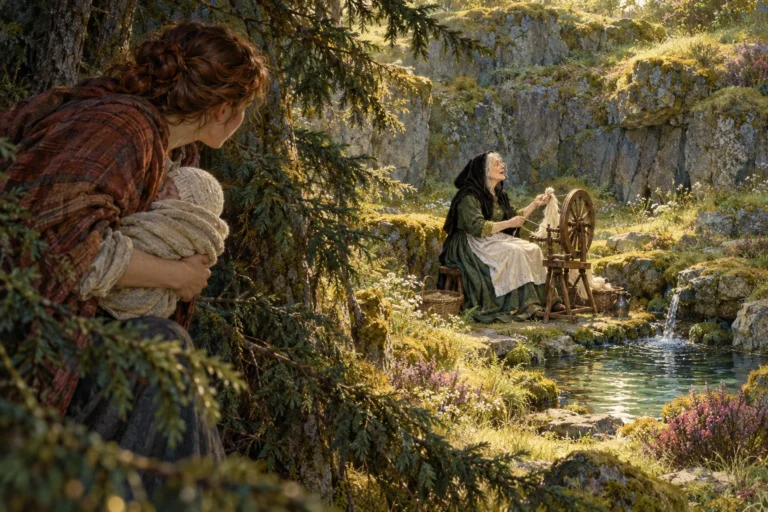
The next morning she wandered out in distress. Beside a stream, below a flower-covered knoll, an old woman was drawing out thread. Her lips were unusually long. When the girl asked why, the woman explained that spinning had made them so. Hearing about the unfinished task, she offered to do it herself. The girl fetched the flax, but before she could discover her helper’s name the woman disappeared among the trees.
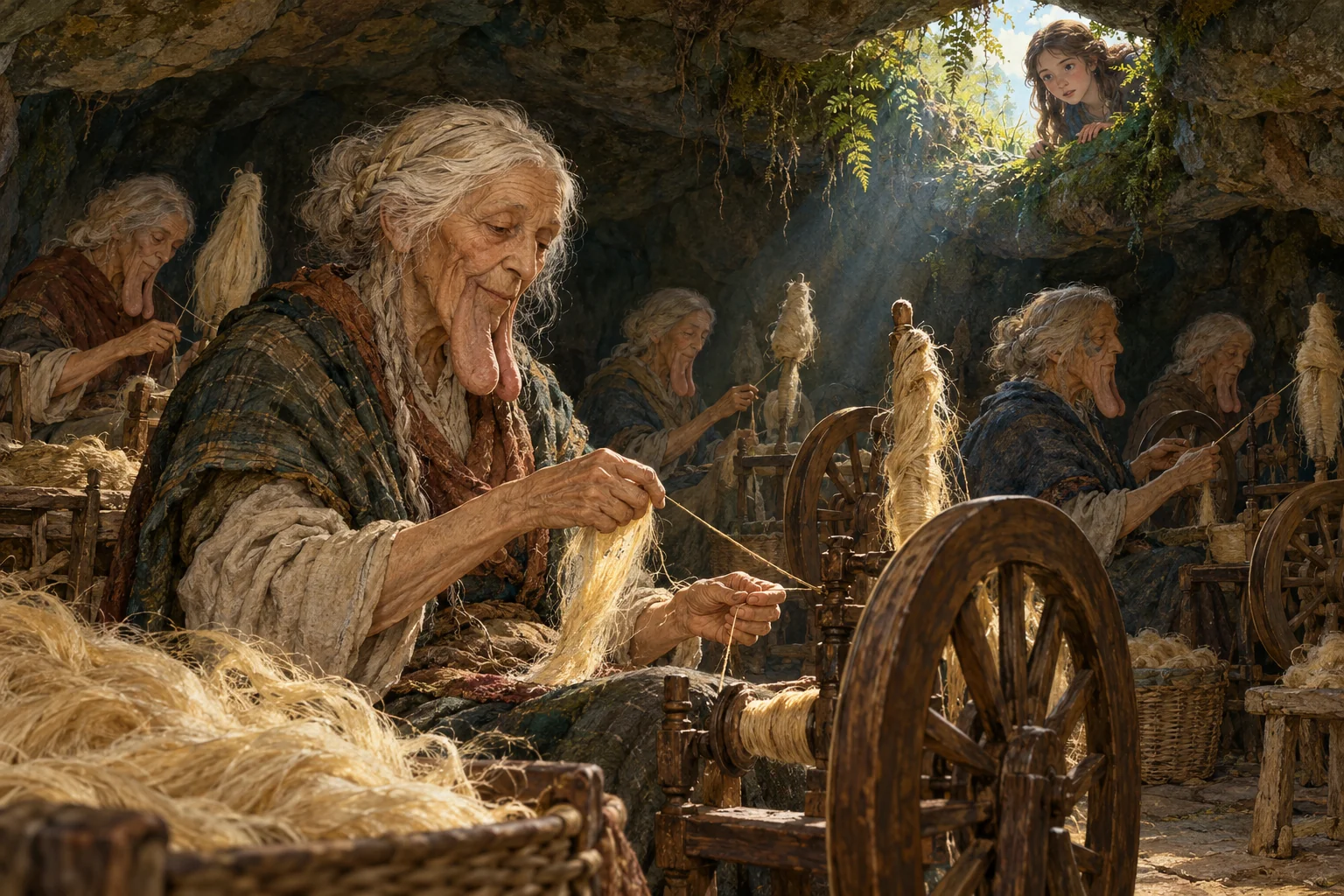
The girl waited and fell asleep. At evening she heard a voice coming from beneath a naturally pierced stone. It was the old woman saying that the girl did not know her name was Habetrot. Looking through the opening, the girl saw a cavern full of spinners. Their lips too bore the marks of their work. Habetrot told one of them, Scanthe Mab, to gather the finished yarn. Then she brought it out, asking for no payment, only that the girl should not tell her mother who had spun it.
At home the girl found black puddings drying by the chimney. Hungry after her long day, she ate all seven. In the morning her mother discovered seven finished hanks and seven missing puddings. Her astonished cries drew the attention of a passing laird. He admired the yarn, met the daughter and decided that she would make an excellent wife.
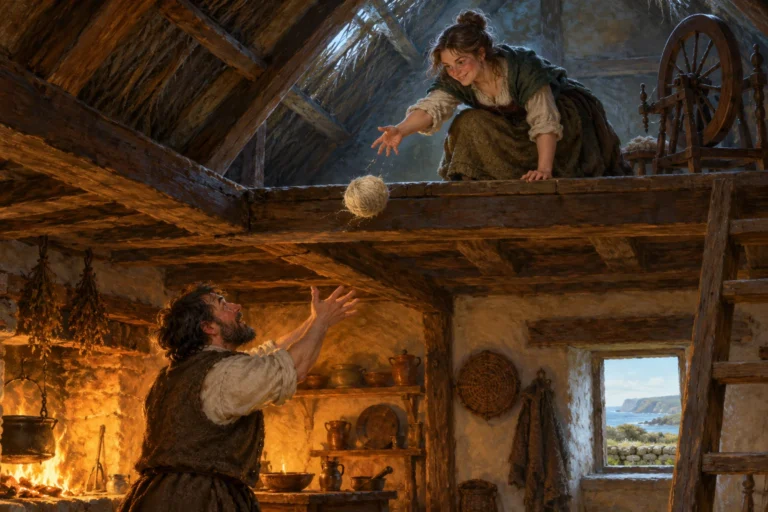
The marriage solved one difficulty and created another: he still expected his bride to spin. Habetrot intervened again. She invited the couple to her underground workshop. The laird asked each spinner about her altered lips, and each blamed constant spinning. Alarmed that the same would happen to his wife, he promised she should never touch a wheel. Thereafter his flax went to Habetrot, and the bride was free to walk and ride with him.
Versions and variations
Henderson’s account and its named intermediary
Henderson presents this as a Selkirkshire legend supplied by Mr Wilkie. It includes the seven heads of flax, seven puddings, the laird’s misunderstanding, Scanthe Mab and a visit to the cavern after the marriage. This is an edited printed witness, not a recording of a named original storyteller.
Chambers’s “Whippety Stourie”
The 1842 text offers a closely related solution to the spinning problem. A woman is already married to a wealthy man who demands twelve hanks a day and a hundred before he returns from a journey. Six little women in green, discovered below a stone, agree to come to dinner. Their explanations of their crooked mouths persuade the husband to burn the spinning equipment. There are no seven puddings or courtship in this telling. The resemblance supports comparison; it does not establish that one text was copied directly from the other.
An overheard name without a ransom
Habetrot’s name is overheard, but the girl does not have to guess it to save a child or cancel a bargain. Name discovery alone should not turn this into a Rumpelstiltskin-style ransom story. Habetrot remains an ally.
Context and evidence
The tale makes women’s textile labour central to marriage and household expectations. Its happy ending depends on relief from that work, achieved by other women’s ingenuity. The descriptions of the spinners’ bodies are part of the story’s comic strategy, not medical evidence about spinning.
Selkirkshire is the source’s regional setting. Henderson does not identify a particular knoll or stream. Our place guide therefore retains the broad location instead of assigning the fairy workshop to a modern landmark. Compare Rowli Pugh’s unseen workers and the Brownie of Blednoch for other arrangements in which supernatural labour changes a household’s prospects.
Sources for this entry
- William Henderson, Notes on the Folk-Lore of the Northern Counties of England and the Borders. New edition, London: Folk-Lore Society, 1879. Chapter VII, “Local Sprites”, Habetrot narrative beginning “A Selkirkshire matron”. Read source — Main printed witness, attributed to Mr Wilkie. About this book
- Robert Chambers, Popular Rhymes, Fireside Stories, & Amusements of Scotland. Edinburgh: William and Robert Chambers, 1842. “Whippety Stourie”, pp.54–55 in the transcribed edition. Read source — A related fairy-spinners narrative, used for comparison with Habetrot; not substituted for Henderson’s text. About this book
Research coverage
The complete Habetrot passage in Henderson’s 1879 edition and Chambers’s 1842 “Whippety Stourie” were examined. The latter is a related spinning tale, not an independent witness to every Habetrot detail. Wilkie’s underlying materials and later oral recordings have not been collated.
The Myths · Scottish collection · Editorial approach
Further Reading