Garth Dorwen fairy traditions · figure
Eilian
The golden-haired servant of Garth Dorwen is recognised in a fairy dwelling. Across two printed tellings, her unexplained departure becomes a story about work, bargains and lost protection.
Also found as: Eilian of Garth Dorwen
Research reviewed 18 October 2026.
Eilian in the stories
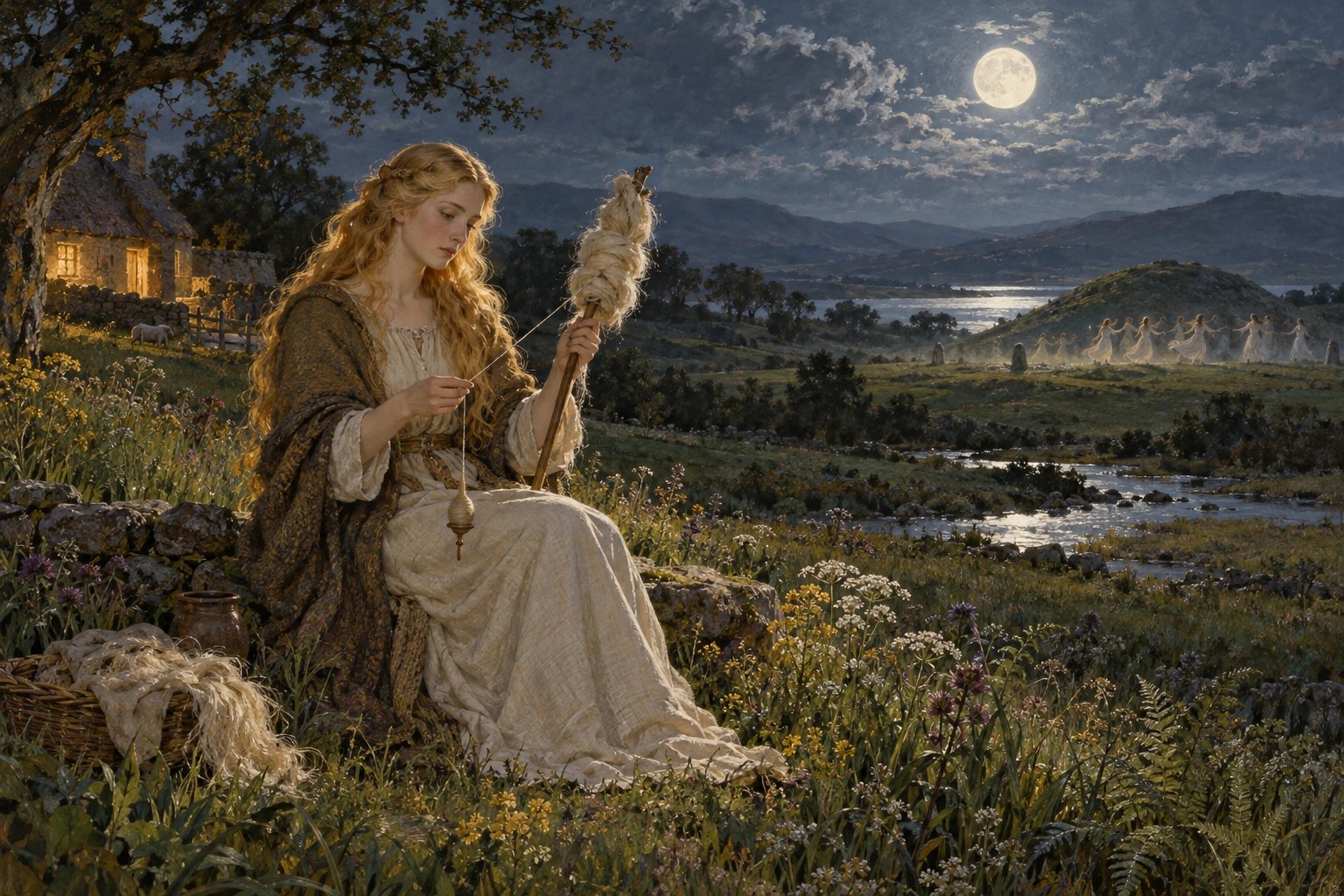
Eilian enters the account at a hiring fair in Caernarfon. An elderly couple take her into service at Garth Dorwen. Her golden hair and habit of spinning in a moonlit meadow distinguish her, but the story first places her within an ordinary employment relationship.
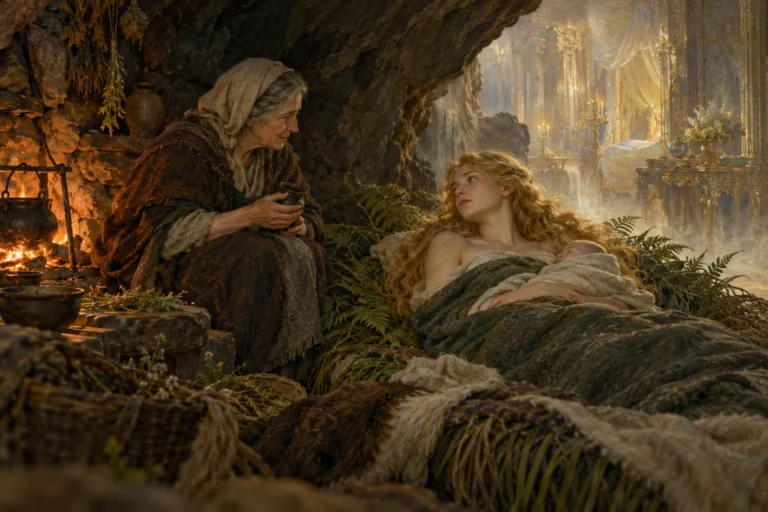
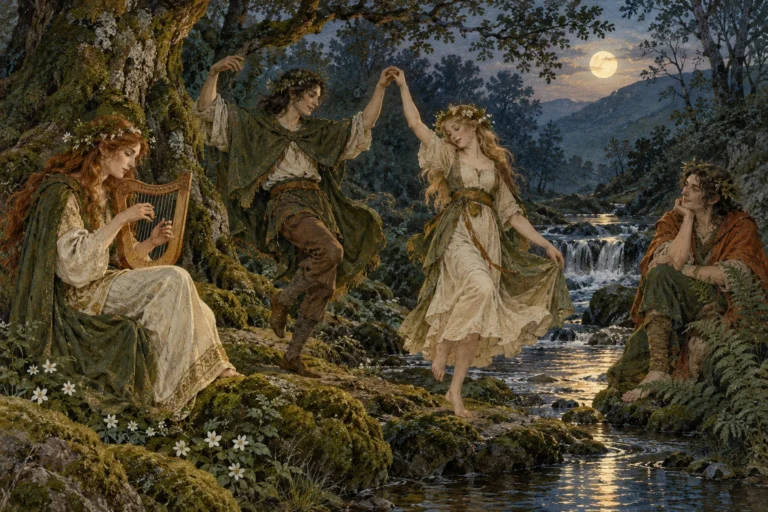
Her association with the Tylwyth Teg grows through their music and dancing. She disappears in spring. When her former mistress is later summoned as a midwife, magical ointment allows the older woman to see through the appearance of a magnificent room. She recognises Eilian on a bed of rushes and fern in a cave.
The recognition is the centre of Eilian’s role in the earlier printed account. Someone thought lost has a new household, but the human visitor cannot safely continue to see into it. At the market, the fairy man destroys the midwife’s altered sight. The story gives Eilian no subsequent return to Garth Dorwen.
How her role changes between tellings
Solomon’s account in Rhŷs, 1901
Rhŷs identifies William Thomas Solomon and records a chain through Solomon’s mother to an old woman at the farm. In the written narrative Eilian goes with the fairies, but does not explain a contract. Rhŷs separately recalls an oral detail about extraordinary spinning and suggests a marriage bargain as an explanation. His suggestion should not be put into the earlier narrator’s mouth.
Thomas’s account, 1908
In The Welsh Fairy Book, Eilian speaks at greater length. She explains that a fairy offered to help with her work if she would marry him. She hoped to keep the help and evade the marriage through a knife and a rowan branch. Exhaustion after sheep-shearing leads her to forget the protections. Thomas’s scene gives her a strategy, a mistake and an explanation of her predicament.
The contrast matters when describing her agency. A concise statement that she “fell in love with a fairy” would go beyond both examined accounts. Equally, the specific broken bargain should be attributed to Thomas’s telling, rather than treated as a documented fact about Eilian in every version.
History, names and comparisons
The named farm and meadow anchor Eilian in local memory. They do not provide a verified biography, birth date or record of a missing servant. Rhŷs’s publication is evidence for the circulation of her story, not proof of the events it narrates.
Compare the help given to human spinners in Habetrot and the fairy spinners. There, the supernatural workers make a marriage easier and free a woman from spinning. In Thomas’s Eilian, help with spinning creates an unwanted marital obligation. This is a thematic comparison between the texts, not evidence that the women are versions of one historical person.
The name Eilian in this tale should also be kept distinct from similarly named saints or sacred wells unless a source actually makes that connection. None of the examined passages establishes one.
Sources for this entry
- John Rhŷs, Celtic Folklore: Welsh and Manx, volume I. Oxford: Clarendon Press, 1901. Chapter III, William Thomas Solomon’s Eilian account, pp. 208–214. Read source — Welsh text, English translation, named transmission chain and Rhŷs’s separate comments. About this book
- W. Jenkyn Thomas, The Welsh Fairy Book. 1908 edition. “Fairy Ointment”, pp. 93–95. Read source — A later literary telling with a marriage bargain, protective objects and market theft. About this book
- W. Jenkyn Thomas, The Welsh Fairy Book. 1908 edition. Preface. Read source — Acknowledges Rhŷs and other collections, and explains that some stories combine material. About this book
Research coverage
This guide compares the Eilian material in Rhŷs and Thomas. It does not claim a full catalogue of Welsh fairy brides or establish a historical identity for Eilian.
The Myths · Welsh collection · Editorial approach
Further Reading