North-west Welsh fairy traditions · place
Garth Dorwen and Bryn y Pibion
A farm, a spinning meadow and a stony rise give Eilian’s fairy-midwife story its local shape. The source records a remembered route, not a verified map of a fairy dwelling.
Also found as: Cae Eilian · Rhos y Cowrt · Eilian’s meadow
Research reviewed 18 October 2026.

Following the named places
In the account printed by John Rhŷs, Garth Dorwen is the home of the elderly couple who hire Eilian. Caernarfon is the setting for both the hiring fair and the later market encounter. Between those visits, the story moves from everyday work at the farm to a concealed household beyond it.
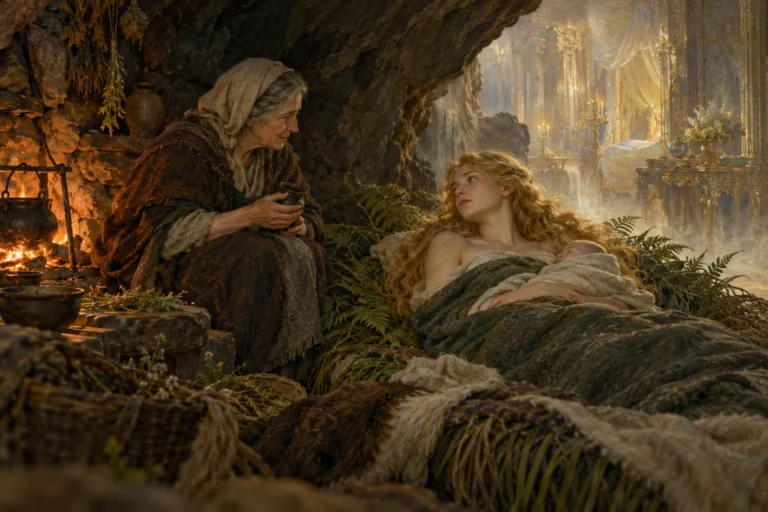
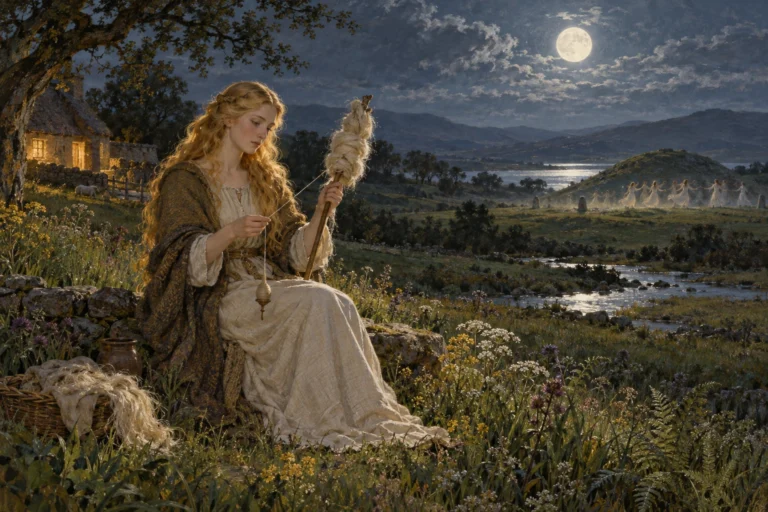
Eilian spins in a meadow where the Tylwyth Teg dance. The narrative remembers the field by her name, Cae Eilian, and as the maid’s meadow. When the mistress is summoned as a midwife, her escort takes her to Rhos y Cowrt and a stony rise called Bryn y Pibion. The rich room appears within an entrance there.
The names matter because they show how a marvellous episode can be told through familiar working places. They should be preserved even when an exact modern identification remains unsettled. Flattening the setting into an unspecified fairy castle would discard a significant part of this witness.
Place names and the source chain
Rhŷs gives William Thomas Solomon as his source and traces Solomon’s knowledge through his mother to an old woman at Garth Dorwen. That is evidence of a claimed local chain of transmission. It is not the same as Rhŷs interviewing Eilian or the midwife.
Thomas’s later “Fairy Ointment” retains the farm and other principal names while expanding the explanation of Eilian’s departure. Agreement on place names in that literary retelling does not provide an independent survey or a second local witness.
The exact scene inside the rise also changes with the observer’s sight. One eye shows luxury; the other reveals rock, rushes, fern and a small fire. The contrast belongs to the story’s magic. It should not be treated as two competing archaeological descriptions.
What has not been established
Rhŷs suggested that Bryn y Pibion deserved investigation as a possible ancient structure. The suggestion is not evidence that an excavation took place or that a barrow or fort was confirmed. This guide does not upgrade that question into a finding.
The examined texts do not securely locate an accessible cave entrance today, establish a surviving Eilian memorial or verify a historical birth in the hill. The illustration is an imagined farm-and-meadow landscape, not a view of a confirmed site.
Further work could compare historical maps and local place-name records with the spelling and route in Solomon’s account. That would refine the geographical reading while leaving the supernatural claims on their own evidential footing.
Sources for this entry
- John Rhŷs, Celtic Folklore: Welsh and Manx, volume I. Oxford: Clarendon Press, 1901. Chapter III, William Thomas Solomon’s Eilian account, pp. 208–214. Read source — Welsh text, English translation, named transmission chain and Rhŷs’s separate comments. About this book
- W. Jenkyn Thomas, The Welsh Fairy Book. 1908 edition. “Fairy Ointment”, pp. 93–95. Read source — A later literary telling with a marriage bargain, protective objects and market theft. About this book
- W. Jenkyn Thomas, The Welsh Fairy Book. 1908 edition. Preface. Read source — Acknowledges Rhŷs and other collections, and explains that some stories combine material. About this book
Research coverage
The place references in Rhŷs and Thomas were compared. No field survey, excavation report or exact modern route has been established for this entry.
The Myths · Welsh collection · Editorial approach
Further Reading