Manx supernatural spinners · figure
Mollyndroat
The giant whose singing gives away his name. Sophia Morrison’s Manx tale makes this extraordinary spinner the loser in a very particular bargain.
Also found as: Mollyndroat the giant · The Lazy Wife’s Foawr
Research reviewed 18 October 2026.
The spinner in the mountain house
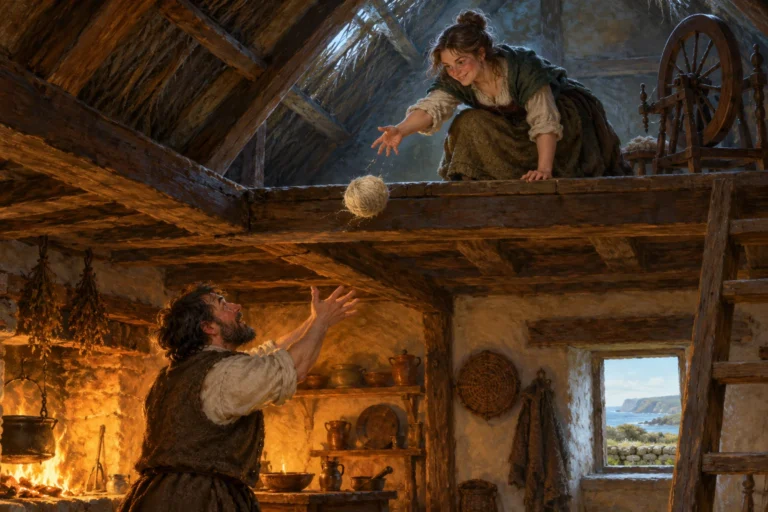
Mollyndroat appears in Sophia Morrison’s “The Lazy Wife”. A woman asks him to spin wool she has neglected, and he agrees on condition that she tell him his name when she returns a week later. If she cannot, the thread remains his.
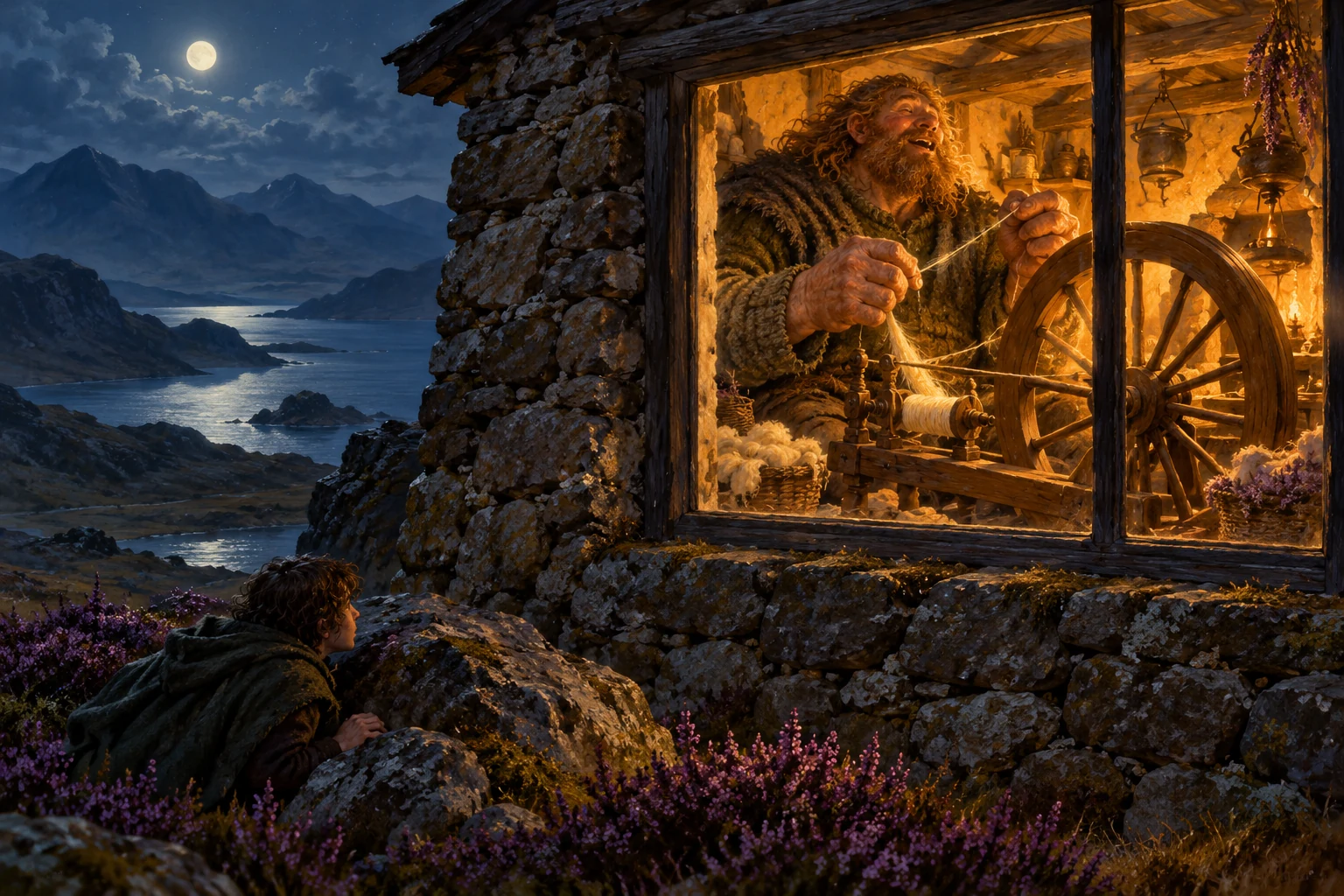
He is a prodigious worker. The woman’s husband sees him through a bright window, spinning rapidly and singing to himself. His song gives away the very answer on which the bargain depends. The husband repeats it at home, without realising that he has supplied his wife with a way to win.
When she returns, the woman tries several names before giving the right one. Mollyndroat becomes angry and accuses her of consulting a fortune-teller, but he throws her the thread. His strength and skill cannot undo the information she has acquired.
Name and published forms
Foawr in 1907, Giant in 1911
The Manx Quarterly printing calls him a Foawr and explains the word as giant. The later book replaces that label with Giant. Both give his personal name as Mollyndroat and preserve the same basic bargain. They are closely related versions published by Morrison, not evidence for two separately named giants.
What the name does
Within the story, the name is a password whose discovery transfers the work to the woman. No secure derivation of Mollyndroat is established by the consulted passages. Resemblance to other Manx names, or the heroine’s sequence of guesses, should not be turned into a confident etymology.
What he does not demand
There is no claim on a baby and no condition of lifelong servitude in the two printings examined. The risk is losing the spun thread. Comparison with Whuppity Stoorie is useful precisely because the supernatural name has a similar function while the threatened loss differs.
Mollyndroat is also distinct from the fynoderee, whose extraordinary labour belongs to a different group of Manx stories. A shared association with work is a reason to link the entries, not to identify the beings as one creature.
Performance and place
The singing is essential to the narrative: it carries secret knowledge from the giant’s house to the human household. Culture Vannin’s music history follows a song and performance tradition associated with the tale, including a stage version by Morrison and Cushag. Those later materials deserve their own comparison; they are not silently treated here as extra prose variants.
The house stands on an unnamed mountain in the consulted texts. No birthplace, family tree, exact residence or wider cycle of adventures has been established for Mollyndroat. This guide keeps the figure closely attached to the story in which he is documented.
His defeat has a comic scale. A being capable of spinning at immense speed is undone by the pleasure of singing about himself. The wife’s earlier deception with a single ball prepares readers for a world in which counting, hearing and interpretation matter as much as effort.
Sources for this entry
- Sophia Morrison, The Lazy Wife. The Manx Quarterly, no. 3, November 1907. pp. 251–252. Read source — Earlier printed telling, calling the spinner a Foawr and giving Mollyndroat as his name. About this book
- Sophia Morrison, Manx Fairy Tales. London: David Nutt, 1911. “The Lazy Wife”, pp. 62–70. Read source — Book version, closely matching the 1907 story while using Giant in place of Foawr. About this book
- Chloë Woolley, Culture Vannin / Manx Music, How a lazy wife and giant inspired a children’s song. 17 May 2024. Song and performance history. Read source — A modern account of the tale’s musical afterlife. The archival recordings and stage script were not directly compared.
Research coverage
The figure is described from Morrison’s two examined printings. Performance history is reported from the named modern article, with original recordings and script not examined. Etymology, a precise home and a broader biography remain unestablished.
The Myths · Manx collection · Editorial approach
Further Reading