Names, bargains and fairy encounters · story
Whuppity Stoorie
A mother promises a stranger anything to save her sow. Only the stranger’s secret name can save her child.
Also found as: Fittletetot · Goodwife of Kittlerumpit
Research reviewed 18 October 2026.
Read the story
The goodwife’s bargain
This retelling follows the child-ransom story printed by Robert Chambers, rather than the separate six-spinners tale with a similar name.
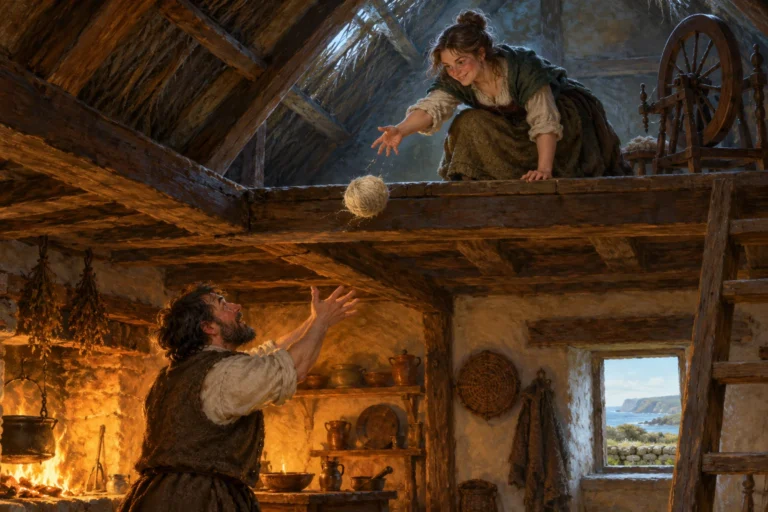
The goodwife of Kittlerumpit had been left to manage alone. Her husband had gone to a fair and never returned; no one could say for certain what had happened to him. She had a baby son, little money and a sow that she hoped would soon give her a litter of piglets. Then the sow fell desperately ill.
As she sat crying outside the cottage, an old woman dressed in green came up the road. She knew about the missing husband and the sick animal. What would the goodwife give her for a cure? Anything she wanted, the mother answered. They sealed the promise by wetting their thumbs.
The stranger rubbed the sow with an oily liquid, spoke over it, and ordered it to rise. Up it got and went to its food. Then she asked for her payment: the baby. The mother pleaded, but the fairy would allow only one escape. She would return on the third day; if the goodwife could tell her true name, the child would stay.
The song in the quarry
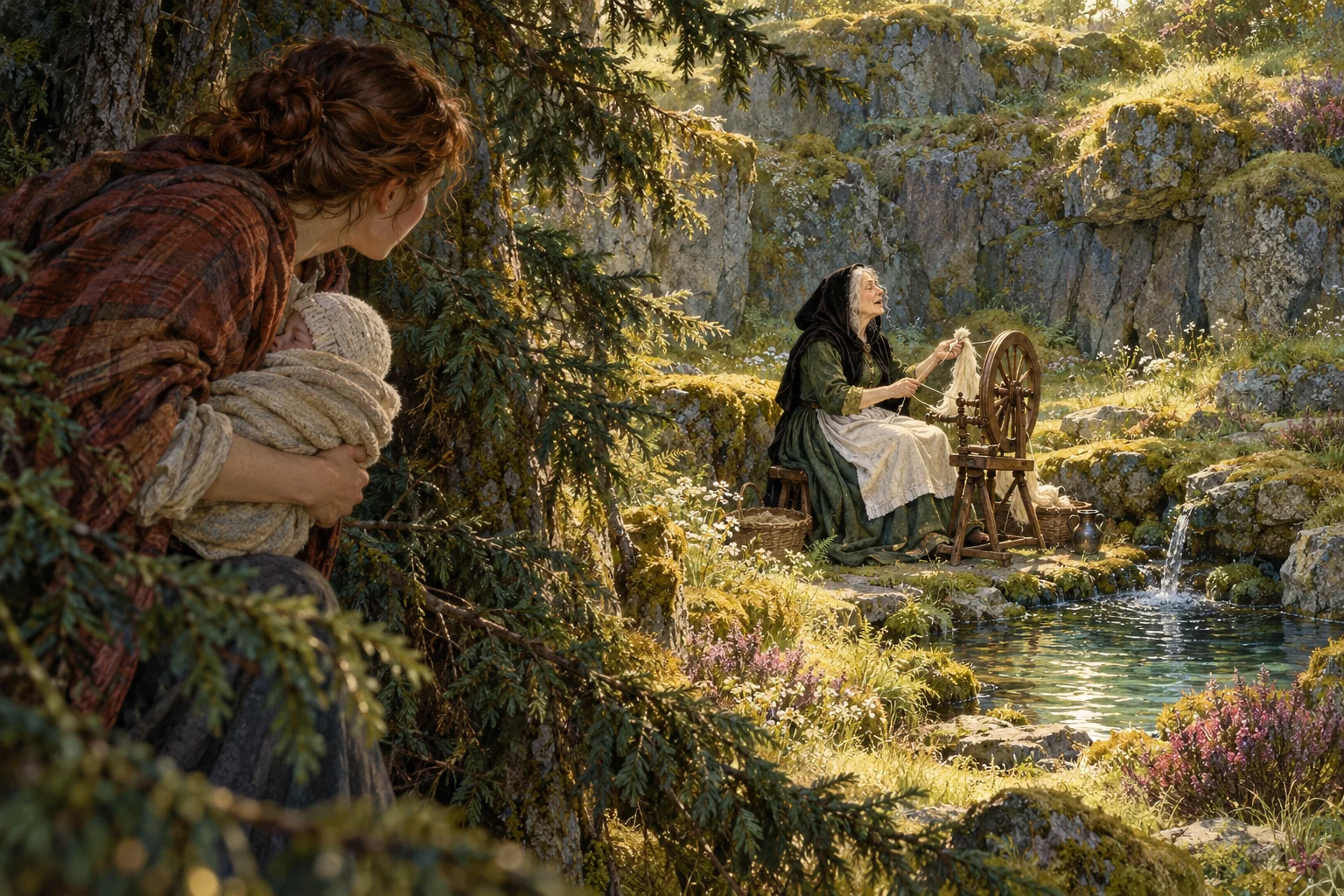
On the second day, the mother carried her son into the fir wood behind the house. In an old grassy quarry, beside a spring, someone was spinning. She crept closer and heard the green woman singing. The song gave away the very thing she needed: Whuppity Stoorie was her name.
When the fairy returned, the goodwife made a show of despair. Would she accept the sow instead? Would she take the mother? The fairy dismissed both offers. At last the goodwife straightened her cap, made a deep curtsey and, with exaggerated respect, addressed her visitor by name: Whuppity Stoorie.
The fairy sprang into the air, then ran down the hillside shrieking with anger. The mother picked up her child and went indoors singing. The cure had been paid for with a secret, and the child was safe.
Versions and variations
Chambers: a child is the price
The printed narrator is Nurse Jenny, whose opening uncertainty about Kittlerumpit is part of the telling. The child is already born; the bargain concerns curing a sow, not spinning straw into gold. A footnote supplies Fittletetot as an alternative name, but does not give a second complete narrative.
Rhys: the same witness in altered language
John Rhys reproduces Chambers in 1901 while deliberately softening the Scots. That is a transmission of the same story, not a second independent account of the events.
A similar title, a different story
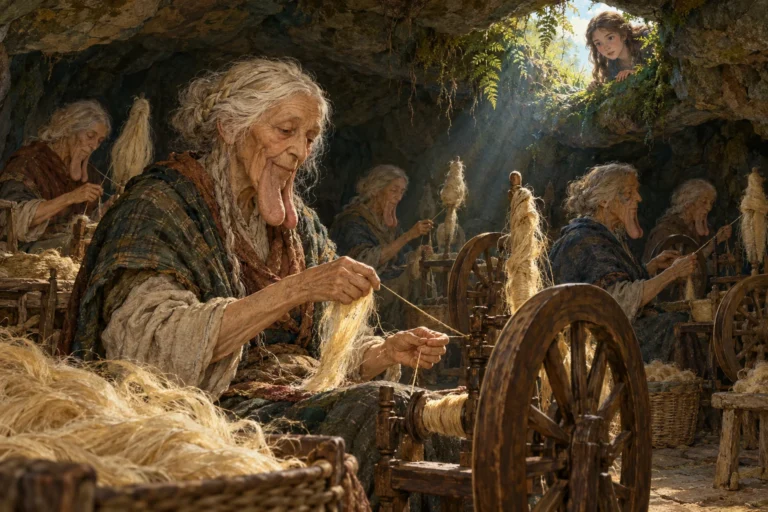
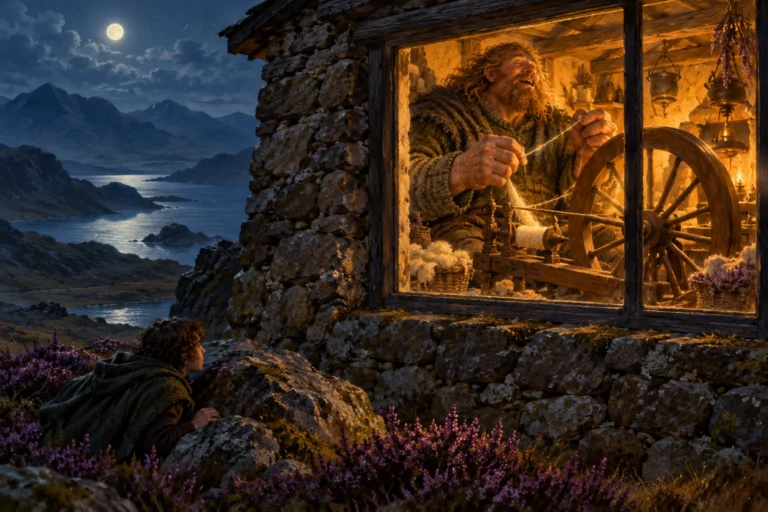
Chambers’s adjacent “A Various Whuppity Stoorie”, like the 1842 “Whippety Stourie”, concerns women who spin for a wife and explain their altered mouths at a dinner. That plot belongs beside Habetrot. Its resemblance does not justify importing a child-ransom episode into Habetrot.
Context and evidence
Kittlerumpit is not securely located by the narrator: she tentatively places it in the Debatable Ground. No identified cottage, quarry or family record has been established here. The uncertainty should remain visible rather than become a precise map pin.
The story makes knowledge a defence against an unequal bargain. The goodwife herself discovers the name, while the opening draws attention to a struggling household that receives sympathy but little practical help. These are readings of the narrative, not proof of its original purpose.
Sources for this entry
- Robert Chambers, Popular Rhymes of Scotland. 1858 text; scanned extract without title leaf. “Whuppity Stoorie”, printed pp.221–225; “A Various Whuppity Stoorie”, following. Read source — Complete child-ransom narrative and adjacent spinning comparison; pagination agrees with the edition cited by Rhys. About this book
- John Rhys, reproducing Robert Chambers, Celtic Folklore: Welsh and Manx. Oxford, 1901, volume II; transcription hosted by D. L. Ashliman. Whuppity Stoorie, pp.585–590. Read source — Dependent reproduction with the Scots softened, not an independent oral witness. About this book
- Robert Chambers, Popular Rhymes, Fireside Stories, & Amusements of Scotland. Edinburgh, 1842. “Whippety Stourie”, pp.54–55. Read source — Six-spinners comparison, a different plot from the child-ransom story. About this book
Research coverage
The passages named below have been read and compared. This entry does not claim to include every oral performance, manuscript witness or modern adaptation; unexamined leads are identified separately.
The Myths · Scottish collection · Editorial approach
Further Reading