Northumbrian fairy encounters · story
My Own Self
A boy and a tiny visitor exchange names by the hearth. When something goes wrong, a piece of wordplay saves him.
Also found as: Me A’an Sel’ · Ainsel
Research reviewed 18 October 2026.
Read the story
A visitor at the hearth
This retelling follows Joseph Jacobs’s “My Own Self”, whose source note traces the tale through Mrs Balfour to a woman from North Sunderland.
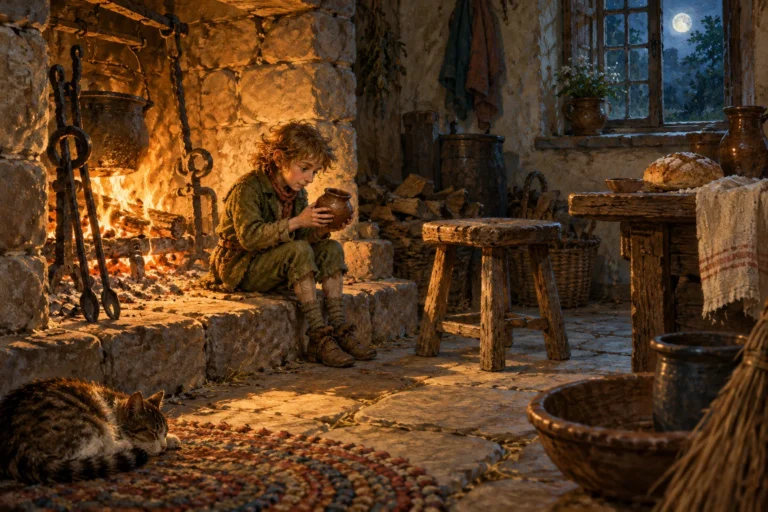
A widow lived with her young son in a lonely northern cottage. One evening she told him it was time for bed, but he wanted to stay beside the fire. At last she went to bed herself and left him sitting at the hearth.
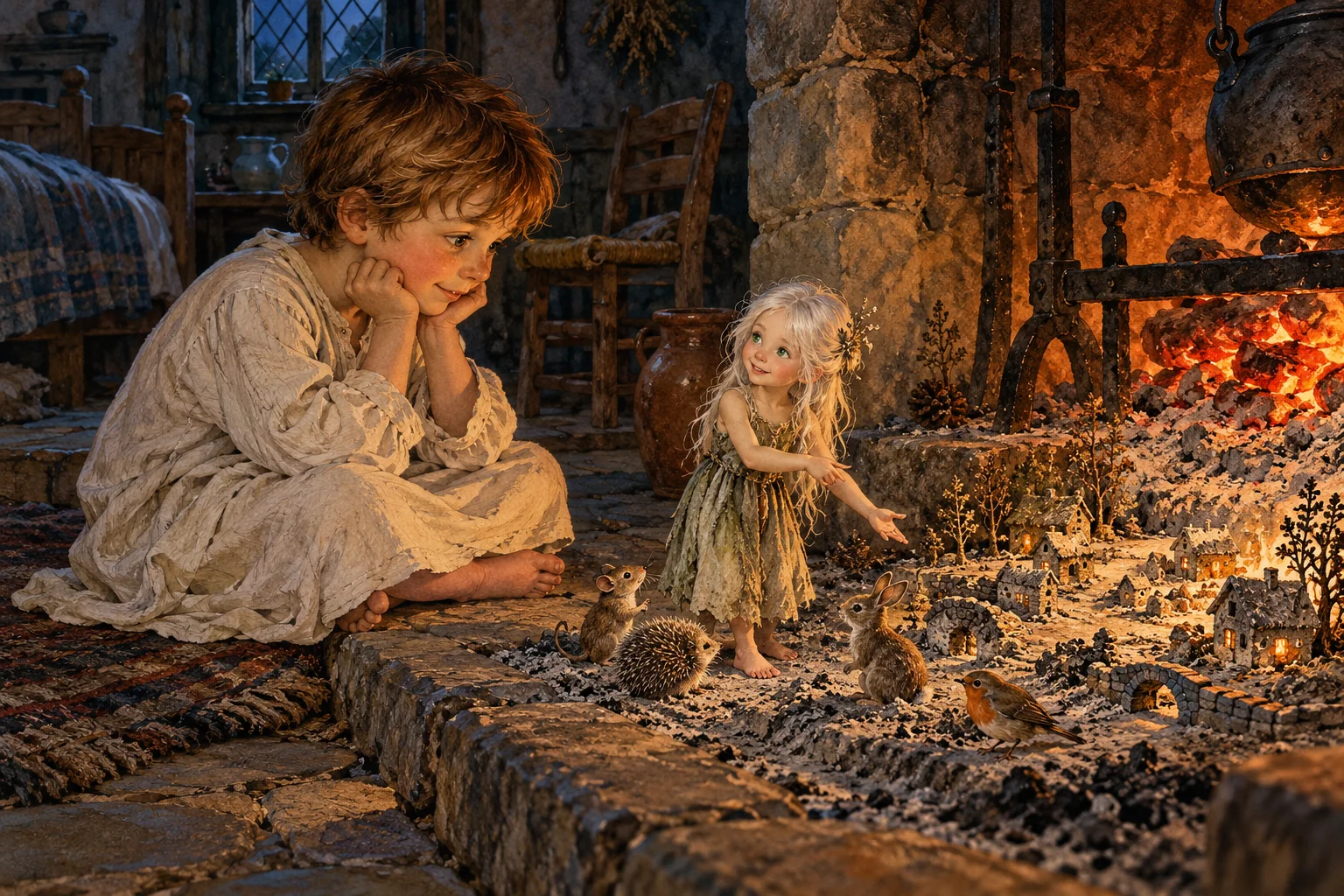
Down the chimney came a little girl scarcely a span high, with silver hair and green eyes. When he asked her name, she answered My Own Self. He said that he was Just My Own Self too.
They began to play. The little visitor made shapes in the ashes: animals and a tiny village that seemed to come alive under her breath. The boy watched, absorbed in their game.
Who did it?
Then he stirred the fire. A hot cinder flew out and hurt the girl’s foot. She cried so loudly that a voice came down the chimney demanding to know what had happened. The boy scrambled into bed.
Asked who had hurt her, the little girl named her playmate: Just My Own Self too. Her mother understood the answer quite differently. If she had done it herself, there was no one else to blame. She reached down, took her daughter and drew her up the chimney.
The boy had escaped the angry visitor through the name he had given. After that, the tale says, he was much more willing to go to bed when his mother told him.
Versions and variations
The telling Jacobs rewrote
Jacobs identifies his source as Mrs Balfour, from Mrs W., a native of North Sunderland. His note gives the title “Me A’an Sel’”. “My Own Self” is his rendering for the printed collection. His preface openly says that he rewrote much of his material; the page is not a verbatim transcript of Mrs W.’s speech.
Ainsel and other named parallels
Jacobs lists “Ainsel” in Hugh Miller, another version in Hartland and a Durham account among his parallels. Those are useful leads, but their complete texts have not been collated for this entry. Their differences are therefore not invented here or blended into Jacobs’s story.
Names as a defence
The accidental self-accusation is different from Whuppity Stoorie, where the mother must discover a fairy’s true name. Both make language decisive, but only one is a name-guessing bargain.
Context and evidence
Mrs W.’s reported familiarity with the cottage and with people who knew the family is part of Jacobs’s source note. It is not independent verification of a fairy encounter. No named widow, boy, dated event or securely identified cottage has been established here.
The North Sunderland guide distinguishes the contributor’s locality from a verified site. This matters because a narrator’s home, a story’s setting and a surviving building are three different kinds of association.
Sources for this entry
- Joseph Jacobs, More English Fairy Tales. New York and London, 1894. XLVII, “My Own Self”. Read source — Complete literary retelling. About this book
- Joseph Jacobs, More English Fairy Tales. New York and London, 1894. Notes and References, XLVII. Read source — Balfour and Mrs W. source chain, original title, and bibliographic parallels. About this book
Research coverage
The passages named below have been read and compared. This entry does not claim to include every oral performance, manuscript witness or modern adaptation; unexamined leads are identified separately.
The Myths · English collection · Editorial approach
Further Reading