Kintyre supernatural tales · story
The Sprightly Tailor
A tailor accepts a night’s sewing in a ruined church at Saddell. An enormous figure rises through the floor, and every completed stitch buys him another moment.
Also found as: The Saddell tailor
Research reviewed 18 October 2026.
Read the story
This retelling follows tale VIII in Joseph Jacobs’s Celtic Fairy Tales. Its close Manx counterpart is compared separately rather than folded into the Scottish chase.
At Saddell Castle, Macdonald offered a handsome reward to anyone who could make a pair of trews during a night in the old church. The place had an alarming reputation, but a lively tailor accepted. He took his cloth, needle, thread and candle, and went up the glen to the ruins.
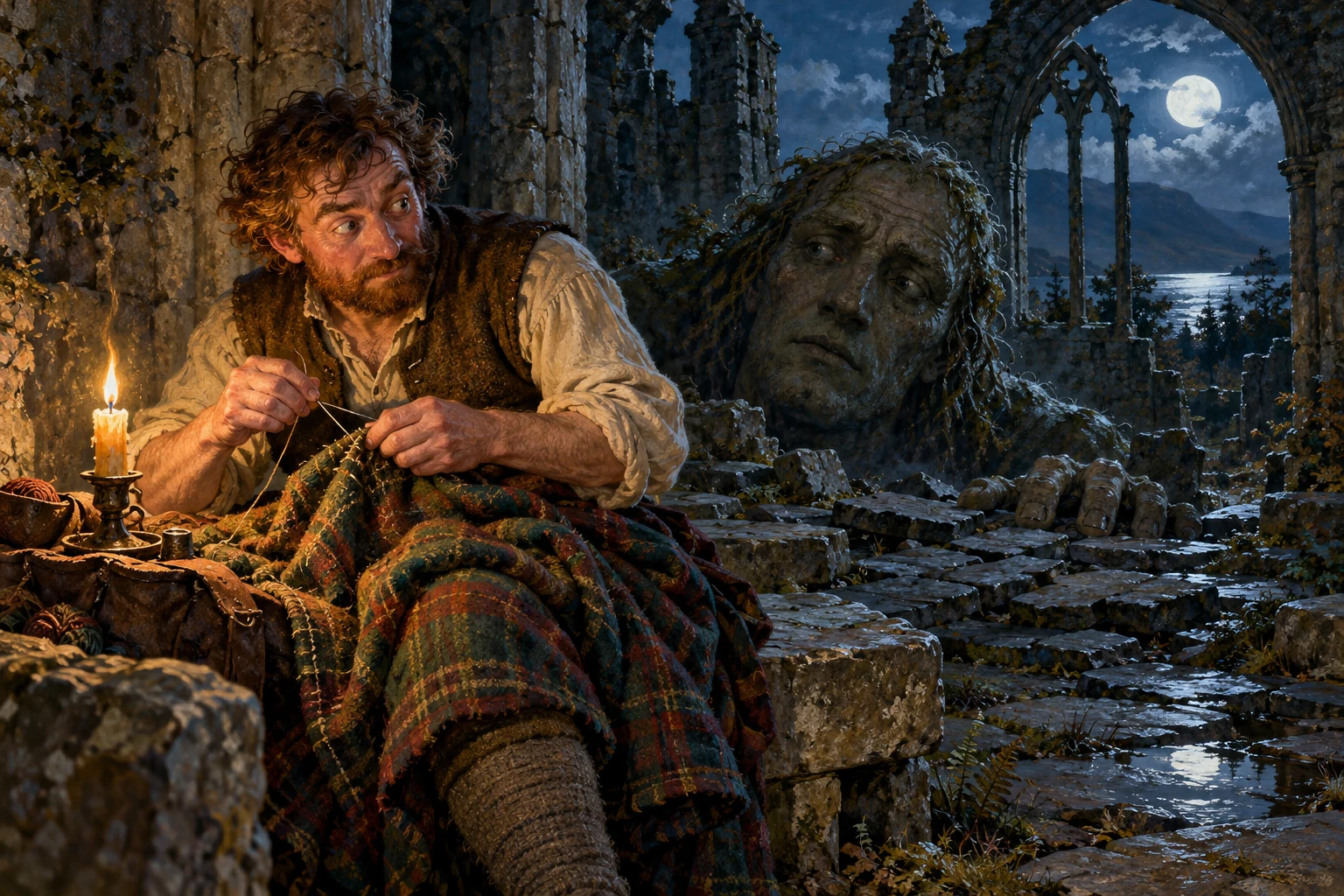
He settled on a gravestone and began to sew. For a while there was only the small light and the movement of his hands. Then a huge head pushed up through the church floor. The apparition asked whether he had ever seen so great a head. The tailor admitted that he had not, and carried on stitching.
A neck followed, then a mighty chest. At each new appearance the figure asked the same sort of question. The tailor answered without putting down his work. He had no wish to remain long enough to see the whole visitor, but he also intended to finish the trews.
Arms emerged, and then a leg. The tailor’s stitches grew longer as the body rose. Just before its second leg was clear of the ground, he completed his work, snatched it up and sprang through the church door.
The creature came after him. Down the glen went the tailor, with the castle ahead and enormous footsteps behind. He reached the gate and shut it just in time. The pursuer struck the wall above it, leaving the marks of five fingers, according to the tale.
The tailor delivered the trews and received his reward. Nobody noticed how long the last stitches had become. Whatever had risen in the church, it had failed to stop him finishing his night’s work.
Versions and comparisons
Jacobs and the earlier Kintyre reference
Jacobs’s note names Cuthbert Bede’s contribution to Notes and Queries of 21 December 1861, collected in Cantyre, as his source. That is a traceable earlier publication reference, but the 1861 article has not been directly collated for this entry. Jacobs also points to other Scottish accounts of enormous visitors. Those references remain further research leads, not additional texts claimed as examined here.
Timothy at St Trinian’s
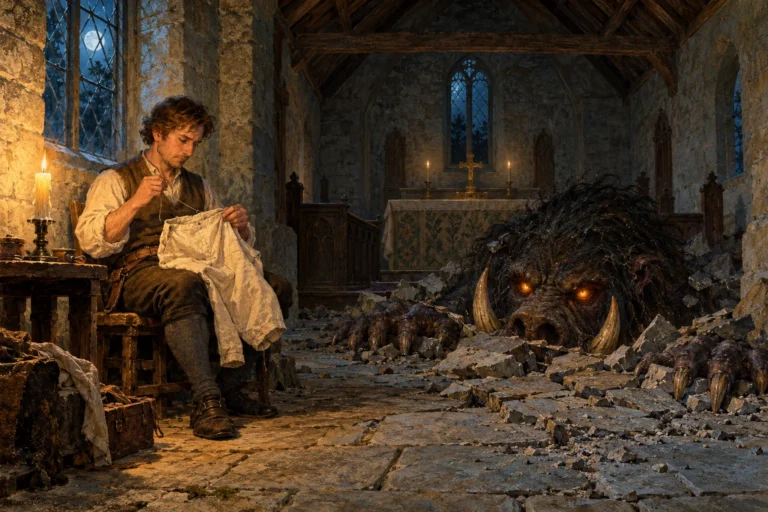
Sophia Morrison’s Manx Fairy Tales gives a closely related sewing challenge in “The Buggane of St. Trinian’s”. There the tailor is Timothy. He sits in a newly roofed church with two candles while a buggane emerges, displaying its frightening body part by part. The building’s roof is already the subject of a dispute between the creature and the monks.
The endings are materially different. Timothy throws burning candle snuff in the buggane’s face, escapes through a window and flees as the roof falls. His refuge is Marown churchyard, not a castle. The buggane throws its own head after him, and the head bursts. The Scottish tale has a door, a castle gate and finger marks. None of the Manx episode’s roof destruction or exploding head has been imported into this retelling.
A shared comic contest
Both stories make a working tailor answer an enormous threat with brisk attention to his task. The steadily appearing body measures the time left to escape. Their similarity supports comparison, but the consulted passages alone do not establish which route of oral or literary transmission connected them. Jacobs’s apparition is unnamed; calling it a buggane would blur that distinction.
Saddell and the supposed marks
The church and castle supply two different kinds of shelter. The church is the dangerous working place; the castle becomes safe only when its gate closes. The flight down the glen joins them into one narrative landscape.
Saddell has surviving abbey ruins and a coastal tower house, but the legend does not identify a historically documented tailor or a particular Macdonald. The claim that five finger impressions remained on the wall is part of the printed story. No surveyed set of marks has been established for this entry.
The tailor’s final long stitches are the joke that returns the supernatural encounter to ordinary life. His employer sees a finished garment, while readers know how close the work came to disaster.
Sources for this entry
- Joseph Jacobs, Celtic Fairy Tales. 1892. VIII, “The Sprightly Tailor”, and Notes and References, VIII. Read source — Saddell narrative and attribution to Cuthbert Bede in Notes and Queries, 21 December 1861. That earlier article was not directly inspected. About this book
- Sophia Morrison, Manx Fairy Tales. London: David Nutt, 1911. “The Buggane of St. Trinian’s”, pp. 153–160. Read source — Close Manx comparison with Timothy the tailor, a fallen roof, churchyard refuge and an exploding head. About this book
Research coverage
Jacobs’s narrative and notes were compared with Morrison’s full St Trinian’s account. The earlier Notes and Queries article and the other Scottish texts listed by Jacobs remain unexamined leads. The relationship between the Scottish and Manx traditions is not presented as proven borrowing.
The Myths · Scottish collection · Editorial approach
Further Reading