Aberdeenshire folklore · story
Molly Whuppie
The youngest of three sisters keeps her head in a giant’s house. A sword, a purse and a ring draw her back across a bridge too slight for her pursuer.
Also found as: Mally Whuppie · Mollie Whuppie · Brig o’ ae hair · Bridge of One Hair
Research reviewed 28 October 2026.
Read the story
This retelling follows “Mally Whuppie”, published in The Folk-Lore Journal in 1884, pp.68–71. We use the familiar spelling Molly in our narration; the printed witness uses Mally. Its disturbing deaths are retained briefly, without graphic detail.
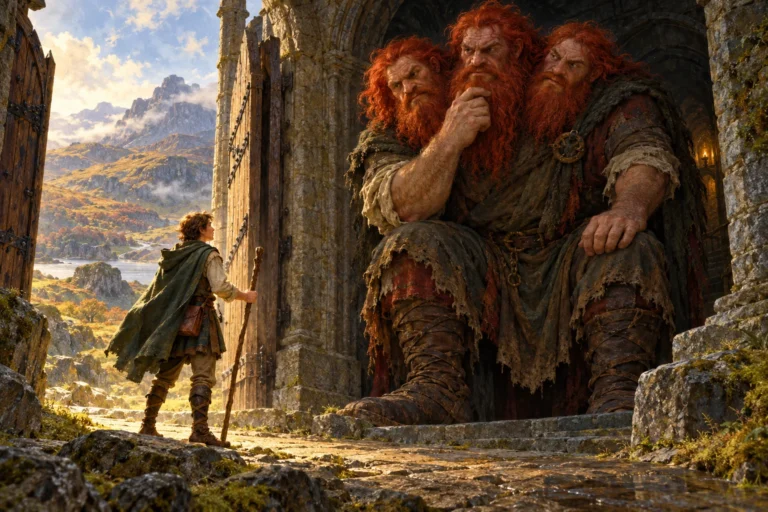
A couple had more children than they could feed. They took the three youngest into a wood and left them there. The girls wandered until darkness came. Then they saw a light and knocked at a house, asking for food and shelter.
The woman at the door warned them that her husband was a giant who would kill them. They pleaded to stay only until they had eaten. She brought them to the fire and gave them bread and milk, but before they could leave the giant returned.
He smelled strangers. His wife begged him to let the hungry girls go unharmed. Instead, he ordered them to stay the night with his own three daughters. Before they slept he put straw ropes round the visitors’ necks and gold chains round his daughters’ necks.
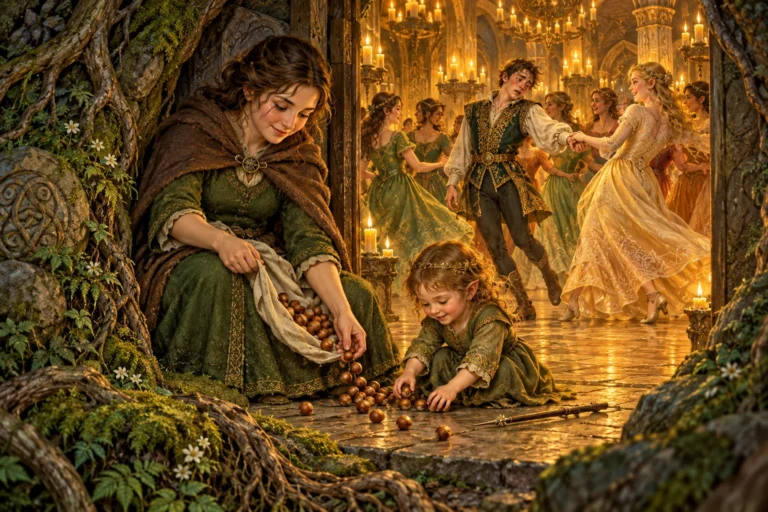
Molly, the youngest visitor, stayed awake. When the house was quiet, she exchanged the ropes and chains. In the dark the giant felt for the straw ropes and killed his own daughters, believing them to be the strangers. Molly woke her sisters and hurried them out of the house.
They ran until morning and came to a king’s home. Molly told him what had happened. He praised her cleverness, then asked for another proof of it. If she could bring him the giant’s sword, which hung behind the bed, her eldest sister could marry his eldest son.
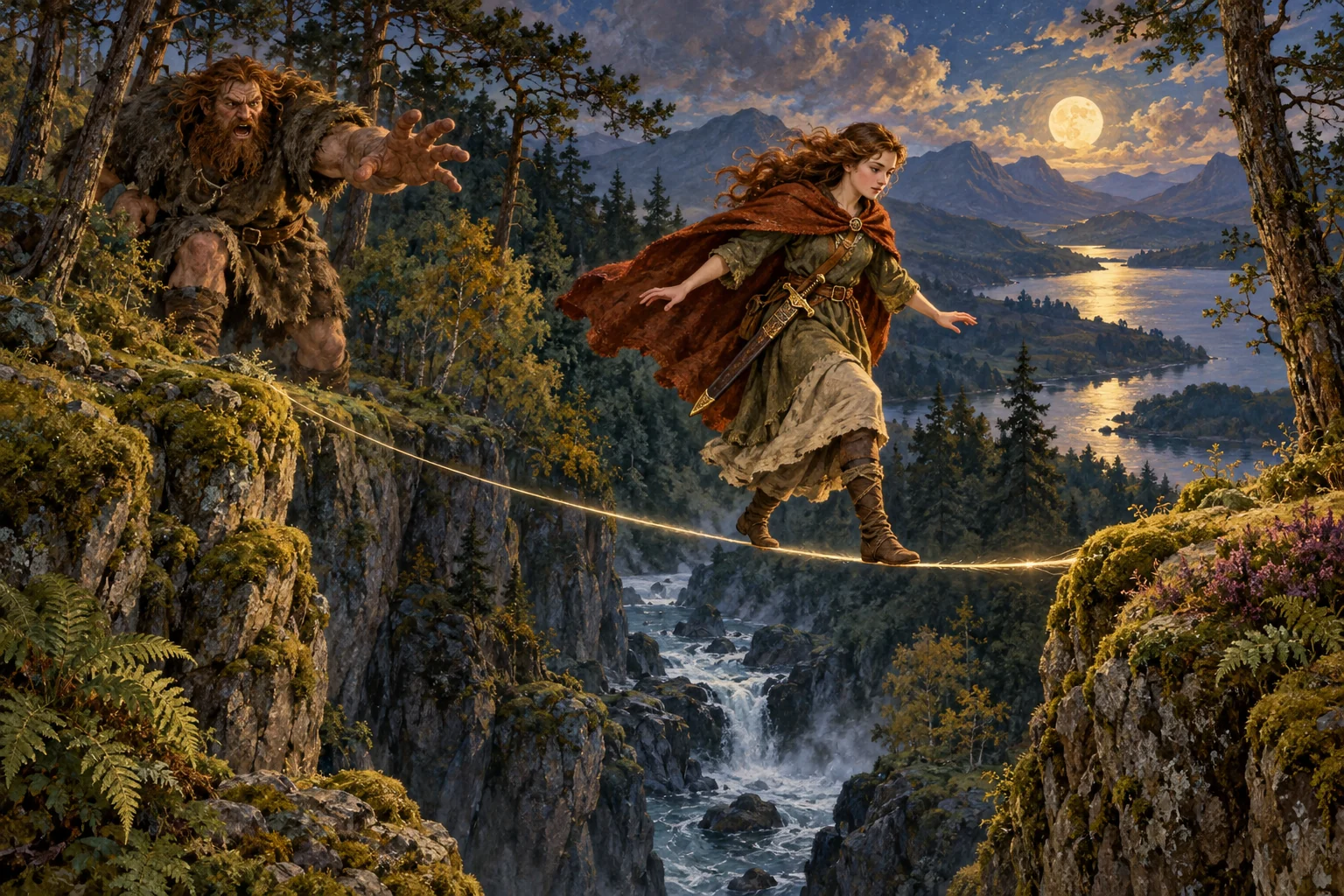
Molly slipped back and hid beneath the giant’s bed. When he was asleep she reached for the sword. It rattled, waking him. She fled with him close behind, until she reached the Bridge of One Hair. She crossed; he could not. He called after her never to return. Molly replied that she would come twice more.
She delivered the sword, and the first marriage took place. Next the king wanted the purse beneath the giant’s pillow, offering his second son to her second sister. Molly returned, took it and escaped once again across the delicate bridge. This time she told the giant she would come back only once.
The final prize was the ring on his finger. If she brought it, the king’s youngest son would marry Molly herself. She hid and waited as before, then worked the ring off the sleeping giant’s hand. He woke and caught her.
He asked what she would do if their positions were reversed. Molly proposed putting him in a sack with a cat, a dog, scissors, needle and thread, hanging the sack up, then fetching a heavy stick from the wood. The giant liked the plan and did exactly that to her.
While he was away, Molly cried out as though she could see something marvellous. The giant’s wife grew curious and begged to look. Molly cut her way out, helped the woman into the sack and sewed it closed. Then she hid behind the door.
The giant returned and struck the sack. His wife called out, but the animals’ noise drowned her voice. Molly did not want her killed. She stepped into view, drawing his attention and his pursuit away from the sack.
They raced to the bridge. For the third time it took Molly safely over and stopped the giant. She promised never to return. The ring went to the king, and Molly married his youngest son. She had no further meeting with the giant.
Versions and variations
Mrs Moir’s text and Walter Gregor’s publication
The 1884 article is headed “Three Folk-Tales from Old Meldrum, Aberdeenshire”. Its introduction says that Mr Moir, rector of Aberdeen Grammar School, communicated the tales from his mother, who wrote out Mally Whuppie and The Red Calf at the contributor’s request. Jacobs’s later note credits the article to Walter Gregor. This documented chain is more precise than saying that Jacobs collected Molly directly from an unnamed Scottish storyteller.
Mally becomes Molly
Jacobs states that he modified the dialect and changed Mally to Molly. The 1884 text uses Scots forms such as the name of the hair bridge; Jacobs generally makes the language more accessible to an English-reading audience. The abandonment, exchanged neck ornaments, three thefts and bridge escapes remain substantially the same. They do not become independent witnesses merely because they are printed in different books.
Does Molly try to save the giant’s wife?
The 1884 ending explicitly says that Mally does not want the wife killed, and comes out of hiding before the giant pursues her. Jacobs retains her appearance and the chase but omits the stated motive. Neither examined passage explicitly says that the wife dies. Our retelling follows the earlier sentence rather than assuming a death or inventing a successful recovery for her.
The curious promise to return to Spain
Both texts retain Spain in Molly’s repeated answer to the giant. The surrounding journey offers no mapped route to Spain. The printed word is therefore recorded as a feature of the tale, not used to relocate its collection history. A proposed correction to a Scottish place-name would require evidence beyond these texts.
Context and evidence
Old Meldrum, now commonly written Oldmeldrum, is the place named by the 1884 article’s heading. It is a record of a storytelling connection, not an identification of the wood, castle or bridge. Those remain unnamed. The kings, princes and giant have no historical identities established by these sources.
Molly’s cleverness is inseparable from the tale’s harsh bargains. Her parents abandon the sisters, the giant murders his own children, and the king repeatedly sends her back into danger. A retelling that keeps only the triumphant thefts loses those tensions. The mercy sentence in the earlier ending also complicates an account of her as simply ruthless.
For another clever escape from a supernatural pursuer, compare The Sprightly Tailor, whose story is associated with Saddell. That is a related motif, not a variant of Molly’s tale. Kate Crackernuts provides another sister-led rescue, while The Red Etin turns a journey to a giant’s castle into a test of generosity and knowledge.
Sources for this entry
- Walter Gregor, contributor; text supplied through Mr Moir from his mother, Three Folk-Tales from Old Meldrum, Aberdeenshire. The Folk-Lore Journal, vol.2 (1884), “Mally Whuppie”, pp.68–71. Linked scan-backed transcription continues through the following three pages. Read source — Introduction and complete Mally narrative; including the explicit wish to save the giant’s wife. About this book or article
- Joseph Jacobs, English Fairy Tales. First published 1890; consulted Project Gutenberg text, tale XXII and note XXII. Read source — Later version, changed name and dialect, and omission of the stated motive in the sack episode. About this book or article
Research coverage
The 1884 narrative on pp.68–71 and Jacobs’s tale and source note were compared. Other children-and-ogre tales mentioned in comparative scholarship have not been fully collated here. No claim is made that this entry captures every Scottish or international form.
The Myths · Scottish collection · Editorial approach
Further Reading