Scottish wonder tale · story
The Red Etin
Two travellers take their mother’s curse and vanish. A third mends a leaking can, shares his bannock and receives the knowledge needed to face a giant.
Also found as: The Red Ettin · The Red-Etin · Red Etin of Ireland
Research reviewed 28 October 2026.
Read the story
This retelling follows Robert Chambers’s 1842 “The Red-Etin”, pp.56–58. It keeps the three travellers and the questions of that text. Jacobs’s later two-brother version is compared below.
Two widows lived on small rented plots. One had two sons and the other had one. When the eldest of the two brothers was ready to seek his fortune, his mother sent him to the well with a can. The water he brought would determine the size of the cake she could bake for his journey.
The can leaked. By the time he came home there was little water left, and the cake was small. His mother offered half with her blessing or the whole with her curse. Thinking of the road ahead, he chose the whole. Before leaving, he gave his brother a knife: while its blade stayed bright he was safe; rust would mean that harm had come to him.
On the third day he met a shepherd, then a keeper of swine, then a keeper of goats. Each said the animals belonged to the Red Etin of Ireland, who held King Malcolm of Scotland’s daughter captive. They repeated that a destined enemy would one day defeat him, but that enemy was not yet born.
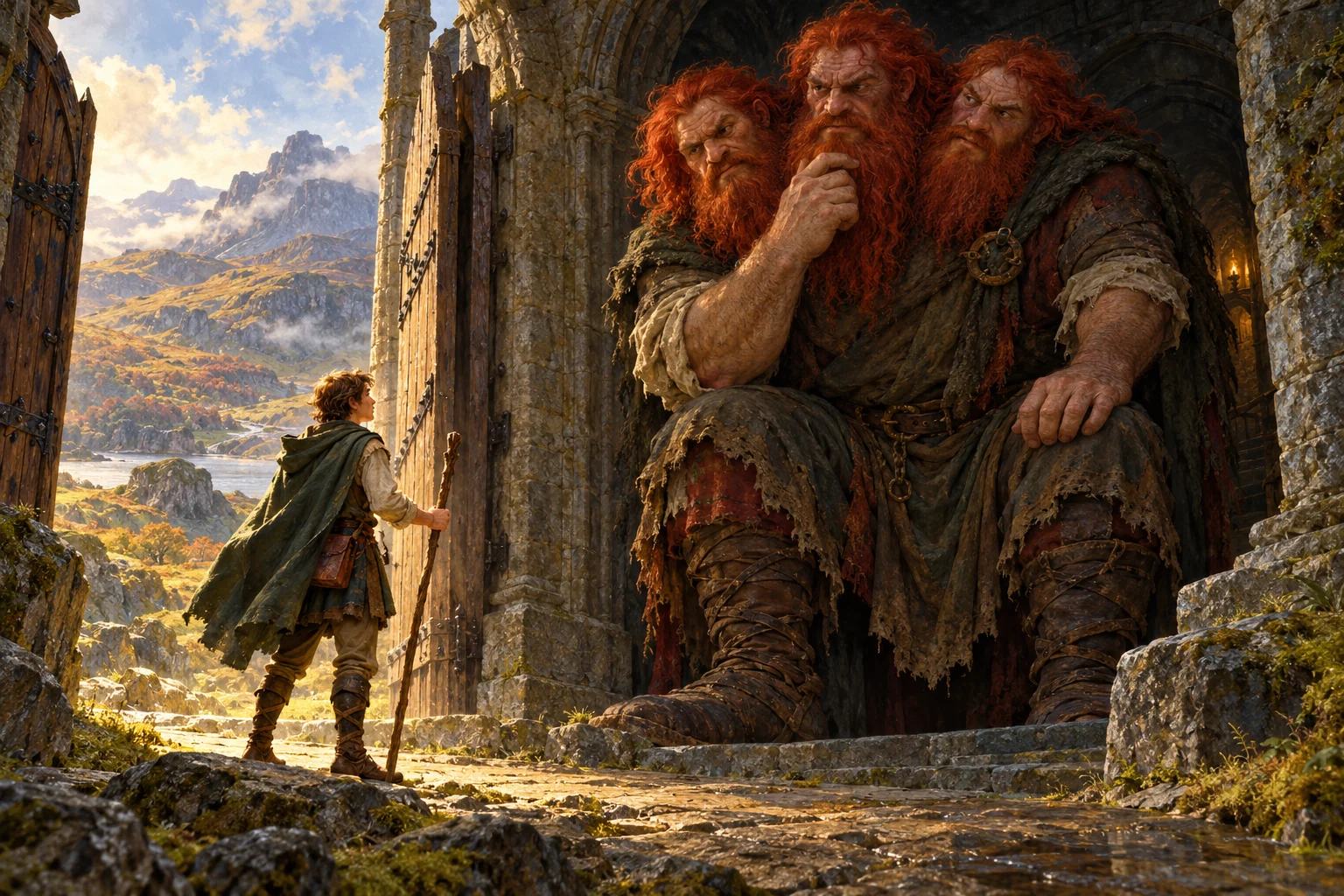
The last herdsman warned of the animals ahead. Soon the traveller met dreadful creatures with two heads and four horns on each head. He fled into a castle, where an old woman sat beside the kitchen fire. She warned him that this was the home of the three-headed Red Etin. Too frightened to go back outside, he asked her to hide him.
The Etin returned and smelled a human visitor. He dragged the youth out and offered his life in return for three answers: had Ireland or Scotland been inhabited first; had man been made for woman or woman for man; and had humans or animals been created first? The traveller could answer none. The giant struck him with a mallet and turned him to stone.
At home, his brother saw the rusty knife and set out after him. He too brought little water in the leaking can, chose the whole cake with the curse, met the herdsmen and failed at the castle. He became a second stone pillar.
A fairy told the other widow and her son what had happened. The young man decided to try to rescue his neighbours. Sent for water, he heard a raven warning that his can was leaking. He stopped, patched the holes with clay and brought home enough for a large cake. He chose half with his mother’s blessing.
On the road an old woman asked him for some of his bannock. He willingly shared it. She gave him a magical wand and told him what lay ahead and how to meet it. Then she vanished, for she was a fairy.
The herdsmen now gave their warnings a different ending: the Etin’s destroyer had arrived. The young man walked among the monstrous beasts; when one attacked, a blow from the wand killed it. At the castle he listened to the old woman’s warning but stood his ground.
The Etin came in and demanded the same three answers. The fairy had taught the traveller what to say. Chambers does not print his answers, only their success. The giant’s power was broken. The young man took an axe and cut off its three heads.
Behind the castle’s closed doors were imprisoned women, including the king’s daughter. In a lower room stood the two stone pillars. A touch of the wand restored the missing brothers. Together the freed company travelled to the king’s court. The rescuer married the princess, and the other two young men married noblemen’s daughters.
Versions and variations
Three travellers become two brothers
Chambers’s 1842 text begins with two widows and three sons in total. Both brothers fail; their neighbour succeeds. In Jacobs’s tale XXIII there is one widow and two sons, so the younger brother becomes the rescuer. The stone prisoners and the marriages change accordingly. Jacobs acknowledges reducing the number in his source note.
The riddles are deliberately replaced
Chambers prints three questions about the settlement of Ireland and Scotland and the order and purpose of creation. He does not supply the successful answers. Jacobs substitutes riddles he says he drew from Wynkyn de Worde’s Demaundes Joyous. His answers are a bowl for something without an end, a bridge for something more dangerous when smaller, and a wooden ship carrying people for the dead carrying the living. These familiar answers belong to that editorial version, not to the questions printed by Chambers.
A shorter journey and a stable central bargain
Chambers repeats the warning through keepers of sheep, swine and goats. Jacobs reduces the herdsmen’s sequence. Both versions retain the leaking can, the maternal blessing, the shared food, the helpful fairy, the three-headed giant and the restoration from stone. The shorter text reshapes an existing printed telling; it is not evidence of a separately collected two-brother tradition.
Context and evidence
Chambers says that his narrative came from Mr Buchan’s manuscript collection. His accompanying note also points to references to the Red Etin in The Complaynt of Scotland and David Lyndsay’s Dreme. Those are evidence that a story under this name was known earlier; they do not preserve every scene of the 1842 text or prove that it remained unchanged.
The verse calls the monster the Red Etin of Ireland and names King Malcolm of Scotland. Neither the king’s identity nor the place called Bellygan is established by this entry. It would be misleading to turn those names into a dated royal biography or a confidently mapped castle. Scotland is the collection context; Ireland is part of the story’s own geography.
The rescue begins with practical attention and generosity: notice a leak, mend it, share food, listen to advice. That pattern connects the ordinary journey to the extraordinary trial. Compare the more self-reliant trickery of Molly Whuppie and the sea-monster rescue in Assipattle and the Stoorworm. The three stories share dangers and rewards without being interchangeable versions of one tale.
Sources for this entry
- Robert Chambers, Popular Rhymes, Fireside Stories, & Amusements of Scotland. Edinburgh: William and Robert Chambers, 1842. “The Red-Etin”, pp.56–58 and accompanying note; consulted complete online transcription. Read source — Three-traveller narrative, original questions and Buchan attribution. About this book or article
- Joseph Jacobs, English Fairy Tales. First published 1890; consulted Project Gutenberg text, tale XXIII and note XXIII. Read source — Two-brother revision and explicit explanation of the substituted riddles. About this book or article
Research coverage
Chambers’s 1842 story and note and Jacobs’s narrative and note were directly compared. Buchan’s underlying manuscript, the full early-modern works mentioned by Chambers and every later retelling have not been collated. Early references are reported as Chambers’s evidence, not represented as newly examined manuscripts.
The Myths · Scottish collection · Editorial approach
Further Reading