Local folklore · story
The Buggane of St Trinian’s
A tailor tries to finish a pair of breeches while a monster rises through a church floor. The roof, the wager and his escape change between tellings.
Also found as: St Trinian’s buggane · Timothy the tailor
Research reviewed 17 October 2026.
Read the story
This retelling follows Sophia Morrison’s 1911 account. Other reasons for the buggane’s anger and other escape routes are compared below.
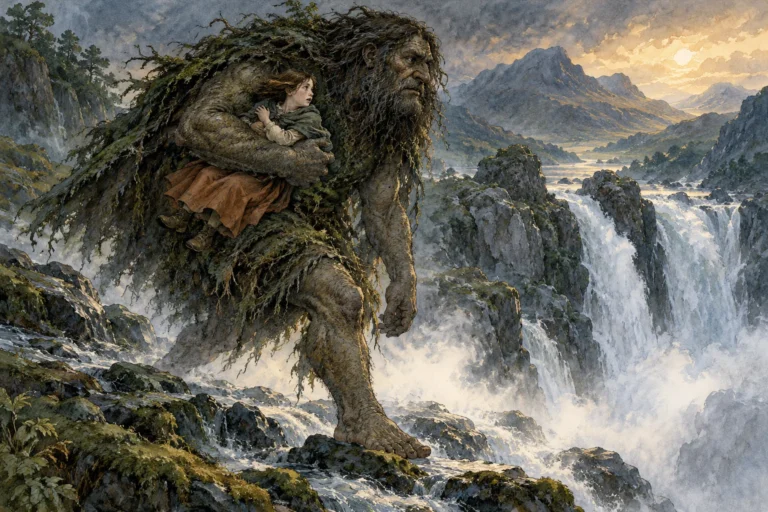
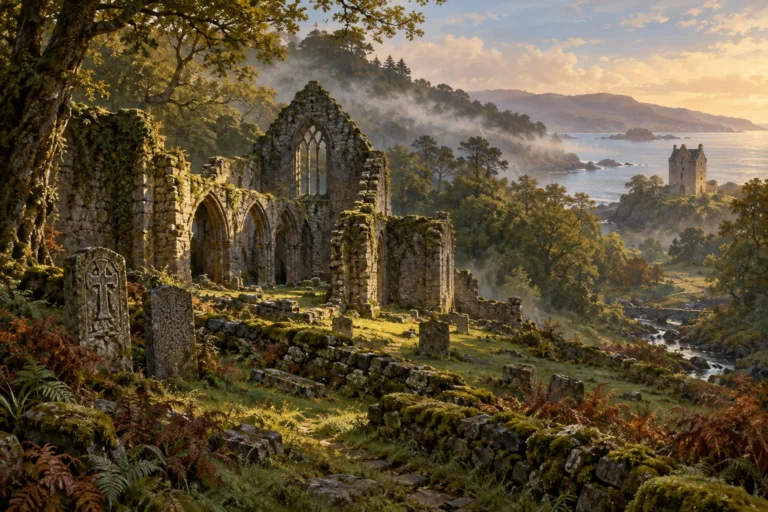
Between Greeba Mountain and the road stood a church that would not keep its roof. The monks had scarcely finished their work before a buggane tore the roof away. In Morrison’s telling, the creature feared the noise of the bells. A second attempt ended like the first, leaving the builders reluctant to try again.
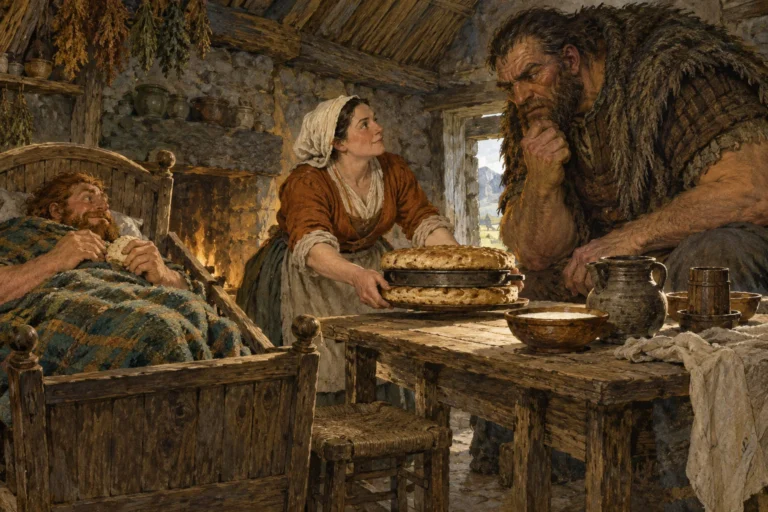
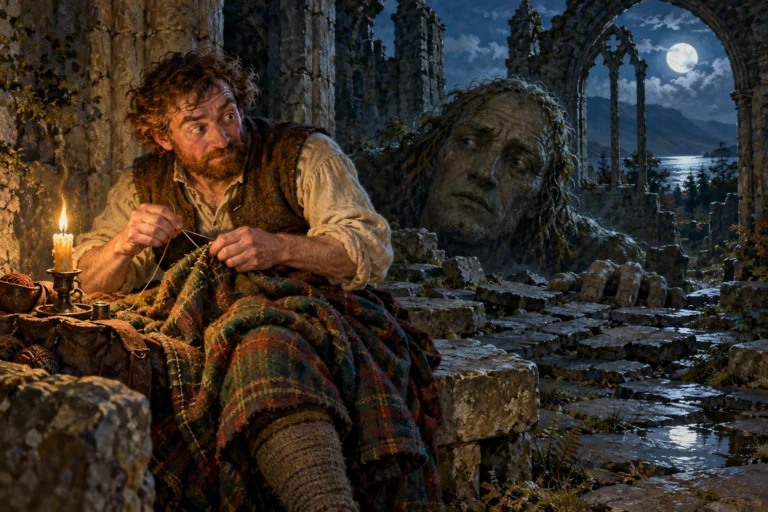
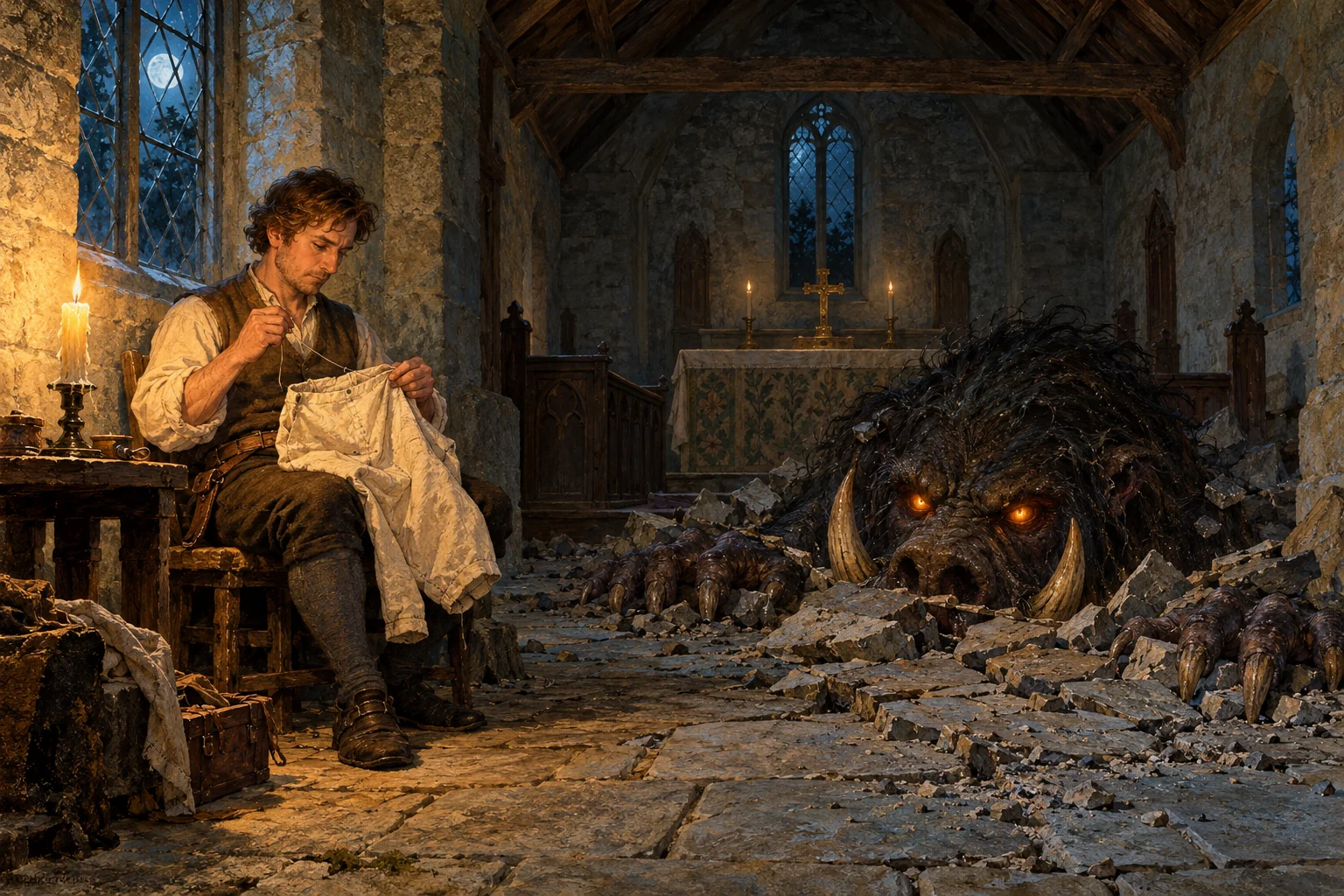
Timothy the tailor was willing to test his courage. He wagered that he could spend the night in the church and make a pair of breeches there. Once another roof was finished, he went inside with his cloth, needle and candles, shut the door and began to sew.
The ground shook. A great head forced its way through the floor, covered with black hair and bearing burning eyes and formidable teeth. The buggane asked whether Timothy could see its head. Timothy answered without giving up his work. More of the creature emerged: arms, body, claws and cloven feet. Each new demand for attention was met by another reply and more hurried stitching.
Timothy even threw the snuff from his candle towards the creature’s face. He had to finish before its display became an attack. With the last stitches taken together, he completed the breeches and escaped through a window as the roof came crashing down.
The buggane pursued him along the road towards Douglas. Timothy reached Marown churchyard and jumped over its wall. The monster could not enter consecrated ground. In fury it tore off its own head and flung it after him. The head burst, but Timothy was safe.
He had won his wager. The creature disappeared from the story, while the ruined church remained roofless. Its visible condition became the reminder through which the adventure could be told again.
Versions and variations
Morrison: bells, wager and Marown
Morrison supplies the bells as motive, a poor tailor’s wager and a specifically named churchyard refuge. These are the details used in the main retelling. The apparent order of building attempts and Timothy’s challenge should be read in this version’s own sequence.
Moore transmitting Train
Moore’s 1891 chapter credits Train for its St Trinian’s account. A vow during a storm at sea supplies a different building origin. Timothy’s claim to sanctity and his sewing remain, but the final refuge is consecrated ground without Morrison’s precise Marown identification. Moore’s inclusion is a transmission of an earlier account, not a fresh oral witness merely by appearing in another book.
Hall Caine: the river and the living headless giant
Hall Caine’s 1909 version begins with quarrying that violates the buggane’s mountain retreat. A guardian angel’s instruction explains Timothy’s attempt. He escapes by the door and jumps a river; the thrown head bursts against a wall on the far bank. The headless buggane survives with new features on its chest. Those details should not be added to Morrison’s churchyard ending as though they all happened together.
Context and evidence
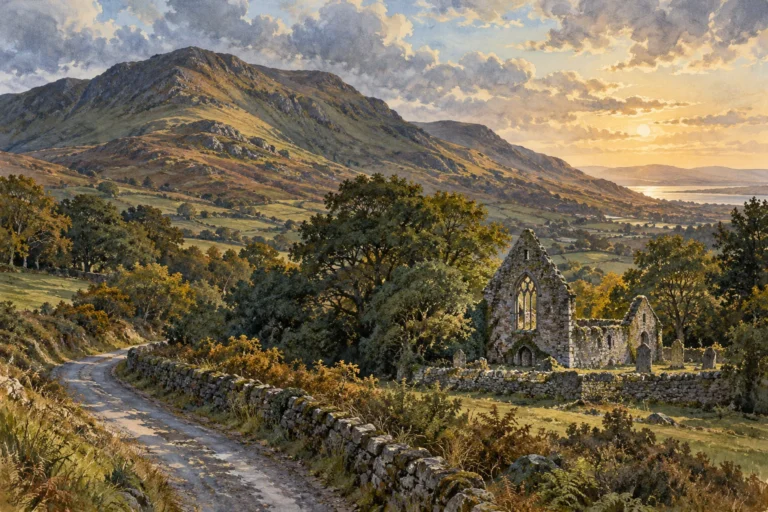
The church is a real ruin, but a roofless building cannot prove why its roof was lost. The associated place page separates architectural observations from storytelling. The versions also make different things protect Timothy: consecrated ground or water. Neither should be announced as a rule obeyed by every Manx supernatural being.
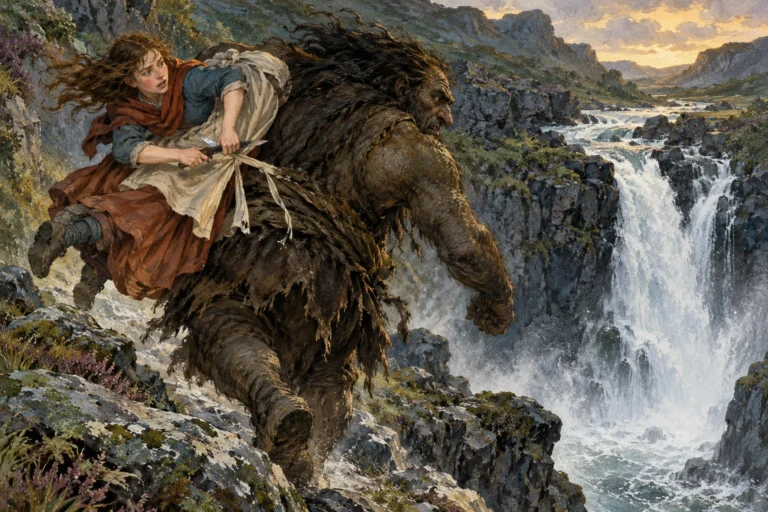
Timothy’s skill is as important as bravery. Work continues while the monster tries to turn his attention to its body. Compare Kirry’s escape at Glen Meay, where an ordinary knife and an apron provide another small, practical answer to a much larger creature.
Sources for this entry
- Sophia Morrison, Manx Fairy Tales. London: David Nutt, 1911. “The Buggane of St. Trinian’s”, pp.153–160. Read source — Main narrative: bells, Timothy’s wager and escape into Marown churchyard. About this book
- A. W. Moore, The Folk-Lore of the Isle of Man. Douglas: Brown & Son; London: D. Nutt, 1891. Chapter IV, “Mythical Beings”, St Trinian’s passage credited to Train; also the Glashtin account credited to Campbell. Read source — Named earlier material transmitted by Moore; not counted as a new oral witness merely because it appears in his book. About this book
- W. Ralph Hall Caine, The Isle of Man. London: Adam and Charles Black, 1909. Chapter XXIII, “The Legend of the Buggane”. Read source — A literary version with a disturbed mountain dwelling, a river escape and a surviving headless buggane. About this book
Research coverage
The complete St Trinian’s narratives in Morrison, Moore’s Train-attributed passage and Hall Caine were compared. Train’s original volume and additional Manx oral recordings have not been independently collated. The three printed presentations are not counted as three independent oral witnesses.
The Myths · Manx collection · Editorial approach
Further Reading