Local folklore · story
The Buggane of Glen Meay Waterfall
Carried towards a waterfall by a buggane, Kirry finds a way to cut herself free. Her kitchen knife changes the outcome of the pursuit.
Also found as: Glen Meay buggane · Kirry and the buggane
Research reviewed 17 October 2026.
Read the story
This retelling follows Morrison’s Manx Fairy Tales (1911). The judgements made about Kirry’s household work belong to that telling.
Kirry and her husband lived near Glen Meay. They had a small holding, a cow, a few sheep and fishing to help feed them. In the story, Kirry resists the work expected of her, and her husband devises a trick. He blocks the windows with straw, leaving her to sleep through the day. When she finally sees light in the west, he pretends that the sun has risen on the wrong side.
He warns her about the buggane beneath the great waterfall, the Spooyt Vooar. Then he goes fishing. Kirry is left with the baking, which she has delayed until after sunset. This is an improper time for it within the tale’s fairy beliefs. She also wants to avoid the neighbours discovering how late she has begun.
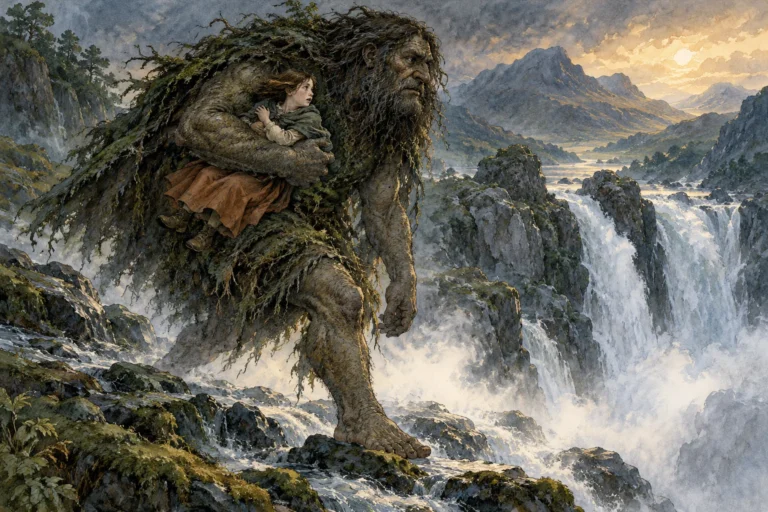
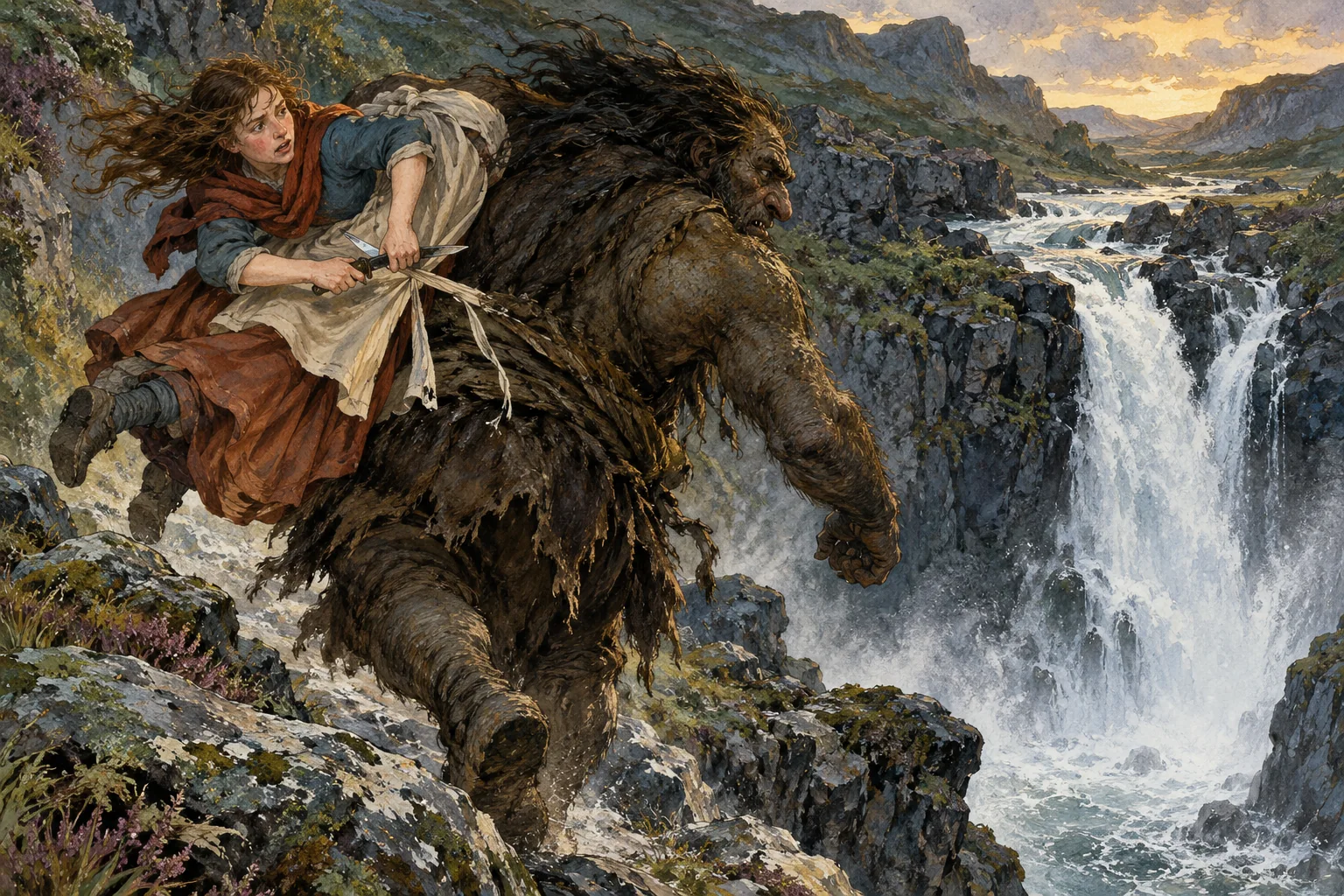
She bolts the door and sets to work on barley bread and a flour cake. A knife is at hand as she shapes the cake. Then the door bursts open. The buggane enters, seizes her by her apron and swings her over its shoulder. It sets off at speed towards the waterfall.
Kirry can hear where they are going. The creature is strong and the drop is close, but she still has the knife. She cuts through the apron string. Freed from the garment holding her, she falls away from the buggane.
The creature cannot stop its own rush. It goes over the waterfall into the pool below, still holding part of the apron. Its roars rise from the water. Kirry’s escape has depended on noticing what she still possesses and cutting the thing by which she is held. The buggane is left with cloth instead of its captive.
Versions and variations
One established narrative for this entry
The complete Glen Meay story examined here is Morrison’s. It names Kirry but not her husband. A second full, independently collected Glen Meay version has not been established; the following comparisons are not offered as substitutes for that missing evidence.
The Glashtin dress-cutting parallel
Moore’s chapter on mythical beings, quoting Campbell, gives an account in which a girl cuts away the part of her dress held by a sleeping Glashtan. It is a related escape device. The creature, circumstances and locality are not the same, and it would be misleading to call it a Glen Meay buggane variant.
A different buggane escape
Timothy at St Trinian’s escapes to protected ground in Morrison, or across water in Hall Caine. Kirry instead separates herself from the garment in the monster’s grip. Those differences help keep a broad creature label from flattening individual stories.
Context and evidence
Morrison’s narrator treats Kirry’s behaviour as a household fault. This is part of the story’s moral and comic framing, not an objective diagnosis or a justification for violence against a woman. The escape also gives her practical agency at the moment of greatest danger.
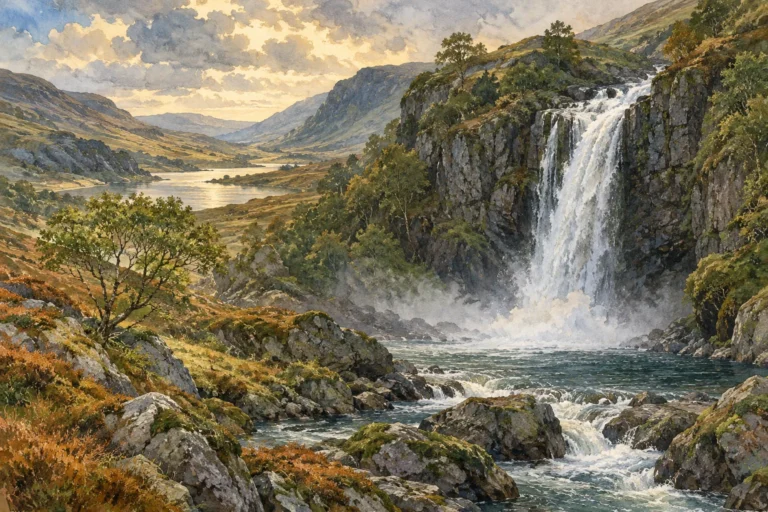
The waterfall supplies a sound, destination and irreversible drop. It does not supply historical evidence of an abduction. The associated Glen Maye guide records the source’s spelling and landscape without turning a supernatural episode into a documented accident.
Sources for this entry
- Sophia Morrison, Manx Fairy Tales. London: David Nutt, 1911. “The Buggane of Glen Meay Waterfall”, pp.8–13. Read source — Main narrative: Kirry, the apron and the waterfall. About this book
- A. W. Moore, The Folk-Lore of the Isle of Man. Douglas: Brown & Son; London: D. Nutt, 1891. Chapter IV, opening Glashtin/Glashan passage credited to Campbell. Read source — Related dress-cutting escape motif, explicitly not a second Glen Meay telling. About this book
Research coverage
Morrison’s complete Glen Meay narrative and Moore’s relevant Campbell-attributed Glashtan passage were examined. No second independent local version is claimed. Wider Manx-language and oral-archive comparison remains open.
The Myths · Manx collection · Editorial approach
Further Reading