Otherworld journeys · story
The Voyage of Máel Dúin
A voyage to avenge a murdered father becomes a long encounter with dangerous islands, inexhaustible food, an island queen and a hermit’s demand for mercy.
Also found as: Immram curaig Máele Dúin · Immram curaig Máile Dúin · The Voyage of Mael Duin’s Boat · The Voyage of Maildun · Maeldun
Research reviewed 17 October 2026.
Read the story
This retelling follows Whitley Stokes’s English translation, selecting episodes from its much longer island sequence. The selection keeps the journey’s beginning, the loss of the three foster-brothers and its resolution; it does not reproduce every landfall.
Máel Dúin grew up in a queen’s household, believing himself her son. He excelled at games, running and feats of strength, until a jealous rival mocked him because no one knew his parentage. Máel Dúin demanded an answer. The queen insisted that no mother could love a child more deeply, but finally took him to the woman who had borne him.
His father was Ailill of the Edge of Battle. In Stokes’s opening, Ailill had raped a young nun; he had later been killed by raiders who burned a church over him. Máel Dúin’s mother had entrusted her child to the queen. Now he went to his father’s people, accompanied by his three foster-brothers, and was welcomed.
Another taunt changed his life. While he was throwing a stone near the burned church, a man challenged him to avenge the father whose bones lay there. Máel Dúin put aside the game and sought the killers. He was told that he must travel by sea.
A druid in Corcomroe prescribed the day to build a boat, the day to sail and the exact company to take. Máel Dúin followed these instructions. But as the vessel pulled away, his foster-brothers ran to the shore and demanded passage. When he refused, they swam after him. Rather than watch them drown, he hauled them aboard.
That night, near two islands, the travellers heard drunken boasting from a fort. One warrior claimed to have killed Ailill. Revenge seemed within reach. Before they could act, a violent wind carried their boat out into the ocean. Máel Dúin blamed the extra passengers for breaking the druid’s condition, then let the boat go where God would direct it.
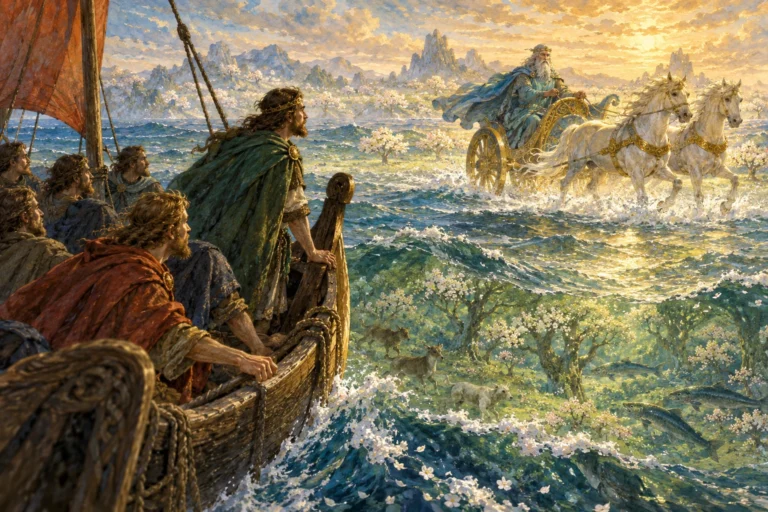
The islands they encountered offered no dependable rule of safety. On one shore, ants as large as foals rushed down to devour them. Elsewhere birds provided food. A branch held as they passed a wooded island finally brought three apples into Máel Dúin’s hand, each capable of sustaining the company for forty nights.
At a white-walled stronghold they found a feast and rows of precious ornaments, guarded only by a small cat playing between stone pillars. They ate and rested. As they departed, one foster-brother took a necklace, although Máel Dúin warned him against it. The cat shot through him like fire, reducing him to ashes. Máel Dúin returned the ornament, soothed the guardian and led the survivors away.
Another island was divided between black and white sheep. Animals thrown over its boundary changed colour at once. Máel Dúin tested the ground with branches; they changed too. He decided that his people should stay aboard. Later, on a shore filled with mourners, another foster-brother joined their crying and could not be distinguished from them. Men sent to retrieve him also began to weep. A second rescue party, protected from the island’s air, recovered those companions, but the brother was lost.
The travellers crossed clear water and a sea that seemed as thin as mist. They passed a vast silver pillar, with a net spreading from its summit. Diurán cut away a fragment, promising to offer it at Armagh if they reached home. Máel Dúin had objected to damaging something so marvellous, but Diurán wanted a token that others might believe.
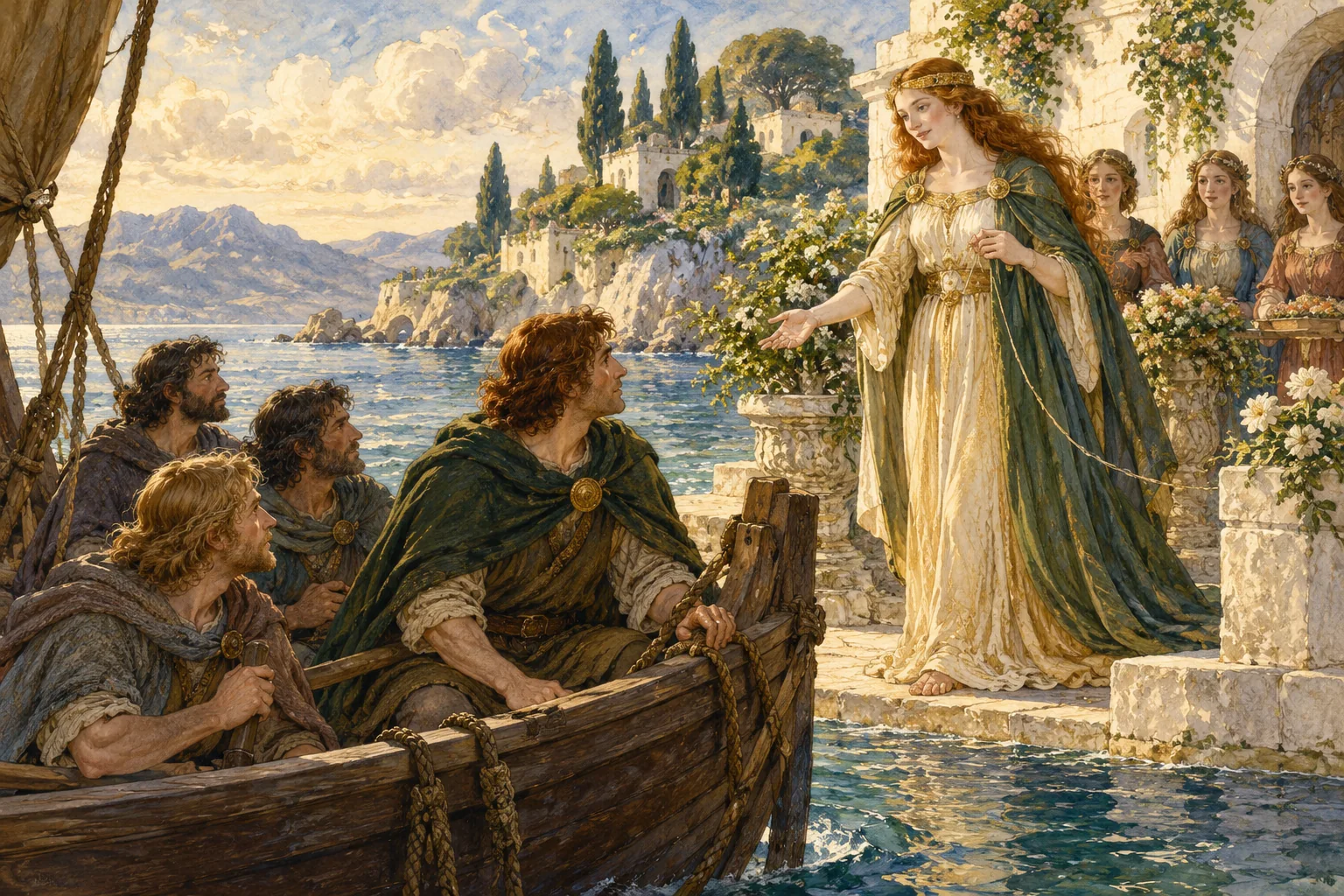
At last they found an island whose queen offered lasting youth and freedom from labour. She ruled after her husband’s death and went out each day to judge her people’s disputes. Máel Dúin stayed with her; his companions paired with her daughters. The men eventually longed for Ireland, but he did not want to leave such abundance.
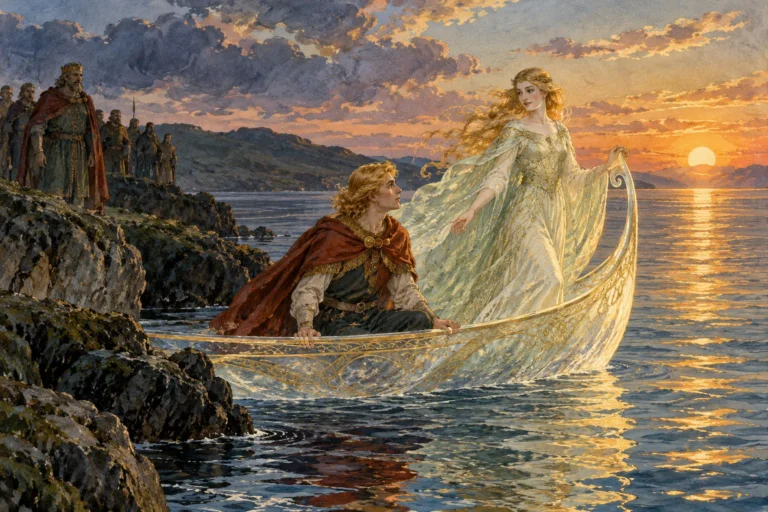
When they finally attempted departure, the queen cast a ball of thread after the boat. It stuck to Máel Dúin’s hand, allowing her to draw them back. More months passed. The crew suspected that he was deliberately catching it. On their last attempt another man caught the ball, and it held him just as firmly. Diurán cut off that man’s hand. The boat escaped while the queen and her household cried after it.
On a later island they watched two great birds tend an older bird, removing its worn feathers before it bathed and recovered its strength. Diurán bathed in the same water, despite his companions’ fears. The tale says his eyes, teeth and hair remained sound afterwards. But marvels still carried danger: on an island of continual laughter, the last foster-brother joined the inhabitants and never returned to the boat.
Finally they encountered a solitary man on a rock. He had once stolen from a religious community on Tory, and told how he had surrendered his stolen wealth and lived in repentance. He said they would reach home and find Ailill’s killer. Máel Dúin must forgive him: God had preserved them through dangers although they too were imperfect people.
Following a bird that resembled those of Ireland, they returned to the island where the boasting had begun. Inside the fort, men wondered what they would do if Máel Dúin appeared. Their chief said they should welcome a man who had suffered so much. Máel Dúin knocked. He entered peacefully, accepted hospitality and told his adventures. Afterwards he returned to his own country, while Diurán carried the silver to Armagh. The voyage that began in revenge ended in a welcome.
Versions and variations
Stokes’s translation and Joyce’s “Voyage of Maildun” belong to different editorial projects. Joyce describes working from Irish texts and being helped by O’Beirne Crowe’s manuscript translation. His retelling first appeared before Stokes’s published edition; it should not be called an adaptation of Stokes.
The opening is materially different. Stokes describes Ailill’s assault on a nun before Máel Dúin’s birth; Joyce begins with Ailill’s death and leaves the circumstances of conception unstated. Stokes gives seventeen as the prescribed crew, immediately recording sixty as an alternative. Joyce consistently chooses sixty in his departure scene. These are useful textual differences, although the manuscript origin of each reading has not been independently established here.
Details also shift within the island sequence. Stokes’s branch carries three sustaining apples; Joyce’s carries seven. Both retain the queen’s thread and the severed hand that finally releases the boat. Joyce’s note LXXIV explicitly says that his great miller combines the accounts in Máel Dúin and the Voyage of the Sons of O’Corra. That passage is therefore an acknowledged literary combination, not a separately collected oral variant.
A later oral comparison is unusually well documented. Sheila Douglas recorded John Stewart’s “Jack and the Seven Enchanted Islands” in Perth in 1979. His hero cuts the thread instead of a man’s hand. Douglas also reports finding James Reeves’s adaptation in Stewart’s household and discusses its possible influence. This is evidence for interaction between books and spoken storytelling, not proof of an unbroken thousand-year oral chain. Read Douglas’s account, especially pp. 89, 93–94 and 102.
The retelling above selects from Stokes’s thirty-four numbered episodes. Its omissions are editorial selection for this page. They must not be mistaken for a newly discovered shorter recension, and the different islands should not be rearranged into a supposedly authentic itinerary.
Context and evidence
The voyage joins heroic revenge to Christian repentance. The druid sets its conditions, but prayer, monastic hospitality, scriptural language and the hermit’s appeal to forgiveness repeatedly shape its movement. Those elements coexist in the transmitted narrative. Calling all the marvels pre-Christian and all the moral material later additions would require an argument beyond the comparisons made here. Stokes, Prologue and episodes I–XXXIV.
Diurán’s silver offering provides the tale with a material token and an Irish religious destination. It is not, by itself, independent evidence that a surviving object records this voyage. Joyce’s preface speculates about an actual journey behind the tale; that nineteenth-century suggestion is not treated here as established history. The story remains an account of extraordinary travel, with its source and limits stated.
Sources for this entry
- Anonymous; edited and translated by Whitley Stokes, The Voyage of Mael Duin. Revue Celtique 9 (1888), pp. 447–495; 10 (1889), pp. 50–95 and 265; public-domain English transcription reproduced at Druidism.ru. English section, The Voyage of Mael Duin’s Boat: Prologue and episodes I–XXXIV. Read source — Principal narrative. Entire English transcription read. It contains transcription blemishes and some missing numerals; numbered episodes, not the unrelated Russian translation above it, are used..
- P. W. Joyce, Old Celtic Romances. London: Longmans, Green, and Co., 1920; first published 1879; Project Gutenberg 38041. Preface, The Voyage of Maildun; chapters I–VIII and XXVI–XXXIV; note LXXIV. Read source — Compared opening, crew count, sustaining apples, queen’s thread, eagle and final forgiveness; editorial source note on the miller. Not a complete manuscript collation.. About this book
- Sheila Douglas; storyteller John Stewart, A Scots Folk Version of ‘The Voyage of Mael Duin’. Scottish Studies 24 (1980), pp. 89–105. Recording history p. 89; thread episode pp. 93–94; discussion of printed influence p. 102. Read source — Recorded modern oral comparison. Only the identified recording history, thread episode and transmission discussion are summarised; no assertion of uninterrupted medieval oral survival..
Research coverage
Entire Stokes English transcription read; selected Joyce passages and notes compared directly. Douglas’s recorded oral account is used only for the specified thread episode and transmission history. The Stokes transcription has typographical defects. Manuscript recensions and H. P. A. Oskamp’s 1970 edition have not been collated; most island episodes are condensed or omitted in this retelling.
The Myths · Irish collection · Editorial approach
Further Reading