Mythological Cycle · story
The Children of Lir
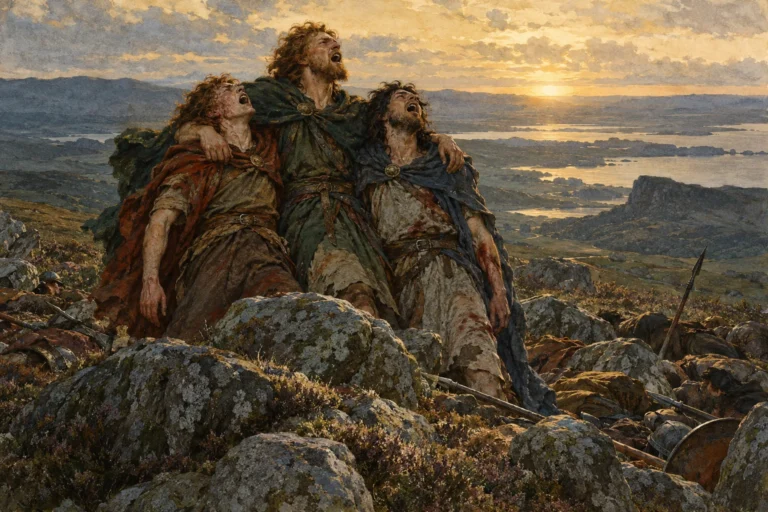
Four children keep their human voices after their stepmother turns them into swans. Their nine centuries of exile carry them from a lakeside gathering to the winter sea and, finally, into a changed Ireland.
Also found as: The Fate of the Children of Lir · The Four White Swans · Oidheadh Chlainne Lir · Oidhe Chloinne Lir · Children of Lear
Research reviewed 17 October 2026.
Read the story
Version followed: this original retelling follows Lady Gregory’s “The Fate of the Children of Lir”, in Part One, Book Five of Gods and Fighting Men (1905). It keeps her ending; other accounts are compared below.
Lir’s happiness had already been broken by bereavement when jealousy entered his household. His wife Aobh died after bearing their younger sons, leaving Fionnuala, Aodh, Fiachra and Conn. He married her sister Aoife, and at first she loved the children too. But the affection their father and his visitors gave them became more than she could bear.
Aoife took the four children away in her chariot, supposedly to visit Bodb Dearg. On the journey she ordered her attendants to kill them. They refused. Unable to carry out the killing herself, she found another way. At Lough Derravaragh she sent them into the water to bathe, then struck them with a magical rod. Four white swans floated where the children had been.
Fionnuala demanded a limit to the enchantment. Aoife named three hundred years on the lake, three hundred on the Sea of Moyle between Ireland and Scotland, and three hundred in the western waters of Erris and Inishglora. Their release would come with the union of a woman from the south and a man from the north. Relenting a little, Aoife left them their speech, their understanding and a singing voice unlike any other.
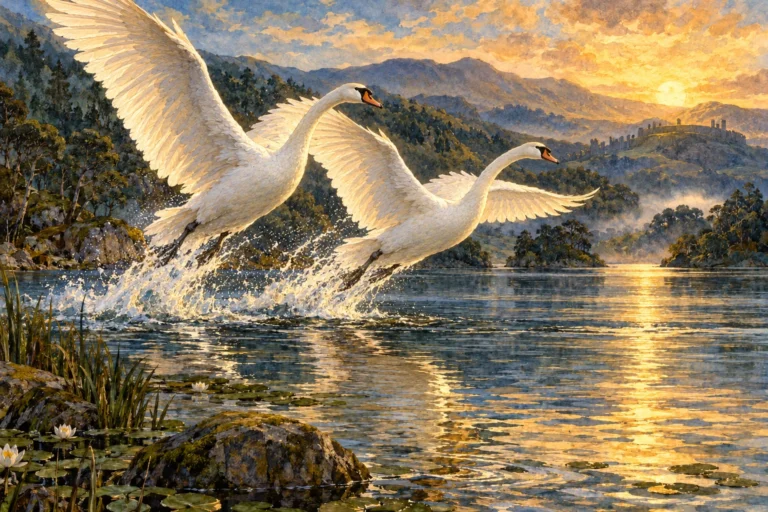
When Lir found them, they could explain their fate but could not return home. Bodb punished Aoife by changing her into a dreadful being of the air. Even he could not undo her spell. For the first three centuries, friends gathered beside the lake to hear the swans sing, and the children still belonged to a community that knew them.
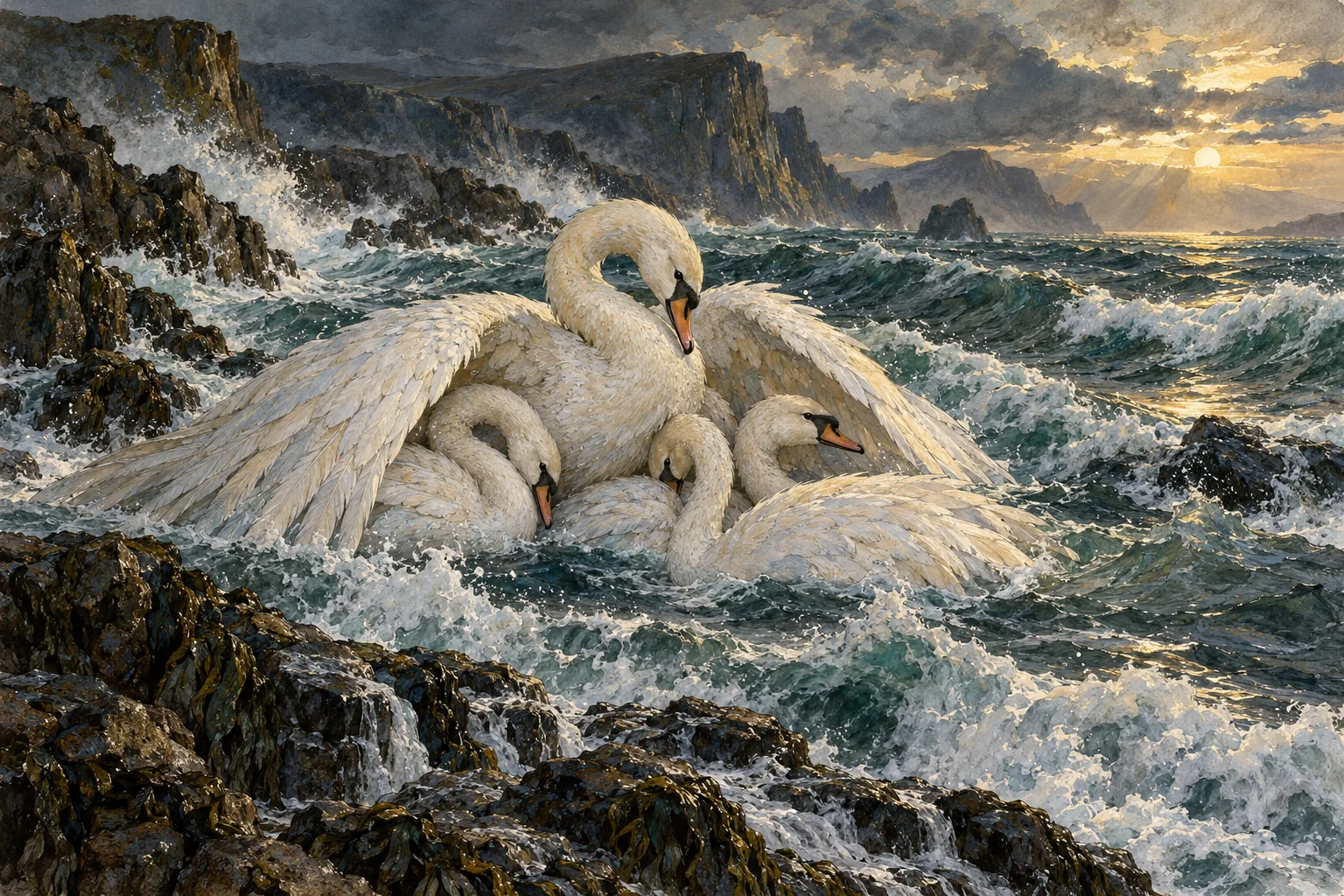
Then they had to leave. On the Sea of Moyle, storms scattered the brothers and sister. Fionnuala sheltered them beneath her wings when they found one another again. In the worst winter their feathers and feet froze to the rocks; pulling free injured them, and the salt water entered their wounds. Their western exile brought more cold and loneliness.
At last the nine hundred years were over. They flew home, but found nettles and empty mounds where their father’s household had stood. Back on Inishglora, they heard the bell of Mochaomhóg. He welcomed them and cared for them, joining the birds in pairs with silver chains.
Deoch, a southern princess married to the northern king Lairgnen, wanted the wonderful swans for herself. When Lairgnen seized them, their feathers fell away. Three frail old men and an old woman stood before the cleric. Fionnuala asked for baptism and for a grave that would hold her brothers beside her as she had sheltered them at sea. They died together, and were buried as she wished.
Versions and variations
Gregory and O’Curry: a traceable line of transmission
Gregory names Eugene O’Curry’s Atlantis edition as her authority for this story. O’Curry’s translation, as revised in R. J. O’Duffy’s 1883 edition, preserves the three periods of exile, the marriage prophecy, Mochaomhóg’s care and the aged children’s baptism and burial. These shared incidents belong to a related textual tradition; their appearance in two books is not evidence for two separate oral recordings. Gregory, Authorities; O’Curry/O’Duffy, §§18–20 and 57–70.
Joyce: a different final image
P. W. Joyce uses the names Finola, Aed, Ficra, Eva and Kemoc. His closing chapter adds a vision: after the children’s deaths, Kemoc sees four radiant children with wings rising away. Gregory ends with baptism, burial and the statement that their souls reached heaven, without that visible apparition. Joyce also has Largnen seize the silver chains, whereas Gregory describes him grasping the birds. Joyce, chapters VI–VII, pp. 30–36.
The differences do not make Joyce’s book an independent ancient witness. His preface acknowledges O’Curry’s printed text and manuscript comparison, including Peter O’Connell’s copy. Names modernised for English readers should likewise be indexed as aliases rather than treated automatically as different characters. Joyce, preface, pp. vii–x.
Context and evidence
The story’s ancient setting is not a date for its composition. Joyce described eighteenth-century manuscript copies available to him; that is a statement about his sources, not proof that the story began then or that no older witness exists. The version examined here also explicitly includes Christian worship and baptism. Calling it an unchanged pagan account would conceal part of the text. Joyce’s manuscript note; O’Curry/O’Duffy, §§58–70.
Lough Derravaragh, the Sea of Moyle and the western islands give the narrative a recognisable geography. They establish where this telling places its suffering and return. They do not establish that four historical children underwent its supernatural events.
Sources for this entry
- Lady Gregory, Gods and Fighting Men. 1905 edition; first published 1904. Part One, Book Five, “The Fate of the Children of Lir”; Notes III, “The Authorities”, entry for this tale. Read source — Main retelling and Gregory’s explicit acknowledgement of O’Curry.. About this book
- Anonymous; translated by Eugene O’Curry, revised by Richard J. O’Duffy, Oidhe Chloinne Lir / The Fate of the Children of Lir. Dublin: Society for the Preservation of the Irish Language, 1883; text and translation derived with revision from O’Curry, Atlantis 4 (1863). English translation pp. 39–78; especially §§18–20, 57–70; CELT T300014. Read source — Earlier printed textual witness behind Gregory; comparison of the prophecy and ending..
- P. W. Joyce, Old Celtic Romances. 1920 reprint, including the 1907 third-edition preface; first published 1879. “The Fate of the Children of Lir”, chapters I–VII, pp. 1–36; preface pp. vii–x. Read source — Compared literary rendering; names, handling of the swans and added final vision.. About this book
Research coverage
Three published presentations examined: Gregory, Joyce, and O’Curry as revised by O’Duffy. Their dependence is recorded. A full manuscript collation, Gerald Griffin’s telling, later schoolbook adaptations, regional oral records and comparative swan-transformation tales still require separate review.
The Myths · Irish collection · Editorial approach
Further Reading