Mythological Cycle · story
The Children of Tuireann
After killing Lugh’s father, three brothers must obtain extraordinary treasures as compensation. Their success brings them home with everything that could save them, but leaves their own lives in Lugh’s hands.
Also found as: The Sons of Tuireann · The Fate of the Children of Tuireann · The Fate of the Children of Turenn · The Quest for the Eric-Fine · Oidheadh Chloinne Tuireann
Research reviewed 17 October 2026.
Read the story
Version followed: this original retelling follows “The Sons of Tuireann”, Part One, Book Two, chapter II of Lady Gregory’s Gods and Fighting Men (1905). The healing object and final deaths differ in Joyce’s version.
War was approaching, and Cian had gone north to gather help for his son Lugh. Crossing the plain of Muirthemne alone, he saw Brian, Iuchar and Iucharba, the sons of Tuireann. Their families were enemies. Cian changed himself into a pig and hid among a herd, but Brian noticed the disappearance and turned his brothers into hounds to find him.
Wounded and cornered, Cian asked to regain his human form. Brian agreed. Cian then told them that killing a man would demand a man’s compensation, not the price of a pig. His weapons would tell Lugh what had happened. To prevent that, the brothers killed him with stones. Six times the earth rejected his body before accepting the seventh burial.
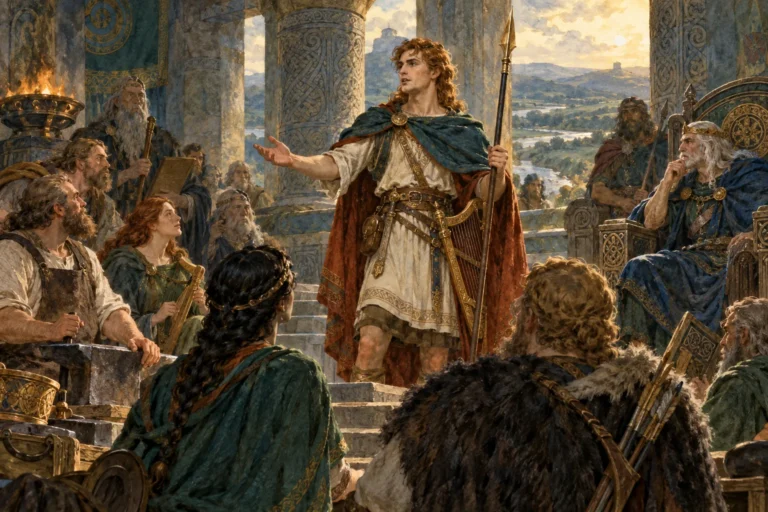
The earth itself disclosed the murder to Lugh. After mourning Cian, he went to Tara and confronted the brothers before the assembled Tuatha Dé Danann. He offered to accept a fine: three apples, a pigskin, a spear, horses and a chariot, seven pigs, a hound, a cooking-spit and three shouts upon a hill. It sounded manageable until he explained which ones he meant.
The apples grew in a guarded garden in the east. The Greek king’s pigskin could heal a dying person. The Persian king’s spear was so dangerous that its head had to be kept in water. Each remaining object had an owner unlikely to surrender it. Worst of all, the last shouts must be made on the hill of Miochaoin, Cian’s old teacher, whose family was bound to prevent anyone shouting there.
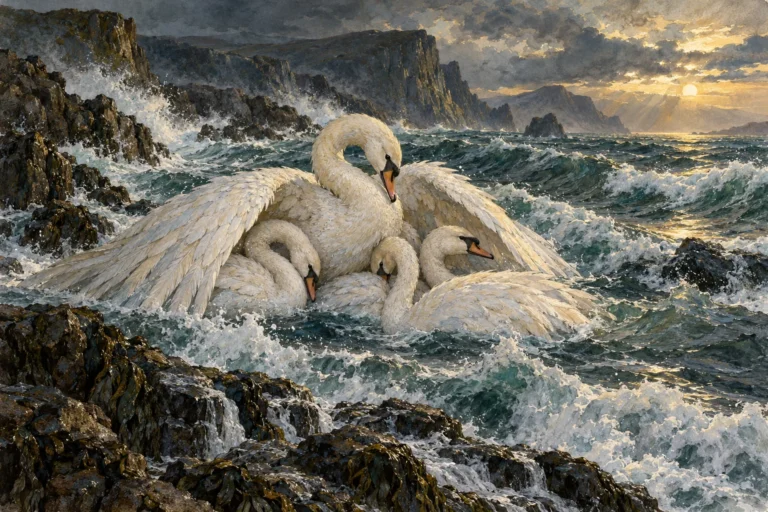
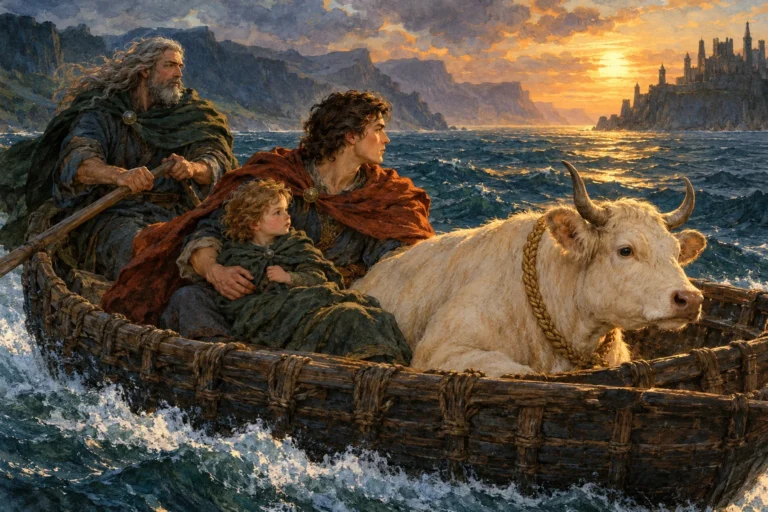
Travelling in Manannán’s boat, the brothers used transformation, deception and force. As hawks they took the apples, then became swans to escape their pursuers. They posed as poets to enter royal courts, and fought for the treasures they demanded. Easal, owner of the seven pigs, chose to give them up rather than lose his people in battle.
When they had obtained the weapons and other treasures Lugh needed, he cast forgetfulness upon them. They returned to Ireland believing the fine complete, and surrendered their acquisitions. Only then did he ask for the spit and the three shouts.
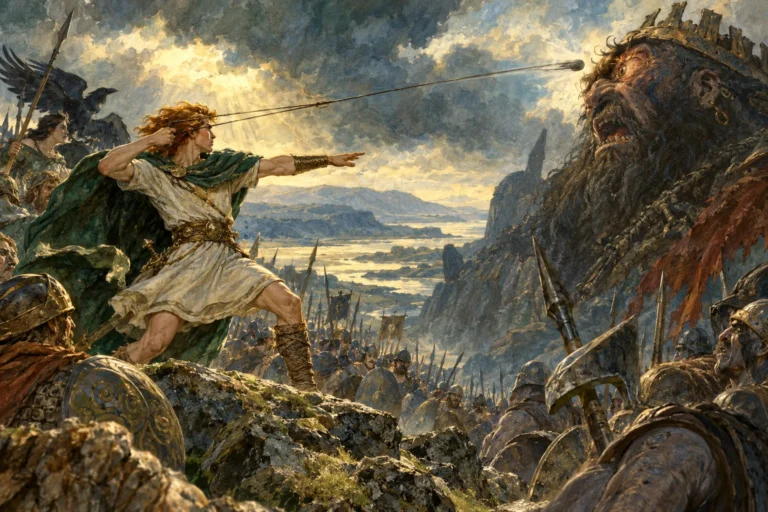
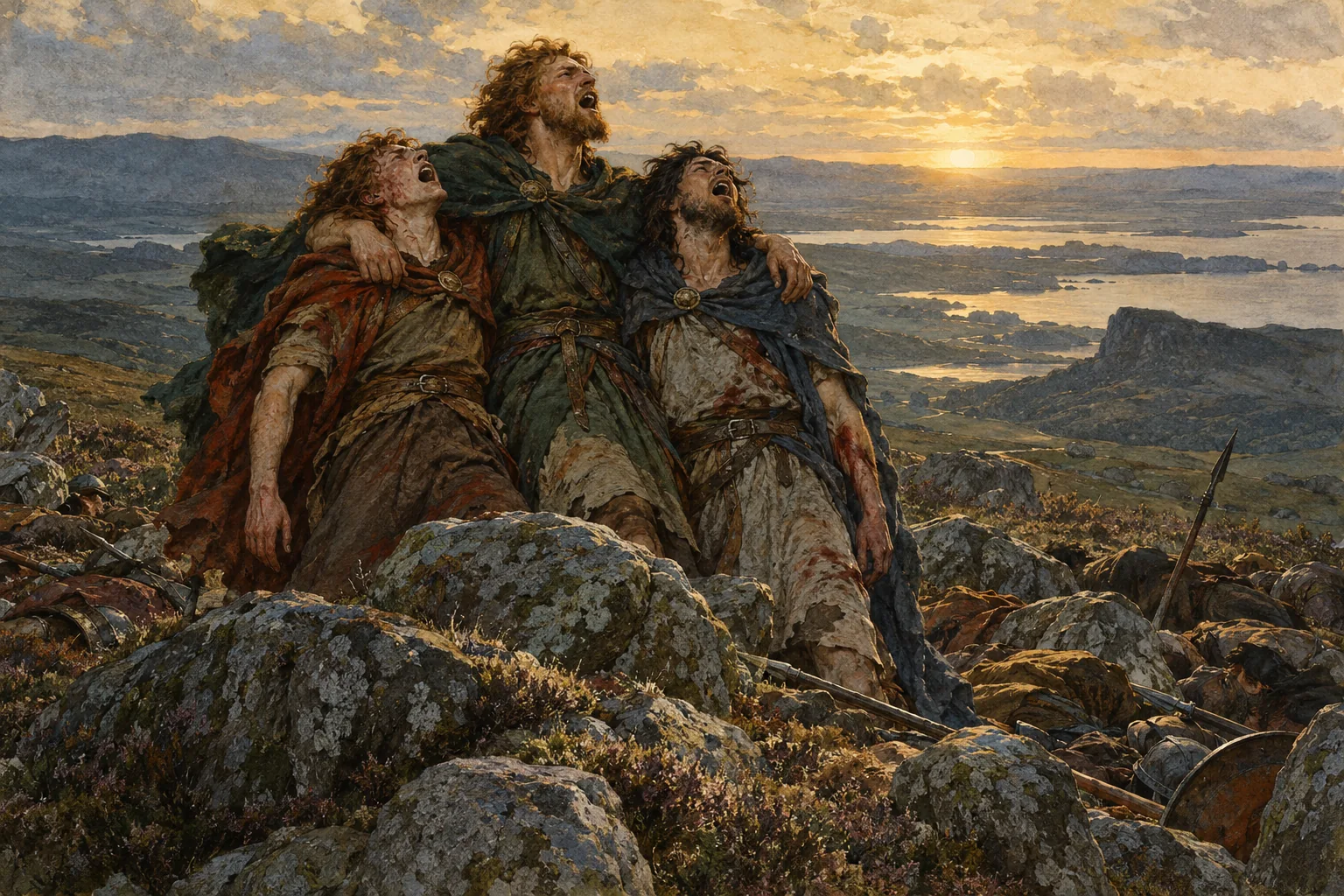
They sailed again. Brian obtained the spit from women beneath the sea. At Miochaoin’s hill they killed its defenders but received mortal wounds. Brian lifted his brothers so that all three could give the required cries.
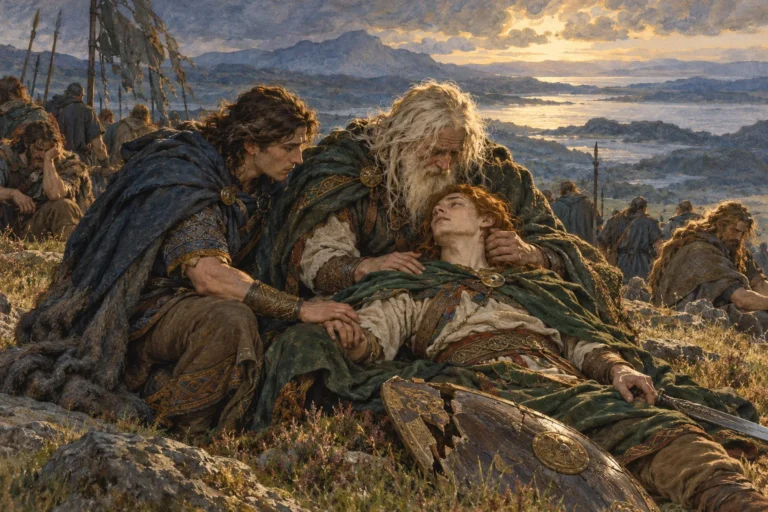
Home once more, they sent Tuireann to ask Lugh for the healing pigskin. Lugh refused. Brian pleaded in person and was refused again: compensation had never extinguished Lugh’s desire for their deaths. Brian lay between his brothers and died with them. Tuireann died grieving over the three, and they shared a grave.
Versions and variations
Which treasure could save them?
Gregory makes the dying brothers ask for the pigskin. Joyce instead makes them ask for the healing apples from the Garden of Hisberna. Both objects have healing power earlier in the quest, but the final request is not identical. An illustration or retelling should therefore identify which ending it follows. Gregory, Part One, Book Two, chapter II; Joyce, chapter XV, pp. 94–95.
Who dies at the end?
In Gregory, the three brothers die together and Tuireann dies in his grief. Joyce explicitly adds the death of their sister Ethnea beside their father and buries them all together. Gregory includes the sister’s earlier lament but does not give her that final death. Joyce, chapter XV, pp. 95–96.
Names and editorial choices
Joyce calls the younger brothers Ur and Urcar, against Gregory’s Iuchar and Iucharba. His preface explains that he selected more pronounceable forms from varying names in the copies. He also acknowledges omitting an opening episode about Nuada and the healers. This is an edited literary presentation, not an untouched transcript of one performance. Gregory’s Authorities supplies a collective list for her first three books and admits rearranging material; it does not assign every Tuireann episode to a particular witness. Joyce, preface, pp. x–xi; Gregory, Authorities.
Context and evidence
The story explores a compensation payment, usually called an éraic, through an impossible quest and a refusal to heal. Its moral difficulty lies in the victims becoming sympathetic without the killing of Cian disappearing. It cannot by itself establish how a real homicide case was decided.
Tara is the setting of the accusation and payment. Gregory also brings the brothers back to Brú na Bóinne before their first return to court, and to Howth on their final homecoming. Greece and Persia belong to the tale’s imagined itinerary; the account supplies no historical evidence for these expeditions. Gregory, Part One, Book Two, chapter II.
Sources for this entry
- Lady Gregory, Gods and Fighting Men. 1905 edition; first published 1904. Part One, Book Two, chapter II, “The Sons of Tuireann”; Notes III, Authorities for Books One, Two and Three. Read source — Main retelling; pigskin ending, Tuireann’s death, place associations and declared editorial method.. About this book
- P. W. Joyce, Old Celtic Romances. 1920 reprint, including the 1907 third-edition preface; first published 1879. “The Fate of the Children of Turenn”, chapters I–XV, pp. 37–96; particularly XIII–XV, pp. 87–96; preface pp. x–xi. Read source — Compared account: apples requested, Ethnea’s death and explicitly altered names.. About this book
Research coverage
Gregory and Joyce have been compared in detail as two influential literary presentations. Their older references are leads, not claimed direct examinations: O’Curry’s Atlantis edition, the relevant Lebor Gabála passages and manuscript copies need their own comparison. No complete oral-variant survey has yet been made.
The Myths · Irish collection · Editorial approach
Further Reading