Mythological Cycle · story
Lugh and the Battle of Mag Tuired
A stranger wins admission to Tara because he commands every art the court needs. Lugh then unites the skills of the Tuatha Dé Danann against the Fomorians and confronts Balor’s deadly eye.
Also found as: The Second Battle of Mag Tuired · Cath Maige Tuired · The Second Battle of Moytura · Lugh comes to Tara · Lug and Balor
Research reviewed 17 October 2026.
Read the story
Version followed: this original retelling follows the Tara arrival and battle episodes in Whitley Stokes’s 1891 translation of Cath Maige Tuired, especially §§53–74 and 95–161. It is a shortened account of those episodes, not a retelling of every incident in the full saga.
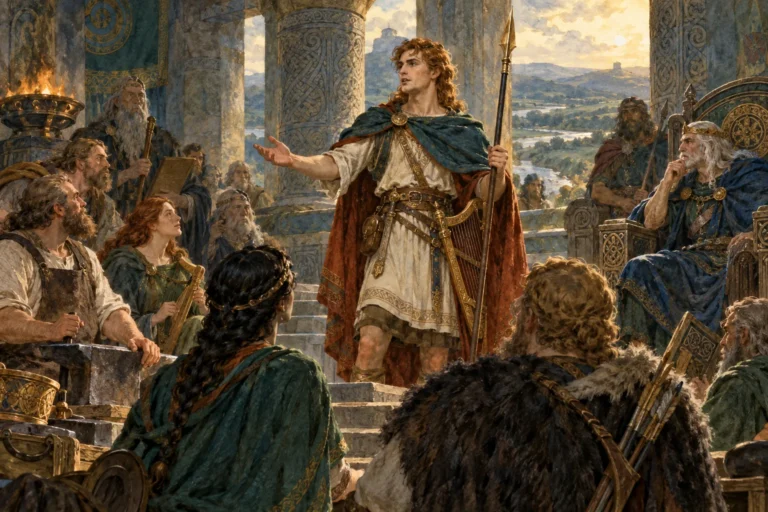
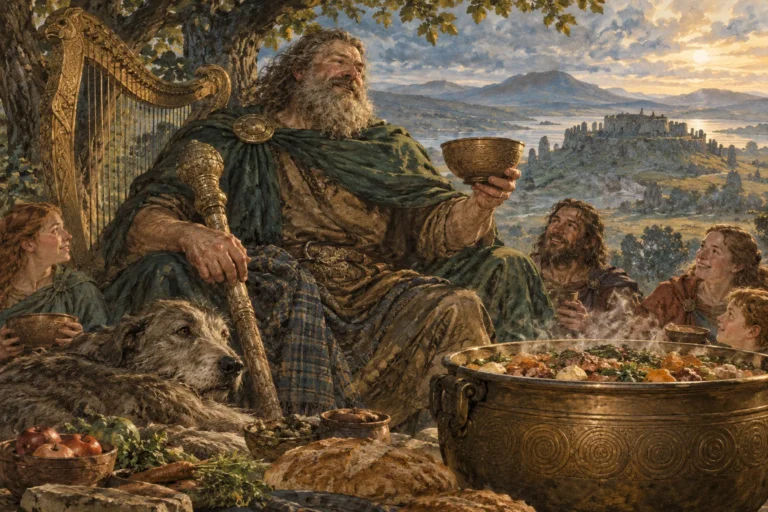
The feast at Tara already had every specialist a king could need. When Lugh arrived, the doorkeeper asked what skill justified admitting him. A carpenter? There was one inside. A smith, a warrior, a harper, a poet, a healer? Each answer met the same objection. At last Lugh asked whether the court possessed one person who could practise all those arts together.
Nuada had him tested. Lugh won at the board game, answered Ogma’s enormous stone-throw, and played music that brought sleep, grief and laughter. Nuada saw a possible answer to the oppression of the Fomorians. For thirteen days he yielded his own seat so that the newcomer could guide the court.
Preparing for war meant more than collecting strong fighters. Lugh and the leaders consulted craftsmen, healers and people of magical learning. Goibniu would replace broken weapons; Luchta would make their wooden parts; Credne would provide metal fittings. Dian Cécht promised to restore the wounded. The strength Lugh had shown at Tara became a way of bringing everyone’s abilities into one effort.
In the fighting, the Fomorians discovered that the opposing army’s weapons were renewed and its wounded returned. A healing well, watched over by Dian Cécht and his children, restored the injured. The enemy sent Ruadán to investigate and attack Goibniu. The smith survived, but Ruadán died. The Fomorians then filled the healing well with stones.
The Tuatha Dé Danann wanted to keep Lugh away from the final clash: his knowledge was too valuable to lose. Nine guardians watched him. He escaped them and reached the front of the army, encouraging his people to end the tribute and subjection they had endured.
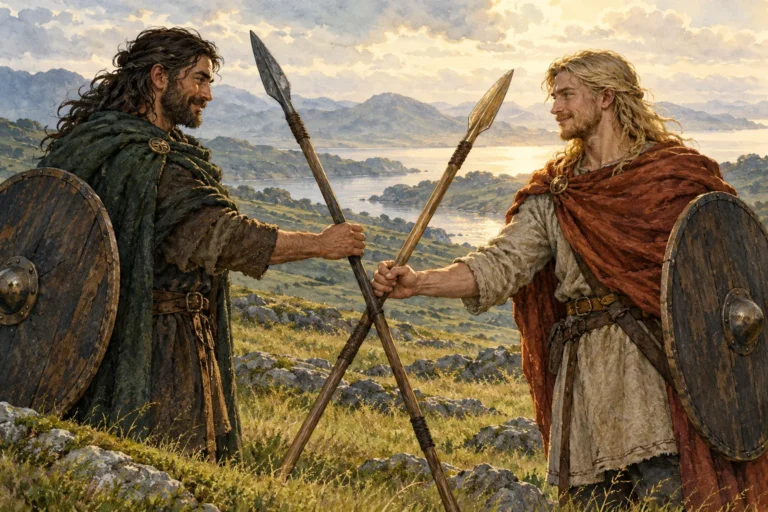
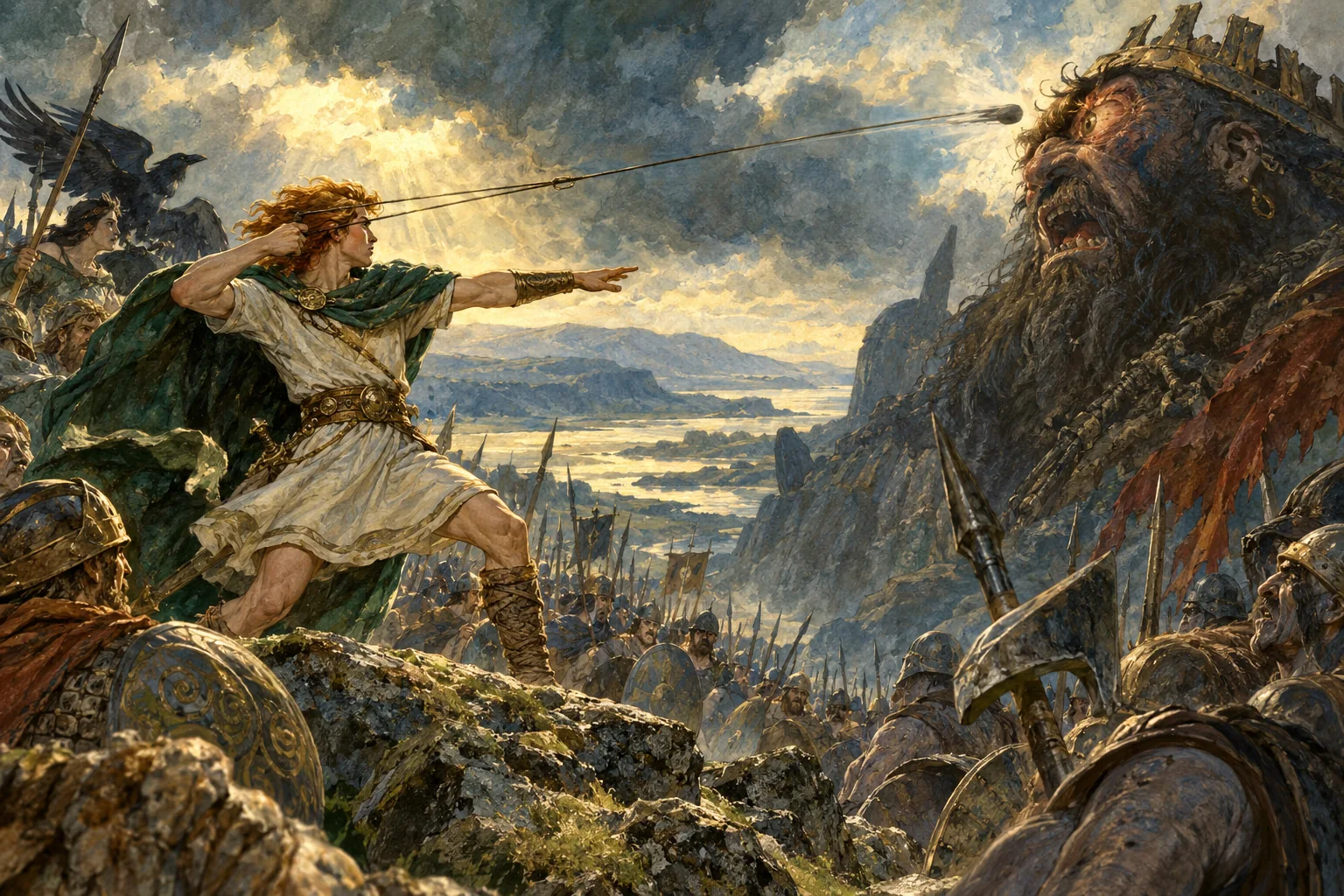
Balor killed Nuada and Macha. His eye could overcome an army when its heavy lid was lifted. As he faced Lugh, he ordered it opened. Before its gaze could strike, Lugh hurled a sling-stone through the eye and out through the back of Balor’s head. Turned towards the Fomorians, the destructive eye struck their own forces.
The Morrígan urged on the Tuatha Dé Danann, and the battle became a rout. Victory nevertheless left another decision: what should happen to Bres? The former ruler offered marvels in exchange for his life, but Lugh and his adviser rejected them. Bres was finally spared for explaining how the people should plough, sow and reap. The war ended with an exchange of useful knowledge as well as the defeat of a dangerous enemy.
Versions and variations
Gregory: a spear and a wider sequence
Gregory’s “Coming of Lugh” and “Great Battle of Magh Tuireadh” share the court’s test of skills, but Gregory gives Lugh a red spear for the blow that drives Balor’s eye backwards, whereas Stokes translates the weapon as a sling-stone. Between them she places the long quest of the sons of Tuireann. Her arrangement lets readers follow one continuous life, but the quest is not an episode in the Cath Maige Tuired text translated by Stokes. Her collective Authorities should accompany that editorial arrangement. Gregory, Part One, Book Two, chapters I–III and Authorities.
Curtin: a heated spear and a different setting
In “Balor on Tory Island”, collected by Jeremiah Curtin, the grandson Lui Lavada attacks Balor with a heated spear near a smith’s forge. The dying Balor’s severed head then creates the hollow of Gweedore Loch. This is a related Balor narrative, not simply the Mag Tuired battle relocated. Curtin says he recorded this account on the mainland and encountered further, incomplete Tory versions. Curtin, pp. 283–295.
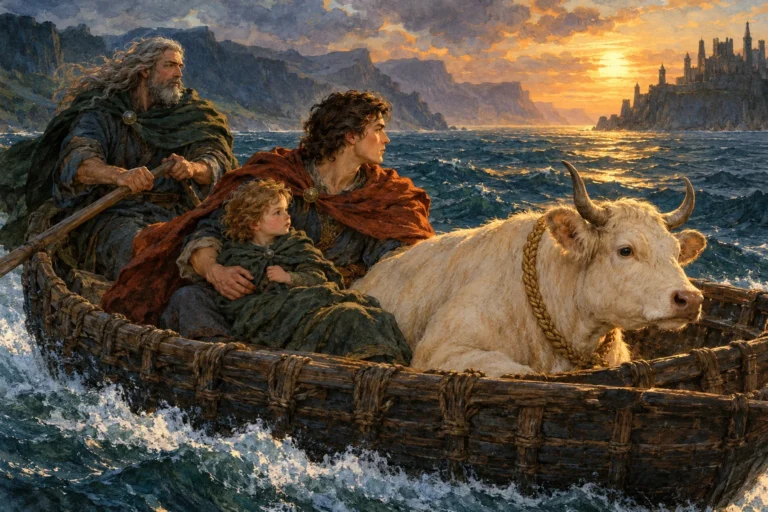
Curtin’s next tale makes Cian the father and places the final spear-cast at Muin Duv, following a long dispute over a magical cow. His preceding tale names the father Fin MacKinealy. These distinctions deserve separate records instead of a single combined family history. “Balor of the Evil Eye and Lui Lavada, his Grandson”, pp. 296–311.
Context and evidence
The text translated by Stokes is tied to a manuscript witness, British Library Harley 5280. That provides evidence for the transmission of a story, not a contemporary report of a war between supernatural peoples. It also contains difficult or untranslated passages. The retelling above does not silently reconstruct those gaps. Stokes/CELT, source description and text.
Tara matters here as the place where Lugh demonstrates the usefulness of combined skills. The battle belongs to a separate setting, Mag Tuired. Archaeological sites and later place associations need their own evidence; no battle casualties or remains identified as Lugh’s are established by the sources examined for this page.
Sources for this entry
- Anonymous; edited and translated by Whitley Stokes, The Second Battle of Moytura (Cath Maige Tuired). Revue Celtique 12 (1891), pp. 52–130, 306–308; CELT electronic edition T300011. §§53–74, the arrival at Tara; §§95–161, preparations, fighting, Balor and the sparing of Bres; manuscript source: British Library Harley 5280, fols. 63a–70b. Read source — Main retelling; numbered, manuscript-based narrative and transmission record..
- Lady Gregory, Gods and Fighting Men. 1905 edition; first published 1904. Part One, Book Two, chapters I–III; Notes III, Authorities for Books One, Two and Three. Read source — Compared synthesis; links Lugh’s arrival, Tuireann quest and battle.. About this book
- Jeremiah Curtin, collector, Hero-Tales of Ireland. London: Macmillan, 1894. “Balor on Tory Island”, pp. 283–295, including collector’s closing note. Read source — Related collected narrative: Fin MacKinealy, Tory, forge, heated spear and Gweedore Loch.. About this book
- Jeremiah Curtin, collector, Hero-Tales of Ireland. London: Macmillan, 1894. “Balor of the Evil Eye and Lui Lavada, his Grandson”, pp. 296–311. Read source — Second collected narrative: Cian, magical cow and spear-cast at Muin Duv.. About this book
Research coverage
The Stokes text, Gregory’s arrangement and two Curtin Balor tales have been compared. The latter are related narratives, not full alternative transcripts of Cath Maige Tuired. Gray’s 1982 edition, later scholarly translations, additional Irish-language oral collections and local place traditions remain to be compared systematically.
The Myths · Irish collection · Editorial approach
Further Reading