Mythological Cycle · figure
The Dagda
A powerful fighter, provider, musician and father who can also be hungry, overworked and outwitted. The Dagda’s stories connect the Brú with the two battles of Mag Tuired.
Also found as: Dagda · Dagdae · Dagán · Eochaid Ollathair · Eochaid Ollathar · The Dagda Mór
Research reviewed 17 October 2026.
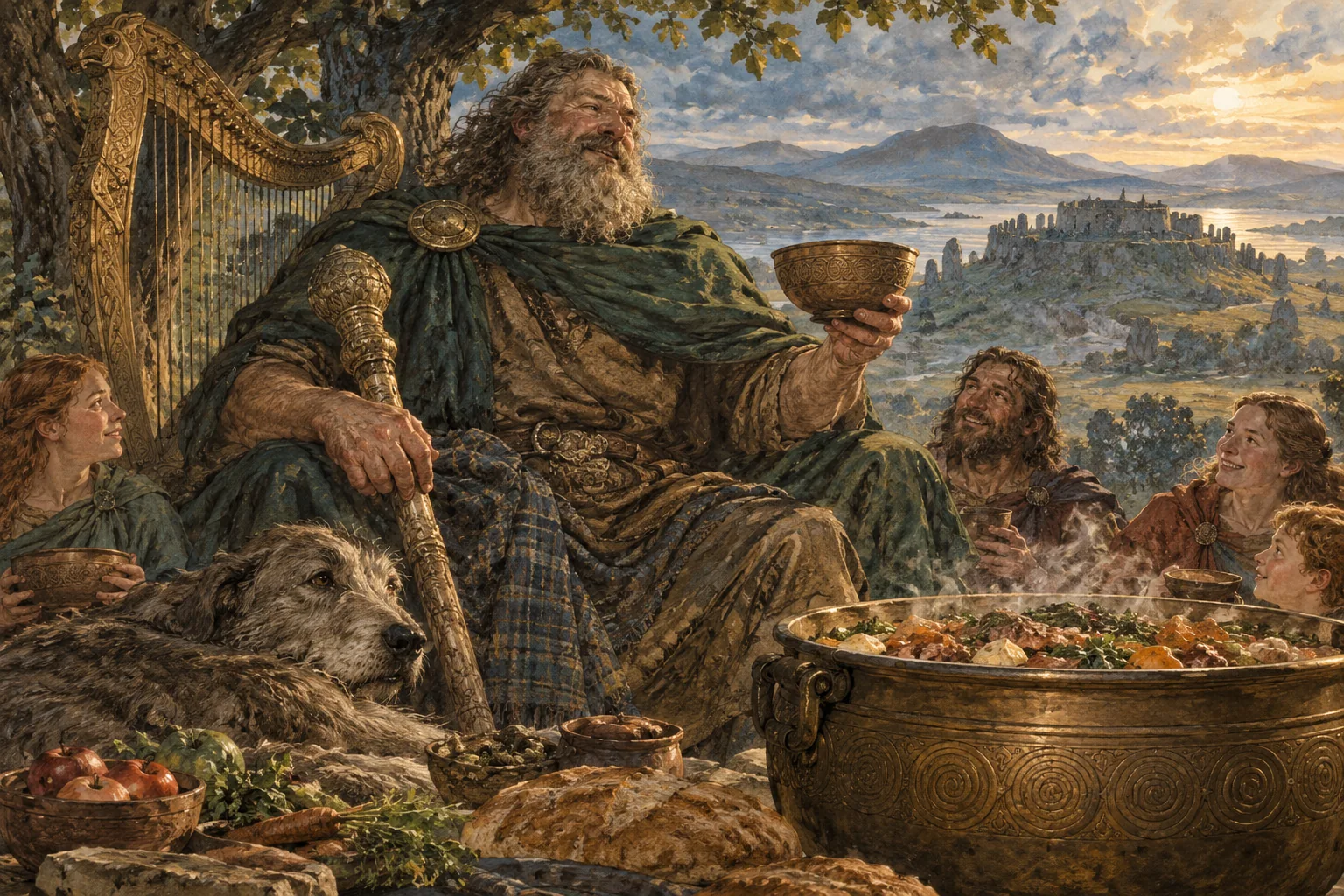
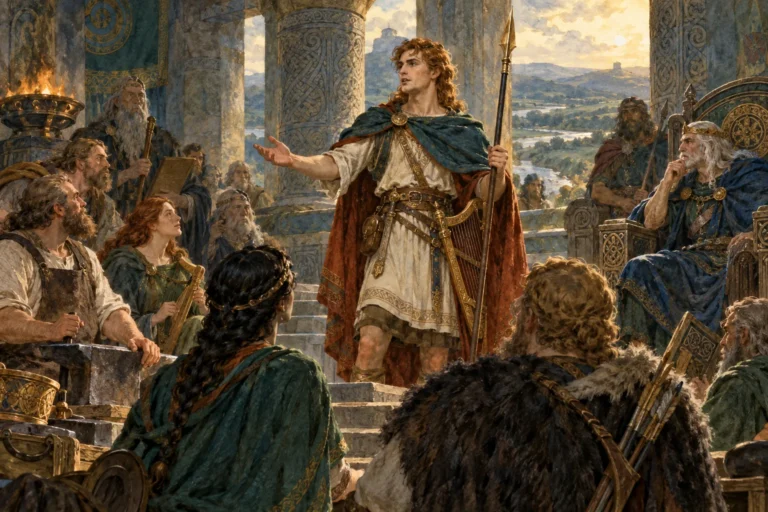
The Dagda is one of the Tuatha Dé’s most capable figures, but his stories give him appetites, burdens and reverses as well as power. Fraser’s First Battle calls him Eochaid Ollathir and associates him with magical knowledge. Stokes’s Second Battle makes him boast that he can perform the abilities of the other specialists himself. Neither role prevents him being mocked, worked to exhaustion or defeated by a carefully worded bargain. Fraser, arrival of the Tuatha Dé; Stokes, §81.
Power and the provision of food
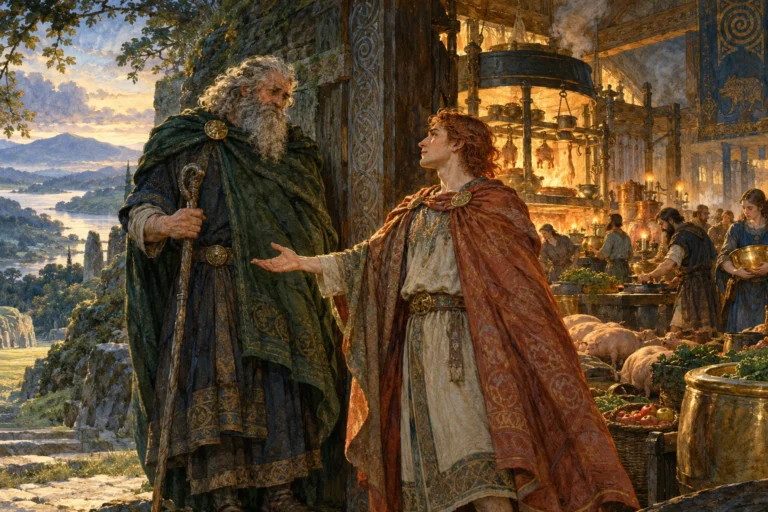
The famous cauldron appears among the treasures brought from the northern cities in the opening of the Second Battle. Its virtue is hospitality: nobody leaves it dissatisfied. Yet the Dagda himself becomes hungry under Bres. He is forced to build the king’s fort, while Cridenbél takes the best portions of his food. Aengus’s lethal trick with pieces of gold frees him from that demand. The contrast makes food a question of obligation and control, not merely an inexhaustible magical supply. Stokes, §§6 and 25–32.
Later Lugh sends him to delay the Fomorians. They try to humiliate him with an enormous meal poured into a hole in the ground, threatening him if he fails to finish it. He eats everything and survives, although his swollen body makes him an object of laughter. This is the enemy’s cooking, not the miraculous cauldron brought from Murias. Keeping those vessels distinct avoids a familiar confusion. Stokes, §§88–93.
Two battles, different scenes
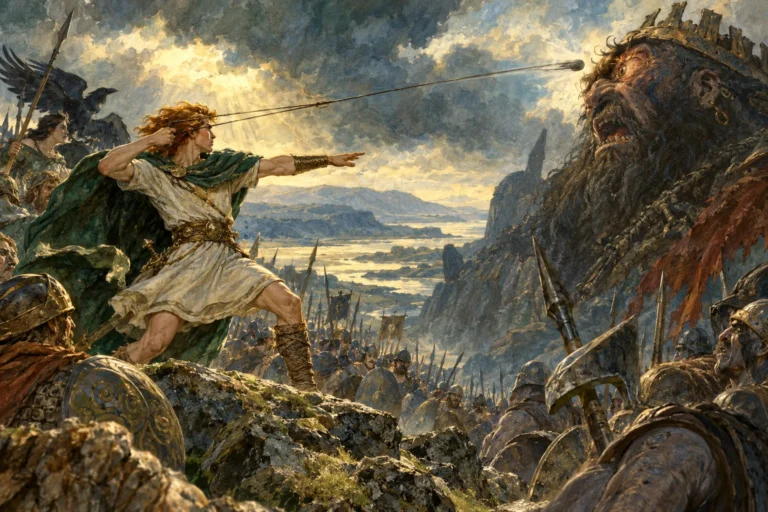
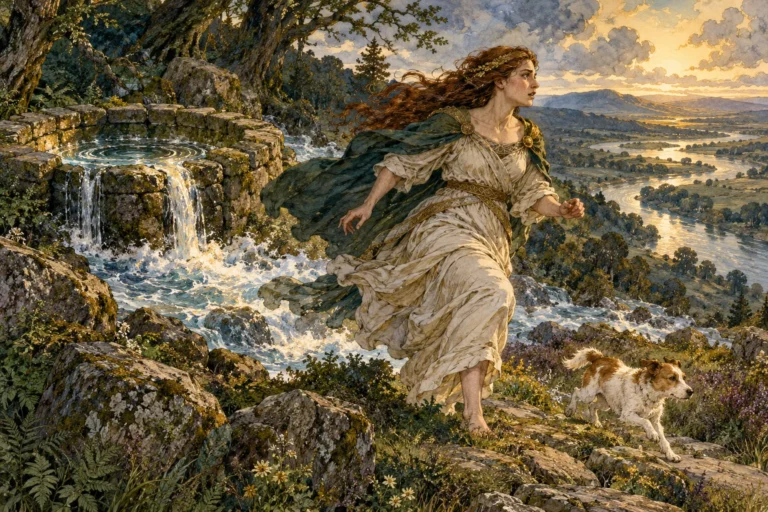
In the First Battle, the Dagda fights the Fir Bolg and helps protect Nuada after Sreng severs his arm. In the separate Second Battle, he works with Lugh and Ogma in preparing resistance to the Fomorians. His encounter with the Morrígan at the river Unius includes their sexual union and her promise of destructive help against the enemy. This is a specific episode in that text; it need not become a universal marriage story explaining every appearance of either figure. Fraser, Nuada’s wounding; Stokes, §§83–85.
Music and a disputed home
After the victory, Lugh, Ogma and the Dagda pursue the enemy and recover his harp. At his call it flies from the wall, killing men in its path. Its music can bring tears, laughter and sleep; the last makes their escape possible. The scene joins an artist’s command of feeling to physical danger. Gregory, Great Battle of Magh Tuireadh, harp episode.
The Brú story exposes a different limit to his authority. In Gregory’s version, Aengus asks for his dwelling for a day and a night, then claims that those words encompass all time. Manannán supplies the magic behind the request. The Dagda leaves his own magnificent household and does not retaliate. Elsewhere he is the father who mobilises help when Aengus becomes sick with longing for Caer. Those changes are worth reading alongside his military strength. Gregory, The Dagda; Gregory, Dream of Angus.
The resulting figure is neither an unvarying ruler nor a simple comic giant. The stories repeatedly bring great power into contact with hunger, service, family loyalty and the consequences of a promise.
Versions and variations
His place in the Brú dispute changes. Hull’s short De Gabáil in t-Shída gives the Dagda the distribution of the mounds and has Aengus take his own dwelling. Gregory adds Manannán’s intervention and the steward’s return. The fuller comparison belongs with Aengus and the Brú; neither account should be silently combined with the Elcmar episode. Hull, short narrative; Gregory, The Dagda.
The Morrígan scene is rearranged. Stokes places their union and her promise before the mission to the Fomorians. Gregory puts a briefer riverside encounter after the food challenge and omits the union there. This changes the sequence and texture of the episode. It does not establish a second independent oral record. Stokes, §§84–93; Gregory, Great Battle of Magh Tuireadh.
Translations have limits. Stokes marks gaps and leaves some material untranslated. His text is an accessible historical translation, not a guarantee that every detail of the underlying Irish has been conveyed. A later critical edition is an important next comparison, especially for difficult names and the omitted passages.
Context and evidence
Literary descriptions of the Dagda’s cauldron, club, music and dwelling are evidence for how stories represent him. They do not identify an excavated object as his possession or establish his existence as a historical person. The Boyne and Brú guide supplies a separate place-based route into the material.
Comparisons with powerful providers or thunder figures in other traditions can be useful, but resemblance alone cannot establish descent, identity or shared ritual. This first guide stays with the Irish episodes named in its references.
Sources for this entry
- Anonymous; edited and translated by Whitley Stokes, The Second Battle of Moytura / Cath Maige Tuired. Revue Celtique 12 (1891), pp. 52–130, 306–308; CELT T300011. §§6, 25–35, 81–93, 118–119 and 163–165. Read source — Separate saga used for the silver-hand coda, Dagda episodes and comparison of narrative sequences..
- Anonymous; edited and translated by John Fraser, The First Battle of Moytura / Cath Maige Tuired Cunga. Ériu 8 (1916), pp. 1–63; online transcription at Celtic Texts. From the arrival of the Tuatha Dé through Sreng’s settlement; final paragraph on Bres and Nuada. Read source — Named basis of the First Battle retelling; webpage paragraph numbering is unreliable, so passage locators are supplied..
- Lady Gregory, Gods and Fighting Men. 1905 edition; first published 1904. Part One, Book Two, chapter III; Book Four, chapter II; Notes III, Authorities. Read source — Literary adaptation; compare each chapter and its source notes rather than treating the collection as an independent oral recording.. About this book
- Lady Gregory, Cuchulain of Muirthemne. London: John Murray, 1902; online transcription checked against the first edition, with the archive’s edition note. VIII, Dream of Angus, pp. 143–147. Read source — Named basis of the original dream retelling.. About this book
- Anonymous; edited and translated by Vernam Hull, De Gabáil in t-Shída / Concerning the Seizure of the Fairy Mound. Zeitschrift für celtische Philologie 19 (1933), pp. 53–58; translation consulted in an online transcription. Whole short narrative. Read source — A distinct account of the mound’s allocation and the day-and-night bargain; original printing not collated..
Research coverage
Battle episodes, the food challenge, harp recovery, the Brú bargain and Aengus’s dream have been examined. The magic-staff tale, fuller dindshenchas material, comparative religion scholarship, contemporary devotional interpretations and the difficult passages of modern critical editions are not yet comprehensively covered.
The Myths · Irish collection · Editorial approach
Further Reading