Mythological Cycle · story
Aengus and the Brú
Aengus asks to borrow the Dagda’s extraordinary dwelling for a day and a night. When the time is up, the meaning of those words becomes the means of keeping it.
Also found as: Aengus takes the Brú · Angus and the Dagda’s house · The day-and-night bargain · De Gabáil in t-Shída
Research reviewed 17 October 2026.
Read the story
Version followed: this original retelling follows the household description and dispossession episode in Gregory’s Gods and Fighting Men, Part One, Book Four, chapter II, “The Dagda”. It does not insert the different Elcmar story into her account.
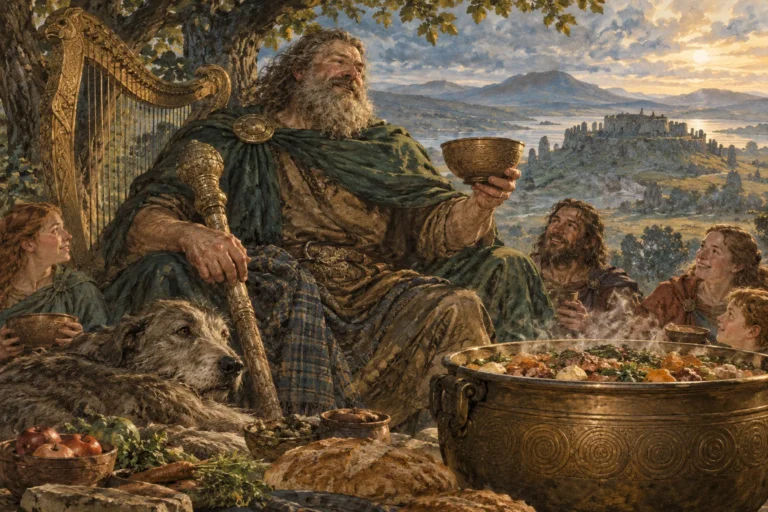
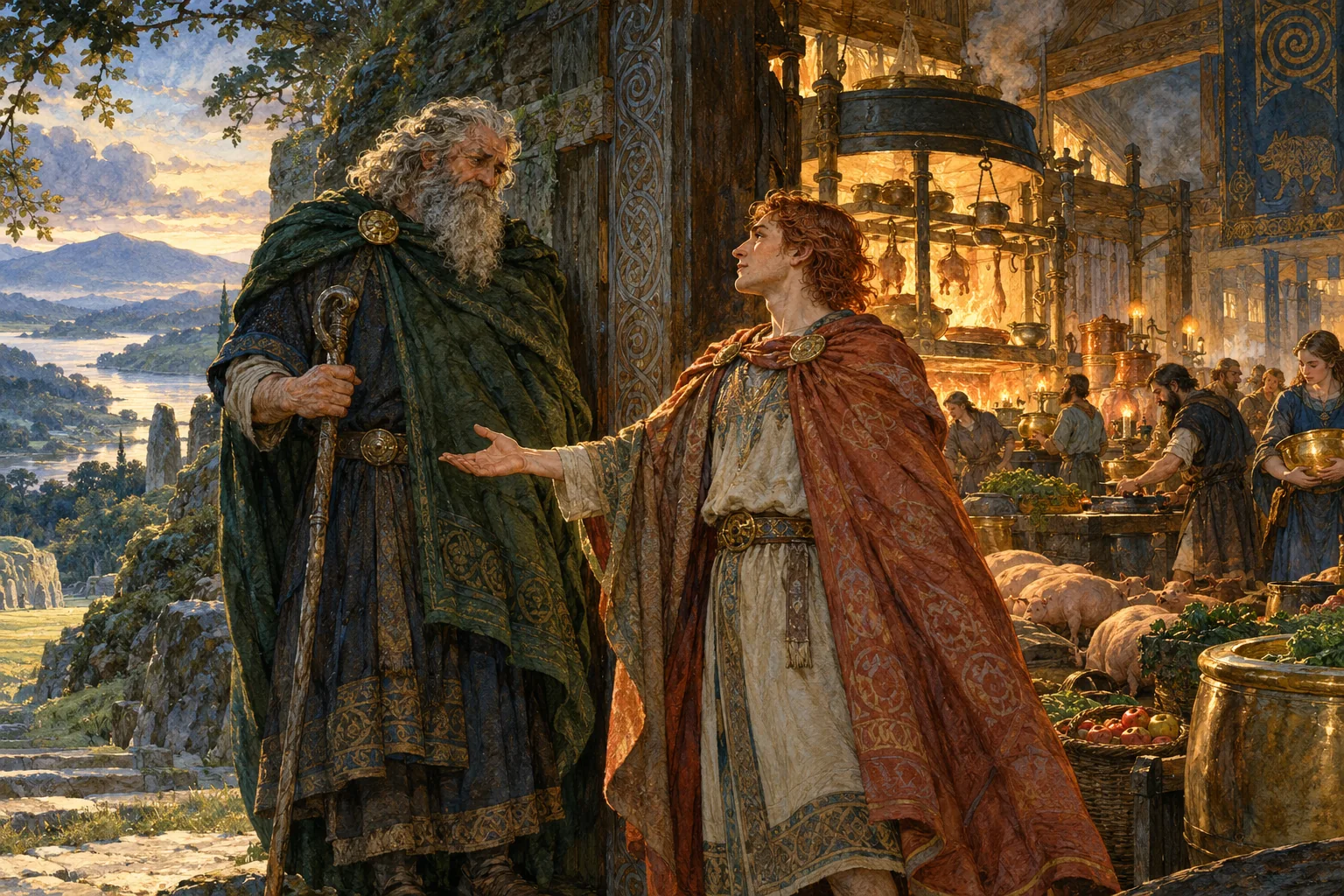
The Dagda’s house at the Brú was a place where familiar household work grew into marvels. A steward managed its provisions, a smith made precious vessels, and musicians served a company whose lives reached into many other stories. Around the dwelling were places named for the Dagda’s family: his bed, Cermait’s birthplace, and a hill associated with Boann’s little hound.
Gregory even imagines the Dagda’s astonishing oven standing there. It had a body of iron and an axle and wheels of wood, with spits and pots in great numbers. Its working carried it down towards the cinders and up towards the roof with the flame. Feeding such a household required something larger than an ordinary hearth.
Its crafts had their difficulties too. The Dagda made a vat for his daughter Ainge, but it leaked whenever the sea was in flood and held its contents when the tide went out. She gathered twigs for a replacement. Gaible stole the bundle and hurled it away; where it landed, a wood grew.
The Brú’s smith, Len, worked in a lake on bright vessels. When he finished for the evening, he cast his anvil eastwards. Fire, water and purple precious stones showered from its flight. The place belonged to a world in which a craftsman’s daily labour could leave its mark across the country.
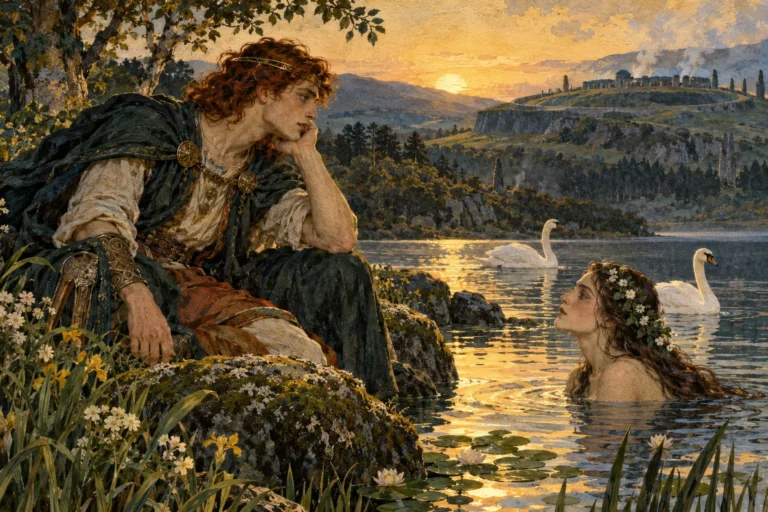
Yet the lord of this extraordinary house would lose it without an army battering its walls. Aengus wanted the Brú, and Manannán offered him a plan. He should ask his father for the dwelling for the length of one day and one night. Manannán would use his art to prevent the Dagda refusing.
Aengus made the request. The Dagda granted the house on those terms. A day passed, and then a night. When the Dagda asked to have his home back, his son answered that the gift had no end. All the world’s time consisted of day and night, following each other. By granting him those, his father had granted him the dwelling for ever.
The words left the Dagda without his home. Manannán’s enchantment lay upon the household as well as its master, and they went away together. The victory came through the exact form of the request and the power that supported it. Aengus remained in possession of what had seemed a temporary loan.
Dichu the steward had missed the exchange. He was away with his wife and son, collecting provisions for a feast for Manannán and his companions. When he returned, he found his old master gone. He took service with Aengus instead, and the household’s work continued under its new lord.
The Dagda did not return to take revenge. Gregory leaves open where he went afterwards, mentioning Tara as one report. Aengus stayed at the Brú behind its hidden walls, with Goibniu’s ale and pigs whose supply never failed. The dwelling had changed hands; its abundance remained.
Versions and variations
The father loses his own dwelling
In De Gabáil in t-Shída, translated by Vernam Hull, Aengus asks for land after the Dagda has distributed the mounds. Nothing remains for him. The day-and-night request obtains the Dagda’s own dwelling, and Aengus’s interpretation makes it permanent. Manannán is absent from this short account. Gregory supplies his advice and enchantment, then adds the returning steward who changes masters. Hull, complete short narrative; Gregory, “The Dagda”.
The father helps take somebody else’s dwelling
In the opening of Tochmarc Étaíne, the Dagda helps Aengus dispossess Elcmar. He advises an armed demand at Samhain, then judges the dispute in his son’s favour. Elcmar receives Cleitech as compensation. The wordplay remains, but the owner, the use of force and the father’s role change. Bergin–Best, Part I, §§5–8.
Keep the accounts separate
Those differences are larger than alternative spellings of a name. One account makes a son outwit the father whose distribution has left him landless; another gives that father a part in planning and adjudicating a seizure. Gregory’s Manannán introduces a further source of power behind the transaction. Combining all three into one scene would hide the very questions a research panel should preserve.
The main retelling includes Gregory’s descriptions of the Brú’s household, but it leaves out the subsequent death of Aedh. Her chapter gathers several episodes around the Dagda; its order should not be mistaken for a proven chronology shared by every medieval text. The online Hull transcription is also a point of access, not a substitute for checking its original edition.
Context and evidence
These accounts explain possession of a place through kinship, bargaining and power. They are literary claims about the Brú, not deeds of ownership or evidence identifying its prehistoric builders. The real monuments need their own archaeological account.
The recurring day-and-night formula is a useful comparison point, but a claim about the precise historical development of the wording would require the Irish texts and their manuscript variants. This page compares the accessible presentations and makes no claim that Gregory preserves an otherwise lost oral original.
Sources for this entry
- Lady Gregory, Gods and Fighting Men. 1905 edition; first published 1904. Part One, Book Four, chapter II, The Dagda; Notes III, Authorities. Read source — Literary adaptation; compare each chapter and its source notes rather than treating the collection as an independent oral recording.. About this book
- Anonymous; edited and translated by Vernam Hull, De Gabáil in t-Shída / Concerning the Seizure of the Fairy Mound. Zeitschrift für celtische Philologie 19 (1933), pp. 53–58; translation consulted in an online transcription. Whole short narrative. Read source — A distinct account of the mound’s allocation and the day-and-night bargain; original printing not collated..
- Anonymous; edited and translated by Osborn Bergin and R. I. Best, Tochmarc Étaíne / The Wooing of Étaín. Ériu 12 (1938), pp. 137–196; CELT T300012. Part I, §§1–8. Read source — Brief factual comparison of Aengus’s parentage, fosterage and seizure of Elcmar’s Brú..
Research coverage
Gregory’s episode, Hull’s short translated account in an online transcription, and the relevant Bergin–Best passages have been compared. Hull’s original printing, Irish wording across manuscripts, the Altram Tige Dá Medar tradition and later local oral versions await separate examination.
The Myths · Irish collection · Editorial approach
Further Reading