Mythological Cycle and place lore · figure
Boann
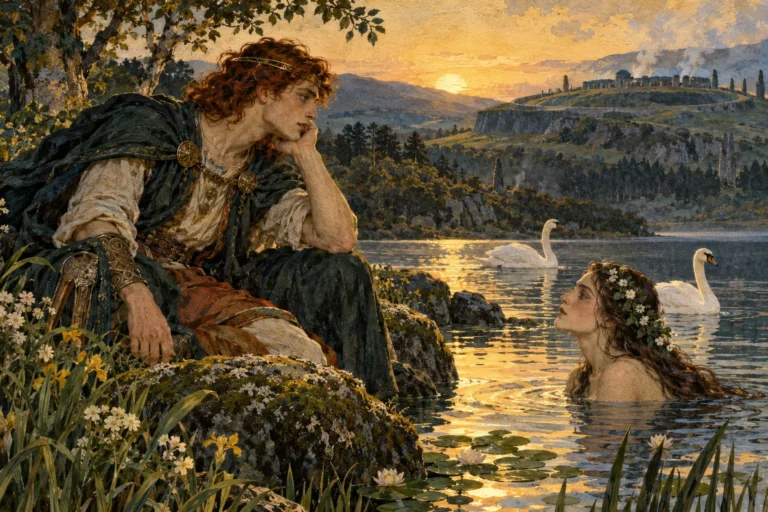
The woman whose flight becomes the Boyne, and Aengus’s mother. Two place-name poems give sharply different reasons for her encounter with the well.
Also found as: Boand · Bóand · Bóann · Boann of the Boyne
Research reviewed 17 October 2026.
A woman and a river
Boann belongs at the centre of a cluster joining the Boyne landscape, Aengus and the Dagda. Her story is not simply a name attached to water. The medieval place-lore poems give her actions, relationships and a violent death, while also making the river part of a much larger imagined geography.
In the poem conventionally called Boand I, she is the wife of Nechtan, son of Labraid. A secret well stands at his dwelling. Its power is dangerous: a person who looks into its depths will lose his eyes, and approaching it threatens bodily harm. Only Nechtan and his three cup-bearers dare go near. Gwynn, “Boand I”, stanzas 11–13.
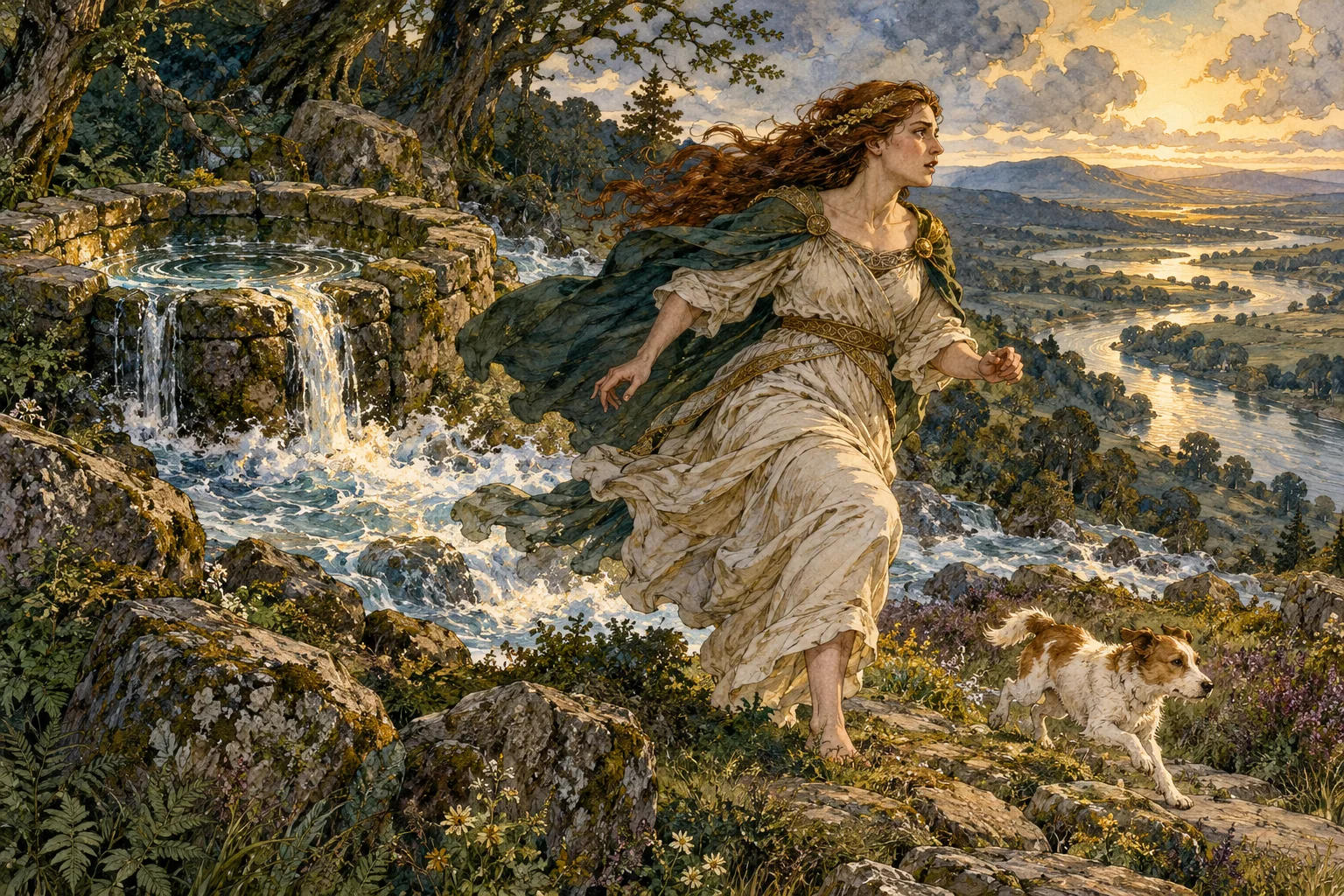
Boann approaches to test that power. The poem says she is not thirsty and describes her as proud. She walks around the well three times. Three waves rise against her, injuring her foot, eye and hand. As she flees towards the sea, the water follows, tracing the river that takes her name. Her little dog Dabilla follows too; the poem explains two offshore stones through the animal’s destruction. “Boand I”, stanzas 14–23.
A different reason for the well
Boand II tells the encounter differently. It first describes Boann, still called Nechtan’s wife, coming to Elcmar’s house. There the Dagda approaches her. The sun is held still for nine months, allowing the child’s conception and birth to fit within a single day. Their son is Aengus.
In this poem Boann hurries to the well because she believes bathing there will conceal her guilt. The fountain rises and drowns her. Its compressed ending does not repeat the first poem’s chase, three separate injuries or story of Dabilla. Curiosity and concealment are different explanations; they should not be blended into a single motive without telling readers. Gwynn, “Boand II”, stanzas 7–13.
The distinction between Nechtan and Elcmar is equally important. In this poem one is her husband and the other owns the house she visits. By contrast, the opening of Tochmarc Étaíne makes her Elcmar’s wife. That narrative explains how the Dagda keeps Elcmar away during Aengus’s conception and birth. The accounts share material, but their relationships should retain their source labels. Bergin and Best, Part I, §§1–3.
More than an origin story
The first poem follows the water through a chain of names that stretches beyond Ireland to rivers including the Severn, Tiber, Jordan and Euphrates. The second calls the Boyne Ireland’s Jordan and invokes Christ. These are features of the poems as transmitted, not evidence that the physical Boyne connects underground with every river mentioned. The writing brings Irish landscape into a learned sacred geography. “Boand I”, stanzas 1–10; “Boand II”, stanzas 1–6.
Boann also acts as a mother. In Gregory’s Dream of Aengus, she responds to her son’s sickness by searching for the woman he has seen, then helps draw others into the search. That role belongs to another story and should not be erased by treating the well episode as her entire identity. Gregory, “The Dream of Angus”.
These sources connect a supernatural woman to a real river and a family of narratives. They do not establish her as an identifiable historical resident of the Boyne valley, or prove that a particular excavated monument was built for her.
Versions and variations
Boand I and Boand II are separate poems, not two modern translations of one passage. Their differences include Boann’s motive, the length and shape of her death scene, the placement of Aengus’s birth and the presence or absence of Dabilla. Both also preserve explanations involving river names; Boand I explicitly offers another explanation through the meeting of waters. Poem 2; Poem 3.
Neither full poem read here describes a salmon eating hazelnuts at Boann’s well. Those motifs occur elsewhere in Irish literature, including Cormac’s vision of the fountain of knowledge. They should not be inserted into Gwynn’s Boann poems and then cited as though he translated them there. The broader relationship between well traditions remains a research question for further source comparison.
Context and evidence
Dindshenchas is place lore: its stories explain and interpret names, often offering alternatives rather than one exclusive origin. These poems are especially useful for the site’s approach because the alternatives are present in the primary material itself. The historical study of the Boyne valley requires independent archaeological and documentary evidence alongside this literary record.
Sources for this entry
- Anonymous; edited and translated by Edward Gwynn, The Metrical Dindshenchas, Part III. Royal Irish Academy, Todd Lecture Series 10; Dublin: Hodges, Figgis, & Co.; London: Williams and Norgate, 1913; public-domain translation reproduced by CELT. Poem 2, Boand I, 23 stanzas, English pp. 27–33. Read source — Full poem read: river names, testing the well, three injuries, flight, motherhood and Dabilla.. About this book
- Anonymous; edited and translated by Edward Gwynn, The Metrical Dindshenchas, Part III. Royal Irish Academy, Todd Lecture Series 10; Dublin: Hodges, Figgis, & Co.; London: Williams and Norgate, 1913; public-domain translation reproduced by CELT. Poem 3, Boand II, 15 stanzas, English pp. 35–39. Read source — Full poem read: a different reason for approaching the well; Nechtan, Elcmar and the Dagda distinguished.. About this book
- Anonymous; edited and translated by Osborn Bergin and R. I. Best, Tochmarc Étaíne. Ériu 12 (1938), pp. 137–196; CELT T300012. Part I, §§1–8. Read source — Brief comparison of Boann’s marriage and Aengus’s birth; not used as the basis of an extended retelling here..
- Lady Gregory, Cuchulain of Muirthemne: The Story of the Men of the Red Branch of Ulster. London: John Murray, 1902. The Dream of Angus; source notes in Notes. Read source — Public-domain adaptation for Boann’s role in seeking the woman of Aengus’s dream.. About this book
- Anonymous; edited and translated by Whitley Stokes, The Irish Ordeals, Cormac’s Adventure in the Land of Promise, and the Decision as to Cormac’s Sword. In Ernst Windisch and Whitley Stokes, eds, Irische Texte mit Übersetzungen und Wörterbuch, third series, part I; Leipzig: S. Hirzel, 1891, pp. 183–229. Cormac’s Cup, English pp. 211–216, fountain and knowledge passages. Read source — Comparison with the separate fountain, hazel trees and salmon in Cormac’s adventure; not evidence that those details occur in the two Boand poems..
Research coverage
Both complete Gwynn Boand poems directly read and compared; brief checks against the opening of Tochmarc Étaíne and Gregory’s Dream of Angus. Prose dindshenchas versions, later oral accounts and a complete study of the river-name’s linguistic history have not yet been collated. No claim that these poems contain every well or salmon tradition.
The Myths · Irish collection · Editorial approach
Further Reading