Mythological Cycle; also appears in Ulster and Fenian narratives · figure
Aengus
Dreamer, sharp adviser, foster-father and lord of the Brú: Aengus connects stories of love and transformation with disputes over land, family loyalty and protection.
Also found as: Óengus · Óengus Óc · Aonghus · Aonghas · Angus Óg · Angus Og · Mac Óc · Mac ind Óc · The Young Son
Research reviewed 17 October 2026.
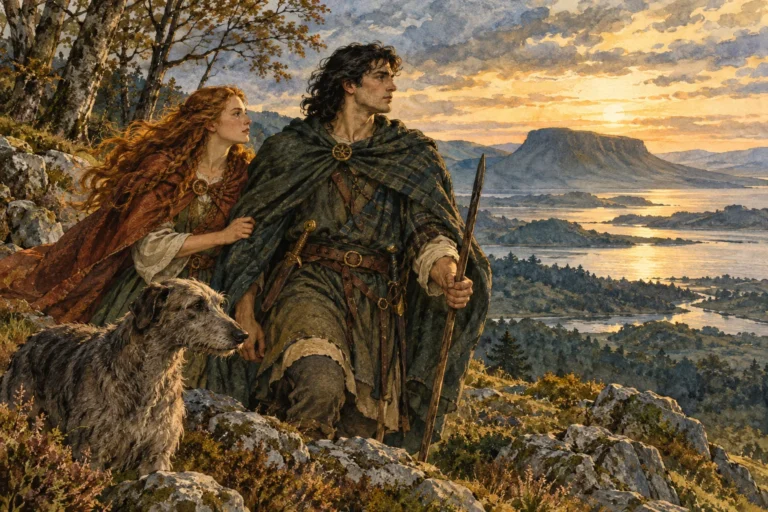
Aengus is a figure whose character changes with the company he keeps. Beside Caer he is a lover searching for someone beyond his reach. Beside the Dagda he can be a calculating adviser or the son who takes his father’s house. Beside Diarmuid he is a foster-father whose protection continues after death. The Brú connects these roles, but they belong to different narratives and should not be forced into one dated life. Gregory, The Dagda, Angus Og and the Diarmuid sequence.
The dreamer and Caer
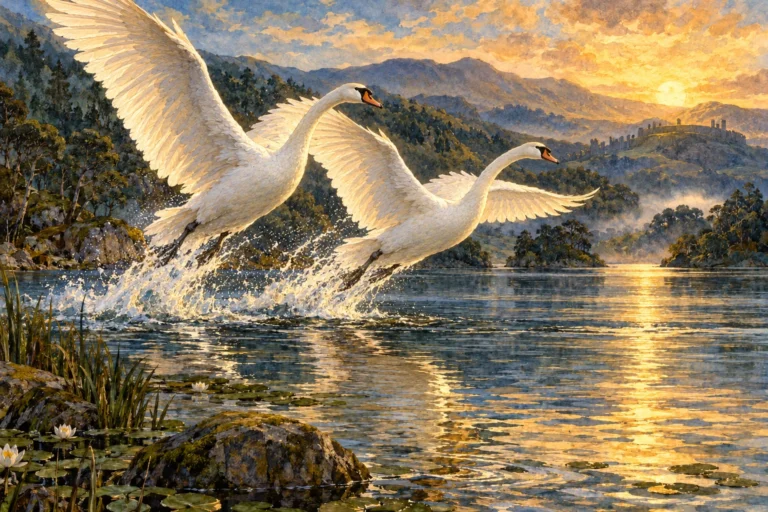
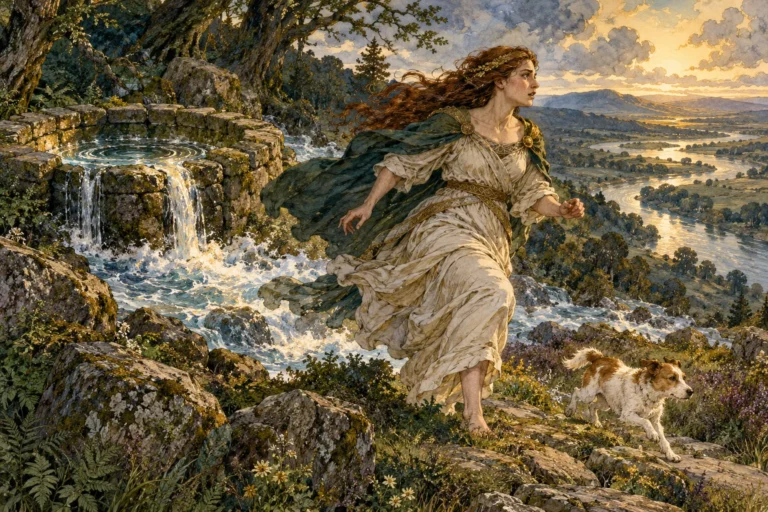
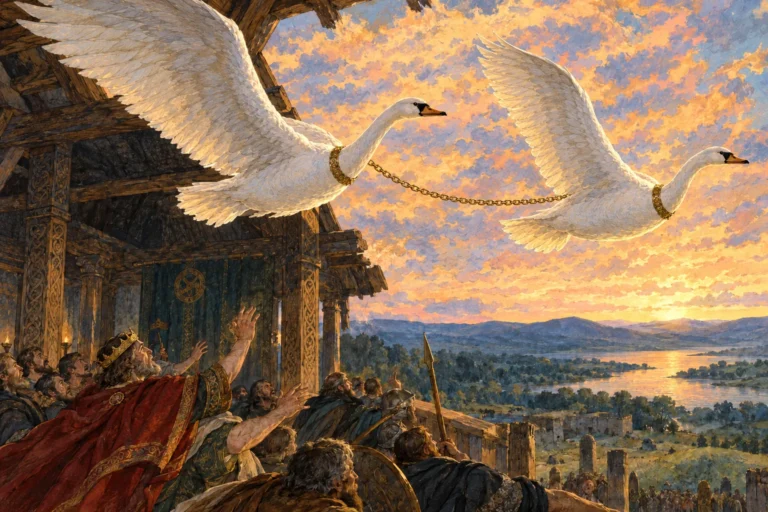
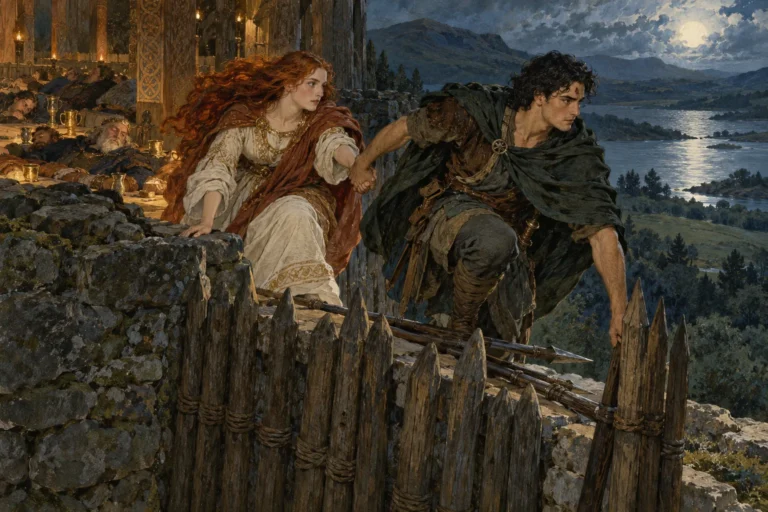
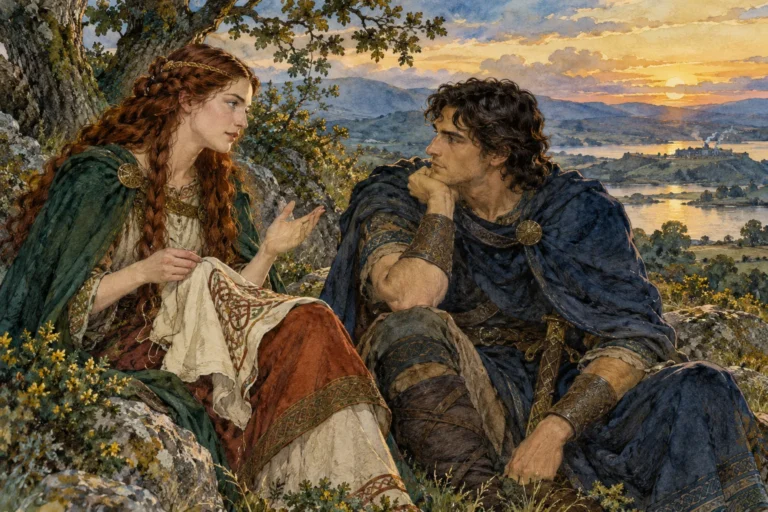
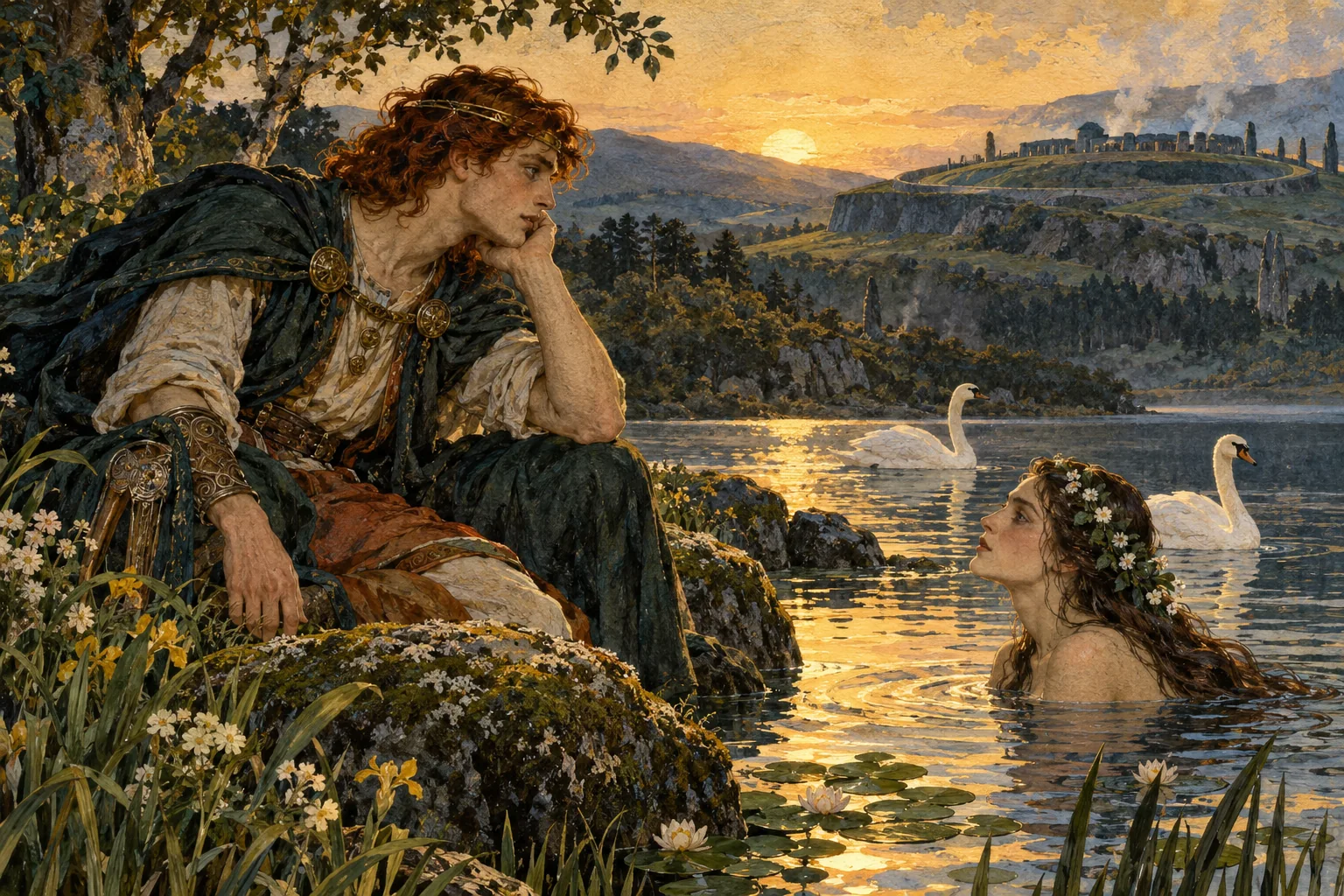
In The Dream of Aengus, a woman’s nightly appearances leave him unable to live contentedly when she vanishes. His mother Boann begins the search; the Dagda and Bodb extend it. Ailill and Medb become involved, and the search includes an attack on Caer’s father’s dwelling. At the lake, however, Caer sets a condition of her own: she must remain free to return to the water. Aengus becomes a swan and joins her there before they fly to the Brú. The story includes longing, coercion and an agreement between the lovers, not simply an effortless romantic conquest. Gregory, Dream of Angus.
Words that change an outcome
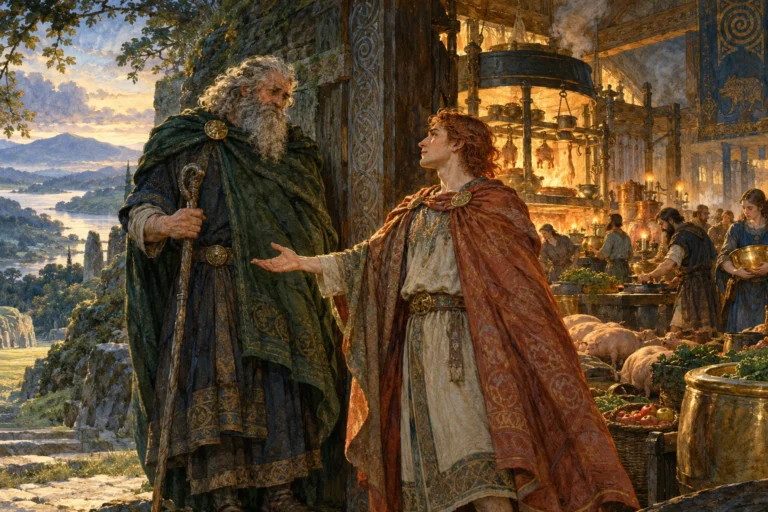
Aengus also understands how a demand can be turned against the person making it. When the Dagda is compelled to give Cridenbél the best pieces of his meal, Aengus advises hiding gold in them. The gold kills Cridenbél, but its value gives the Dagda an answer when Bres accuses him. Aengus then tells his father what animal to choose as wages. This is dangerous practical intelligence, far removed from the helplessness of his lovesickness. Stokes, Second Battle, §§26–32.
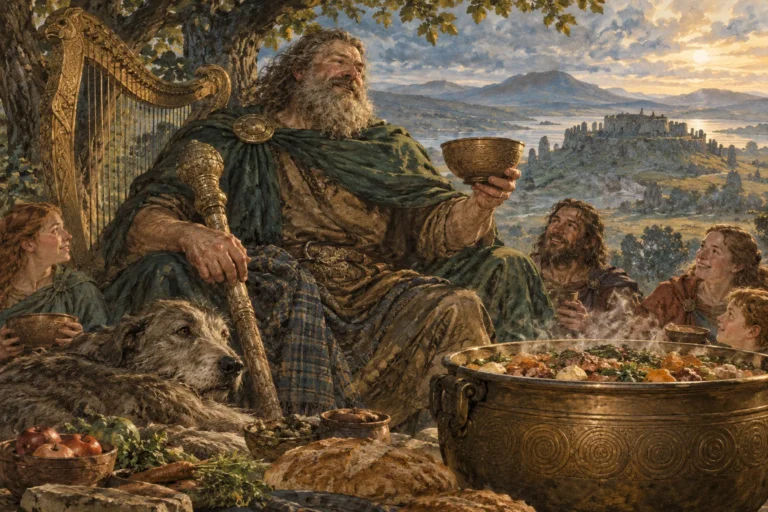
The same attention to wording drives the day-and-night bargain. In Gregory, Manannán helps Aengus obtain the Dagda’s house for what sounds like a short visit. Aengus claims that days and nights contain all time. Other accounts change the dispossessed owner and the father’s involvement, so the linked story keeps those versions separate. Gregory, The Dagda.
A home for other people’s stories
Gregory’s Étaín finds shelter with Aengus when Fuamnach drives her away. He makes a fragrant, sheltered place for her and brings her with him on his journeys. His role here is that of a protector within a conflict centred on Midir’s household. Gregory, Midhir and Etain.
The bond with Diarmuid is different: Aengus rears him at the Brú. After Diarmuid’s death, he asks for the body to be taken home and declares that, even if full restoration is impossible, he will give it enough life to speak with him. That qualified promise should not be simplified into a permanent resurrection. It expresses the foster-father’s refusal to abandon their relationship. Gregory, Birth of Diarmuid; The Boar of Beinn Gulbain.
A reader can therefore follow Aengus through love, advice, ownership and fosterage. Each route reveals something the others leave out. His place in the collection is a meeting point between stories, with the differences in his conduct preserved.
Versions and variations
Family and fosterage: the opening of Tochmarc Étaíne makes him the Dagda and Boann’s hidden son, fostered by Midir. An insult prompts him to demand acknowledgment and land. This supplies a context absent from Gregory’s short account of the day-and-night bargain. Bergin–Best, Part I, §§1–5.
Love as a label: Gregory explicitly calls Angus a god of youth and love in her 1902 Notes. That is a named modern author’s description. It is not a formal title spoken in the dream episode, and it does not cover the full range of actions assembled here. Gregory, Notes, p. 356.
Names: Aengus, Óengus and Angus are indexed together here for these linked accounts. Mac Óc is another designation in the texts. An unrelated figure called Aengus must still be identified by parentage and story: Gregory’s Angus son of Umor in the Cruachan material is not automatically the Dagda’s son. Gregory, Cruachan, p. 158.
Context and evidence
The sources establish a figure in literature and traditional narrative, not an independently dated historical owner of Newgrange. The language of gods, fairy households and fosterage also belongs to different contexts of transmission. Calling the stories timeless would obscure those differences.
This guide is a route through the texts actually consulted. Broader claims about worship, the history of the name or an equivalent deity elsewhere need distinct evidence and are not inferred from a modern label.
Sources for this entry
- Lady Gregory, Gods and Fighting Men. 1905 edition; first published 1904. Part One, Book One, chapter II; Book Four, chapters II, III and VII; Part Two, Book Six, chapter I, Birth of Diarmuid; Book Seven, chapter VIII, The Boar of Beinn Gulbain. Read source — Literary adaptation; compare each chapter and its source notes rather than treating the collection as an independent oral recording.. About this book
- Lady Gregory, Cuchulain of Muirthemne. London: John Murray, 1902; online transcription checked against the first edition, with the archive’s edition note. VIII, Dream of Angus, pp. 143–147. Read source — Named basis of the original dream retelling.. About this book
- Lady Gregory, Cuchulain of Muirthemne: Notes. 1902. pp. 356–360; Dream of Angus and Cruachan source lists. Read source — Documents Gregory’s dependence on earlier editions and her practice of rearranging passages.. About this book
- Anonymous; edited and translated by Osborn Bergin and R. I. Best, Tochmarc Étaíne / The Wooing of Étaín. Ériu 12 (1938), pp. 137–196; CELT T300012. Part I, §§1–5. Read source — Brief factual comparison of Aengus’s parentage, fosterage and seizure of Elcmar’s Brú..
- Anonymous; edited and translated by Whitley Stokes, The Second Battle of Moytura / Cath Maige Tuired. Revue Celtique 12 (1891), pp. 52–130, 306–308; CELT T300011. §§26–32. Read source — Separate saga used for the silver-hand coda, Dagda episodes and comparison of narrative sequences..
- Lady Gregory, Cuchulain of Muirthemne. 1902; Internet Sacred Text Archive transcription. p. 158, Angus son of Umor. Read source — Literary adaptation compared for omissions, rearrangement and the treatment of Nera’s family.. About this book
Research coverage
This guide compares the dream, the Brú bargain, the Dagda’s labour, Étaín’s shelter and Gregory’s Diarmuid material. It is not a complete catalogue of Aengus references. Altram Tige Dá Medar, further dindshenchas, the original Irish Diarmuid versions, and modern ritual or comparative interpretations await separate study.
The Myths · Irish collection · Editorial approach
Further Reading