Fenian Cycle · story
The pursuit of Diarmuid and Gráinne
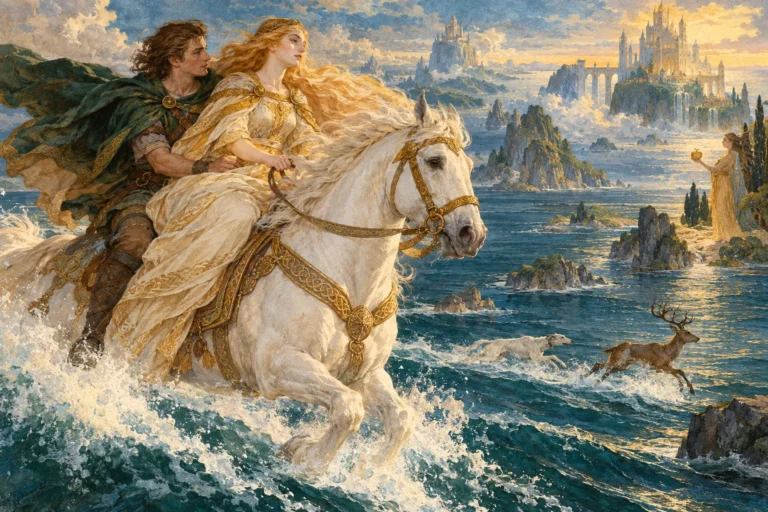
Gráinne escapes a marriage to Fionn with one of his own warriors. A pursuit across Ireland ends in peace, but an old grievance returns during a hunt on Benbulben.
Also found as: Diarmaid and Grainne · Dermat and Grania · Dermot and Grania · Tóraigheacht Dhiarmada agus Ghráinne · The Boar of Benbulben · Diarmuid Ua Duibhne
Research reviewed 17 October 2026.
Read the story
A condensed retelling of Lady Gregory’s Book VII, “Diarmuid and Grania”. Her composite version is identified throughout; other published treatments differ, especially at the beginning and ending.
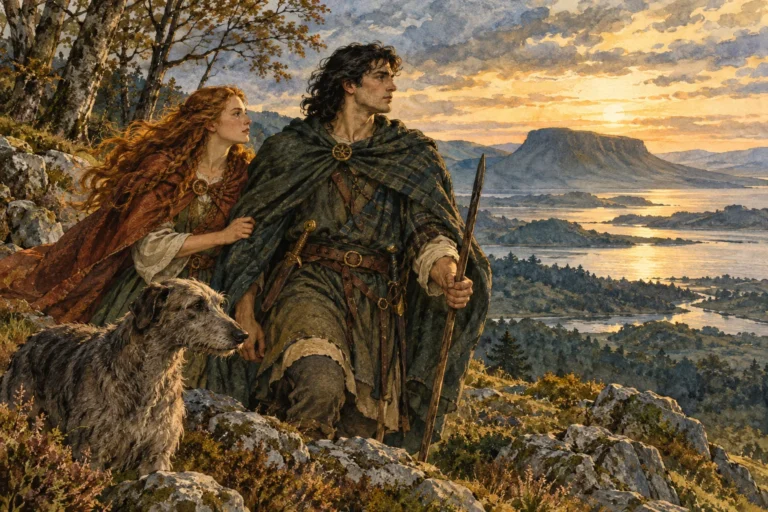
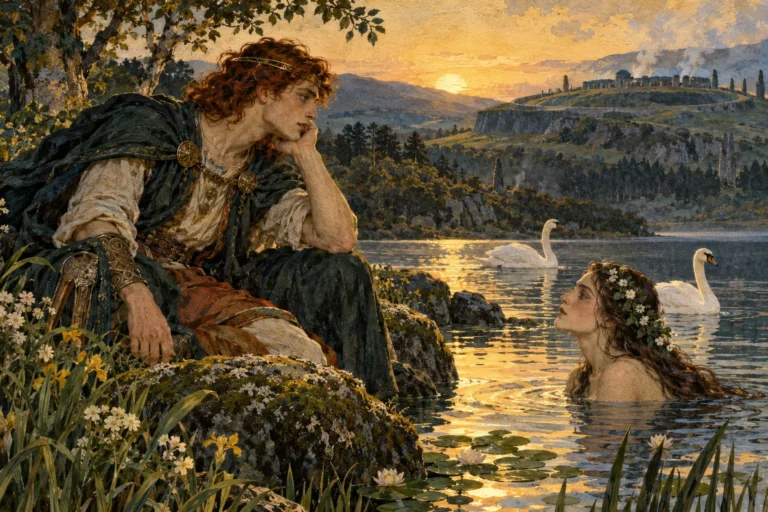
Fionn wanted a wife, and his messengers went to Tara to ask for Gráinne, daughter of the High King. She agreed before seeing the man she was to marry. When Fionn arrived, she found him older than her father. At the feast her attention turned to Diarmuid, one of the Fianna. As he separated fighting dogs outside, his cap fell and revealed the love-spot on his forehead. Gráinne saw it and loved him.
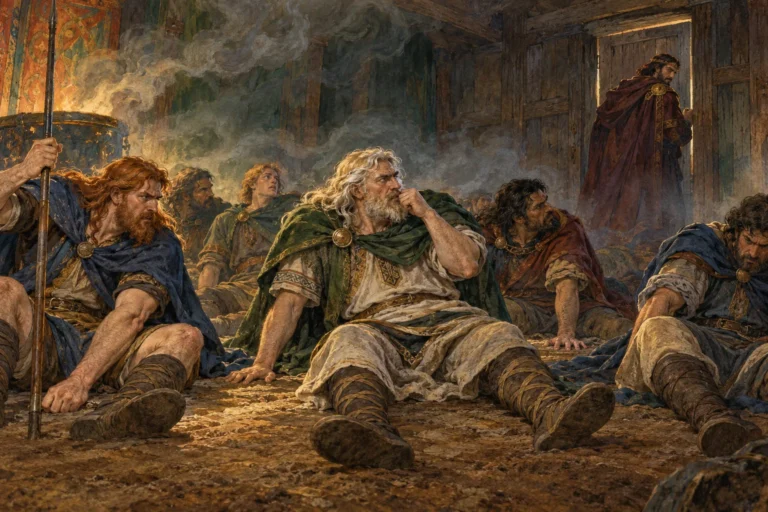
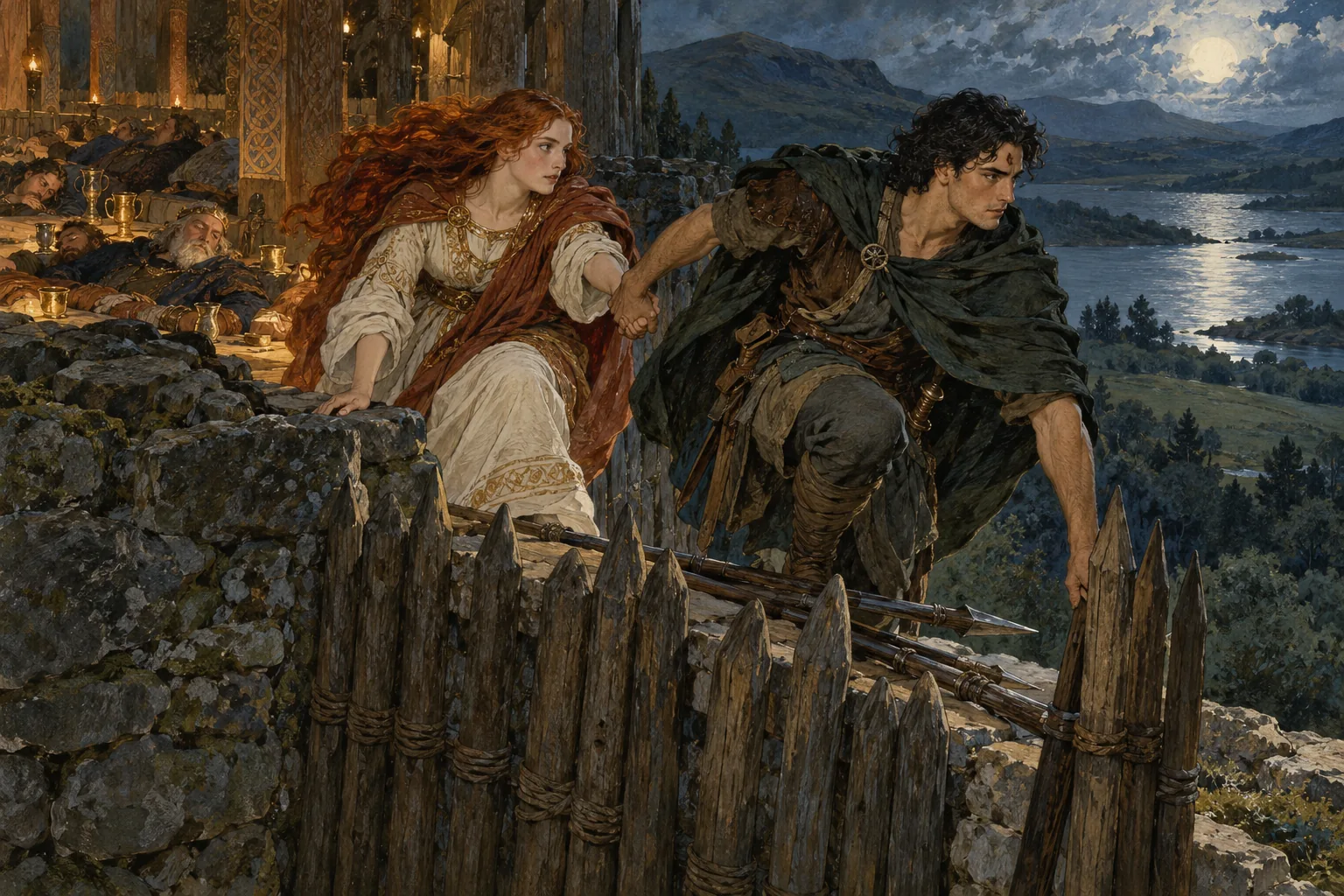
She sent round wine that put Fionn, the king and much of the company to sleep. Then she asked Diarmuid to take her away. He refused to betray his leader. Gráinne placed binding obligations upon him to leave with her before the sleepers woke. His companions told him he could not break those bonds.
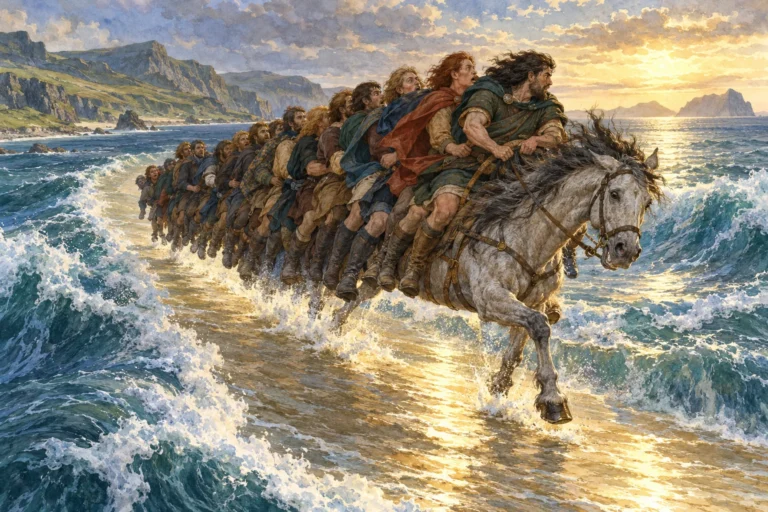
Diarmuid crossed the rampart on his spears and joined her outside. Still he would not accept her as his wife. They crossed the Shannon and hid in the Wood of the Two Huts, where he built a shelter with seven doors. Fionn’s pursuit closed around them. Some of the Fianna tried to warn their friend; Angus, Diarmuid’s foster-father, carried Gráinne away beneath his cloak. Diarmuid escaped through the danger himself.
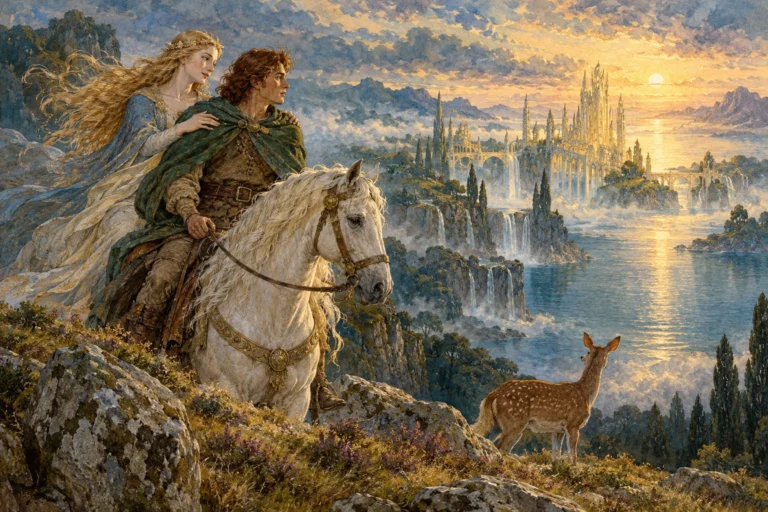
So began a life of hiding, flight and resistance. Help came from loyal companions and from Angus, whose home at Brú na Bóinne offered refuge. Fionn used trackers, warriors and enchantment against the fugitives, but could not finish the pursuit. At last Angus negotiated peace. After sixteen years in hiding, Diarmuid and Gráinne settled at Rath Grania, raised children and grew wealthy.
Gráinne eventually urged her husband to invite Fionn and her father to a feast. She hoped hospitality would restore affection. But while the guests were staying, Diarmuid heard hounds calling in the night. At daybreak he went out, taking his lesser weapons despite Gráinne’s advice.
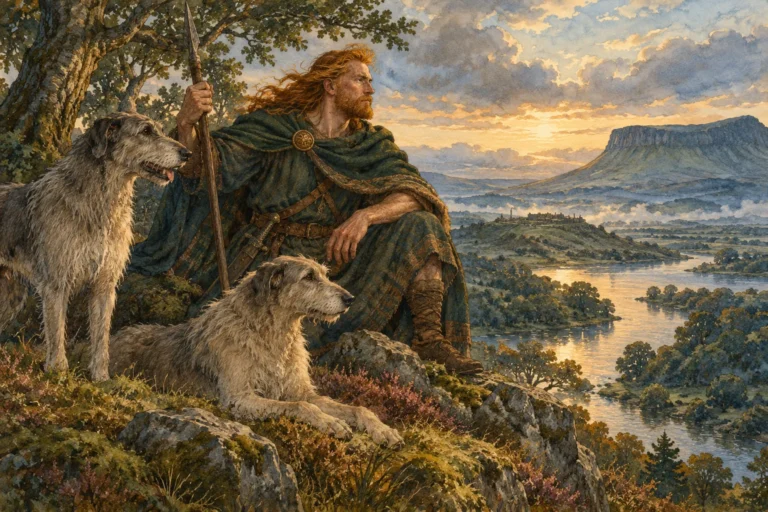
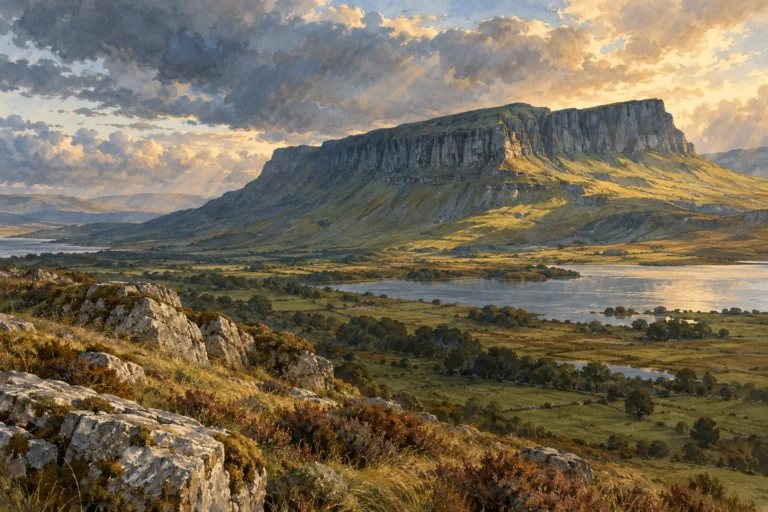
On Beinn Gulbain he found Fionn and learned that a terrible boar was approaching. Fionn warned that the animal would be his death. Diarmuid refused to flee. His spear failed to pierce it and his sword broke. The boar mortally wounded him; he killed it with the remaining sword-hilt.
Fionn could still save him. Water carried in his cupped hands possessed healing power. Twice he fetched it, remembered Gráinne and let it drain away. Oscar threatened him, and on the third attempt Fionn brought the water back. Diarmuid was already dead.
Angus took the body to Brú na Bóinne. Gráinne mourned and called on her sons to avenge their father. Yet Gregory’s ending takes a further turn: Fionn later persuaded Gráinne to return with him, and she eventually made peace between him and her sons. The book preserves both blame of her change of mind and a suggestion that Fionn enchanted her. It offers no single comfortable judgement on what followed the death. Read Gregory, Part II, Book VII.
Versions and variations
A love-spot, a first refusal and an edited ending
Gregory’s opening: Gráinne sees Diarmuid’s love-spot when his cap falls during the quarrel among the dogs. She then approaches him directly. This episode is part of Gregory’s arrangement; it should not be silently imposed on every Pursuit text. Book VII, chapter I.
The prose text presented by UCC: the published parallel extract has Gráinne ask Diarmuid to accept her after Oisín has refused. His reply mentions both Oisín and Fionn before she imposes the bonds. The site juxtaposes the edited Irish text, O’Grady’s version and his translation. This is a useful check on the changed sequence in Gregory, rather than evidence for another historical wedding. §1.7, lines 155–167.
Joyce’s ending: his retelling ends with Angus taking Diarmuid’s body to the Boyne. Crucially, Joyce says in his preface that he deliberately omitted the continuation concerning Gráinne and her sons because he considered it inferior. An omitted remarriage is therefore an editorial decision in this book, not proof that his manuscript lacked it. Gregory retains the return to Fionn and explicitly lists O’Grady among her sources. Joyce, preface pp. xv–xvi and story pp. 349–350; Gregory, Book VII, chapter VIII and Authorities.
Context and evidence
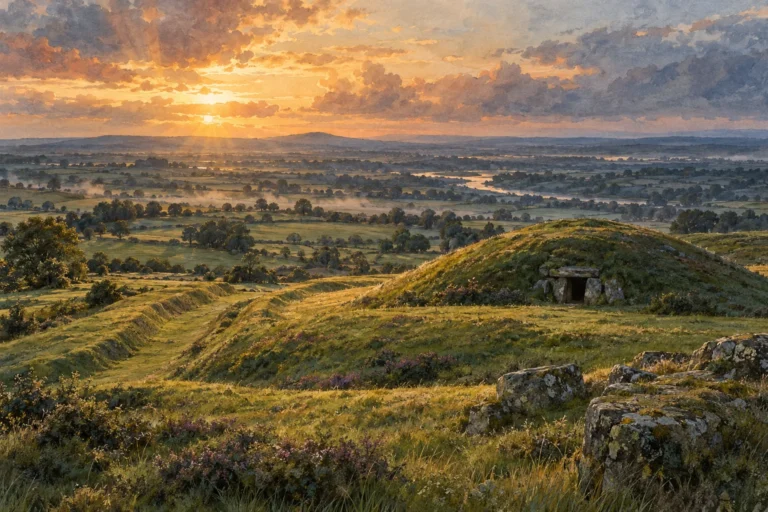
This is a long narrative tradition, not a fixed itinerary of one couple’s travels. Tara, the Boyne and Benbulben have specific roles in the texts examined here, which makes them useful links in a place directory. A tomb called a “bed of Diarmuid and Gráinne” would need its own local source and archaeological description before being added as another stop. The three-way conflict also makes Fionn a more difficult figure than a consistently generous hero: his knowledge gives him the means to heal, while grievance prevents him from using it. That is a reading of the story, not a diagnosis of a historical individual. Gregory, Book VII.
Sources for this entry
- Lady Gregory, Gods and Fighting Men. 1905 edition displayed by Project Gutenberg; work first published 1904. Part II, Book VII, chapters I–VIII; Notes III, Diarmuid and Grania; Notes V, Beinn Gulbain. Read source — Principal condensed retelling; composite version explicitly acknowledged; relevant passages directly consulted. About this book
- Anonymous; editions by Nessa Ní Shéaghdha and Standish Hayes O’Grady, Tóruigheacht Dhiarmada agus Ghráinne: parallel extracts. UCC Irish Sagas Online, comparing Ní Shéaghdha’s edited Irish text with O’Grady’s text and English translation. §1.7 (lines 155–167); §§1.10–1.12; §2.35 and editorial summary of the pursuit. Read source — Directly consulted textual extracts; not a claim to have collated the complete critical edition. About this book
- P. W. Joyce, Old Celtic Romances. 1920 edition displayed by Project Gutenberg; work first published 1879. The Pursuit of Dermat and Grania, especially chapter X, pp. 334–350; preface pp. xv–xvi. Read source — Comparison of the fatal hunt and deliberately shortened ending; relevant passages directly consulted. About this book
Research coverage
Gregory, Joyce and UCC’s selected textual parallels examined. This is not a full collation of the manuscript tradition. Next research priorities are the full critical edition, Irish and Scottish death lays, and local oral accounts of the lovers’ beds. Scottish Ben Gulbin/Glenshee associations require their own sources and must not be conflated with Sligo’s Benbulben. No uncited claim about Gráinne’s death, a poisoned foot or a universal remarriage ending has been added.
The Myths · Irish collection · Editorial approach
Further Reading