Ulster Cycle · story
Deirdre and the sons of Uisliu
Deirdre and Naoise escape the king who intends to claim her, but a promised safe return leads to betrayal, exile and the destruction of trust in Ulster.
Also found as: Derdriu · Deirdre of the Sorrows · The Exile of the Sons of Uisliu · Longes mac nUislenn · Sons of Usnach · Sons of Usnech
Research reviewed 17 October 2026.
Read the story
This retelling follows the older exile narrative, using Leahy’s Book of Leinster version and Hull’s edition. Its ending differs from Lady Gregory’s.
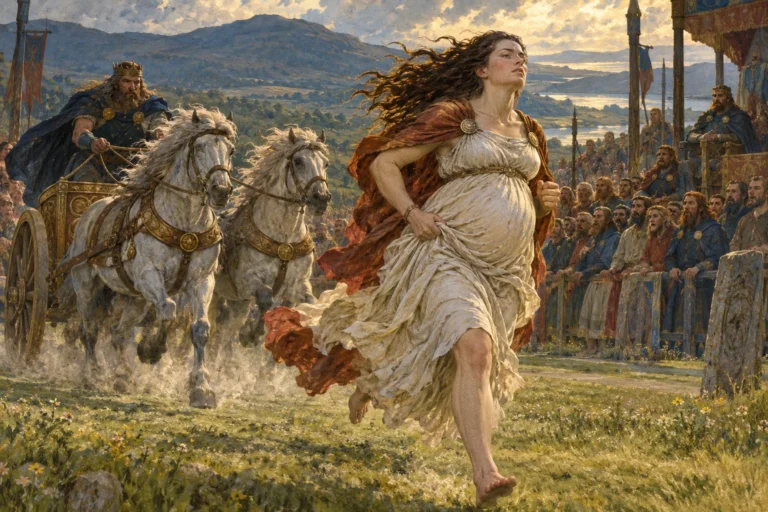
Before Deirdre was born, a cry from her mother’s womb disturbed a gathering of the Ulstermen. Cathbad foretold that the child would be beautiful, but that violence and exile would follow. Some wanted the baby killed. King Conchobar refused. He would have her brought up apart, intending that she should become his own companion.
Deirdre grew in seclusion. One winter she saw a raven drinking blood on snow and imagined a man with hair as dark as the bird, cheeks as red as the blood and skin as white as the snow. Leborcham knew such a man: Naoise, one of the three sons of Uisliu.
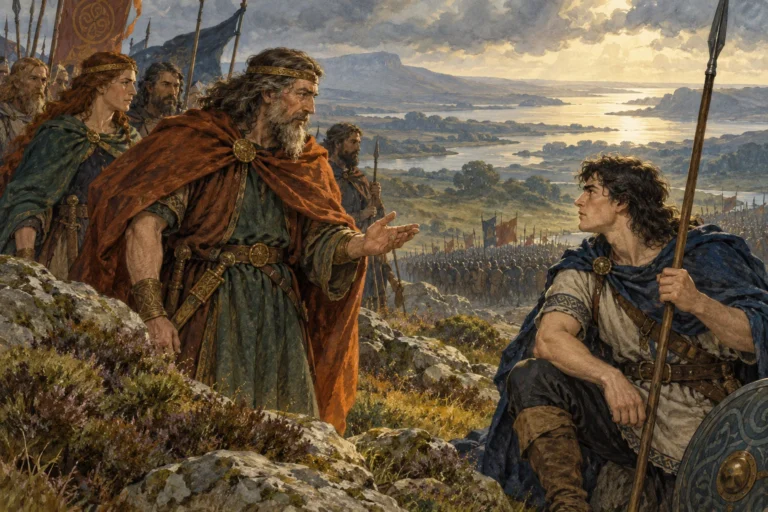
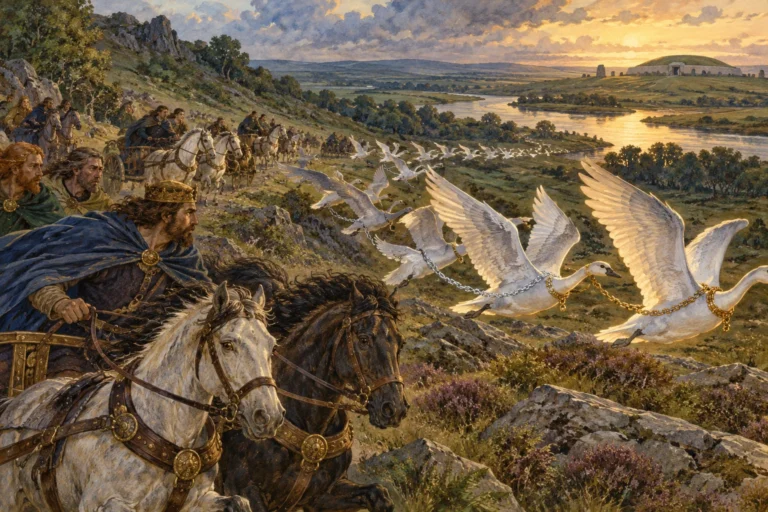
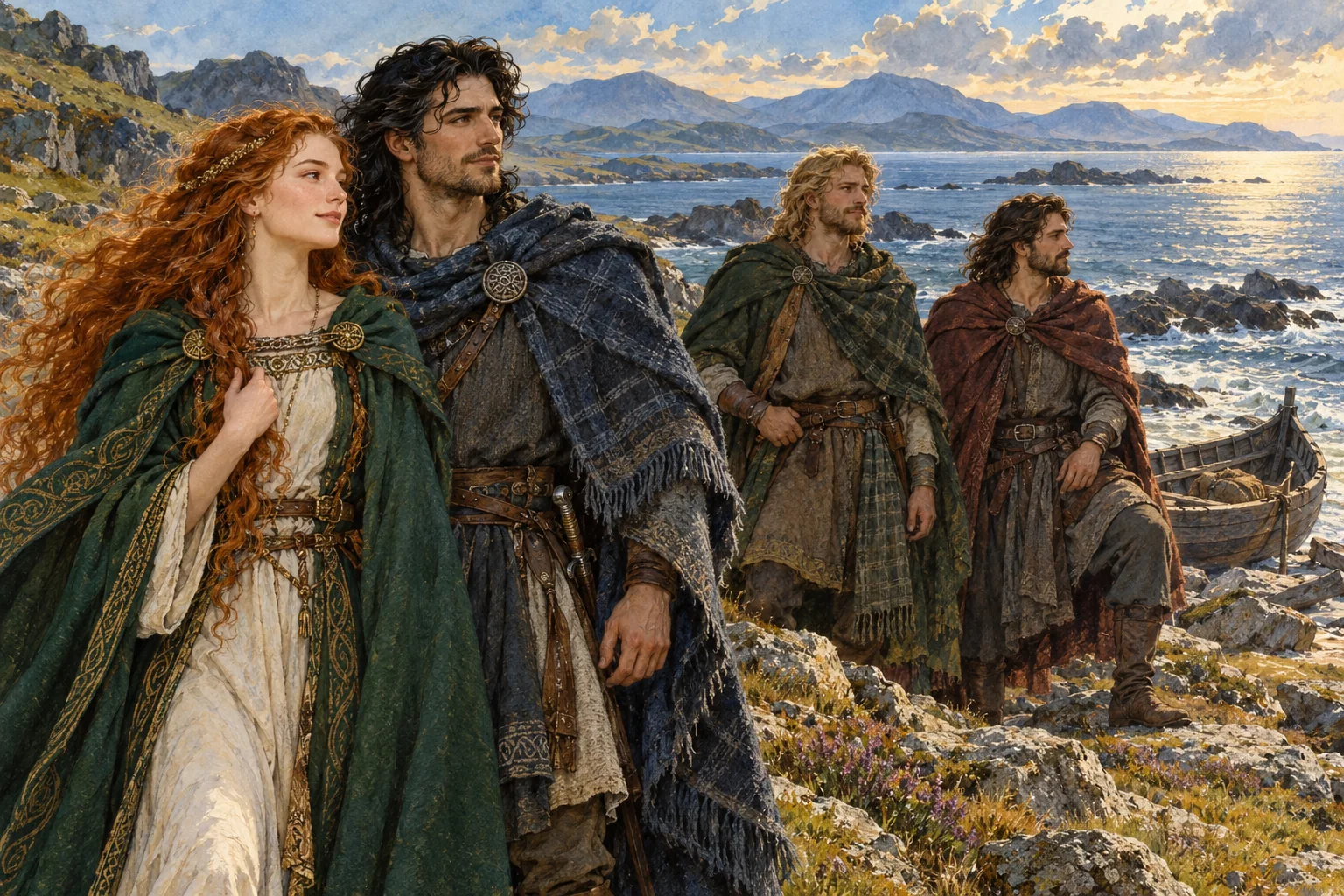
When Deirdre met him, Naoise feared the king and the prophecy. She pressed him to choose her. At last he agreed to leave, and his brothers Ainnle and Ardan stood with him. Their departure took them through Ireland and eventually across the sea to Alba, with followers as well as the four people at the story’s heart. Leahy, “The Exile of the Sons of Usnach”.
Exile did not make them safe. A king in Scotland desired Deirdre and tried to have the brothers removed. She warned Naoise, and they escaped again. When word came that Conchobar would receive them back, the offer was welcome, provided that trusted men guaranteed their safety.
Fergus was among those guarantors. But on the journey he was drawn away to feasting. His son continued with the returning party. At the green of Emain Macha, Eógan mac Durthacht approached Naoise with a spear. Fergus’s son tried to shield him with his own body. The protection promised to the exiles collapsed; the sons of Uisliu were killed.
The betrayal divided Ulster. Fergus and his allies retaliated, then went into exile with Ailill and Medb. Conchobar had recovered Deirdre but not her affection. For a year she remained with him in grief.
When he asked whom she hated most, she named him and Eógan, the man who had killed Naoise. Conchobar declared that she would be given to Eógan. On the journey that followed, Deirdre killed herself against a roadside stone. The tale ends with several losses bound together: the deaths of Deirdre and the brothers, the violation of protection, and Fergus’s exile from Ulster. Hull, pp. 65–69.
Versions and variations
The older exile narrative. The Book of Leinster tradition makes the broken guarantee central. Eógan kills Naoise at Emain; Deirdre survives for a year before her death. Leahy and Hull are translations/editions of this tradition, not two independent folk tellings. Hull, pp. 65–69.
The Glenmasan telling. The return journey receives much fuller treatment. Deirdre dreams of the companions without their heads, advises going to Cú Chulainn at Dundalk for protection, and recognises the danger of being lodged in the Red Branch house while the king remains elsewhere. These particular warnings belong to this account and should not be silently inserted into the shorter narrative. MacKinnon, paragraphs 20–26.
Gregory’s changed ending. Gregory’s Deirdre obtains a carpenter’s knife after the brothers’ burial and dies before the king can take her back to Emain. Her notes explicitly acknowledge Scottish Gaelic material for the circumstances of Deirdre’s birth and death. The change is substantial: it removes the older narrative’s year of captivity and confrontation with Eógan. Gregory, pp. 139–140; her source notes.
Names such as Uisliu, Uisnech and Usnach also vary across editions. Spelling differences alone do not establish a different plot or an independent source.
Context and evidence
The tale connects personal coercion with a political disaster. Its narrator repeatedly directs blame towards Deirdre; a modern reader can also examine Conchobar’s decision to reserve a child for himself and his later breach of protection. That distinction between a narrator’s judgement and a reader’s interpretation belongs in the research panel.
Emain Macha is the return destination and the place of betrayal in the older text. Alba is the overseas refuge, but the story’s journey should not become an exact modern itinerary without further place research. The survival of Navan Fort establishes the place’s archaeology, not the historicity of Deirdre or the killings.
Sources for this entry
- Anonymous; translated by A. H. Leahy, Heroic Romances of Ireland, volume I. London: David Nutt, 1905. The Exile of the Sons of Usnach: introduction and Book of Leinster version. Read source — Checked public-domain translation forming the main retelling’s narrative basis.. About this book
- Anonymous; edited and translated by Vernam Hull, Longes Mac n-Uislenn: The Exile of the Sons of Uisliu. Original edition 1949; New York reprint 1971 used by CELT, T301020B. Translation, pp. 60–69, especially pp. 65–69. Read source — Scholarly check of the older exile narrative, not a new oral version..
- Anonymous; edited and translated by Donald MacKinnon, The Glenmasan Manuscript. The Celtic Review, serial publication 1904–1908; CELT T800012. Paragraphs 20–26: Deirdre’s dream, proposed appeal to Cú Chulainn, arrival at Emain. Read source — Checked later narrative treatment of the return journey. Only the passages identified here were compared..
- Lady Gregory, Cuchulain of Muirthemne. London: John Murray, 1902. VII. Fate of the Children of Usnach, pp. 104–142; knife ending pp. 139–140. Read source — Checked literary synthesis with a different death scene.. About this book
- Lady Gregory, Cuchulain of Muirthemne: Notes by Lady Gregory. 1902. Opening account of transferred passages and Scottish Gaelic versions; Fate of the Children of Usnach authorities, pp. 359–360. Read source — Gregory’s statement of editorial method and source dependence.. About this book
Research coverage
Compared the older exile narrative, specified Glenmasan return passages and Gregory’s adaptation. A complete study still requires the full later Oidheadh Chloinne Uisneach manuscript tradition, Scottish oral recordings and modern literary rewritings. This is not a complete census of Deirdre variants.
The Myths · Irish collection · Editorial approach
Further Reading