Ulster Cycle; a fore-tale to the Táin · story
Nera’s Adventure
A Samhain challenge sends Nera from a gallows into the Otherworld beneath Cruachan. The destruction he witnesses may still be prevented, but returning to warn his people is only the beginning.
Also found as: Echtra Nerai · The Adventures of Nera · The Adventure of Nerae · Táin Bó Aingen
Research reviewed 17 October 2026.
Read the story
Version followed: this original retelling follows Kuno Meyer’s 1889 translation, §§1–19. It condenses the cattle episode but retains it before the final raid, along with the text’s repeated warnings and returns.
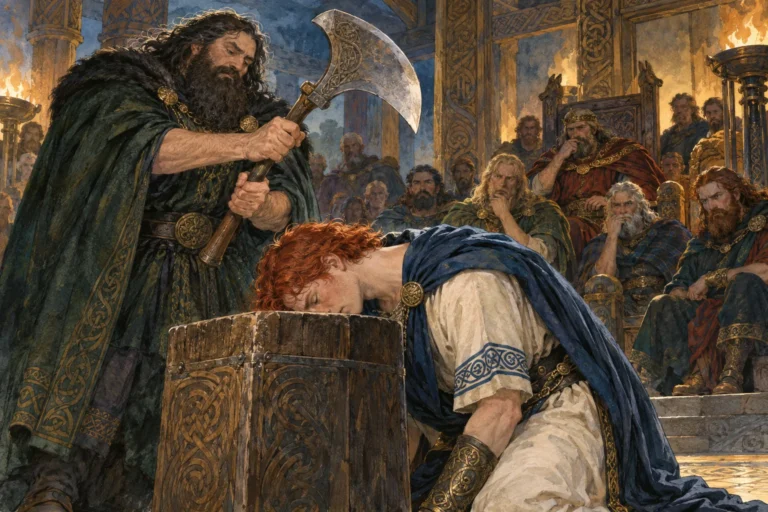
At Samhain, Ailill and Medb’s household gathered at Cruachan while their food cooked. Outside stood the gallows where two captives had been hanged the previous day. Ailill offered a reward to anyone brave enough to fasten a withe around one dead man’s foot. Those who tried came quickly back. Nera accepted, and Ailill promised his gold-hilted sword.
Nera armed himself and went out. Three times the withe slipped loose. Then the corpse spoke, telling him how to secure it. Once the task was done, the dead man asked for another service: he had been thirsty when he died. Would Nera carry him to a house where he could drink?
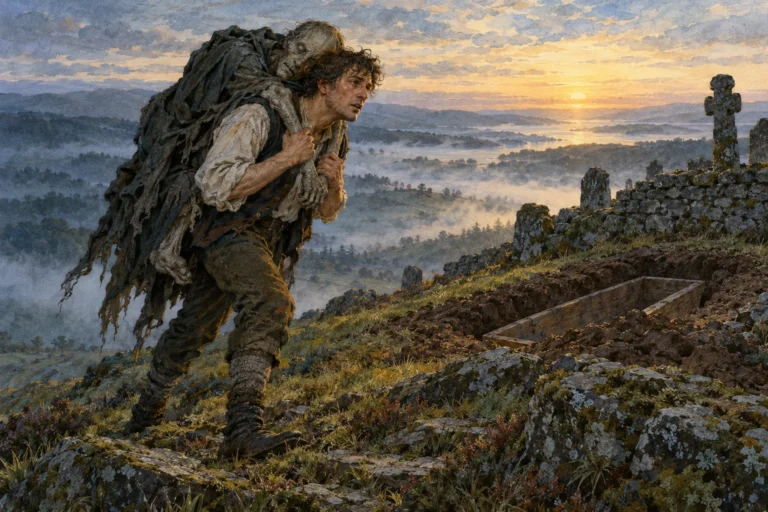
With the corpse on his back, Nera approached three houses. At the first they saw fire surrounding the dwelling; at the second, water. The dead man refused both. At the third he found water left in washing vessels and a slop-pail. He drank, then spat the last mouthful over the sleepers. They died. Nera carried him back to the gallows and turned towards the royal stronghold.
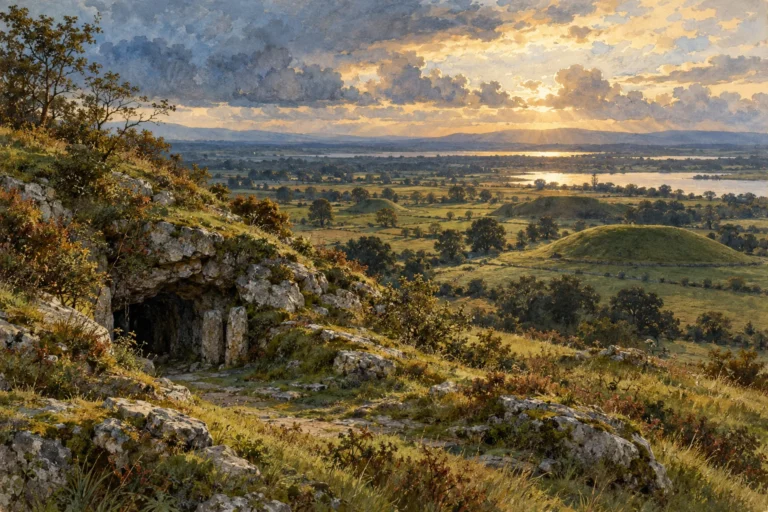
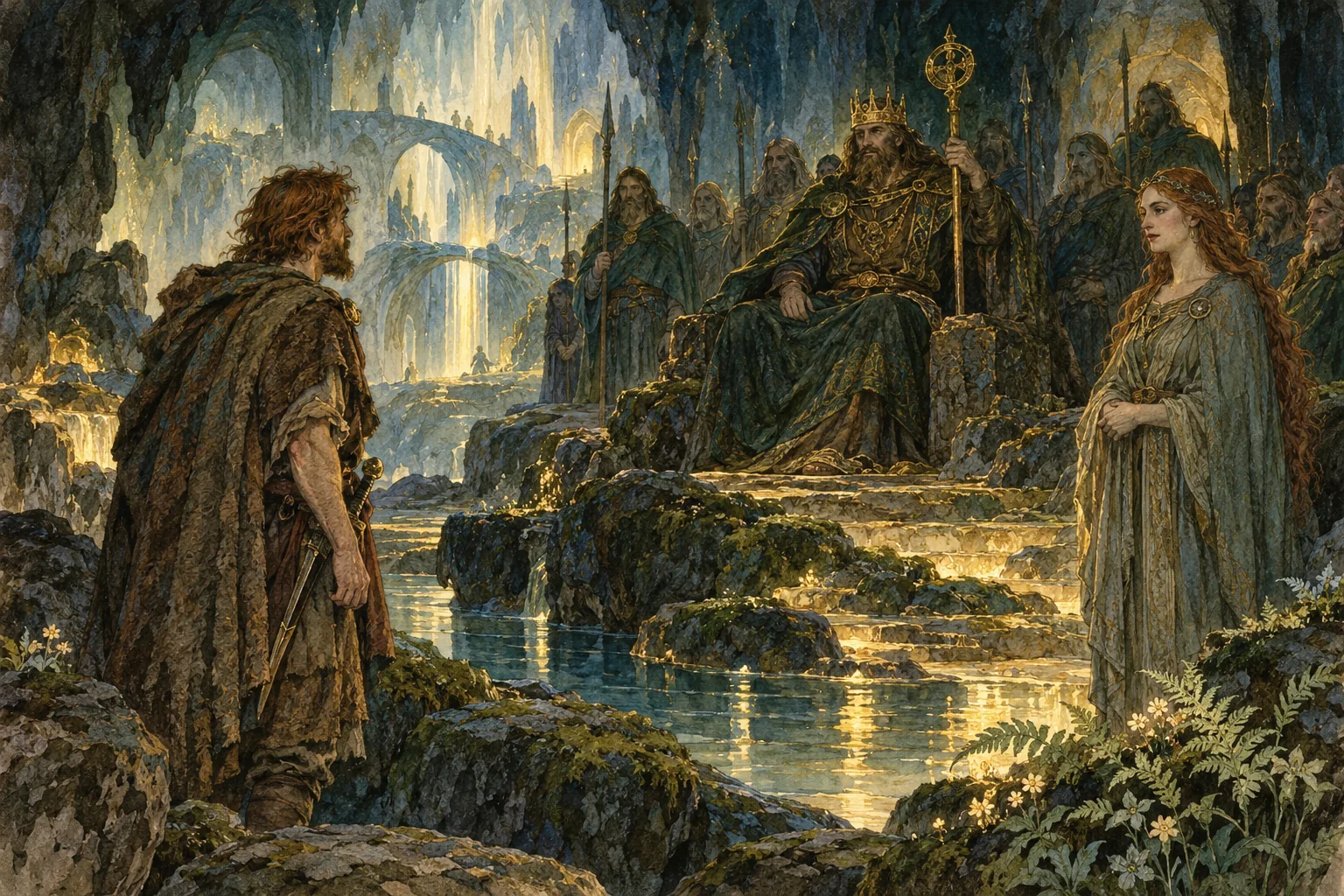
Cruachan appeared to be burning. The heads of its people lay before him, and a company of warriors moved away. Nera followed them into the cave and onwards into the síd. The warriors noticed the stranger behind them, passing the news along their line until he was brought before their king.
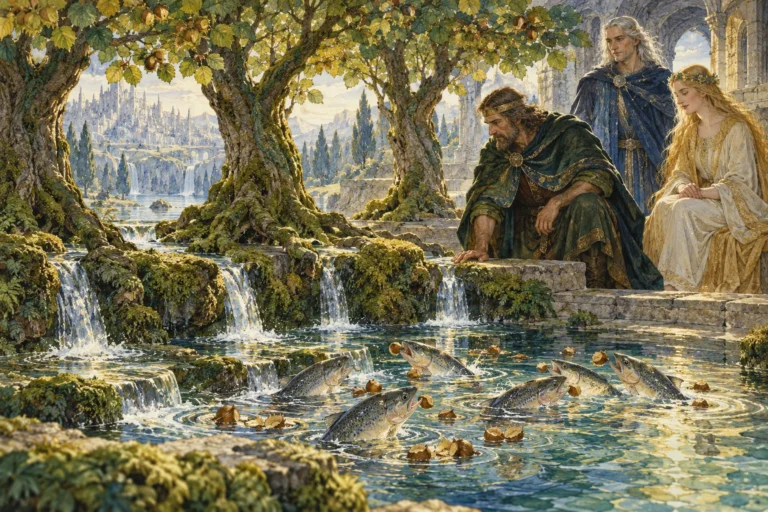
The king sent him to a woman who lived alone and required him to bring firewood each day. Nera stayed with her as her husband. On his daily journeys he saw a blind man carrying a lame man to a well. They checked that something was still there, then withdrew. His wife explained that they guarded the king’s golden crown.
She also explained the ruin he thought he had seen. Cruachan had not yet been destroyed. The sight would become true unless he warned his people. Although he seemed to have spent three days and nights away, they were still beside the same cooking pot. To prove his journey, she gave him summer plants to carry back. She told him she would bear his son, and asked him to protect their household when his own people attacked the síd.
Nera returned with wild garlic, primrose and golden fern. His people believed his account and gave him the sword. A year passed. Before the planned attack, Ailill sent him back for his family and cattle. His wife welcomed him: she had carried his firewood in his absence, explaining that he was ill. Their son now had a cow of his own.
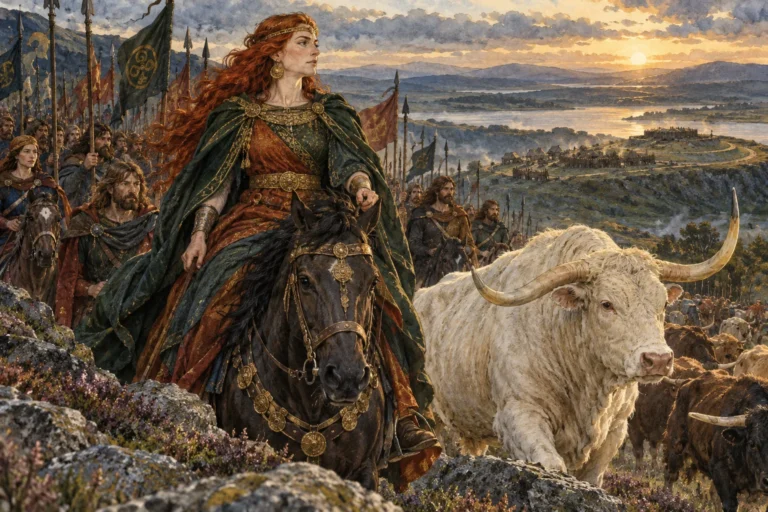
While Nera slept, the Morrígan took that cow to the Brown Bull of Cooley. The animal returned, and its calf became part of a new warning. The tale repeats the prospect of an attack at the next Samhain and another return to Ailill’s court. When Nera finally brought the cattle out, the calf bellowed, alarming Fergus.
The calf fought Finnbennach, the Whitehorn, and lost. Medb’s herdsman interpreted its cry: its father, Donn Cúailnge, would defeat the victor. Medb swore that she must see those two great bulls fight.
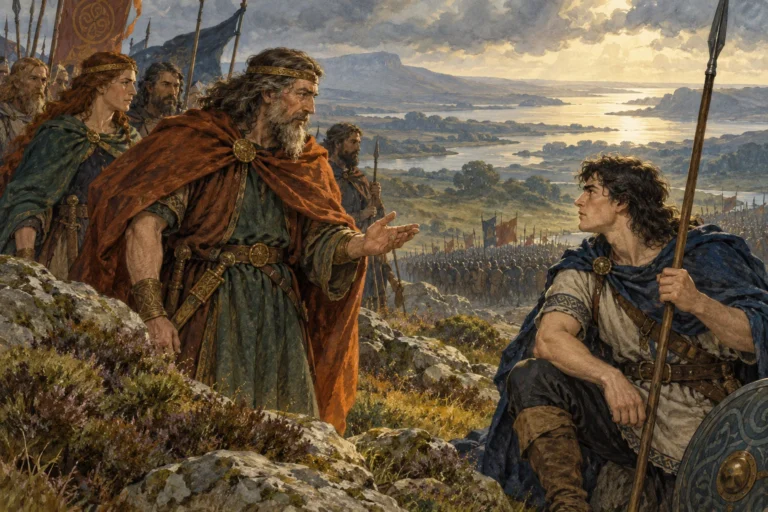
The men of Connacht and their Ulster allies entered the síd and plundered it, carrying away the crown. Nera remained there with his own people. The tale ends by saying that he has never returned, and will remain until the world’s judgement.
Versions and variations
The corpse’s journey is shortened
Meyer gives the visits to three houses, the water left overnight and the death of the sleepers. Gregory reduces that whole episode to Nera finding the dead man a drink and returning him to the gallows. Her version therefore preserves Nera’s courage and strange companion while removing the household prohibitions and the corpse’s lethal action. Meyer, §§3–6; Gregory, Cruachan, pp. 155–156.
The family and the cattle change position
In Meyer, Nera’s wife promises a son; the son’s cow and its calf join the Otherworld household directly to the cattle-raid material. Gregory retains the wife but omits that explicit child-and-cow connection. She finishes the raid on the hill and Nera’s permanent stay before introducing a further episode in which the Morrígan takes a cow to Donn Cúailnge. That is a change of arrangement, not proof that she collected a second independent performance. Meyer, §§10–19; Gregory, pp. 157–158.
Uneven time is part of the surviving account
Meyer’s version moves from three apparent days to an unchanged cooking pot, then through repeated year-long preparations. Gregory’s abridgement makes the approach to the final raid simpler. The retelling above marks the repetition rather than inventing dates that resolve it. A complete structural study would need to consider the Irish text and its variants.
Gregory lists Meyer among the authorities for her Cruachan chapter, together with O’Beirne Crowe, O’Curry and Rhys. That chapter also contains stories other than Nera’s. Its collective bibliography cannot establish the precise source of every sentence. Gregory’s Notes, p. 360.
Context and evidence
Nera belongs to the literary world of Medb, Ailill and Fergus. Its cattle episode connects Cooley to the Ulster stories; that setting is not evidence that the corpse, the journey or the predicted destruction happened historically.
Rathcroghan is an archaeological landscape as well as a story setting. The visitor centre’s account distinguishes its monuments and the constructed entrance to Oweynagat. Meyer’s wording gives a cave route into the síd, but identifying every space inside the tale with a particular excavated feature would go beyond the evidence used here.
Sources for this entry
- Anonymous; edited and translated by Kuno Meyer, Echtra Nerai / The Adventures of Nera. Revue Celtique 10 (1889), pp. 212–228; scan hosted by University College Cork. English translation, §§1–19; introduction and manuscript variant apparatus. Read source — Named basis of the original retelling; contains both the Otherworld visit and the cattle sequence..
- Lady Gregory, Cuchulain of Muirthemne. 1902; Internet Sacred Text Archive transcription. IX, Cruachan, especially pp. 155–158. Read source — Literary adaptation compared for omissions, rearrangement and the treatment of Nera’s family.. About this book
- Lady Gregory, Cuchulain of Muirthemne: Notes. 1902. pp. 356–360; Dream of Angus and Cruachan source lists. Read source — Documents Gregory’s dependence on earlier editions and her practice of rearranging passages.. About this book
- Rathcroghan Visitor Centre, Discover Rathcroghan. Official heritage website, consulted 17 October 2026. Óenach Cruachain and Accessing the Irish Otherworld sections. Read source — Place context; not an independent witness to Nera’s narrative..
Research coverage
Meyer’s complete English text, introduction and visible apparatus, plus Gregory’s Nera passage and following cattle episode, have been examined. No full manuscript collation has been made. John Carey’s later translation, the history of the textual repetitions, and local oral retellings remain to be assessed.
The Myths · Irish collection · Editorial approach
Further Reading