Ulster Cycle · story
The Cattle Raid of Cooley
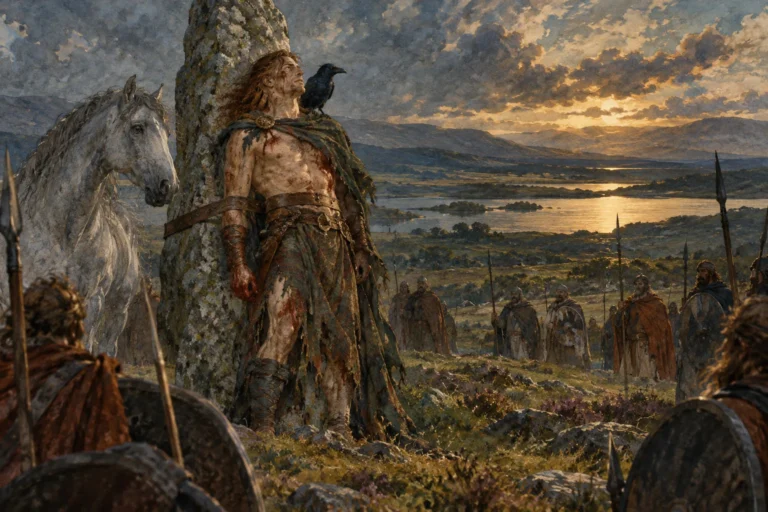
Medb and Ailill lead a great army into Ulster to seize its exceptional brown bull. Cú Chulainn holds the invaders at bay while Ulster’s warriors lie helpless, but victory comes at a cost that neither side can undo.
Also found as: Táin Bó Cúailnge · Táin Bó Cúalnge · The Táin · The Brown Bull of Cooley · The Cattle-Raid of Cualnge
Research reviewed 17 October 2026.
Read the story
An original overview of the whole epic, following L. Winifred Faraday’s 1904 translation for the campaign and ending. The opening dispute and failed loan follow Joseph Dunn’s 1914 Book of Leinster-based translation. The shorter Ferdiad encounter retained here differs from the four-day version told on our separate Ferdiad page.
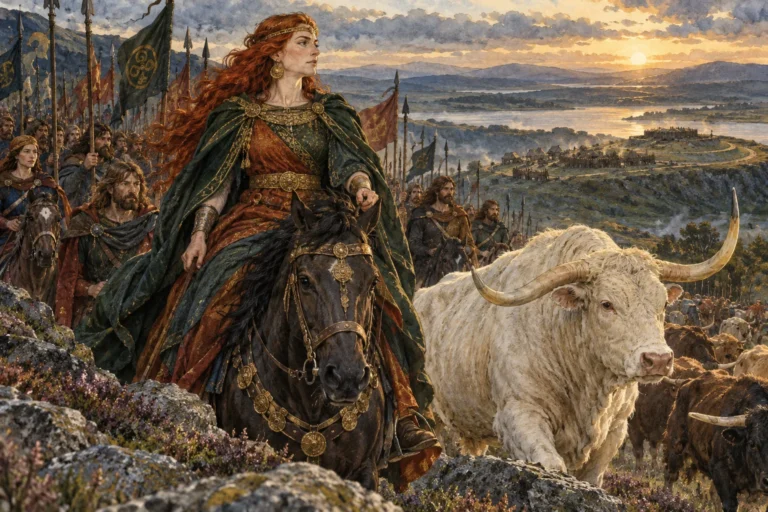
One night at Cruachan, Ailill told Medb how fortunate she was to have a wealthy husband. She had been wealthy before she married him, she replied. They compared their possessions, bringing out treasure and clothing, counting animals and matching one valuable beast against another. Everything balanced until they reached the cattle.
Ailill owned Finnbennach, the Whitehorned, a bull without an equal in Medb’s herds. Once it had belonged to her, but it had left a woman’s ownership for the king’s. To Medb, the difference made every other possession seem worthless. Her messenger knew of an animal that could answer it: Donn Cúailnge, the Brown Bull of Cooley, belonging to Dáire mac Fiachna in Ulster.
At first Dáire agreed to lend the bull for a year. The promised payment was handsome. Then his guests drank too much and boasted that, had he refused, they would have taken the animal by force. When the words reached him, the agreement collapsed. The messengers returned empty-handed. Medb decided to take what she could no longer borrow. Dunn, chapters I–II, pp. 1–9.
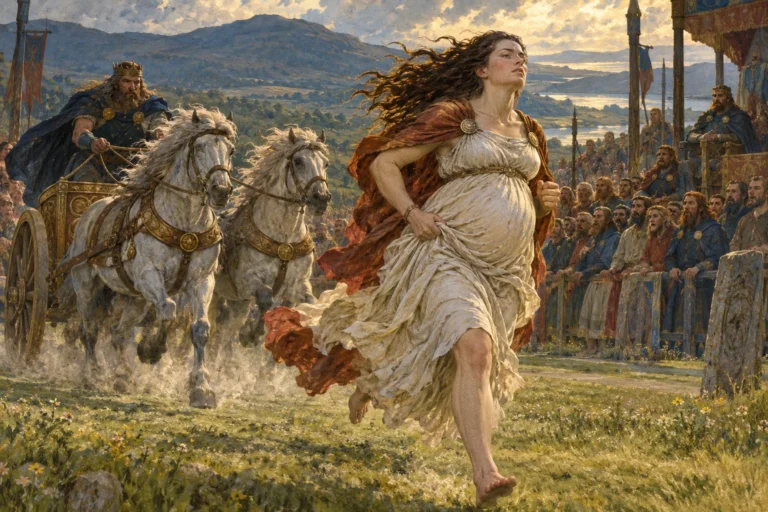
A great coalition assembled at Cruachan. Among its leaders was Fergus mac Róich, an exile from Ulster who still loved people on the side he would invade. Medb expected little resistance: Conchobar and his warriors were suffering the recurring weakness associated with Macha’s curse. Yet the prophet Fedelm repeatedly foresaw blood. When Medb explained why the army should be safe, the warning did not change.
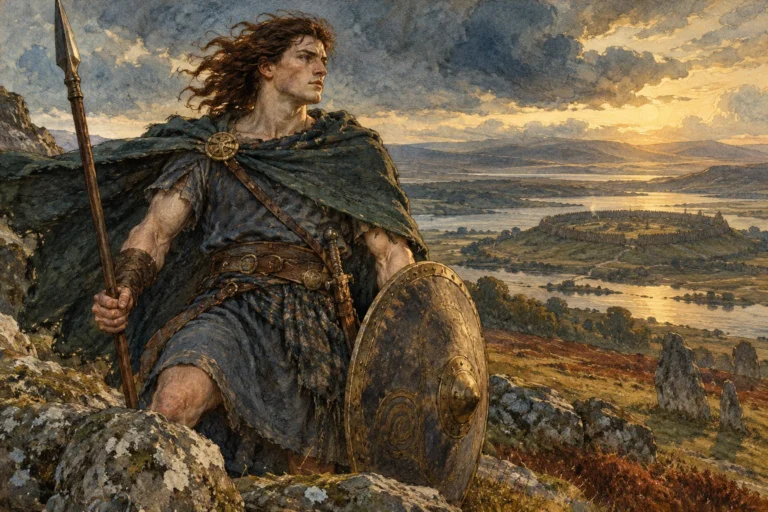
The army advanced, and Cú Chulainn became the obstacle it could not easily remove. While his fellow warriors were helpless, he and his charioteer Láeg watched the roads and fords. His attacks made camping dangerous. Men died before the force could settle into the routine of conquest. Ailill offered him wealth, land and service under another king. He would not abandon Conchobar.
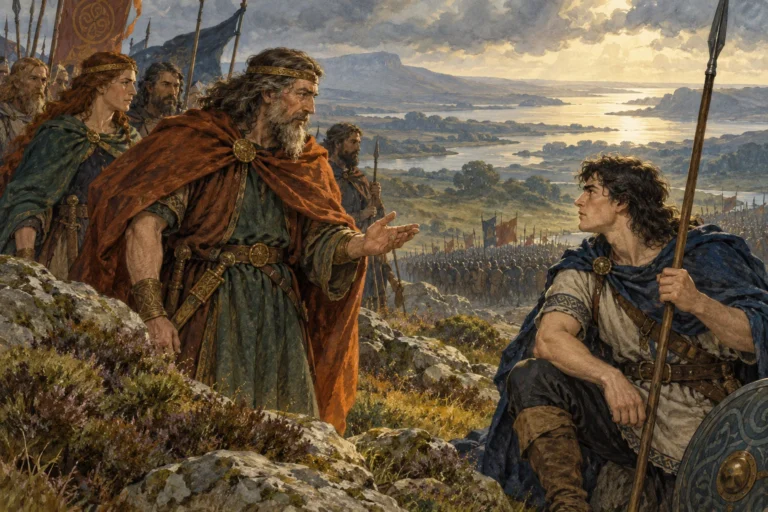
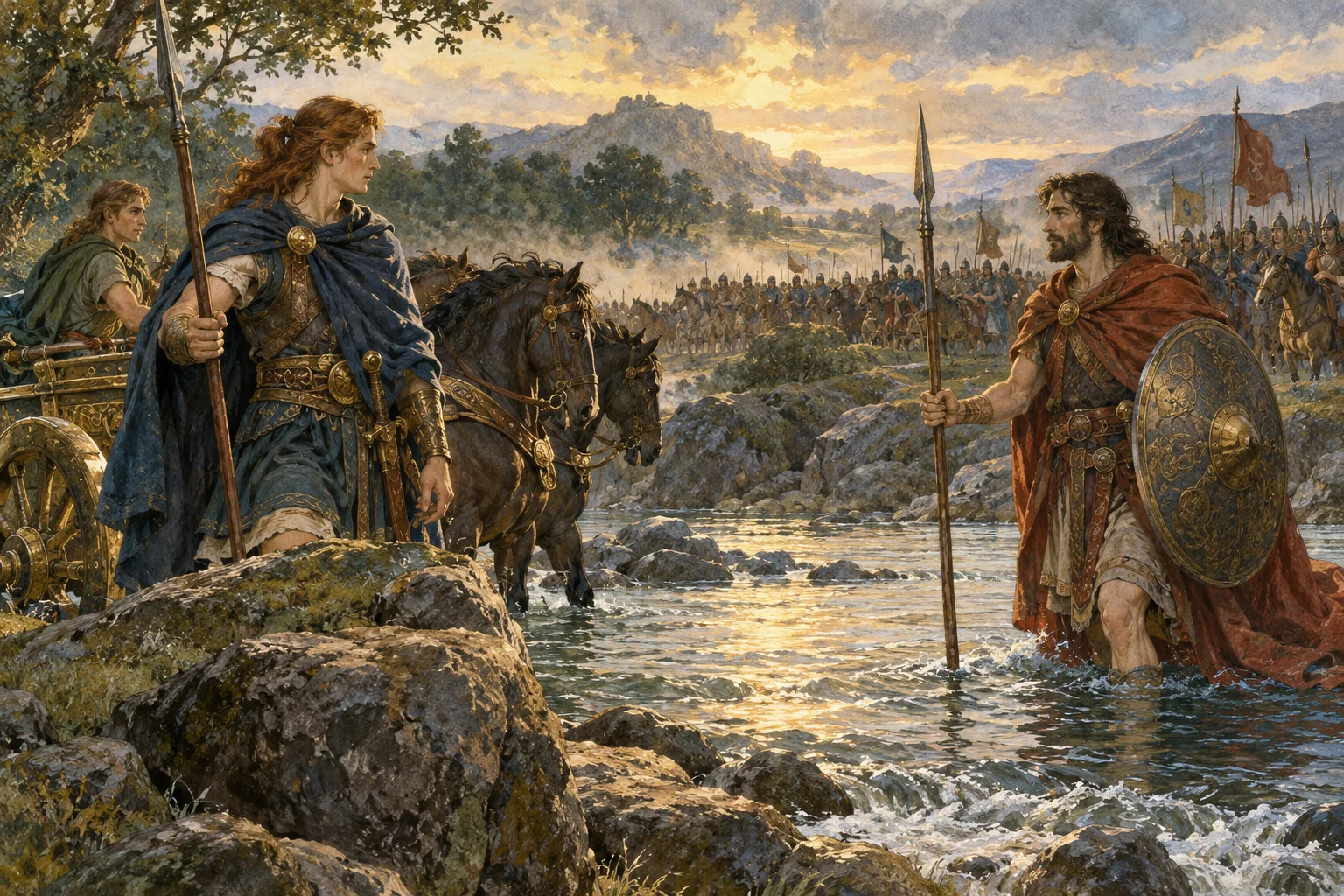
Fergus understood the bargain that might be possible. If a champion met Cú Chulainn in single combat, the cattle must remain where they were for the agreed interval. The invaders preferred losing one fighter to losing many in night attacks. Cú Chulainn needed time for Ulster to recover. The ford became the place where the campaign’s movement was measured in lives. Faraday, opening muster and negotiation before “The Death of Etarcomol”.
The compact did not make the conflict orderly. Some men came boasting; some were promised Findabair, Medb and Ailill’s daughter. Others were sent in groups when fair combat failed. Etarcomol ignored Fergus’s warnings and kept demanding a fight until Cú Chulainn killed him. Old acquaintances were drawn into the danger, so that each new challenge could bring another personal loss.
Meanwhile Medb’s forces spread through the country. They found the Brown Bull and brought him to the camp despite Cú Chulainn’s pursuit and the death of a man driving the herd. Capturing him was not the end of the war. The invaders still had to get their army, animals and plunder home.
A beautiful stranger offered Cú Chulainn her love and assistance. He rejected her, preoccupied with battle. She was the Morrígan, and during his combat with Loch she attacked in other shapes: an eel round his legs, a wolf driving cattle, and a heifer leading the herd. He wounded her in each encounter. Later, disguised as an old woman milking a cow, she obtained healing through his blessings on the milk she gave him.
Winter wore him down. Lugh came to him as his father from the otherworld, treated his wounds and promised to take his place while he slept. For three days and nights Cú Chulainn rested. During that interval boys from Emain came south to help him and were killed. When he woke and learned their fate, his restored strength turned to fury. He drove against the army in a terrible, transformed state, avenging the children with slaughter. “The Finding of the Bull”; “The Conversation…”, “The Healing of the Morrigan”; “The Coming of Lug Mac Ethlend” and the second death-of-the-boys account.
Fergus too was sent against him. Cú Chulainn knew that his friend’s sword had been stolen by Ailill and replaced with wood. Neither wanted the other dead. They agreed that Cú Chulainn would withdraw now, and Fergus would yield to him when the decisive battle came.
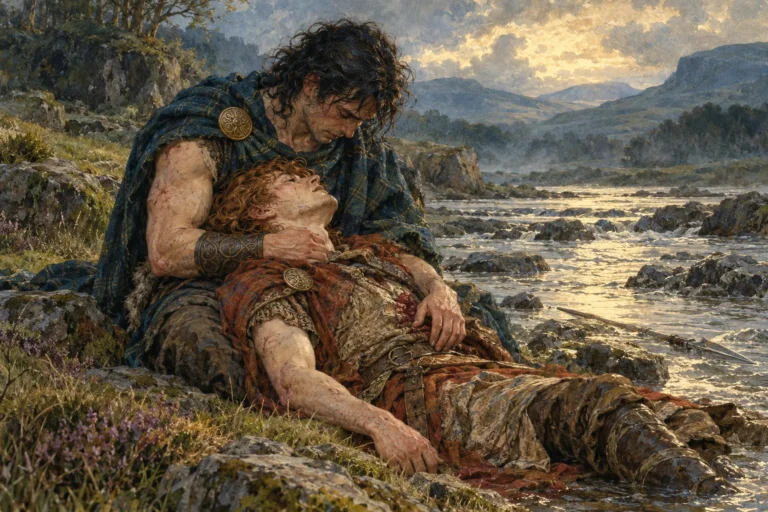
Then Medb summoned Ferdiad, Cú Chulainn’s beloved companion from their training with Scáthach. Gifts, threatened disgrace and the claim that Cú Chulainn despised him overcame his reluctance. At the ford their shared skill could not save their friendship. In this shorter telling, Láeg sent the gáe bolga along the water; Cú Chulainn used it to draw Ferdiad’s defence down, then struck above the shield with his spear. Ferdiad died, and the victor lamented the friend he had killed. Fergus encounter and “The Combat of Fer Diad and Cuchulainn”.
At last the Ulstermen gathered. Sualtaim carried the call for help; companies assembled around Conchobar. Across the camps, Fergus recognised the arriving leaders from the descriptions brought by Mac Roth. The single defender, covered in wounds, now had an army behind him.
In the great battle Fergus recovered his real sword and attacked with devastating force. His anger at Conchobar nearly became vengeance, until others intervened. Cú Chulainn heard his blows, forced himself into action and called in their promise. Fergus withdrew with his men. Other contingents followed, and Medb’s remaining force gave way. When she asked Cú Chulainn for protection, he granted it and allowed the retreat westward.
The Brown Bull nevertheless reached Connacht and met the Whitehorned. Their own struggle trampled Bricriu to death and continued beyond human control. The Brown Bull prevailed, carrying his opponent’s torn remains on his horns. Fergus prevented the men from killing him, and the animal turned towards home. Parts of the Whitehorned fell along the route, supplying the tale with explanations for place-names.
Donn Cúailnge reached the northern country and died. Medb had obtained the bull, but could not keep him; Ailill had lost the animal that began their contest. The survivors made peace. In Faraday’s ending, the two sides remained without mutual bloodshed for seven years. Ulster returned to Emain with its victory and its dead to remember. “The Long Warning of Sualtaim”, final battle, bull-fight and closing paragraph.
Versions and variations
The opening depends on the version. Faraday’s translated narrative opens with the army assembling at Cruachan and Fedelm’s prophecy; the famous bedroom argument is explained in her introduction rather than translated as its opening scene. Dunn begins with the pillow-talk and the embassy to Dáire, drawing principally on the Book of Leinster tradition. This page identifies the added opening instead of implying that Faraday’s first recension contains Dunn’s first two chapters in the same position. Dunn also incorporates passages from other witnesses and marks them in notes: his book should not be described as a pure, single-manuscript text. Faraday, introduction and opening; Dunn, preface and chapters I–II.
Ferdiad’s last wound changes. In Faraday’s shorter encounter, the gáe bolga makes Ferdiad lower his shield and a spear thrust above it pierces his heart. Dunn’s chapter XX expands the fight into four days and makes the gáe bolga itself the fatal weapon, entering from below. That difference is more consequential than modernised spelling: it alters both the duration and mechanics of the most famous duel. Our separate Ferdiad story follows the expanded tradition. Conclusion of “The Combat of Fer Diad and Cuchulainn”; Dunn, chapter XX, especially pp. 253–257.
The bull-fight also carries alternatives. Faraday has Fergus encourage the Brown Bull against his opponent; Dunn’s principal account and Gregory give the intervention to Cormac Conlongas. Faraday ends the bull’s journey at Druim Tairb after further movement through the north. Gregory describes his return home, final bellow and bursting heart. These details should not be silently blended into one supposedly universal ending. Gregory also opens “The Two Bulls” with the swineherds’ transformations, supplying an earlier life for the animals before returning to the end of the raid. Final bull-fight; Dunn, chapters XXVIII–XXIX; Gregory, chapter XIII, pp. 268–275.
This comparison samples major structural differences. It does not replace a complete recension-by-recension reading or an audit of later Irish and Scottish oral accounts.
Context and evidence
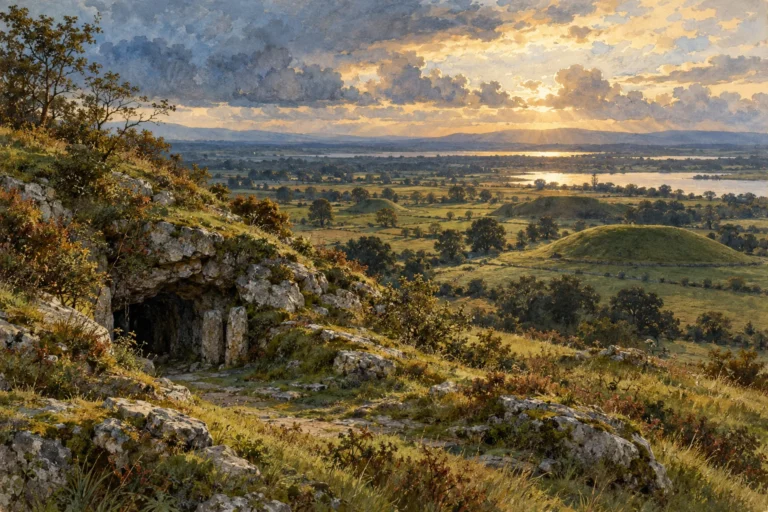
The Táin is a large narrative assembled from journeys, negotiations, poems, origin stories and combats. Its countries are a story-world with real geographical anchors, not a modern border map. Start with Rathcroghan, follow the Cooley landscape and Muirthemne, then return to Emain Macha. Read Macha’s curse for the explanation of Ulster’s debility, and Medb and Fergus for perspectives beyond Cú Chulainn. The medieval witnesses demonstrate that the story circulated and changed; they do not establish that its enormous army, supernatural combats or particular war happened as described.
Sources for this entry
- Anonymous; translated by L. Winifred Faraday, The Cattle-Raid of Cualnge (Táin Bó Cúalnge): An Old Irish Prose-Epic. London: David Nutt, 1904. Grimm Library, no. 16. Introduction; main narrative from muster to final peace; specifically negotiations, bull capture, Morrígan, Lug, Fer Diad, Sualtaim, final battle and bull-fight sections. Read source — Main public-domain campaign narrative, based on Lebor na hUidre and Yellow Book of Lecan material. About this book
- Anonymous; translated by Joseph Dunn, The Ancient Irish Epic Tale Táin Bó Cúalnge. London: David Nutt, 1914. Preface; I–II, pp. 1–9; XX, pp. 217–267; XXVIII–XXIX, pp. 363–369. Read source — Opening used in retelling; Book of Leinster-based edited translation with additional witnesses; comparison of duel and ending. About this book
- Lady Augusta Gregory, Cuchulain of Muirthemne. London: John Murray, 1902. XIII, “The Two Bulls”, pp. 268–275. Read source — Compared adaptation combining the swineherd pre-tale with the bulls’ final fight. About this book
- Lady Augusta Gregory, Cuchulain of Muirthemne: Notes. London: John Murray, 1902. Authorities for the War for the Bull, Awakening of Ulster and Two Bulls. Read source — Source dependencies of Gregory’s composite narrative. About this book
Research coverage
A whole-story overview rather than an episode-by-episode abridgement. Examined substantial selected passages across Faraday and Dunn, including their openings and conclusions, plus Gregory’s Two Bulls and related campaign passages. All named differences were checked directly. Full manuscript collation, the third recension, modern critical translations and Scottish Gaelic oral Táin versions remain outside this comparison. The campaign’s order follows Faraday; her textual uncertainties and omissions are not reproduced as if resolved.
The Myths · Irish collection · Editorial approach
Further Reading