Ulster Cycle · story
The death of Cú Chulainn
The warrior’s final enemies turn his obligations against him. Mortally wounded, he binds himself to a stone, and even then they hesitate to approach.
Also found as: Aided Con Culainn · Aided Chon Culainn · Brislech Mór Maige Muirthemne · Cuchulain’s last battle
Research reviewed 17 October 2026.
Read the story
This retelling follows the final battle shared by Stokes’s abridgement of the Book of Leinster text and Gregory’s adaptation. The larger revenge campaign and its later expansions need their own comparison.
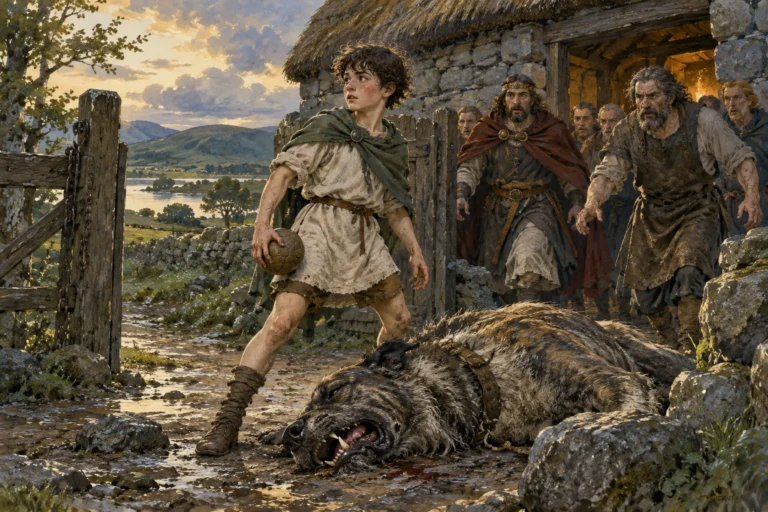
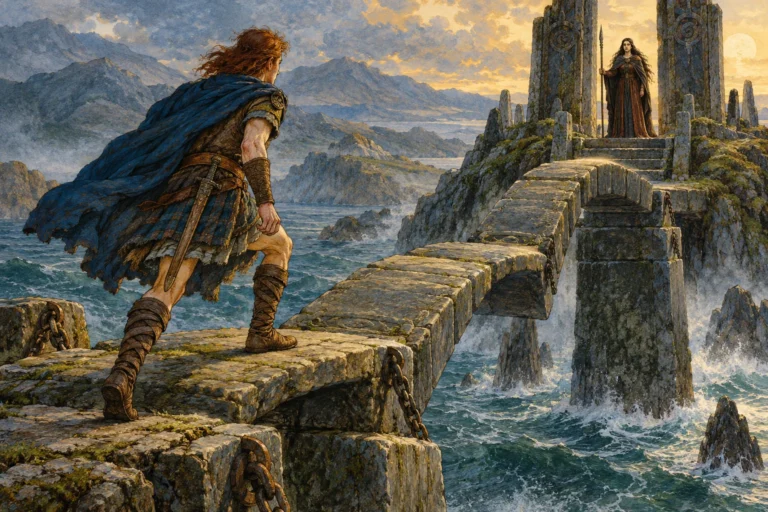
On the road to his last battle, Cú Chulainn met three women preparing a hound for food. He knew that the encounter brought danger. To eat the flesh of his namesake was forbidden to him. Yet their challenge also touched the honour he guarded: would he pass them because their meal was humble?
He accepted the food. Strength left the hand that took it and the leg on which he rested it. The warrior went on, but he no longer carried all his former power into the fight.
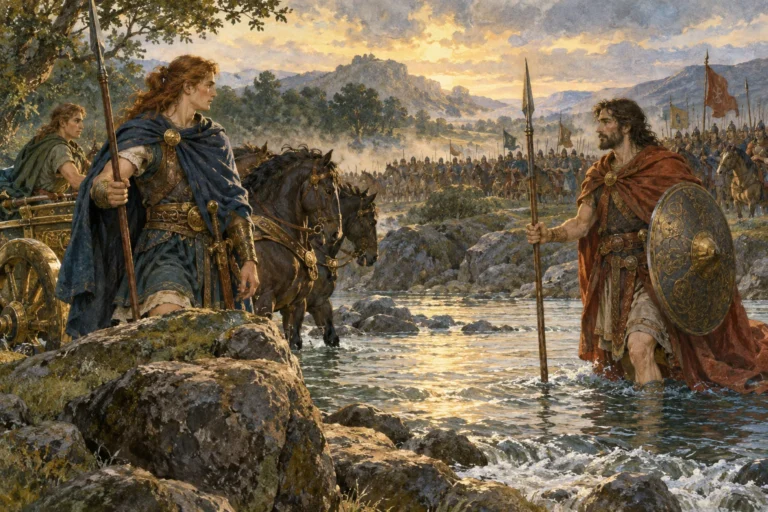
His enemies had arranged another trap. Men pretended to quarrel, and a satirist called on Cú Chulainn to intervene and surrender his spear. Refusal would invite shame. He answered by throwing it, killing the demander, but the weapon passed into hostile hands. Lugaid cast it back and killed Láeg, his charioteer. A king had fallen, the enemies said: the king of charioteers. Stokes, pp. 176–179.
The demand was repeated. Another captured spear struck the Grey of Macha, the king among horses. With the third, Lugaid mortally wounded Cú Chulainn himself. His remaining horse broke away, leaving him to face the end on the plain of Muirthemne.
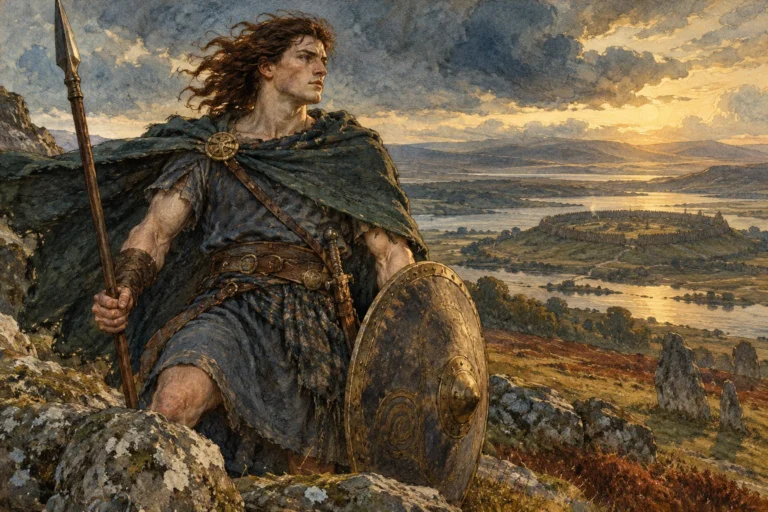
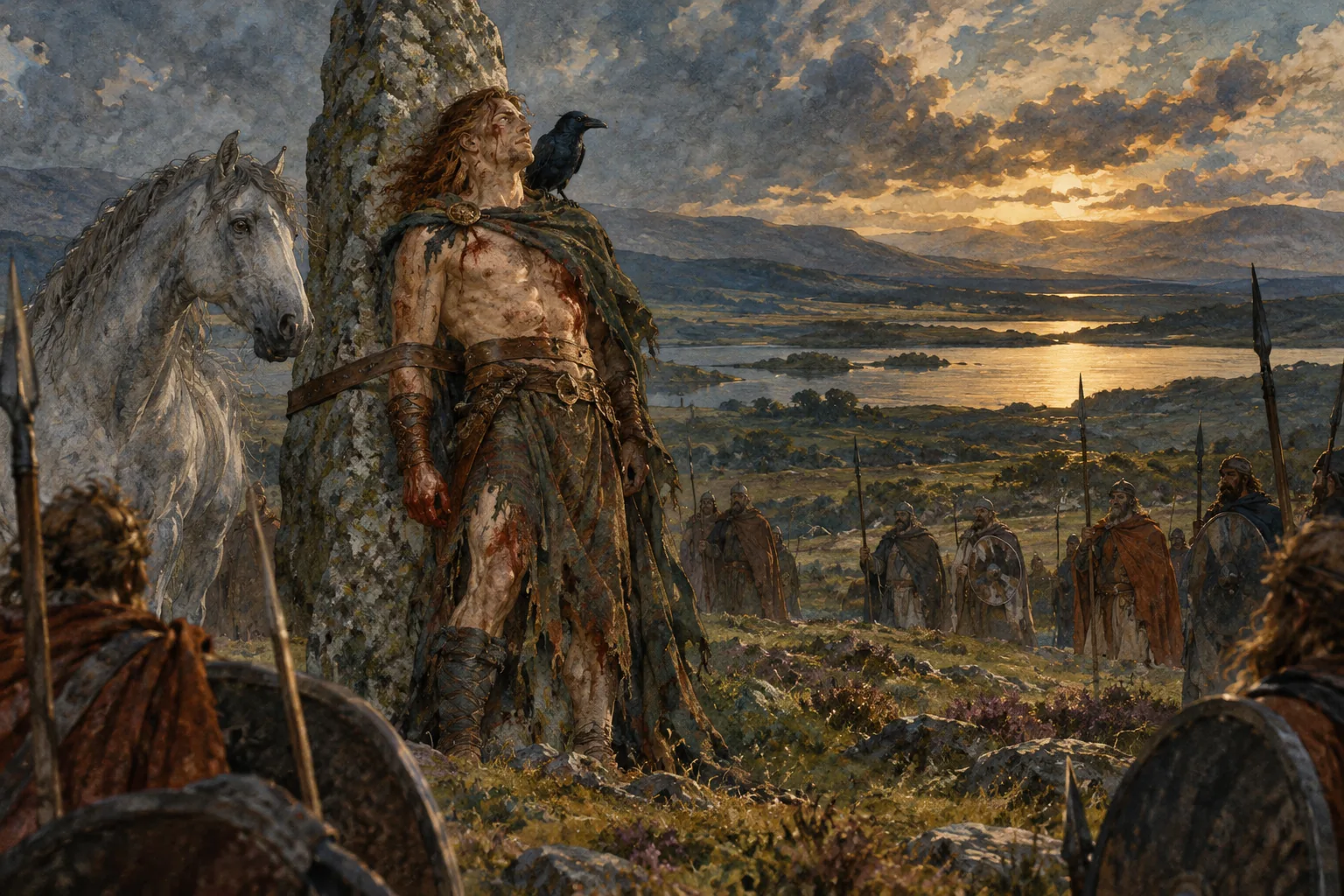
Cú Chulainn asked leave to reach a nearby lake. He drank and washed, then turned towards a standing stone. He fastened his belt around it so that he would remain upright. His enemies surrounded him at a distance. Even wounded, even motionless, he was still a man they feared to touch.
The Grey of Macha returned and defended him. For a while the last battle continued around the stone. Then a bird settled on the warrior’s shoulder. The enemies took that small movement as the sign they had been waiting for.
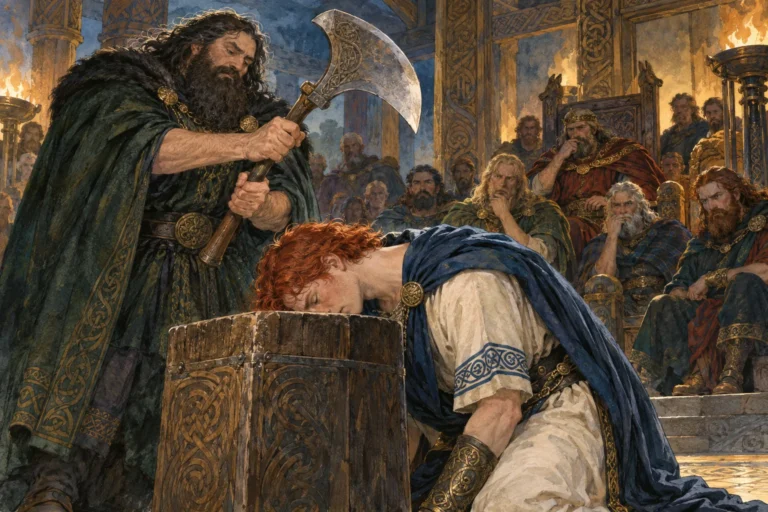
Lugaid approached and severed his head. As Cú Chulainn’s sword fell, it struck Lugaid’s hand. Death had ended the hero’s resistance, but the story was not finished with revenge. Conall Cernach came in search of him and pursued the killers, keeping the promise that whichever companion survived would avenge the other. The final image of the standing warrior is therefore followed by another violent obligation. Gregory, pp. 338–342.
Versions and variations
The opening farewell. Stokes’s abridged medieval account has Cú Chulainn visit his foster-nurse and receive a drink. Gregory opens this chapter with his mother Dechtire and a repeated omen in which the drink appears as blood. Her continuous life-story is a synthesis, not a literal translation of the one Book of Leinster text. Gregory, pp. 334–335.
The food prohibition. Both accounts connect the hound’s flesh with the hero’s own name and show the food weakening him. Stokes marks uncertainty in translating the cooking-hearth prohibition. That uncertainty matters: the frequently repeated explanation involving a neat pair of universally worded vows should not replace the particular wording of each source. Stokes, pp. 176–177.
The final bird. Gregory calls it a bird; Stokes translates the corresponding arrival as birds. Neither of these passages explicitly names the visitor as the Morrígan. A retelling that identifies her should name the source or label that identification as interpretation.
What follows the death. Gregory continues through Conall’s revenge, Emer’s lament and her death beside Cú Chulainn. Her notes list several printed and manuscript authorities for the gathering and death chapters. These endings should be mapped separately rather than treated as one unchanged medieval text.
Context and evidence
This story reverses the assurance of the boyhood naming tale. The Hound’s name, generosity and concern for honour become points at which he can be harmed. The interpretation offered here is that the tale tests a warrior’s social obligations as fiercely as his physical strength.
Mag Muirthemne is the narrative landscape of his final battle. Local monuments associated with the death deserve individual place pages with the history of each association. This entry does not claim that an identified standing stone proves the hero existed or that the killing happened there. A medieval death-tale is evidence for the story’s transmission; archaeological evidence must be assessed separately.
Sources for this entry
- Anonymous; edited and translated in abridged form by Whitley Stokes, Cuchulainn’s Death, abridged from the Book of Leinster. Revue Celtique 3 (1876–1878 volume), pp. 175–185; commonly cited as 1877. Book of Leinster ff. 77a1–78b2; food pp. 176–177; spears pp. 178–181; stone and birds pp. 181–182. Read source — Checked scan of the abridged medieval account. Translation uncertainties and abridgement remain visible.. About this book
- Lady Gregory, Cuchulain of Muirthemne. London: John Murray, 1902. XX. Death of Cuchulain, pp. 334–350. Read source — Checked influential literary synthesis; main comparison for farewell, final bird and extended ending.. About this book
- Lady Gregory, Cuchulain of Muirthemne: Notes by Lady Gregory. 1902. Gathering at Muirthemne and Death of Cuchulain source list, p. 360. Read source — Identifies Gaelic Journal texts, O’Grady in Hull, Stokes and an unpublished manuscript among Gregory’s authorities.. About this book
Research coverage
Checked Stokes’s abridgement against Gregory’s final chapter. A complete account of common versions still needs the later Brislech materials, modern critical editions and oral/local traditions, including the provenance of the Morrígan-as-final-bird identification. The exact modern death-site associations are not verified here.
The Myths · Irish collection · Editorial approach
Further Reading