Ulster Cycle · story
Bricriu’s Feast
A feast designed to provoke rivalry sends three Ulster champions through a series of impossible tests. The final challenge asks whether any man who can take a head is prepared to offer his own.
Also found as: Fled Bricrenn · Fled Bricrend · The Feast of Bricriu · The Champion’s Portion · The Champion’s Bargain
Research reviewed 17 October 2026.
Read the story
An original, shortened retelling of the main sequence in George Henderson’s 1899 translation of Fled Bricrend. Some intermediate contests are omitted; the two beheading episodes are kept distinct.
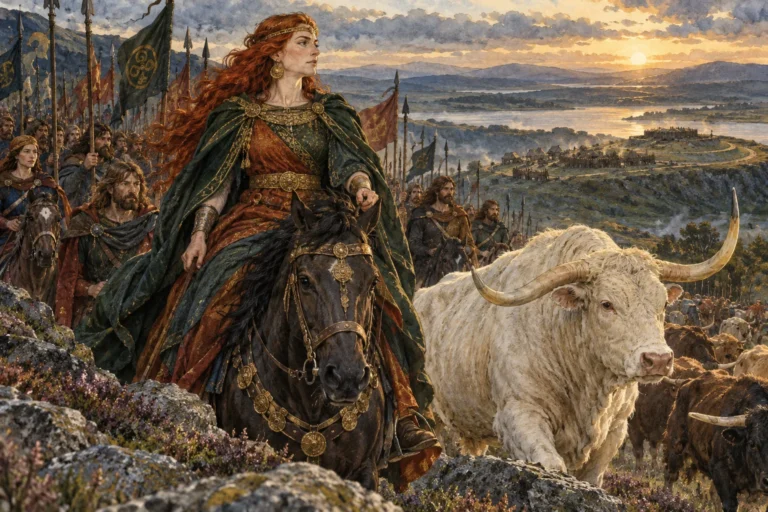
Bricriu spent a year preparing a feast that nobody wanted to attend. His new hall at Dún Rudraige was magnificent, with costly fittings and a raised seat for King Conchobar. He had even built himself a separate viewing room. He knew the guests would refuse to let him remain among them once the food was served.
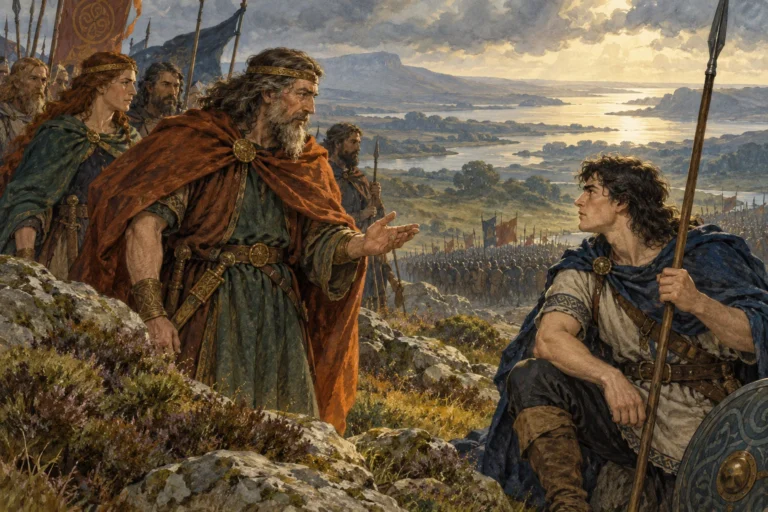
The warriors had good reason to distrust him. Bricriu could turn a gathering into a quarrel with a few well-chosen words. When they declined his invitation, he threatened to set their households against one another. Sencha proposed a compromise: they would go, but Bricriu must give guarantees and leave the hall under guard.
Before the company sat down, Bricriu privately approached Lóegaire, Conall Cernach and Cú Chulainn. To each he described the champion’s portion: excellent meat, honeyed cakes and wine, reserved for the greatest warrior. Each heard that he alone deserved it. When the servants began distributing the food, three charioteers rose to claim the same prize.
Swords came out. Conall and Lóegaire attacked Cú Chulainn together, until Conchobar and Fergus intervened. For that night, Sencha said, everyone should share the disputed portion. Ailill of Connacht would judge the claims later. The feast resumed, but Bricriu had already found a second opportunity.
Outside, he separately flattered the champions’ wives: Fedelm, Lendabair and Emer. Whichever woman entered the hall first, he told each, would take precedence over the others. Their dignified walk became a race. The doors were shut against them, and an argument about their own qualities and their husbands’ prowess replaced the struggle at the entrance.
The husbands responded with feats of strength. Cú Chulainn raised the side of the building so that Emer and the women with her could enter. When he lowered it, the wall sank into the earth and Bricriu’s viewing room collapsed. The host who had arranged everyone else’s humiliation fell among the dogs. Only Cú Chulainn could set his house upright again. Henderson, §§1–27.
The rivalry nevertheless continued. At Cruachan and elsewhere the champions underwent further tests, but success proved easier to achieve than agreement. Medb and Ailill eventually supplied different cups as tokens of their judgement. Cú Chulainn’s was gold, finer than his rivals’ gifts. Back at Emain, the others alleged that he had bought his advantage.
They were sent to further judges, and at a lake they encountered Úath, a shapeshifter. He proposed a bargain: a champion could cut off his head, provided that Úath might return the blow next day. Conall and Lóegaire refused. Cú Chulainn accepted, struck, and watched the headless figure carry head and axe into the water. When he returned, Cú Chulainn offered his neck. Úath lowered the reversed axe three times and declared him the winner. Still the rivals disputed it. Henderson, §§72–78.
At Cú Roí’s revolving fortress the three took turns on watch. A huge attacker threw the older men outside the walls. Cú Chulainn faced raiders, a monster rising from the lake, and the giant himself, surviving them all. Another judgement in his favour followed; another argument followed that.
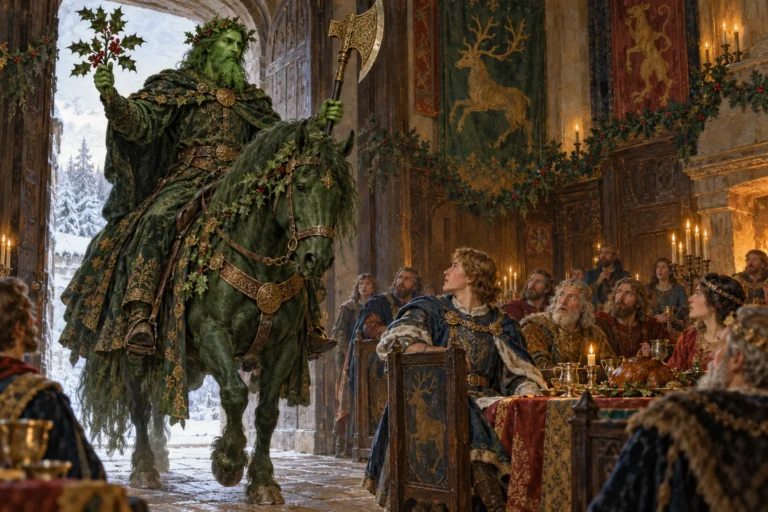
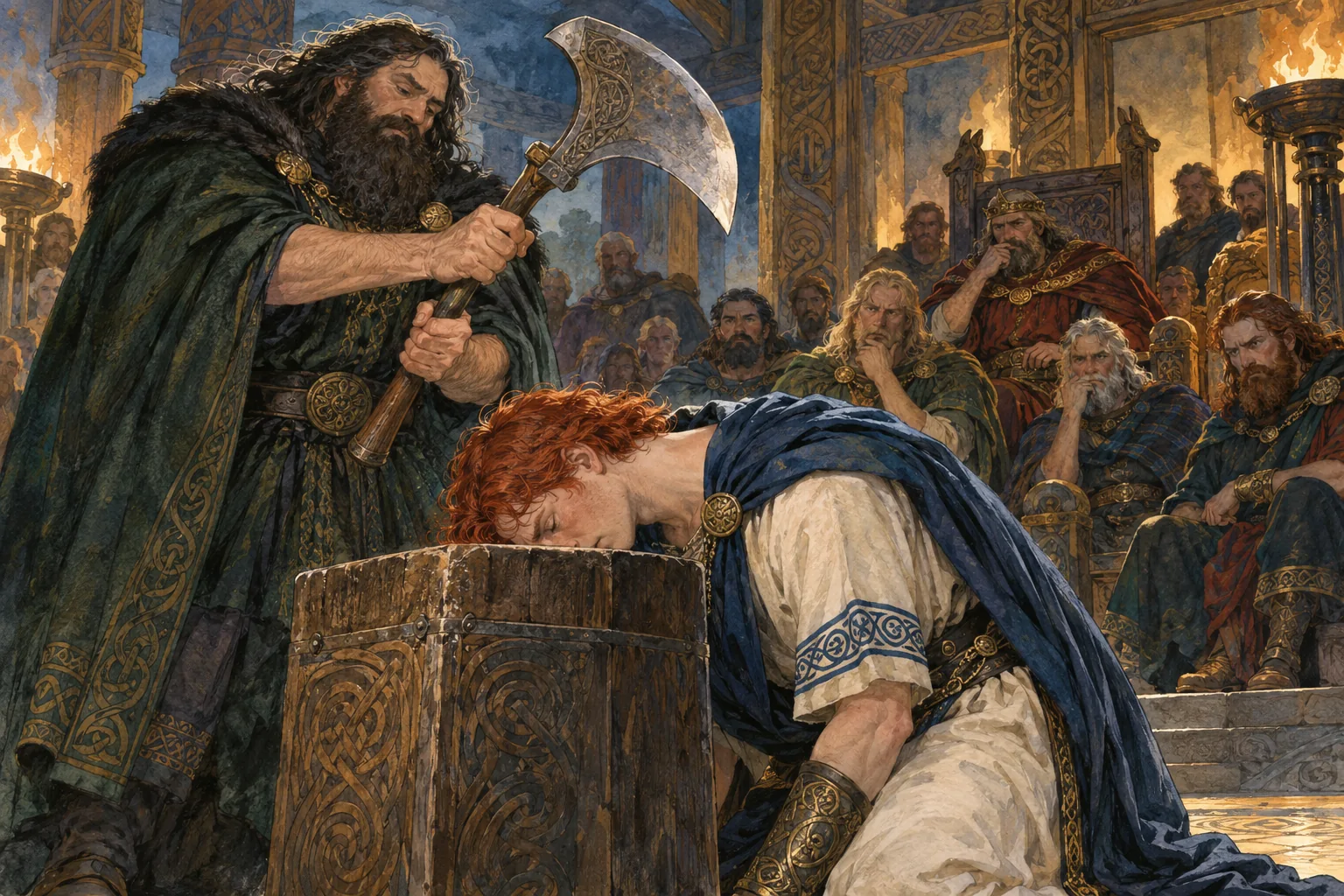
At last a monstrous stranger entered the hall at Emain carrying an enormous axe and block. He challenged the assembled warriors to exchange beheading blows. One man took his head, but disappeared before the return appointment. Lóegaire and Conall also accepted and failed to keep their promises. Each evening the stranger returned alive.
When Cú Chulainn took the challenge, he struck fiercely enough to send the stranger’s head towards the rafters. Next day he waited. He was visibly miserable; the company expected to mourn him. Yet when the stranger arrived, he laid his neck across the block and asked that the business be finished.
The axe rose above him, then came down with its blunt side against his neck. Cú Chulainn was told to rise. This was Cú Roí in disguise, and his verdict concerned courage and truth together. The champion’s portion belonged to Cú Chulainn; Emer should have precedence among the women. This time, the judgement stood. Henderson, §§79–102.
Versions and variations
Two trials become one. Henderson’s §§75–78 place Úath mac Imomain at a lake before the visit to Cú Roí. His §§91–102 then tell a second beheading challenge at Emain, whose monstrous visitor proves to be Cú Roí. Gregory omits the separate lakeside trial but calls the visitor at Emain “Uath, the Stranger”. Her reader therefore encounters a joined version of material Henderson presents as two episodes. This is an identifiable editorial combination, not evidence that two independent oral tellers agreed. Henderson, §§75–78, 91–102; Gregory, chapter V, pp. 74–81.
Who accepts first, and where does the axe fall? In Henderson’s concluding episode a warrior translated as Fat-Neck tries the challenge before Lóegaire and Conall. Gregory starts with Lóegaire. Henderson’s final blow lands blunt-side-down on Cú Chulainn’s neck; Gregory expressly makes it strike the floor without touching him. Both reward his keeping the appointment, but they stage the danger differently. Henderson also preserves an alternative inside §77: “other books” made Lóegaire and Conall accept the earlier Úath bargain and then default, rather than refuse it at once. The medieval text itself acknowledges competing tellings. Henderson, §§77, 95–102; Gregory, pp. 78–81.
The surviving ending is not all from one manuscript. Henderson marks the point in §94 where Lebor na hUidre breaks off and continues with the Edinburgh manuscript. His translated whole is therefore an edited reconstruction of the surviving story, not an unbroken transcription of one witness. Other changes are smaller but revealing: his Buan is Samera’s daughter (§§66–70), while Gregory makes her Garmna’s daughter during the Ercol episode. Her compression removes Samera’s role. Henderson, §§66–70 and note to §94; Gregory, pp. 70–71.
Context and evidence
Food and precedence are public measurements of rank in this story. The comedy depends on heroes who cannot accept a verdict unless it flatters them; the final test makes a promise more decisive than another display of strength. The tale links Emain Macha with Cruachan/Rathcroghan, but its revolving fortress and returning heads belong to literary marvel. A resemblance to later beheading-game stories is a useful comparison, not by itself proof of a direct line of borrowing. Follow Cú Chulainn and Emer into their other stories to see how this celebration of their standing sits beside much less triumphant episodes.
Sources for this entry
- Anonymous; edited and translated by George Henderson, Fled Bricrend: The Feast of Bricriu. Irish Texts Society, volume 2. London: David Nutt, 1899; translation republished by In Parentheses, Cambridge, Ontario, 1999. §§1–27, 66–78, 79–102; especially source-change footnote at §94. The online PDF has its own pagination.. Read source — Public-domain translation; main retelling and direct textual comparisons. About this book
- Lady Augusta Gregory, Cuchulain of Muirthemne. London: John Murray, 1902. IV, “Bricriu’s Feast, and the War of Words of the Women of Ulster”, pp. 48–61. Read source — Literary adaptation; opening feast comparison. About this book
- Lady Augusta Gregory, Cuchulain of Muirthemne. London: John Murray, 1902. V, “The Championship of Ulster”, pp. 62–81; particularly pp. 70–81. Read source — Dependent literary adaptation; named comparisons of combined trials and altered details. About this book
- Lady Augusta Gregory, Cuchulain of Muirthemne: Notes. London: John Murray, 1902. Source list for Bricriu and the Championship, pp. 359–360. Read source — Documents Gregory’s use of Henderson and other scholarship. About this book
Research coverage
Examined Henderson’s feast, selected intermediate contests, both beheading episodes and ending, and Gregory’s chapters IV–V. This abridged retelling omits several intermediate demonstrations and speeches. A full collation of all manuscript witnesses and a source-by-source study of Welsh, French and English beheading games remain outstanding.
The Myths · Irish collection · Editorial approach
Further Reading