Ulster Cycle · story
The Sickbed of Cú Chulainn
An attack on enchanted birds brings Cú Chulainn a year of illness and an invitation into the otherworld. There he wins a battle and loves Fand, but returning home forces three people to face what their love has cost.
Also found as: Serglige Con Culainn · The Wasting Sickness of Cú Chulainn · The Only Jealousy of Emer · Oenét Emire
Research reviewed 17 October 2026.
Read the story
An original retelling based on A. H. Leahy’s translation of the preserved composite narrative. Its two journeys by Láeg are compressed into one here. The source’s changes between Ethne and Emer are discussed below.
The Ulstermen were gathered on the plain of Muirthemne for the celebrations around Samhain. While they waited for absent companions, a flock of beautiful birds settled on the lake. The women wanted pairs to wear at their shoulders, and Cú Chulainn was asked to catch them. He did, but when the birds were shared out, Ethne Inguba received none.
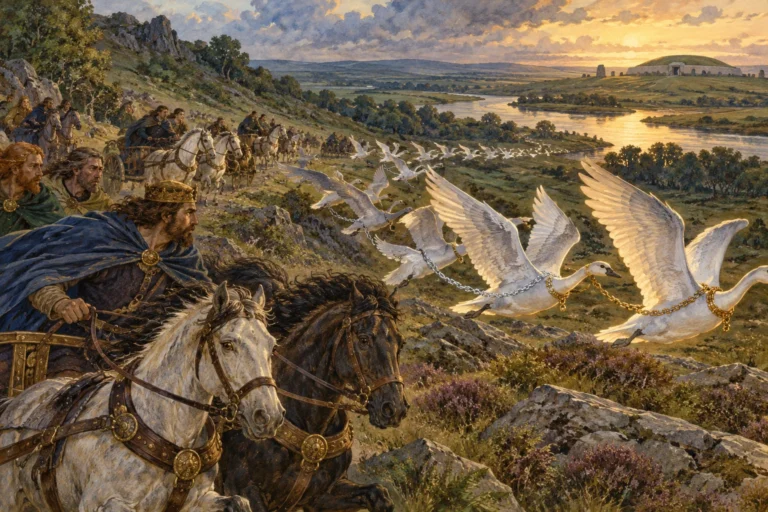
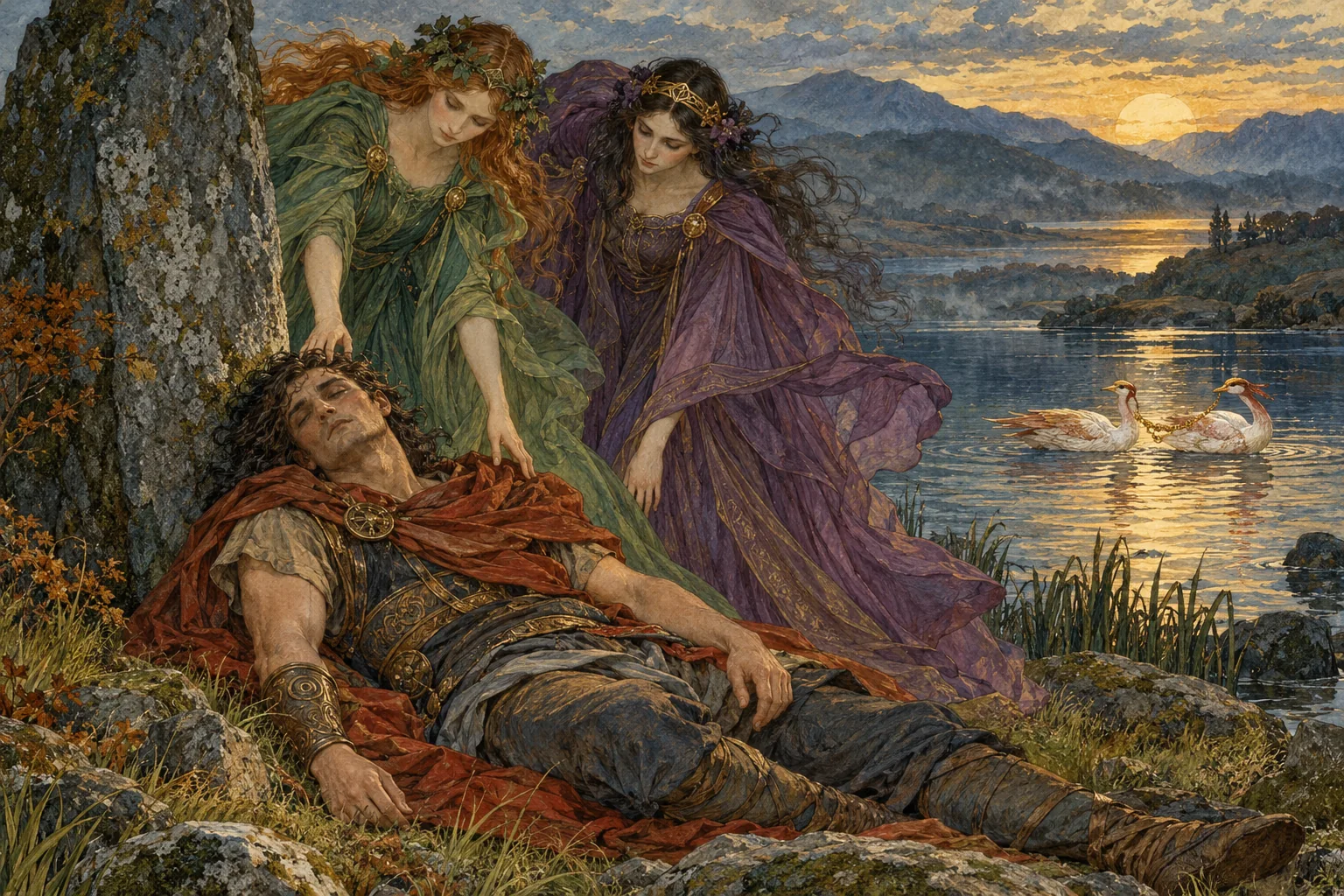
Cú Chulainn promised her the finest pair that came next. Soon two birds appeared, linked by a chain of red gold, singing a melody that sent the company towards sleep. Láeg and Ethne urged him to leave them alone. Some other power was present. He would not listen. Two slingstones missed; his spear pierced a wing, and the birds disappeared beneath the lake.
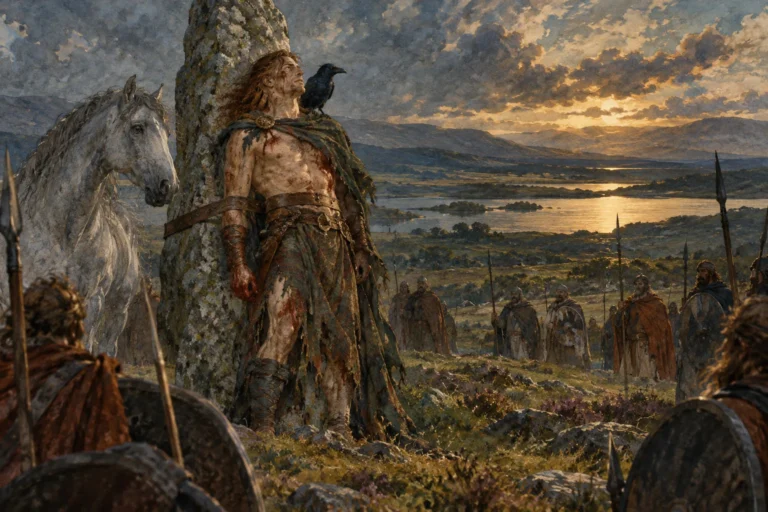
Angry and unsettled, he rested against a standing stone and fell asleep. Two women approached him in a vision, one wearing green and the other purple. They smiled, then struck him repeatedly with whips until he was almost dead. When he woke, his strength and speech had deserted him. He asked to be carried to the sickbed at Tete Brecc instead of home to Dún Delga.
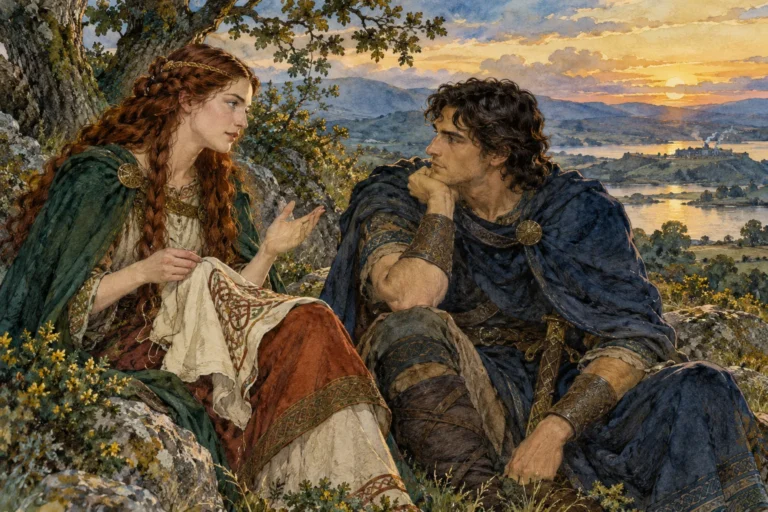
For a year he lay there. Then an unknown visitor brought a message: help could come from the daughters of Aed Abra. Cú Chulainn finally spoke of his vision, and Conchobar advised him to return to the stone. There he met the woman in green. Her name was Lí Ban, and she said that her sister Fand loved him. Fand’s husband, Manannán, had left her.
Lí Ban’s own husband, Labraid, needed a champion. If Cú Chulainn would fight for him for one day, his sickness could be overcome and Fand would be his companion. The warrior hesitated. He was scarcely fit to face anyone. Láeg would first have to see this country and bring back news. Leahy, “The Sick-bed of Cuchulain”, opening through Lí Ban’s invitation.
Emer also learned what had happened. She reproached the companions who had left their protector helpless: had one of them fallen ill, Cú Chulainn would have searched far for a cure. She came to his bedside and urged him to rise. When he stood and passed his hand across his face, the heaviness began to lift.
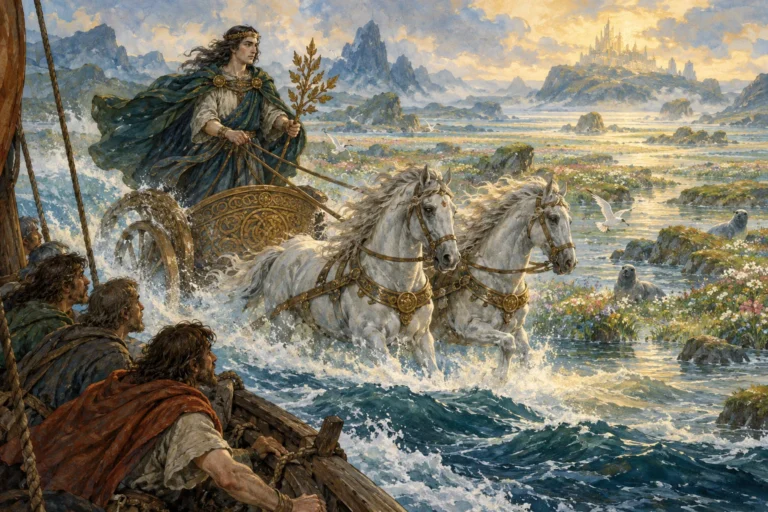
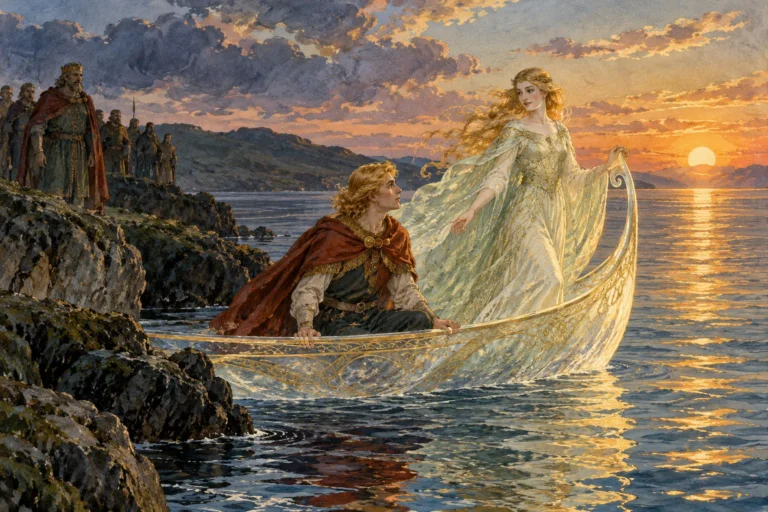
Láeg returned with a description of extraordinary beauty: bright halls, precious metals, music, fruit-bearing trees and a welcome from Fand. Yet this delightful country had enemies and armies of its own. Cú Chulainn travelled there with Lí Ban, taking his chariot, and Labraid showed him the forces they must face.
At dawn Cú Chulainn struck Eochaid Juil with a spear and killed other opponents, including Senach. Labraid’s enemies broke. Victory did not immediately make the champion safe to approach: Láeg feared that his undischarged fury might turn against their own company and called for cold water to cool him.
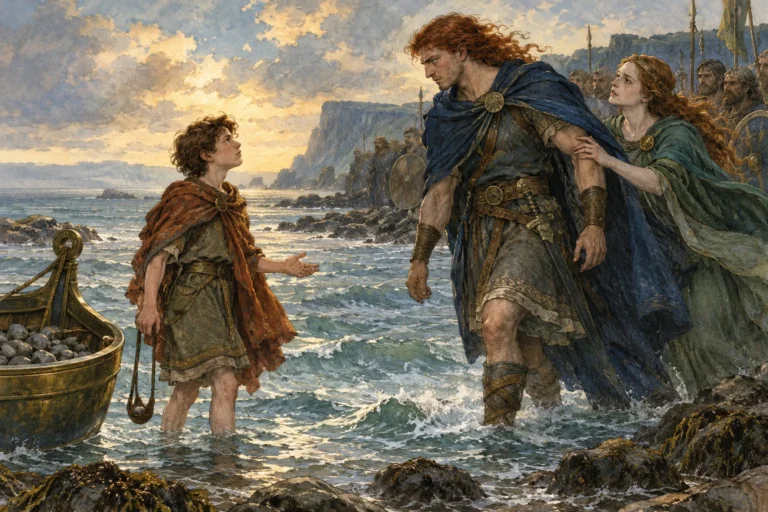
Cú Chulainn stayed with Fand for a month. Before he left, they arranged another meeting at the Strand of the Yew-Tree’s Head. Word reached Emer. She went there with fifty women carrying sharpened knives. Fand saw them coming while Cú Chulainn and Láeg were absorbed in a board game.
He offered Fand protection and answered Emer with praise of his new lover. Emer asked why he would disgrace the life they had shared. What was new seemed beautiful, she said; familiar things were easily undervalued. Her grief reached him, and he declared that she still had his love.
Then each woman offered to be the one abandoned. Fand knew that she could call companions of her own, yet she chose departure. Loving Cú Chulainn had not made the parting bearable. Manannán came for her, visible to Fand alone, and she returned to the husband who had once left her.
Seeing her go, Cú Chulainn lost his peace entirely. He wandered without food or drink until Emer sought help from Conchobar. The learned men brought him back to himself with spells and gave him a drink that removed his memory of Fand. Emer too received a drink to forget her anguish. Finally Manannán shook his cloak between the lovers, separating their worlds so that they would never meet again. Leahy, later narrative from Emer’s visit to the conclusion.
Versions and variations
Two versions within the surviving story. Leahy’s introduction distinguishes an “Antiquarian” strand from a “Literary” one. In the first, Lí Ban guides Láeg across water in a bronze boat; he meets Fand and Labraid, returns, and encourages Cú Chulainn. After an interruption concerning Lugaid’s election and a king’s duties, the narrative effectively starts that approach again: Cú Chulainn is still ill, Emer is summoned, and Láeg makes another journey. These are not two internet copies of one translation. They are the narrative seams discussed by the translator within the transmitted text. Our retelling compresses the repeated reconnaissance but does not claim that this creates an original, seamless medieval version. Leahy, introduction and editorial note between the two narrative sections.
Ethne is not simply a spelling of Emer. The opening explicitly calls Ethne Inguba Cú Chulainn’s wife; later Emer occupies that role. Leahy’s commentary notes the problem, even though his bridging explanation calls Emer the “real wife”. Gregory instead introduces Eithne as a woman who loved Cú Chulainn and identifies Emer as the wife waiting at Dundealgan. That makes her adaptation easier to follow, but the certainty comes from editorial arrangement. It should not be carried back into every medieval passage as an established family history. Opening bird hunt; editorial transition; general notes; Gregory, chapter XIV, pp. 276–280.
A related adaptation with a different arrangement. Gregory brings Emer’s intervention forward into a continuous course of illness, healing, journey and love. Her next chapter separately presents the advice to a prince, material Leahy omits while marking its position. Her notes cite O’Curry’s Atlantis translation and d’Arbois de Jubainville among the authorities for this tale. Gregory (1902) cannot depend on Leahy’s later 1905 book; both nevertheless work from the older textual tradition. Neither is an independently collected modern oral account. The ending with both drinks of forgetfulness and Manannán’s cloak is shared by the examined narratives. Gregory, XIV, especially pp. 292–293; Gregory’s source notes.
Context and evidence
The story gives Emer and Fand substantial speaking parts: each argues over loyalty, humiliation and the terms on which she will remain in a relationship. Its supernatural cure comes only after ordinary persuasion proves insufficient. The opening places the gathering in Muirthemne, while Conchobar’s court supplies help when the hero’s grief becomes unmanageable. Mag Mell and Labraid’s island are otherworld settings; their marvellous descriptions do not supply a securely identifiable real island. This is also a useful companion to The Wooing of Emer: winning a marriage does not settle the later stories about it.
Sources for this entry
- Anonymous; translated by A. H. Leahy, Heroic Romances of Ireland, volume I. London: David Nutt, 1905. “The Sick-bed of Cuchulain”, pp. 57–85, with preceding introduction and concluding general notes; opening bird hunt, transition before Emer’s visit, final tryst and separation. Read source — Main public-domain translated text, including the editor’s explicit account of its composite structure. About this book
- Lady Augusta Gregory, Cuchulain of Muirthemne. London: John Murray, 1902. XIV, “The Only Jealousy of Emer”, pp. 276–293. Read source — Compared literary adaptation; Ethne/Emer distinction and narrative rearrangement. About this book
- Lady Augusta Gregory, Cuchulain of Muirthemne: Notes. London: John Murray, 1902. “Only Jealousy of Emer” and “Advice to a Prince” source lists. Read source — Source dependencies, including O’Curry’s Atlantis translation and d’Arbois de Jubainville. About this book
Research coverage
Compared the main narrative and editorial apparatus in Leahy with Gregory’s adaptation. The two medieval narrative strands have not been independently re-edited from manuscript images here; their boundaries are presented as Leahy’s analysis. O’Curry’s complete Atlantis text and subsequent critical work remain further reading, not additional independently audited witnesses. Spelling modernised; long poems and the interrupted royal-election material are not reproduced.
The Myths · Irish collection · Editorial approach
Further Reading