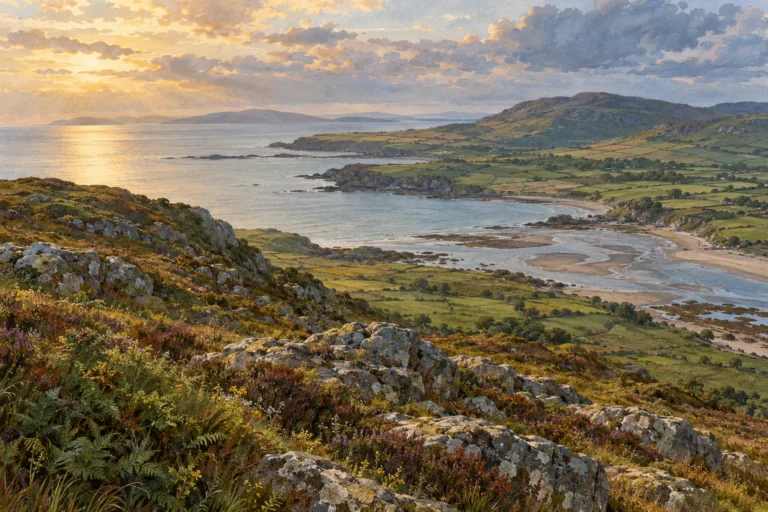
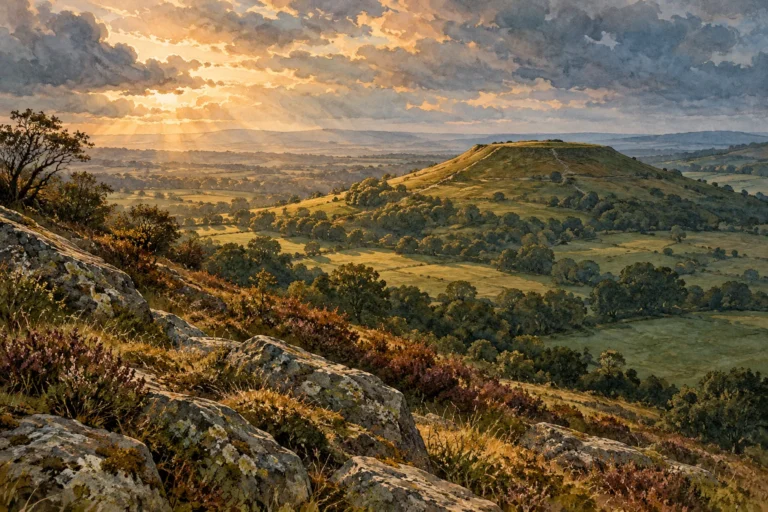
Place · Dundalk and the coastal plain of County Louth, Ireland; Dún Dealgan monument at Castletown.
Dundalk and Muirthemne
Cú Chulainn’s home landscape in the Ulster tales, where a real medieval motte must be distinguished from the fort described by storytellers.
Also found as: Dún Dealgan · Dun Delga · Dundealgan · Mag Muirthemne · Mag Murthemne · Plain of Muirthemne · Byrne’s Folly
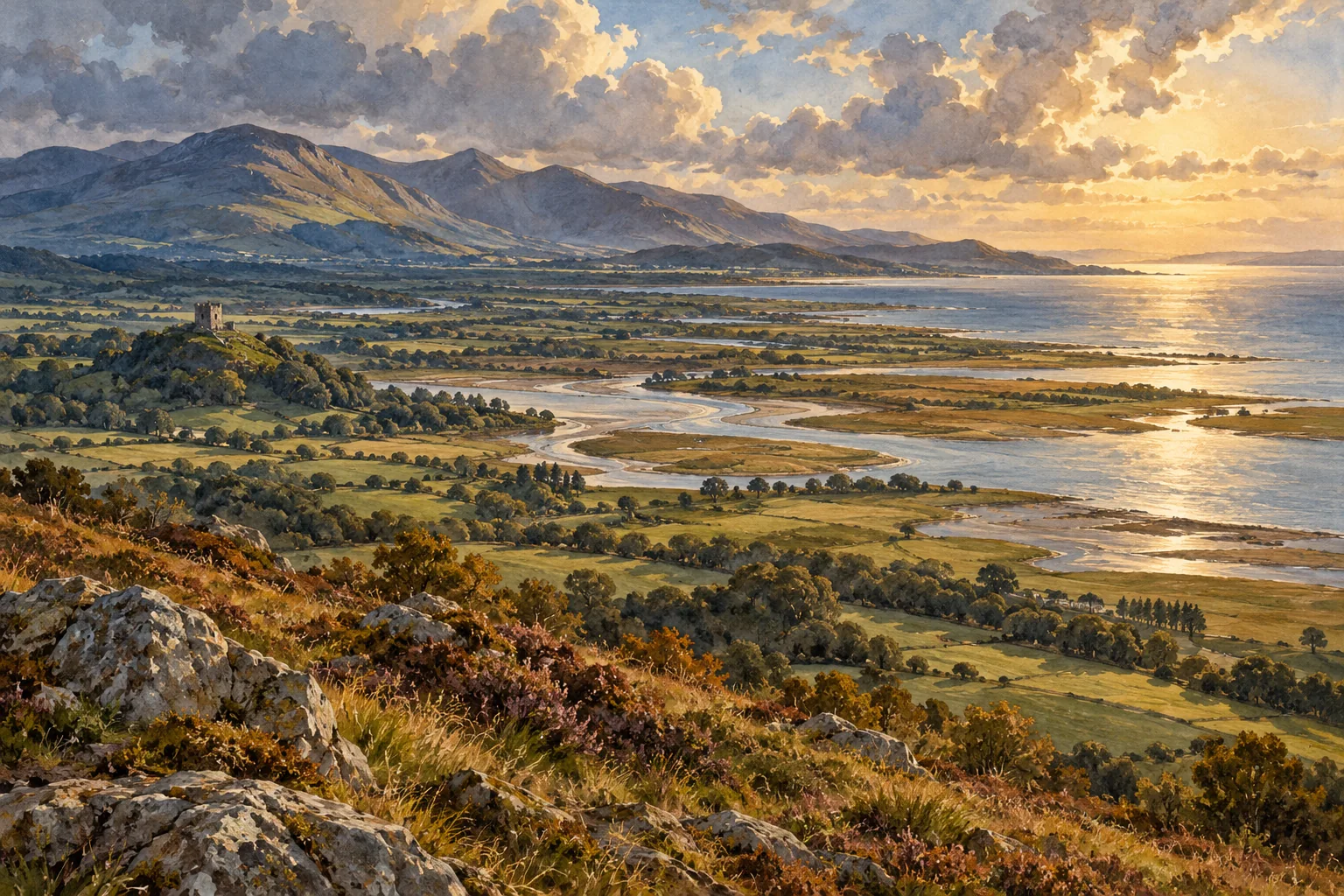
Dundalk and Muirthemne belong at the centre of a guide to Cú Chulainn. In the stories they are home ground: a place from which he negotiates, fights, falls ill and receives visitors. They also belong to a real landscape with its own long history. A literary association can explain why a monument matters to readers without identifying its builders as characters from the tale.
In her place-name notes, Lady Gregory identifies Dundealgan with Dundalk and describes Muirthemne as the coastal part of Louth between Dundalk and the Boyne. These are useful bearings for her book, not a claim that every medieval use of the name had a precisely surveyed boundary. The adjoining Cooley landscape and the Boyne valley connect this home territory with other places in the Ulster stories. Gregory, Notes, place-name list, p. 358.
What survives at Dún Dealgan? The Office of Public Works identifies the earthwork as a motte and bailey associated with the Norman de Verdun family and dated to the late twelfth century. The building above it is later again: Patrick Byrne added it around 1780, and it is known as Byrne’s Folly. Those surviving structures cannot serve as archaeological proof of Cú Chulainn’s residence. The same official account presents the hero’s birthplace association as mythology, keeping that tradition distinct from the construction history. Heritage Ireland, Dún Dealgan.
There is evidence of activity before the Norman earthwork. John Bradley’s 1985 Urban Archaeology Survey, with contributions by Heather A. King, points to the souterrain as evidence of earlier occupation. It also says that the nature and extent of that settlement were unknown at the time of the survey, despite folkloric identifications with the Táin’s Dún Dealgan. An earlier settlement therefore deserves investigation in its own right; it does not automatically identify a named legendary inhabitant. Urban Archaeology Survey, County Louth, p. 62.
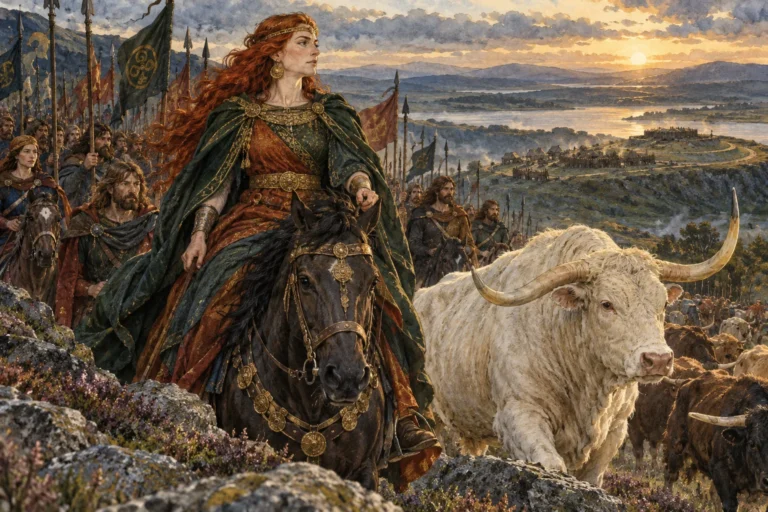
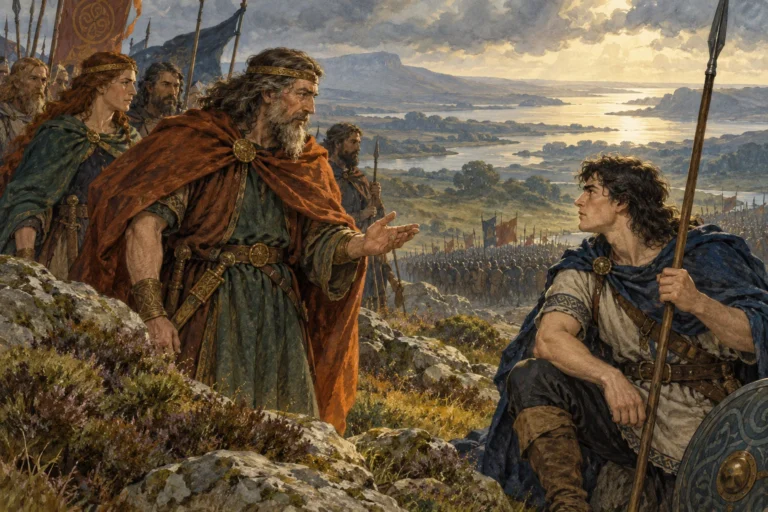
How the stories use the place. In Faraday’s translation of the Táin, Fergus and Etarcomol find Cú Chulainn at Delga, with his charioteer Láeg, before Etarcomol provokes a disastrous challenge. Negotiations also name Mag Muirthemne among the lands Cú Chulainn values. This gives the landscape a domestic and political role as well as a martial one: the defender is protecting a home, not fighting across an empty stage. Faraday, negotiations and The Death of Etarcomol.
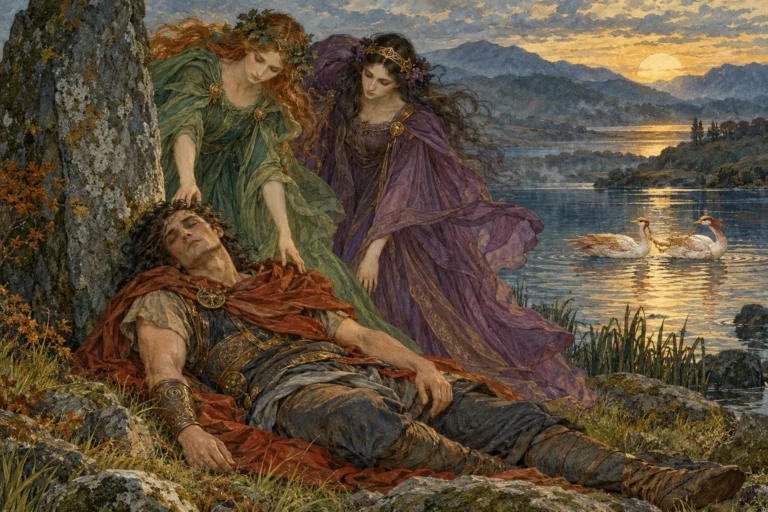
The opening of The Sickbed of Cú Chulainn places the Ulstermen’s Samhain gathering on the plain of Muirthemne. After the attack by the mysterious women, the sick hero is offered a choice of places to recover; Dún Delga, where Emer is, is one of them. His refusal in that passage matters because the transmitted story later gives Emer a central part in his recovery. The place-name helps reveal the tale’s changing domestic arrangements. Leahy, The Sick-bed of Cuchulain, opening episode.
For the broader cluster, continue with the birth traditions, the wooing of Emer and the hero’s death. Keep the scale of each link in view: a story associated with Muirthemne as a region is not necessarily set on the surviving motte. Our place pages distinguish the named landscape, the particular account being read and the material remains that can be independently dated.
Sources for this place
- Office of Public Works / Heritage Ireland, Dún Dealgan. Official site guide; accessed 17 October 2026. Historical and mythological description. Read source — Dates the surviving motte and later building; explicitly identifies Cú Chulainn association as mythology..
- John Bradley, with contributions by Heather A. King, Urban Archaeology Survey, Part I: County Louth. Report commissioned by the Office of Public Works; date of release 1985; National Monuments Service digital copy. Title page and p. 62, The Archaeological Potential of Castletown. Read source — Earlier occupation and limits of knowledge in the 1985 survey. Title and p. 62 were read through search-indexed extracts; full PDF retrieval was unavailable..
- Augusta, Lady Gregory, Cuchulain of Muirthemne. London: John Murray, 1902. Notes, place-name list, p. 358. Read source — Gregory’s identifications of Dundealgan and Muirthemne; a historical literary guide, not a modern boundary survey.. About this book
- L. Winifred Faraday, translator, The Cattle-Raid of Cualnge (Táin Bó Cúalnge): An Old Irish Prose-Epic. London: David Nutt, 1904; Grimm Library, volume 16. Negotiations over Cú Chulainn’s lands and The Death of Etarcomol. Read source — Direct literary connection between Delga, Mag Muirthemne, Cú Chulainn and Fergus.. About this book
- A. H. Leahy, translator, Heroic Romances of Ireland, Volume I. London: David Nutt, 1905. The Sick-bed of Cuchulain, opening prose, pp. 57–61. Read source — Samhain gathering in Muirthemne and the proposed return to Emer at Dún Delga.. About this book
Research coverage
This page distinguishes a regional literary association from the documented dates of the surviving monument. It uses the current OPW guide and a specifically dated 1985 archaeological assessment, not a complete audit of later excavation reports. The survey title page and p. 62 were examined through indexed text because the complete PDF could not be opened. Birthplace, dwelling-place and grave traditions have not been exhaustively collated.
The Myths · Irish collection · Editorial approach
Further Reading