Ulster Cycle · figure
Fergus mac Róich
A former king of Ulster, Cú Chulainn’s foster-father and Medb’s ally: Fergus stands where promises to friends collide with loyalty to a people.
Also found as: Fergus mac Róig · Fergus mac Roich · Fergus son of Róich · Fergus son of Rogh
Research reviewed 17 October 2026.
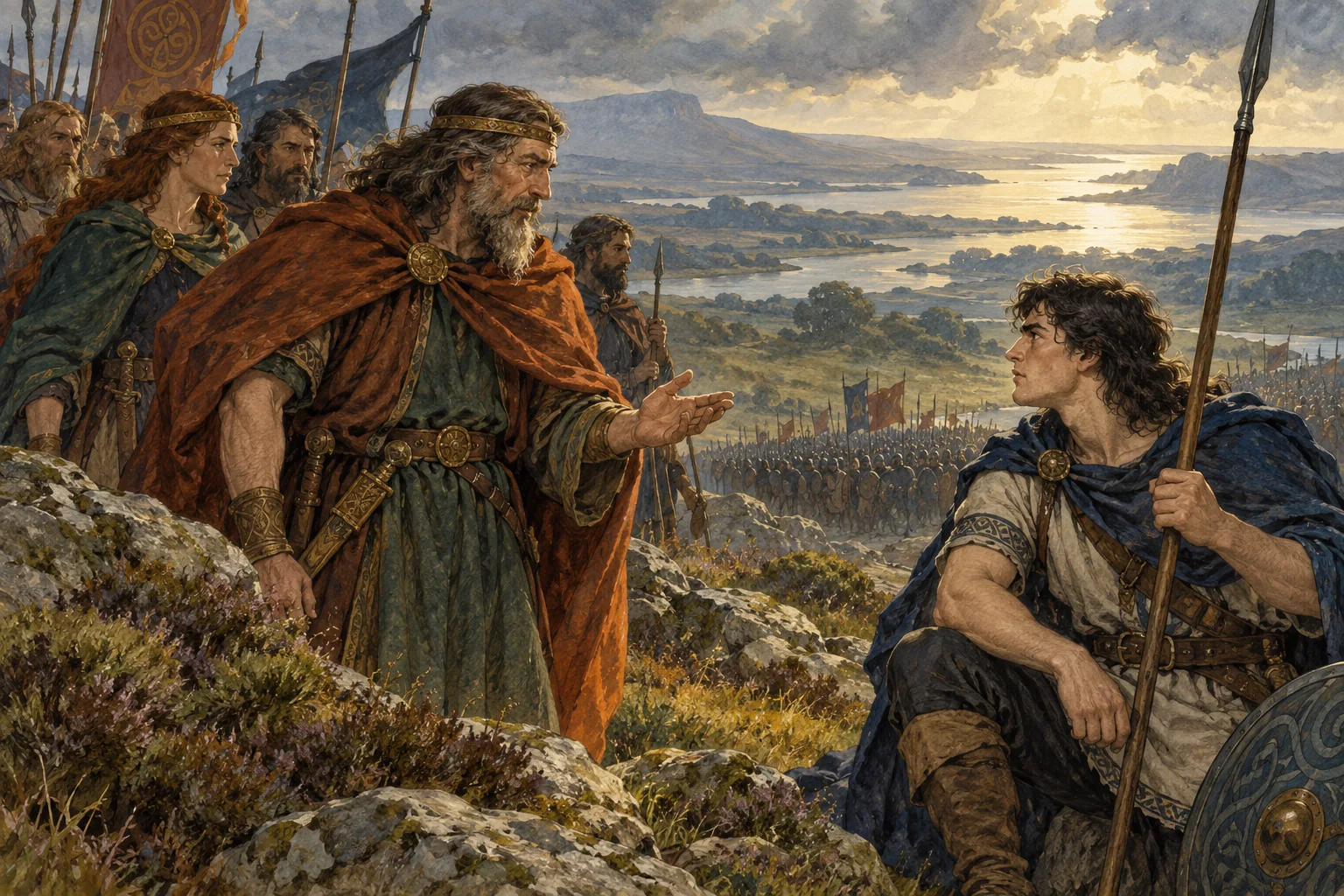
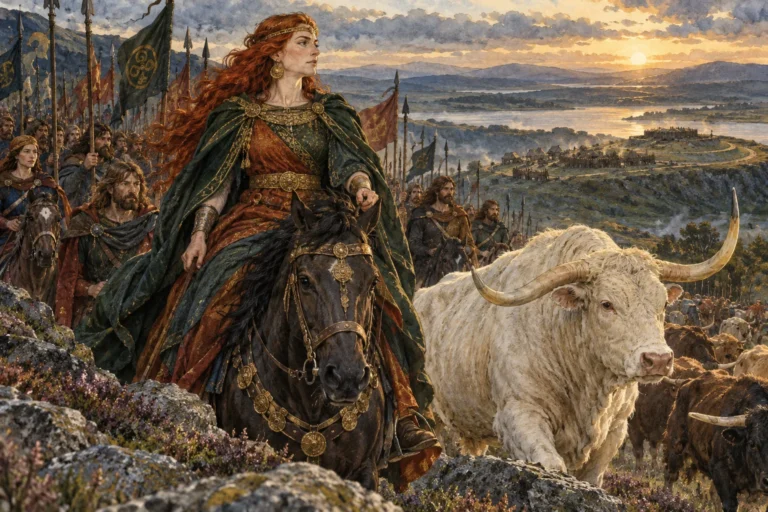
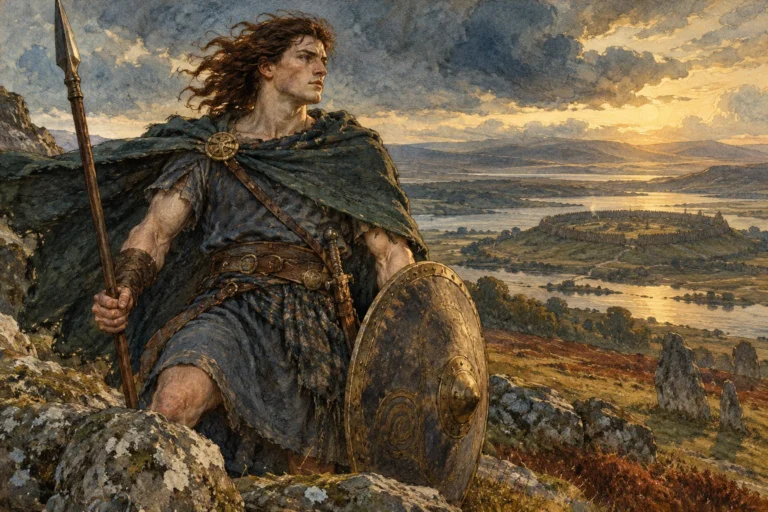
Fergus mac Róich belongs to both sides of the Ulster stories. He is a former king of Ulster and a foster-father of Cú Chulainn, yet in the Cattle Raid of Cooley he marches with the invaders. His presence makes the war a conflict within a community as well as between provinces. He recognises the young defender’s tricks, explains his childhood exploits and helps negotiate terms between armies. Knowledge and affection do not remove the danger of standing on the opposing side. This guide follows the particular accounts identified below, rather than treating every appearance as a consistent biography.
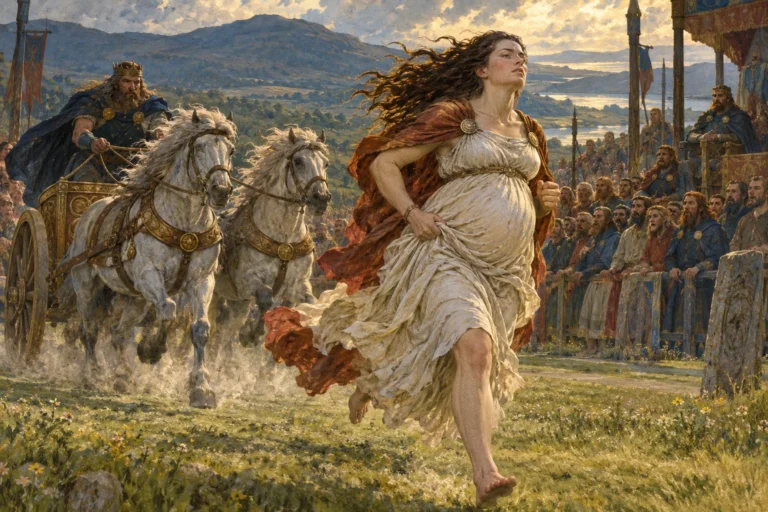
Lady Gregory begins his loss of kingship with his wish to marry Ness. She agrees only if her son Conchobar can rule for a year, establishing a royal claim for his descendants. Fergus accepts, expecting to resume his position afterwards. Ness cultivates the leading men, and Conchobar proves sufficiently attractive as king that the Ulstermen decide to keep him. In this telling Fergus is displaced by a bargain he freely made, not defeated in battle. Gregory, chapter I, pp. 1–2.
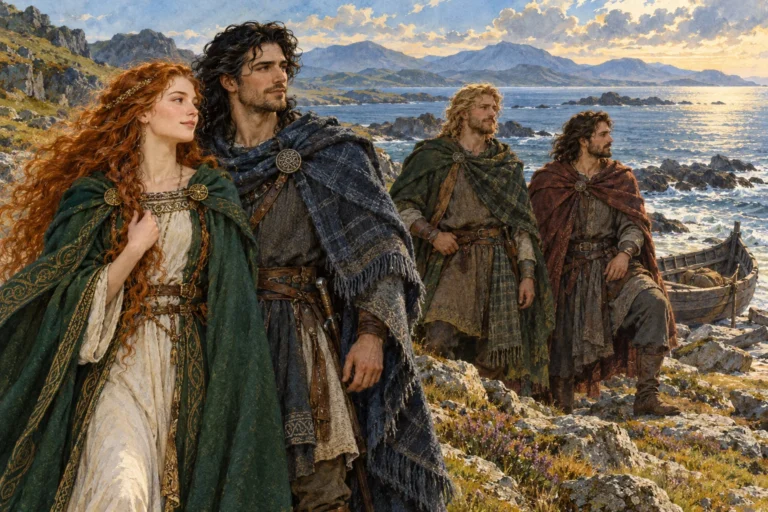
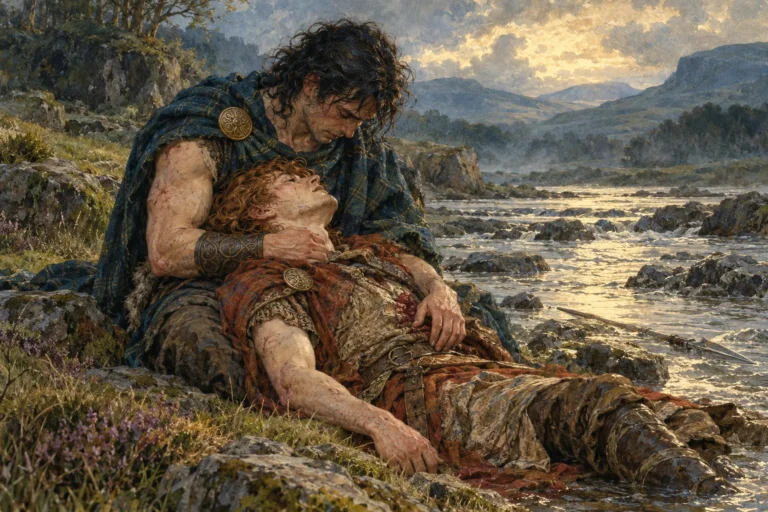
A much darker breach follows in the story of Deirdre and the sons of Uisliu. In the early account translated by A. H. Leahy, Fergus, Dubthach and Cormac guarantee the returning exiles’ safety. Conchobar arranges a drinking feast that delays the guarantors. Fergus’s son Fiacha accompanies the brothers, and dies trying to shield Naoise from the spear directed at him. When Fergus and the others discover what has happened, they attack Conchobar’s household, burn Emain and leave for Connacht. Their subsequent alliance with Medb and Ailill carries the consequences of that broken protection into the Táin. Leahy, The Exile of the Sons of Usnach, Book of Leinster version, closing prose.
Fergus consequently cannot be reduced to a genial adviser travelling beside Medb. He has an active grievance against Conchobar, and he brings fighting men into Ulster. At the same time, he understands Cú Chulainn’s worth and tries to manage encounters with him. When the arrogant Etarcomol demands a duel despite Fergus’s protection, Fergus cannot make either an impatient challenger or a lethal battlefield obey his wishes. His authority has limits. Faraday, The Death of Etarcomol.
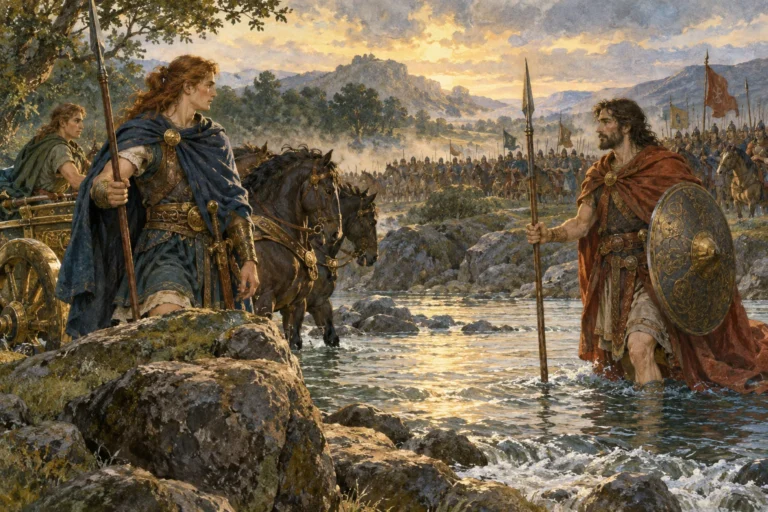
His relationship with Medb creates another vulnerability. Ailill discovers them together and removes Fergus’s sword. When Fergus is subsequently required to face Cú Chulainn, his scabbard conceals a wooden substitute. The younger warrior agrees to withdraw if Fergus will return the favour when asked. During the final battle Cú Chulainn calls in that promise. Fergus leaves the field, his men follow, and the retreat spreads through the invading force. A personal obligation changes the outcome of a provincial war. Faraday, The Death of Etarcomol; Fergus’s encounter before Fer Diad; the final battle.
The last stages also expose his anger. Once his sword has been restored, Fergus threatens Conchobar, and other warriors must intervene. His final disparagement of an army led by a woman belongs to a character who has himself helped lead the expedition. Readers can examine that contradiction without accepting his judgement of Medb as the story’s only possible meaning. Faraday, the final battle and Medb’s retreat.
Fergus’s literary afterlife extends beyond these episodes. Elva Johnston’s scholarly guide notes his place in genealogies, including those of the Ciarraige, and in stories where he returns from death to restore the forgotten Táin. She also summarises a death-tale in which Ailill tricks the blind Lugaid into killing him. These are leads to further texts, not proof that a historically identifiable king lived this sequence of adventures. Johnston, Dictionary of Irish Biography, “Fergus”.
Versions and variations
The sons who keep the pledge change. In Leahy’s translation of the Book of Leinster Deirdre narrative, Fiacha son of Fergus goes with Naoise and dies shielding him. Gregory’s much longer chapter VII instead sends two sons, Fair-Haired Iollan and Rough-Red Buinne. Buinne accepts Conchobar’s offer and abandons his charge; Iollan continues defending it and is killed by Conall, who has misunderstood the situation. Gregory therefore makes the failure of protection unfold through contrasting decisions by two sons, rather than the single act of sacrifice in the earlier account. The familiar names should not be inserted silently into a retelling based on Leahy’s early version. Leahy, Book of Leinster version, concluding prose; Gregory VII, pp. 117–131.
A smaller difference occurs at the bulls’ contest. In Faraday’s Táin, Fergus urges the Brown Bull to defend itself. In Dunn’s edition, Cormac performs that encouragement; Gregory likewise gives it to Cormac. This changes a brief intervention, not the outcome of the struggle, but it is a useful example of why a guide should identify its textual basis even for apparently minor details. Faraday, closing bull-fight; Dunn XXVIII, pp. 363–365; Gregory XIII, pp. 272–275.
These books have different kinds of authority. Faraday translates an early recension preserved through more than one manuscript. Dunn principally follows the Book of Leinster but incorporates readings from other witnesses. Gregory creates a continuous literary adaptation from published scholarship and translations. Agreement between those books can reflect shared underlying material: it does not establish three independent oral traditions. The source of Fergus’s lost kingship, his exile, his military bargains and his eventual death should therefore remain visible rather than being merged into an undocumented timeline.
Context and evidence
Fergus connects Emain Macha, the court he leaves, with Medb’s Connacht and the fighting around Cooley. These are narrative connections; the surviving texts do not establish that a particular excavated building was his residence. His role also makes fosterage, guarantees and exchanged favours central to understanding the Ulster Cycle. The stories repeatedly test whether a promise can protect someone when kings, relatives and armies have conflicting interests. Different answers, and different failures, are part of the tradition rather than errors a modern retelling must erase.
Sources for this entry
- Augusta, Lady Gregory, Cuchulain of Muirthemne. London: John Murray, 1902. I, Birth of Cuchulain, pp. 1–2; VII, Fate of the Sons of Usnach, especially pp. 117–131. Read source — Literary adaptation; checked account of Iollan and Buinne. The separate chapter-I link appears inline for the kingship episode.. About this book
- A. H. Leahy, translator, Heroic Romances of Ireland, Volume I. London: David Nutt, 1905. The Exile of the Sons of Usnach: Book of Leinster version, final prose paragraphs; The Sick-bed of Cuchulain, opening, for Fergus as foster-father. Read source — Public-domain translation of the earlier Deirdre account; Fiacha, violated sureties and Fergus’s exile.. About this book
- L. Winifred Faraday, translator, The Cattle-Raid of Cualnge (Táin Bó Cúalnge): An Old Irish Prose-Epic. London: David Nutt, 1904; Grimm Library, volume 16. The Death of Etarcomol; encounter with Fergus before the Fer Diad episode; final battle, retreat and bull-fight. Read source — Public-domain translation of the earlier recension; principal source for Fergus during the raid.. About this book
- Joseph Dunn, translator, The Ancient Irish Epic Tale Táin Bó Cúalnge. London: David Nutt, 1914. XXVIII, The Battle of the Bulls, pp. 363–365. Read source — Comparison: Cormac, rather than Fergus, encourages the Brown Bull.. About this book
- Augusta, Lady Gregory, Cuchulain of Muirthemne. London: John Murray, 1902. XIII, The Two Bulls, pp. 272–275. Read source — Dependent modern literary adaptation; bull-fight comparison.. About this book
- Elva Johnston, Fergus. Dictionary of Irish Biography; first published and revised October 2009; DOI 10.3318/dib.003048.v1. Paragraphs on genealogy, recovery of the Táin and Aided Fergusa meic Roich. Read source — Modern scholarly orientation; death and recovery tales identified as further research, not directly translated here..
Research coverage
Checked selected Fergus episodes in Faraday, Dunn, Leahy and Gregory, plus Johnston’s scholarly overview. No complete genealogy, manuscript collation or oral-tradition survey is claimed. The death-tale and recovery-of-the-Táin narratives are signposted from Johnston; their full primary texts have not been audited for this guide.
The Myths · Irish collection · Editorial approach
Further Reading