Ulster Cycle · story
Sétanta and Culann’s hound
A boy arrives late for a feast, kills the guard dog that attacks him, and offers to take its place. The incident gives Sétanta the name Cú Chulainn.
Also found as: Setanta · Sétanta · How Cú Chulainn got his name · Culann’s Hound · Cuchulain’s Boy Deeds
Research reviewed 17 October 2026.
Read the story
This retelling follows the ball-and-hound account in the Book of Leinster tradition, also used by Lady Gregory. The different account preserved in Recension I is described below.
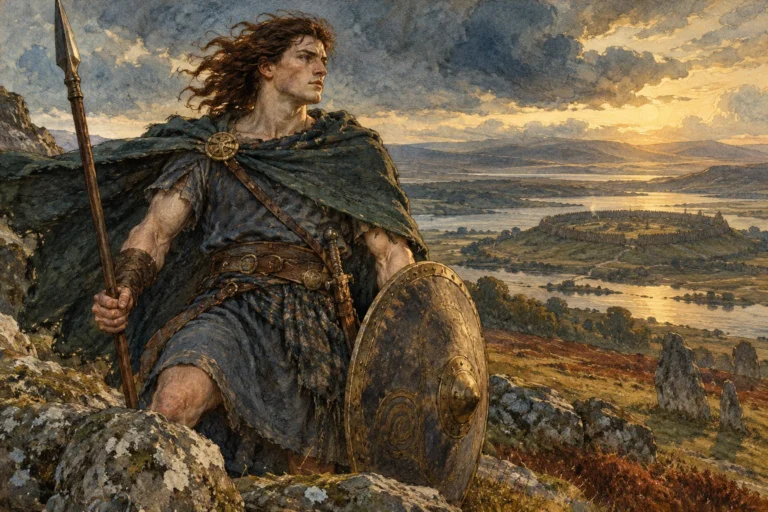
Before he was called Cú Chulainn, the boy was Sétanta. At Emain Macha he played with the other boys of Ulster, though playing against him was hardly an equal contest. When King Conchobar passed their games on his way to a feast, he stopped to watch. The boy’s strength and quickness already suggested what sort of warrior he might become.
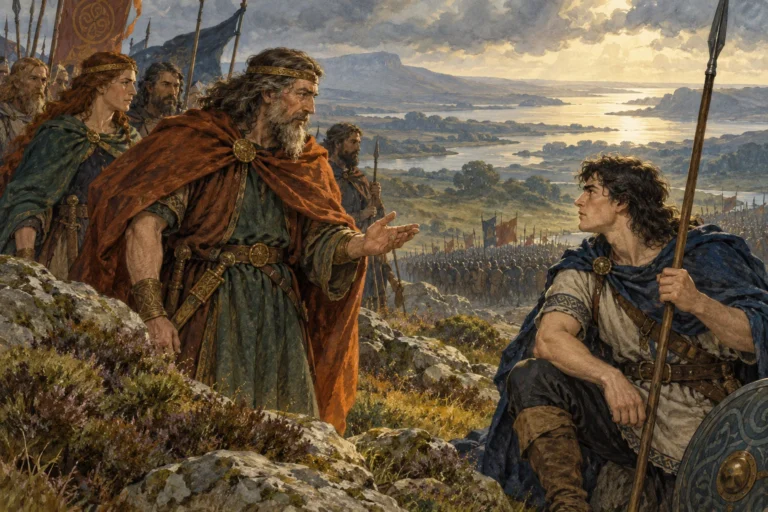
The feast was at the home of Culann, a smith. Conchobar invited Sétanta to come, but the game was still going. Sétanta would follow when the others had finished. He could find the way by the tracks of the king’s company.
At Culann’s house the guests settled to their food and drink. Before releasing the animal that guarded his property, the smith asked whether anyone else was expected. Conchobar had forgotten his invitation. No one, he said. The hound was unchained.
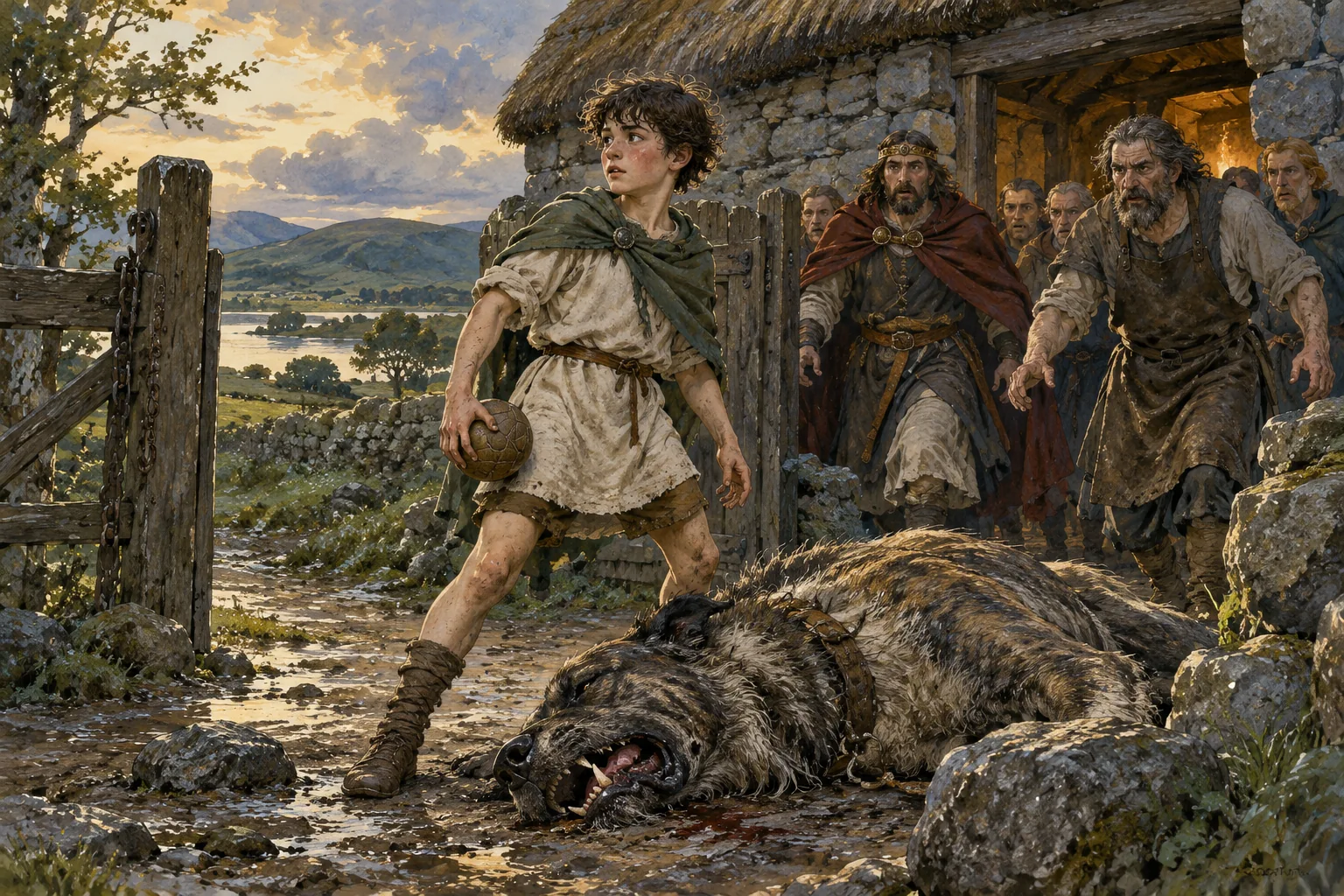
Sétanta came along the road with his playthings. The hound heard him and rushed out. Inside the house, its baying brought Conchobar’s promise back to him. The king feared that his sister’s son had been killed. The guests scrambled outside, some taking the quickest route over the enclosure.
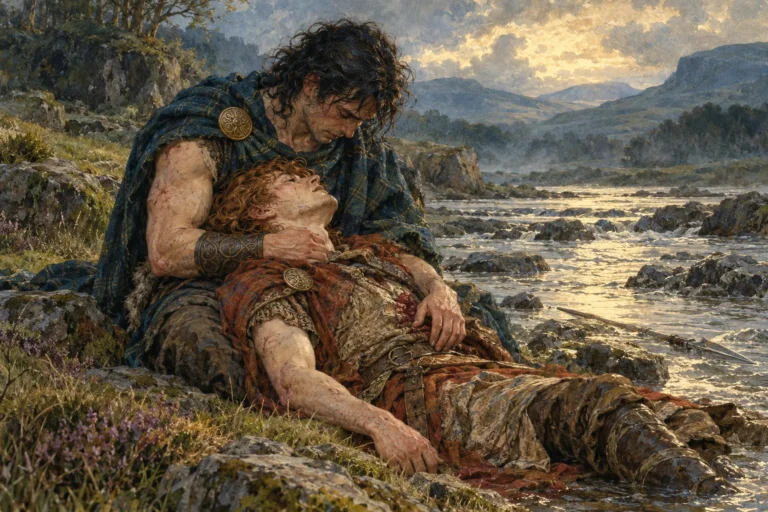
But the boy had faced the animal. He drove his ball into its open mouth, then seized it and struck it against a stone. By the time the men reached him, the hound was dead and Sétanta was alive. Fergus lifted the boy and carried him to the king. Gregory, “Boy Deeds”, pp. 9–11.
The relief of the guests was not shared by Culann. His guardian had protected his animals and everything he owned. The boy had survived, but the smith had suffered a serious loss.
Sétanta offered to repair it. If a puppy of the same breed could be found, he would rear and train it. Until it could do the work, he himself would guard Culann’s property. The king approved, and Cathbad the druid found a name in the promise: Cú Chulainn, the Hound of Culann.
The boy preferred his old name at first. Cathbad answered that this new one would travel far beyond the smith’s house. Sétanta accepted it. The name remembered both his extraordinary strength and the obligation he had undertaken after using it. Book of Leinster Táin, youthful deeds, pp. 160–163.
Versions and variations
Hands or ball? Recension I actually preserves a disagreement inside the narrative. Its principal account has the boy put aside his playthings, seize the dog’s throat and head, and strike it against a pillar. It then records an alternative in which his ball kills the hound. This is a documented variant, not a modern guess about how the incident happened. Faraday, pp. 24–26; O’Rahilly, Recension I, pp. 140–142.
The longer ball account. The Book of Leinster narrative combines the ball with the subsequent striking against the stone. It also has Sétanta initially resist the new name. Gregory’s version follows that broad pattern; her familiar hurling scene should therefore be labelled a literary retelling of the saga tradition, rather than a separately collected eyewitness account.
Age and the dog’s origin. Recension I places the exploit at seven; the Book of Leinster narrator says six years after his birth. Recension I calls the hound an import from Spain and explicitly disputes another explanation of its origin. These details should remain attached to their witnesses, rather than being forced into a single settled biography.
Gregory’s source notes direct the boyhood stories to the same authorities as her Táin chapters, including manuscript translations and O’Grady’s synopsis.
Context and evidence
The naming episode joins two ideas: exceptional strength and responsibility for its consequences. Culann is a working smith, and the loss of his guardian matters even in the presence of a king. This is our reading of the story, rather than an ancient explanation supplied by its narrator.
Emain Macha / Navan Fort is a real archaeological place near Armagh, associated with the Ulster court in the tales. Its surviving earthworks do not verify Sétanta’s game or the killing of the hound. Culann’s house is a narrative location here; this entry does not assign it an unverified modern address. Department for Communities: Navan Fort.
Sources for this entry
- Anonymous; translated by Cecile O’Rahilly, Táin Bó Cúailnge, Recension I. Dublin Institute for Advanced Studies, 1976; CELT electronic edition T301012. The killing of the Smith’s Hound by Cú Chulainn and the reason why he is called Cú Chulainn, pp. 140–142. Read source — Checked medieval recension in scholarly translation; explicit hand/ball alternative, age and imported hound.. About this book
- Anonymous; translated by Cecile O’Rahilly, Táin Bó Cúalnge from the Book of Leinster. Dublin Institute for Advanced Studies, 1970; CELT T301035. Here begin the youthful deeds of Cú Chulainn; Cormac Cond Longas’s account, pp. 160–163. Read source — Checked second recension; principal narrative outline and initial resistance to the new name.. About this book
- L. Winifred Faraday, translator, The Cattle-Raid of Cualnge. London: David Nutt, 1904. Cuchulainn’s Boyish Deeds, pp. 24–26. Read source — Earlier translation of Recension I material, not an independent oral variant.. About this book
- Lady Gregory, Cuchulain of Muirthemne. London: John Murray, 1902. II. Boy Deeds of Cuchulain, pp. 9–11; Notes by Lady Gregory, Boy Deeds and War for the Bull entries. Read source — Checked influential literary synthesis; compared with the medieval accounts.. About this book
- Department for Communities, Northern Ireland, Navan Fort. Official heritage-site information; accessed 17 October 2026. About Navan Fort. Read source — Place identification and archaeological context, not evidence for the legendary incident..
Research coverage
Compared the two principal Táin recensions in translation and Gregory’s adaptation, with Faraday as a translation check. Later schoolbook versions, oral archive recordings, manuscript-level variants and exact proposed locations of Culann’s house remain to be surveyed.
The Myths · Irish collection · Editorial approach
Further Reading