Ulster Cycle · figure
Medb
The queen of Connacht who drives the Táin’s campaign is also a judge, negotiator and formidable speaker. Her stories explore authority, desire and rivalry, while her relationship to sovereignty mythology remains a matter of interpretation.
Also found as: Maeve · Méabh · Meadhbh · Medb Chruachna · Queen Maeve · Medb of Cruachan
Research reviewed 17 October 2026.
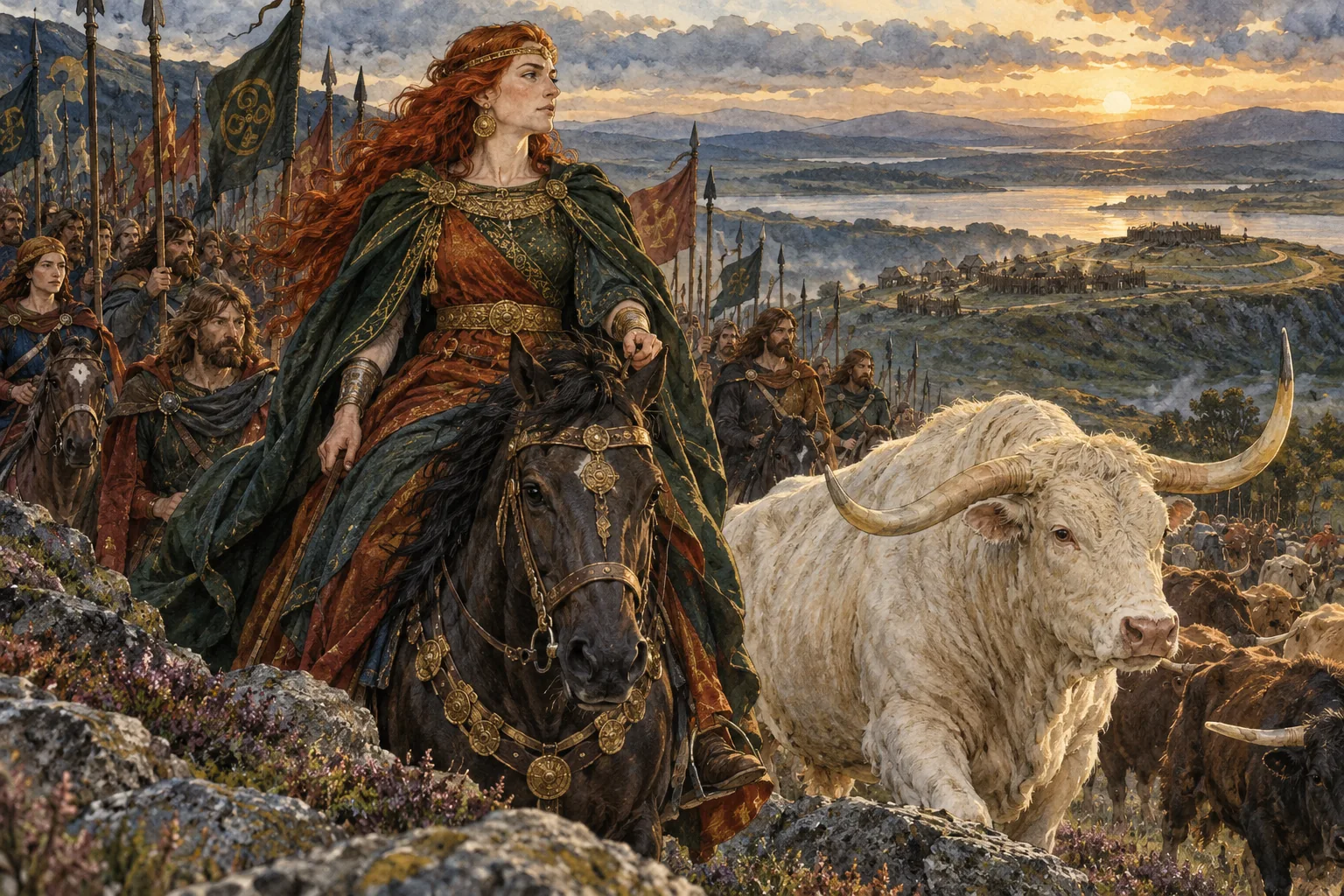
Medb rules Connacht alongside Ailill, with their court at Cruachan, the literary counterpart of Rathcroghan. She is best known for launching the cattle raid of Cooley, but her importance goes beyond being Cú Chulainn’s enemy. The tales let her command armies, bargain over relationships, evaluate warriors and explain her own authority at considerable length. Reading those speeches matters: a description of her simply as a jealous queen removes much of what the texts make interesting.
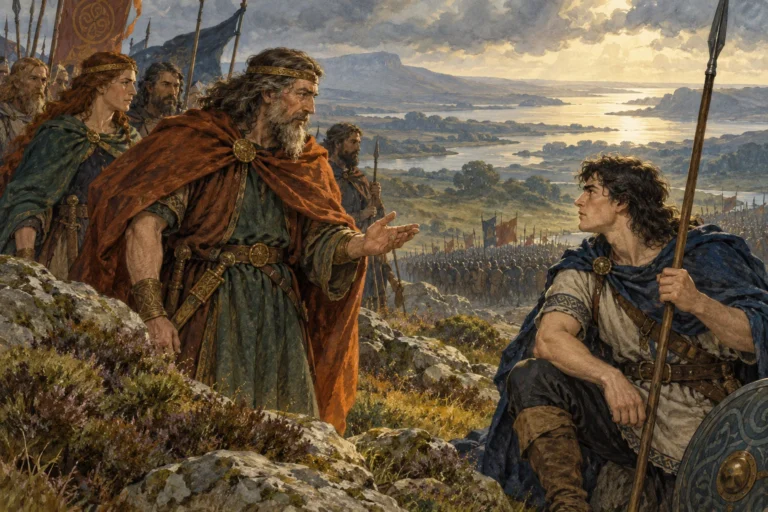
At the beginning of Joseph Dunn’s Book of Leinster-based Táin, Ailill suggests that marriage has made her prosperous. Medb answers with a history of her own wealth and followers. She says her father, Eochaid Feidlech, entrusted Connacht to her, and describes the husband she required: a man without stinginess, fear or jealousy. She considers generosity and military courage her own accomplishments, and expects a partner capable of matching them. Her speech claims independence; Ailill then gives his own account of his claim to the kingdom. The conversation is an argument between characters, not an impartial legal certificate. Dunn, I, pp. 1–4.
Their inventories produce the dispute over Finnbennach, the Whitehorned bull. Medb seeks Donn Cúailnge to restore equality, first by requesting a loan and then by force after the negotiations fail. She assembles a coalition and presses on despite Fedelm’s prophecy of bloodshed. In this narrative, personal competition becomes public catastrophe. Ailill, messengers, allies and warriors all participate; making Medb solely responsible for every decision would simplify the machinery the story shows. Dunn, II–IV, pp. 5–18.
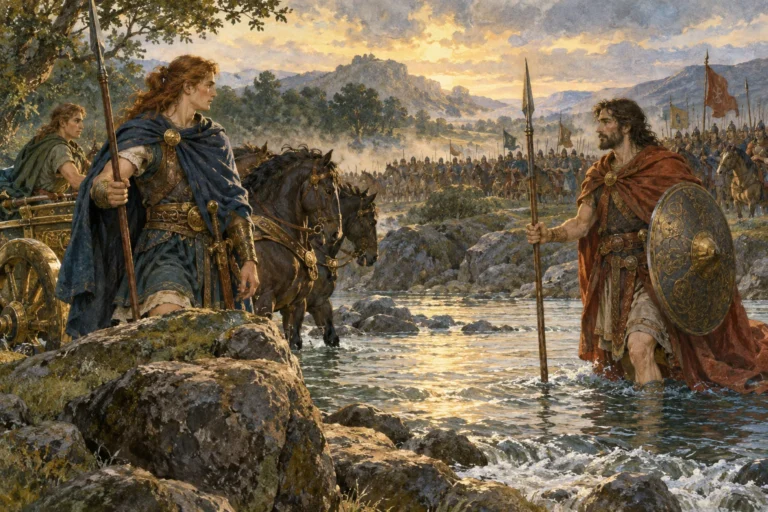
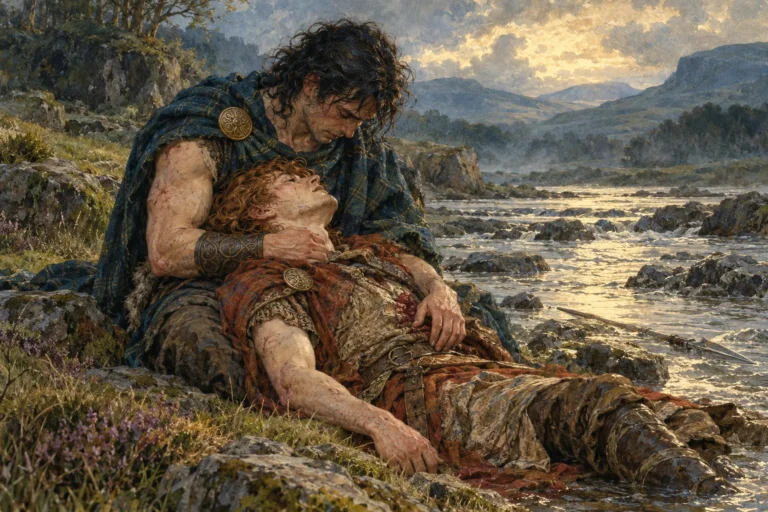
During the campaign she is resourceful and ruthless. Gifts, land and the prospect of marriage to her daughter Findabair are used to recruit challengers against Cú Chulainn. In the Ferdiad episode, threatened public ridicule and a claim that his foster-brother has belittled him help overcome his reluctance. The cost appears most painfully in the relationship between the two men at the ford. Findabair’s use in these bargains also deserves attention: she is repeatedly offered as part of decisions made by others. Faraday, “The Combat of Larine Mac Nois” and “The Combat of Fer Diad and Cuchulainn”.
Medb has another role in Bricriu’s Feast. When the champions of Ulster arrive seeking judgement, she recognises their danger and arranges a welcome. Gregory’s version makes her impatient with Ailill’s hesitation, then has her distribute graded cups that disclose the champions’ relative worth. Here her intelligence is used to manage other people’s pride, although the losing men still refuse the result. This is a helpful counterpoint to the queen whose own rivalry drives the Táin. Gregory, V, pp. 62–74.
Her connection with Fergus complicates the war. He is an Ulster exile in her army and her lover, yet remains attached to Cú Chulainn. Ailill’s discovery of their relationship leads to the theft of Fergus’s sword. The coalition therefore contains divided loyalties and private grievances from the start. At the defeat, Medb asks Cú Chulainn for protection and receives it. Survival, rather than a final triumphant possession, closes her part in the campaign. The Death of Etarcomol; final battle and retreat.
Was there a historical Medb? The examined stories establish a powerful legendary figure, not a verified queen with a securely recoverable biography. John Carey outlines the influential interpretation of Medb as a figure of sovereignty, possibly a goddess of kingship, while recording scholarly disagreement. That interpretation should be identified as such. Her literary identity, the archaeological landscape of Rathcroghan and any hypothetical historical person are related questions with different kinds of evidence. Carey, “Medb Chruachna”, opening discussion.
Versions and variations
Different openings produce different first impressions. Dunn gives Medb her long account of choosing a husband before the raid is planned. Faraday’s narrative begins at the muster, so a reader encounters her through military preparations and resistance to Fedelm’s warning. Both are important; neither opening should be treated as a complete character portrait detached from its version. Gregory follows the wealth comparison but shapes it into her continuous account of the heroes’ lives. Dunn, I–IV; Faraday, opening; Gregory, XI, opening.
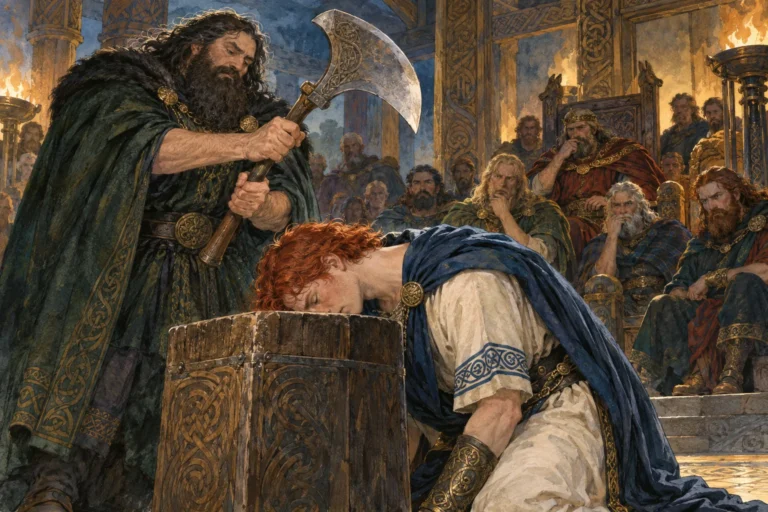
The treatment of Findabair is not consistent. Faraday’s closing sentence leaves Findabair with Cú Chulainn after the peace. Dunn’s “White-fight of Rochad” relates her death from shame on discovering how many men have died because of the promises concerning her. Those outcomes cannot both become the ending of one tidy family biography. The disagreement also affects how readers understand the raid’s human cost. A Medb guide needs to preserve the disagreement because it changes the consequences of the queen’s bargaining for her daughter. Final paragraph; Dunn, XXIIIc, pp. 288–291.
Medb and sovereignty. Carey distinguishes Medb of Cruachan from Medb Lethderg of the Tara tradition while explaining the scholarly argument connecting their roles. A shared name or a proposed divine background does not establish that every story about either belongs to one woman’s life. Later accounts of Medb’s death and extended marriage traditions require their own comparisons; they are not silently filled in here from modern summaries. Carey, historical and sovereignty discussion; concluding biographical outline.
Context and evidence
For a route through Medb’s stories, begin with the Táin overview, then read Ferdiad’s duel and Bricriu’s Feast. Follow Fergus to see how her allies can remain emotionally bound to her enemies. The Rathcroghan place guide keeps the physical landscape separate from the deeds assigned to its legendary rulers. The name Maeve is familiar in English adaptations, including Gregory’s; Medb is used as this directory’s main heading so that spelling differences do not split one figure across several disconnected entries.
Sources for this entry
- Anonymous; translated by Joseph Dunn, The Ancient Irish Epic Tale Táin Bó Cúalnge. London: David Nutt, 1914. I–IV, pp. 1–18; XXIIIc, “The White-fight of Rochad”, pp. 288–291. Read source — Medb’s speeches, campaign motivation and alternative Findabair outcome. About this book
- Anonymous; translated by L. Winifred Faraday, The Cattle-Raid of Cualnge (Táin Bó Cúalnge): An Old Irish Prose-Epic. London: David Nutt, 1904. Grimm Library, no. 16. Opening prophecy; Etarcomol, Larine and Fer Diad episodes; final battle, retreat and peace. Read source — Queen’s campaign tactics, Fergus relationship and contrasting final sentence. About this book
- Lady Augusta Gregory, Cuchulain of Muirthemne. London: John Murray, 1902. V, “The Championship of Ulster”, pp. 62–74. Read source — Medb’s role as host and judge in a literary adaptation. About this book
- Lady Augusta Gregory, Cuchulain of Muirthemne. London: John Murray, 1902. XI, “The War for the Bull of Cuailgne”, opening wealth comparison. Read source — Compared adaptation’s opening. About this book
- John Carey, Medb Chruachna. Dictionary of Irish Biography. First published October 2009; revised April 2021; DOI 10.3318/dib.005781.v1. Opening historicity and sovereignty discussion; distinction from Medb Lethderg. Read source — Modern scholarly interpretation, used only for the clearly identified historical and interpretive limits.
Research coverage
Figure guide based on examined Táin passages and the Bricriu tradition, with Carey for scholarly debate. It is not a complete biography assembled from every saga. Medb’s death tales, all marriage traditions, early genealogical poems and modern oral traditions remain to be examined separately. No assertion that a historical queen or a single original goddess has been proven.
The Myths · Irish collection · Editorial approach
Further Reading