Irish fairy folklore · story
The Legend of Knockgrafton
A basket-maker improves a fairy song and receives an extraordinary gift. When another man tries to repeat his success, impatience turns the encounter into a disaster.
Also found as: Lusmore and the Fairies · Lusmore of Knockgrafton · The Legend of Knockgraffon
Research reviewed 17 October 2026.
Read the story
This retelling follows “The Legend of Knockgrafton” in Croker’s collection, in the 1906 edition. The story’s treatment of bodily difference and its severe ending belong to that account.
In the Glen of Aherlow, beneath the Galtee Mountains, lived a man known as Lusmore. He made baskets with such skill that customers paid more for his work than for other people’s. A sprig of foxglove was usually tucked into his straw hat, and from that flower he took his name.
His back was curved, and walking tired him. Some neighbours treated his difference as a reason for suspicion. They whispered that he knew charms or dealt in dangerous herbs, finding something uncanny where others might have recognised an accomplished craftsman. Their gossip did not make his baskets any less useful or his journeys any shorter.
One evening he was returning from Cahir towards Cappagh when weariness overcame him near the old moat of Knockgrafton. He sat down to rest. Night settled around the hill, and from inside it came a sound so delicate that he first had to listen carefully to be sure he heard it.
Many voices were singing together. The words named Monday and Tuesday, over and over, with a pause between the repetitions. Their harmony pleased him, but the little song seemed to be waiting for something. Lusmore listened until he understood its movement. Then, at the proper moment, he added Wednesday.
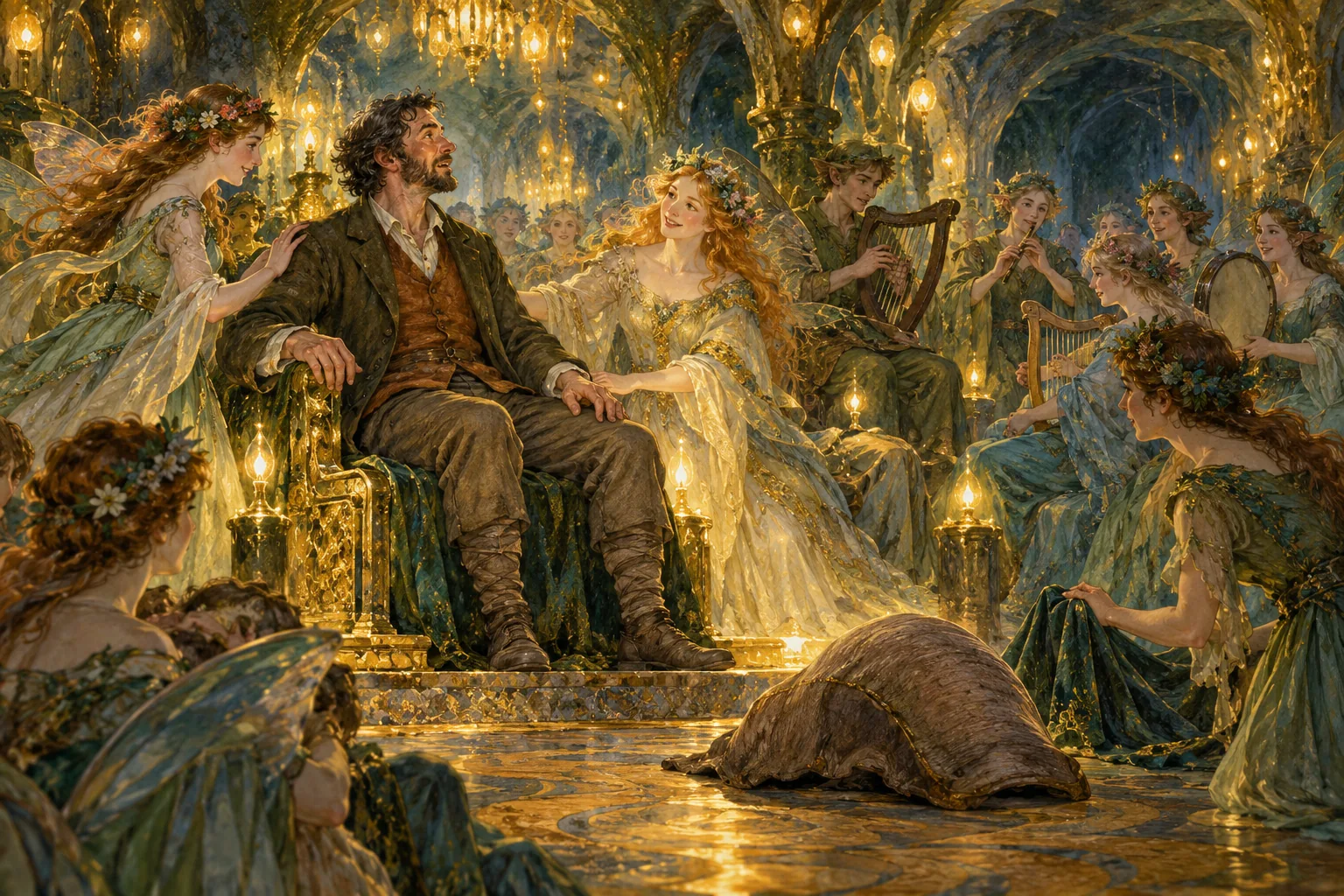
The voices rose in delight. His small addition had completed what they were trying to sing. Before he could decide whether to be frightened, he was lifted from his resting place and swept into the hill. Around him opened a brilliantly lit hall filled with fairies, musicians and attendants. They placed him above the music, treating the tired traveller as an honoured guest.
Honour did not immediately quiet his fear. He had entered a place no ordinary invitation could have brought him to, among beings whose intentions he did not know. But their song explained the reward they had prepared. They praised Lusmore and promised that he would leave his burden behind.
As they sang, the curve of his back disappeared. He saw what had been removed lying on the floor. Suddenly light and upright, he scarcely knew how to hold himself. He raised his head cautiously, almost afraid he might strike the ceiling. The lights and movement overwhelmed him, and at last he fell asleep.
He woke outside in daylight. Sheep and cattle were about the hill; the splendid hall had vanished. He put his hands behind him and discovered that the change remained. There were new clothes too. With a thankful prayer he set off towards Cappagh, moving so easily that the journey seemed entirely different.
People who knew him failed to recognise him. Once he explained what had happened, the news travelled farther than he could. Eventually an old woman came from the Decies in Waterford. A woman she knew had a son with a similar back, and she wanted to learn how he might receive the same kindness.
Lusmore kept nothing secret. He described the hill, the hour, the tune and the words he had added. The visitor went home with the account, and she and the young man’s mother arranged to bring him there. His name was Jack Madden.
After a long cart journey, they left Jack at the hill as darkness fell. Soon the fairies began the song Lusmore had improved. Jack wanted the reward without the waiting. Before the music reached a suitable pause, he shouted his own addition across it. He imagined that adding more words would earn him more than Lusmore had received.
The song stopped. This time the movement inside the hill was furious. Jack was dragged into the fairy company, where the discarded burden from Lusmore’s back was brought out. Instead of removing Jack’s own, the fairies fastened the other upon it. Then they drove him from their hall.
His mother and her companion found him barely alive. They were frightened even to complain of what had been done, and the return journey was harder than the outward one. Jack died soon after reaching home. He left a curse, the story says, upon anyone who would go listening for fairy music again. The beautiful song had brought him only suffering.
Versions and variations
Croker’s printed story and Jacobs’s reprint. The 1844 account, chapter III, pp.21–26, and the 1906 text share the central sequence: Lusmore listens successfully, Jack interrupts, and the second encounter ends in death. Joseph Jacobs’s “The Legend of Knockgrafton”, tale XL, pp.156–163, belongs to this printed transmission. His note explicitly names Croker as his source. It therefore cannot be counted as another collector independently hearing the same story from a local speaker.
Edwin and Sir Topaz: an earlier literary analogue. In Thomas Parnell’s “A Fairy Tale, in the Ancient English Style”, the setting is an imagined Britain in Arthur’s time. Edwin loves Edith but believes his appearance disadvantages him beside the handsome Sir Topaz. He stumbles into a fairy celebration, tells the truth and dances. The fairies suspend him by his back; in the morning his hump has disappeared. Topaz deliberately seeks the same company but pretends he arrived by accident. Exposed as a liar, he receives Edwin’s former hump. Unlike Jack, he is not already carrying one, and the poem does not end with his death. Truthfulness and romantic rivalry replace the Irish tale’s musical judgement and imitation. This is a documented comparison, not proof that Parnell recorded a Knockgraffon tradition.
What the editions do not settle. The 1844 and 1906 texts print Jack’s sung addition inconsistently with the earlier weekday sequence: one form repeats the word already used in Lusmore’s contribution. This retelling describes his interruption without silently repairing the Irish into an authoritative lyric. Jacobs also mentions a Japanese parallel in his note, but the Japanese tale has not been independently collated for this entry. His proposed route of transmission should not be mistaken for established history.
Context and evidence
The story gives Lusmore a trade, a route and a place in a community before introducing the fairies. His skill at listening is as important as the supernatural gift. Jack’s death, however, makes this more disturbing than a simple lesson in politeness. The retelling preserves the outcome while avoiding the original narrator’s suggestion that bodily difference reveals someone’s character. Read the selected account.
The modern place is Knockgraffon. An NLI drawing catalogue title uses both Knockgrafton and Knockgraffon, providing a useful spelling connection. A real named setting does not establish that Lusmore or the fairy meeting existed.
Sources for this entry
- Thomas Crofton Croker, collection; Thomas Wright, later editor, Fairy Legends and Traditions of the South of Ireland. Seventh edition, June 1906; Library Ireland transcription. The Legend of Knockgrafton, complete story. Read source — Chosen narrative; printed literary presentation of folklore. About this book
- Thomas Crofton Croker, collection, Fairy Legends and Traditions of the South of Ireland. Philadelphia: Lea and Blanchard, 1844, A New Edition. III: The Legend of Knockgrafton, pp.21–26; preface. Read source — Earlier printed parallel and evidence of editorial condensation, not an independent oral witness. About this book
- Joseph Jacobs, selected and edited; John D. Batten, illustrator, More Celtic Fairy Tales. First published 1894; linked edition New York: G. P. Putnam’s Sons / London: D. Nutt, 1895. XL: The Legend of Knockgrafton, pp.156–163; note XL, pp.230–231. Read source — Dependent anthology text; source note explicitly names Croker. About this book
- Thomas Parnell, The Poetical Works of Thomas Parnell. London: William Pickering, 1833, Aldine edition. Poem 8: A Fairy Tale, in the Ancient English Style, beginning p.25; complete poem. Read source — Earlier literary analogue: Edwin and Sir Topaz; not a second Knockgraffon field record.
- National Library of Ireland, Knockgrafton [Knockgraffon] moat, church and castle, County Tipperary, 1840. Catalogue record; created date given as undated; main creator William Frazer, contributor George Victor Du Noyer. Drawing PD 1975 TX 5 (15), title and creator fields. Read source — Primary catalogue evidence connecting the two spellings; not identification of a fairy chamber.
Research coverage
The 1906 narrative and the 1844 parallel have been read; Jacobs’s source note and Parnell’s whole poem have been examined. No named local oral informant or Irish-language manuscript has been collated. The original 1825 printing and a directly sourced Japanese account remain gaps. This is a documented selection, not a claim to all variants.
The Myths · Irish collection · Editorial approach
Further Reading