Fenian Cycle · story
The Hostel of the Quicken Trees
A splendid feast becomes a trap when Fionn and his companions find themselves fixed to the floor. Outside, a handful of younger warriors must hold a ford until the enchantment can be broken.
Also found as: Bruighean Caerthainn · The Fairy Palace of the Quicken Trees · The House of the Rowan Trees · The House of the Quicken Trees
Research reviewed 17 October 2026.
Read the story
This retelling follows P. W. Joyce’s “The Fairy Palace of the Quicken Trees”, chapters I–VII, pp. 177–222. Names are lightly modernised; the sequence and outcome remain those of Joyce’s account.
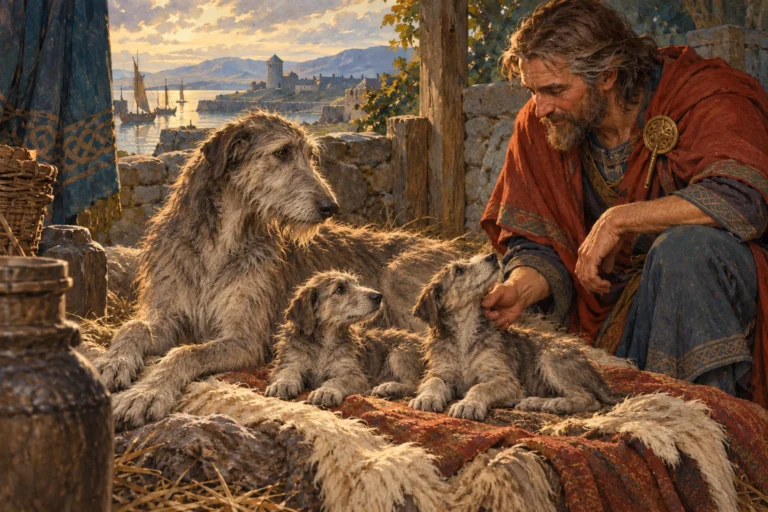
Years before the enchanted feast, the king of Lochlann had brought an army into Ireland. The Fianna defeated him, and Oscar killed him in battle. His son Midac survived. Fionn spared the young man and brought him into his household, where he learned the habits, strengths and weaknesses of the warriors who had destroyed his father’s army.
Eventually Fionn gave Midac lands of his own beside the Shannon. Fourteen years passed without an invitation to his house. While the Fianna hunted elsewhere, Midac made other friendships. He gathered foreign warriors, among them Sinsar, called the King of the World, and three kings whose island possessed a terrible kind of earth: anyone seated upon it could be held there by enchantment.
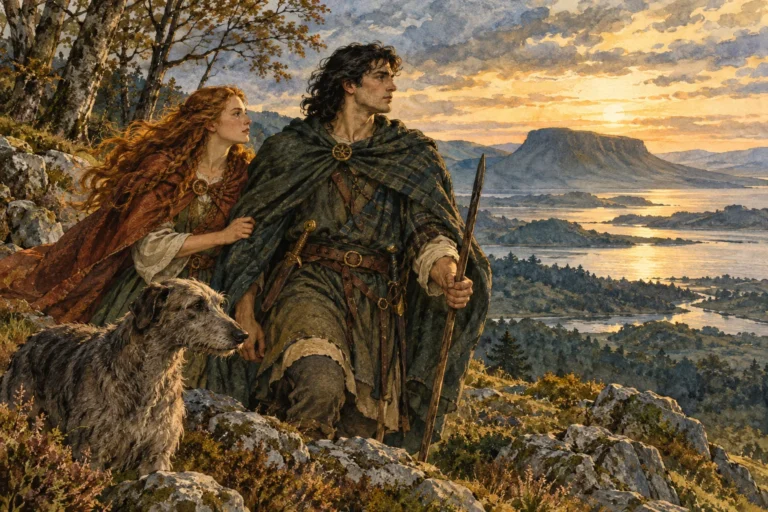
One day the Fianna were hunting near Knockfierna. A stranger approached their resting place, dressed as a noble warrior but presenting himself as a poet. He challenged Fionn with riddles about a mysterious house and a queen whose children could be seen through her skin. Fionn recognised the house of Brugh and the river Boyne. Yet it was Conán who recognised the man speaking: this was Midac, their former companion.
Conán accused him of withholding hospitality. Midac answered with an invitation, binding Fionn to accept it. He had two palaces, he said; the feast awaited them at the one among the quicken trees. Fionn agreed. Oisín stayed behind with several companions to await the hunters, and Fionn promised to send news of the welcome he received.
The palace stood beside a river ford, surrounded by trees bright with berries. Its doors were open, but no servants came to meet the guests. Inside were coloured walls, soft furs and a fragrant fire. Fionn’s companions settled on the couches. Midac appeared, looked silently from face to face, then left and closed the door.
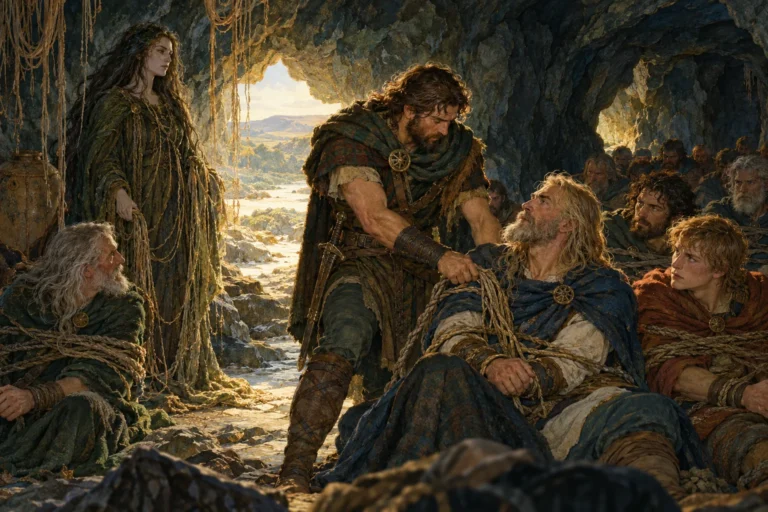
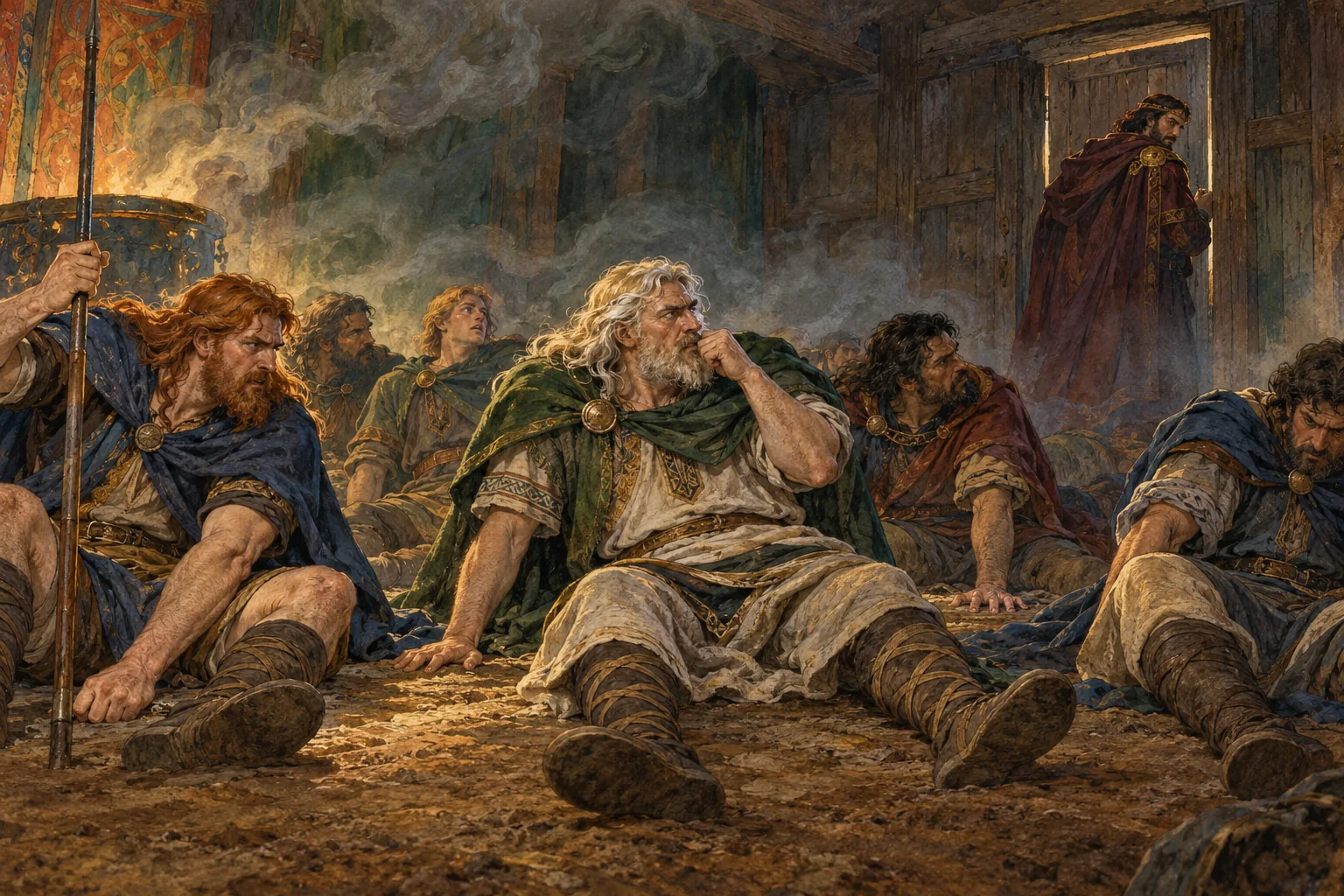
Gradually the room changed. The fire poured out foul smoke. The beautiful walls became roughly joined boards. Seven doors dwindled to one narrow opening. Beneath the warriors, the cushions vanished, leaving cold earth. Conán planted his spear to help himself stand. He could not rise. Neither could anyone else.
Fionn put his thumb to his tooth of knowledge and understood. They sat on soil brought from the Island of the Torrent. Their enemies were preparing to kill them while they remained helpless. Only the blood of the island’s three kings could break the spell. With no weapon able to help them, the prisoners sounded the sorrowful music of the Dord-Fian.
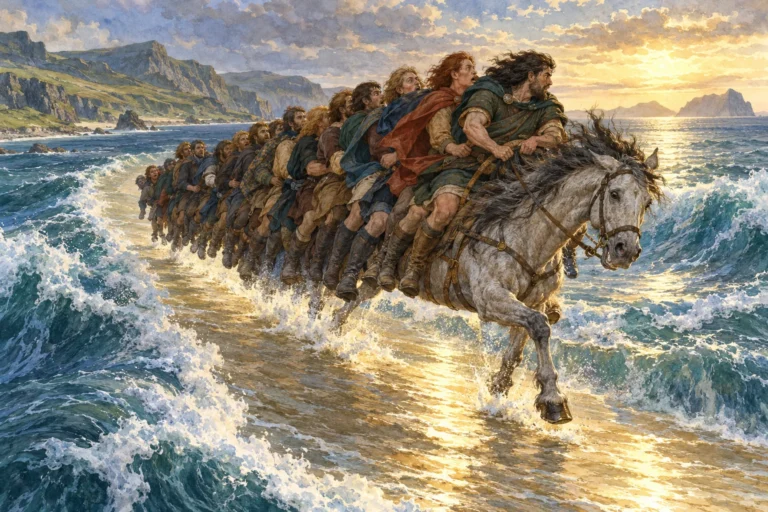
When no messenger returned, Oisín sent Fionn’s son Ficna and his foster-son Innsa to investigate. They heard the music and learned what had happened. Fionn urged them to escape, but neither would abandon him. The ford was narrow: a single defender could delay an army there. Innsa stayed to guard it while Ficna went to discover the enemy’s strength.
Innsa fought until he was exhausted. An enemy captain killed and beheaded him, then carried the head away. Ficna met the captain, took his foster-brother’s head into his hands and recognised the disaster. He killed the man, buried Innsa beside the ford and returned to defend the crossing himself.
Ficna too was overwhelmed by repeated attacks. Diarmuid and Fatha arrived while he fought Midac. Diarmuid cast his spear and mortally wounded the betrayer, but before he could reach them Midac killed Ficna. Diarmuid beheaded Midac and brought Fionn the bitter news. The trap was becoming costly even to those who had never entered it.
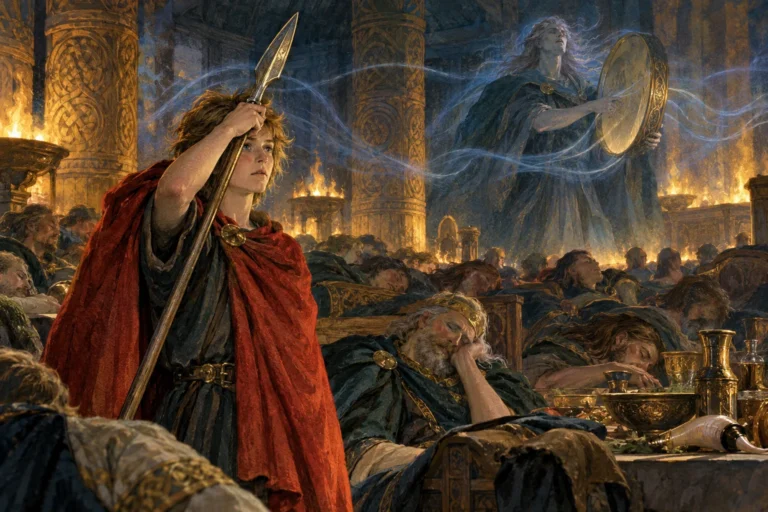
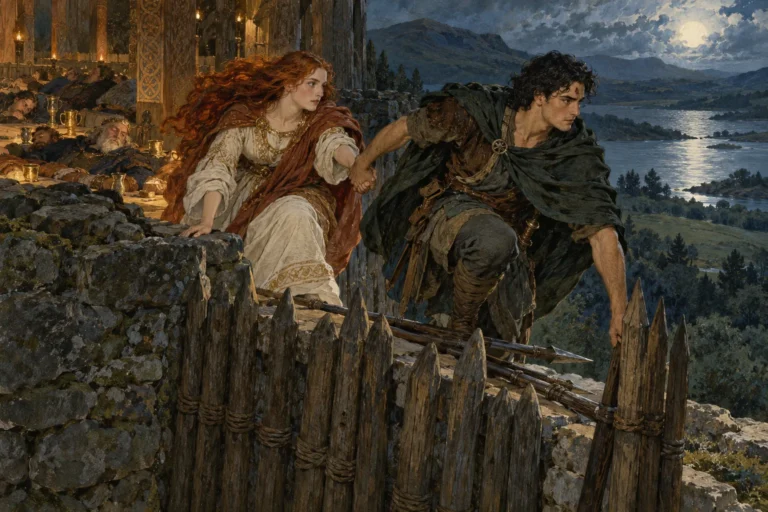
Still Conán demanded food. Diarmuid stole into the enemy’s feast and brought him a meal and wine, pouring the drink through a hole in the roof. Then he and Fatha faced the three island kings. When Diarmuid killed them, the rescuers carried their heads to the house and sprinkled their blood on its door and floor. The door opened; the prisoners could stand.
Their strength returned only with sunrise. Until then Diarmuid and Fatha held the ford. At dawn the freed warriors joined them, followed by Oisín and the returning hunters. Goll killed the enemy prince Borba; Oscar killed Sinsar himself. The surviving invaders fled to their ships. Fionn was free, but the victory could not restore the two young men who had defended him through the night.
Versions and variations
Joyce’s extended rescue narrative. Joyce gives the trap a long history: Oscar’s killing of Midac’s father, Midac’s upbringing among the Fianna, his lands and his fourteen-year conspiracy. He then makes the defence of the ford a succession of sacrifices. Innsa and Ficna die before Diarmuid and Fatha can save the prisoners. Goll and Oscar receive separate victories in the final battle. These details belong to Joyce’s seven-chapter account, pp. 177–222; a short retelling that omits them changes the emotional balance from bereavement towards a straightforward escape.
Gregory’s concentrated Diarmuid episode. In Part II, Book VI, chapter V, “The House of the Quicken Trees”, Lady Gregory starts with Miodac posing as a poet and moves quickly to the changing room and the spell. She does not narrate Midac’s childhood or name the two doomed defenders. Diarmuid becomes the clear centre of the rescue. Conán asks for food while Diarmuid is freeing the company, whereas Joyce places the food raid before the fight with the three kings. Gregory also includes a bee-army riddle alongside the Boyne and Brugh riddles; Joyce’s displayed riddle sequence has the house and river.
Two adaptations, with manuscript ancestry. Their similarity does not establish two independent oral performances. Joyce identifies three Royal Irish Academy manuscripts in his preface, p. xiv, copied in 1733, 1766 and 1841. Gregory’s “Authorities”, Part II credits manuscripts in the Academy and Douglas Hyde’s possession, without identifying individual shelfmarks there. That leaves a real research task: collating the Irish copies before deciding whether a particular difference is inherited or editorial. The two English books demonstrate different published forms; they do not by themselves show how frequently any form circulated.
Context and evidence
The story turns hospitality into danger: Fionn honours an invitation from someone he once protected, while the apparent comforts of the house conceal captivity. Its young defenders answer betrayal with loyalty. These are readings of the narrative, rather than evidence that the invasion occurred. Joyce locates its action around Knockfierna and the Shannon country; his romantic “King of the World” belongs to the tale’s imagined international world. The Boyne and Brugh enter as subjects of riddles, not as the site of the enchanted hostel. Compare the different rescue at Kesh, where Goll takes the decisive role.
Sources for this entry
- P. W. Joyce, Old Celtic Romances: The Fairy Palace of the Quicken Trees. 1920 edition; collection first published 1879. Preface p. xiv; story chapters I–VII, pp. 177–222. Read source — Main retelling; manuscript statement; complete story consulted. About this book
- Lady Gregory, Gods and Fighting Men: The House of the Quicken Trees. 1905 edition; first published 1904. Part II, Book VI, chapter V; Notes III, Authorities, Part II. Read source — Compared literary adaptation; complete chapter and authority note consulted. About this book
Research coverage
Compares the complete Joyce and Gregory narratives. The Irish manuscripts named by Joyce and Gregory have not been collated here; no independent oral recording has yet been added. This is a documented selection, not a claim to cover every common version.
The Myths · Irish collection · Editorial approach
Further Reading