Fenian Cycle · story
Fionn and the Cave of Kesh
Enchanted thread robs the Fianna of their strength and traps them inside a cave. Their rescue falls to Goll mac Morna, Fionn’s rival and indispensable ally.
Also found as: The Enchanted Cave of Keshcorran · Bruidhen Chéise Chorainn · The Cave of Ceiscoran · The Enchanted Cave of Cesh Corran
Research reviewed 17 October 2026.
Read the story
This retelling follows Standish Hayes O’Grady’s translation of “The Enchanted Cave of Keshcorran”, §§1–15. It includes the final combat and aftermath absent from Gregory’s shorter chapter.
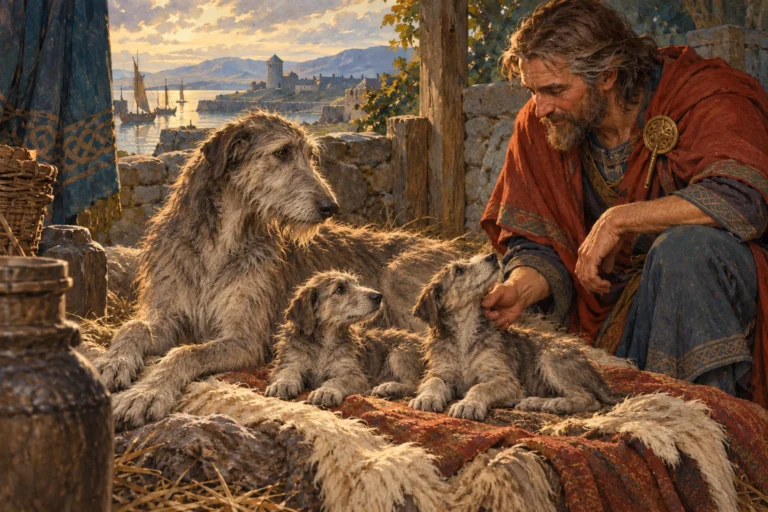
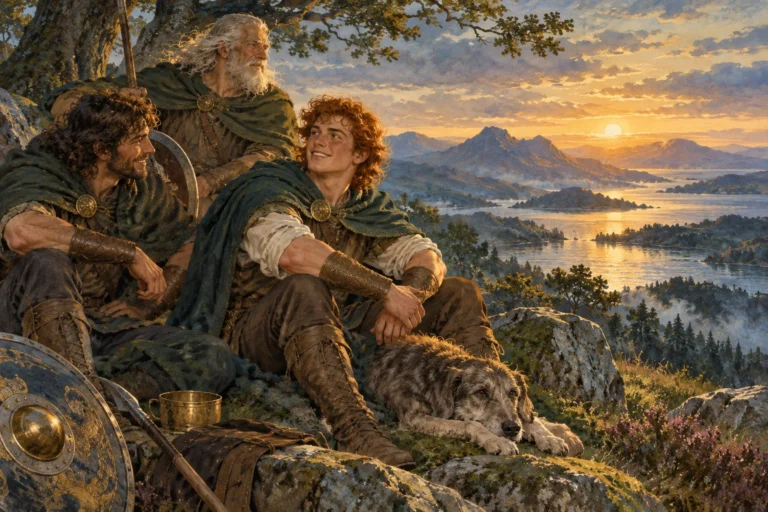
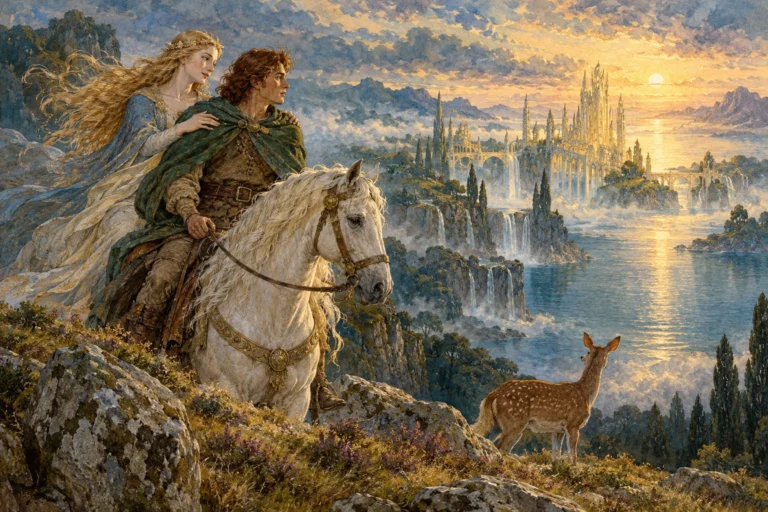
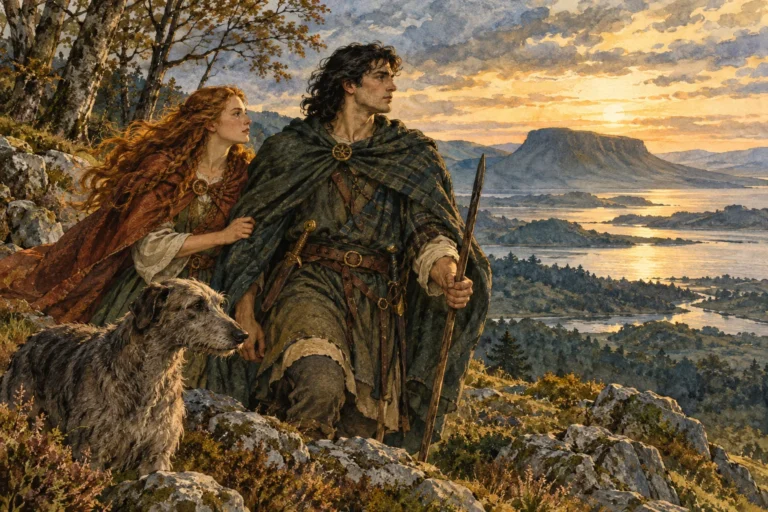
The hunt ranged across woods, plains and thick coverts. Hounds were baying, men were calling, and animals broke from their hiding places before the advancing hunters. On the height of Keshcorran, Fionn sat listening with Conán and the hounds Bran and Sceólang. To him, the noise was the sound of a successful day.
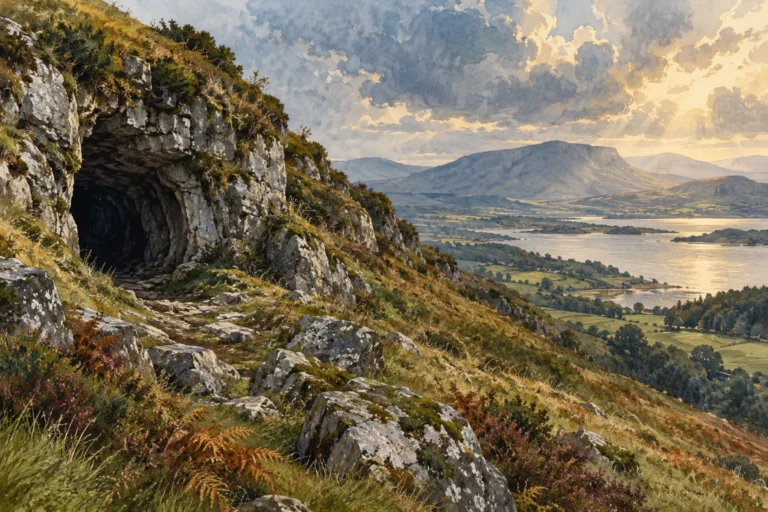
Conarán, the Otherworld ruler of the place, heard it differently. He ordered three of his daughters to take vengeance on Fionn for the hunting. They went to a cave entrance and hung enchanted hanks of yarn upon three crooked holly sticks. Then they began to wind the thread.
Fionn and Conán came upon them at their work. They saw tangled hair, fierce eyes and long hands with formidable nails. Curious to look more closely, the men stepped through the suspended yarn.
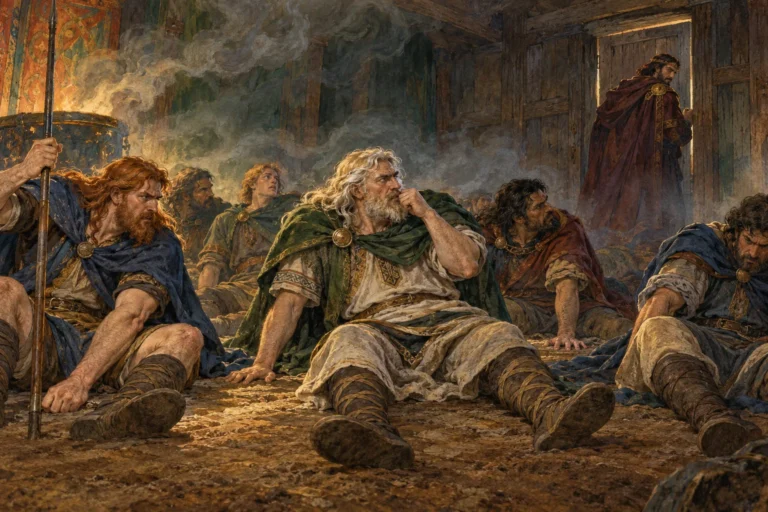
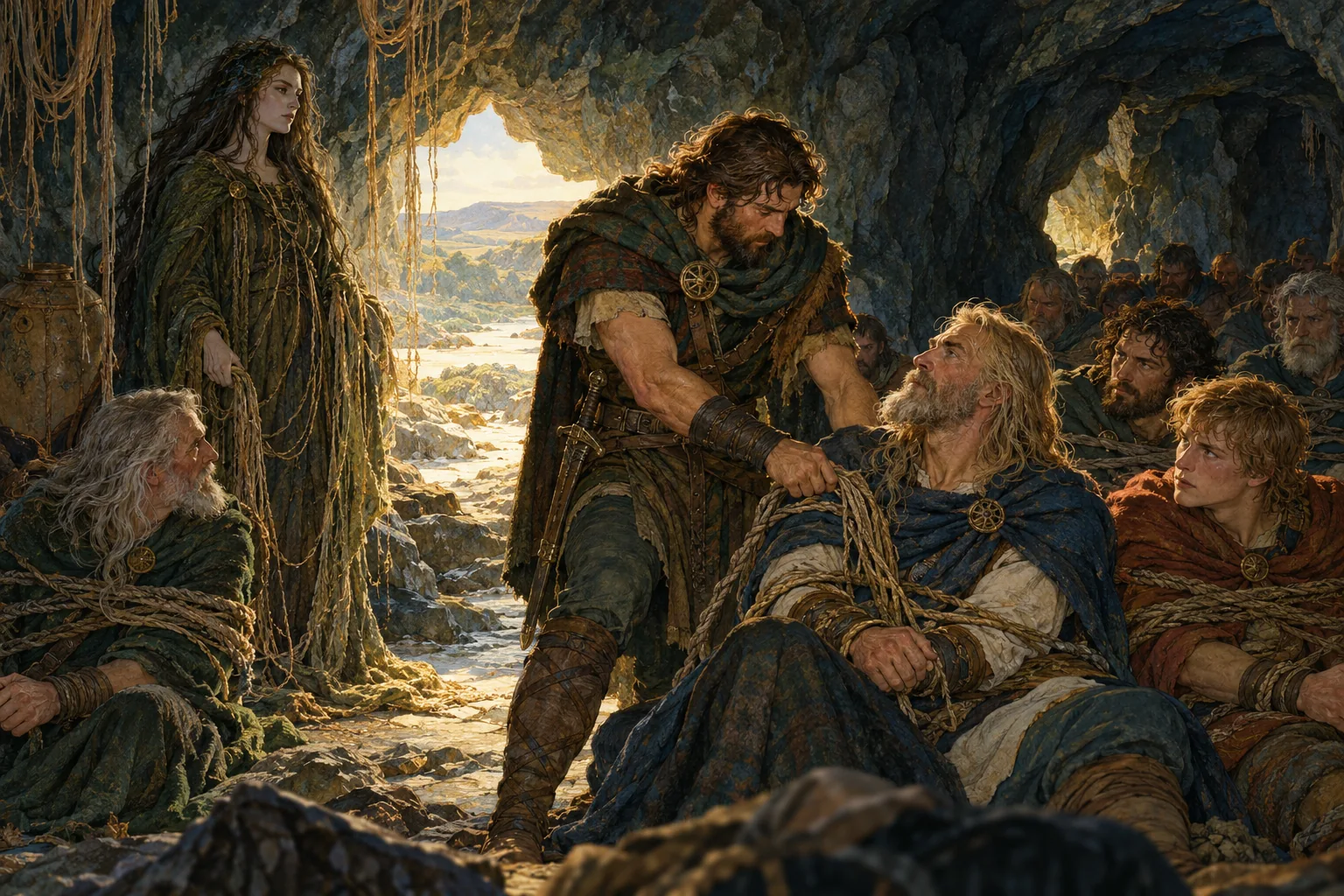
At once their bodies began to tremble. The strength that had carried them through battles deserted them. The women bound them before they could resist. More hunters approached, crossed the same threshold and collapsed into the same helplessness. Oscar and the leading men of Fionn’s kindred were caught; the men of Morna’s family followed them. Soon the warriors had been carried into the cave’s dark passages, bound and unable to defend themselves.
Outside, the hounds cried for their missing owners. The hunters’ dead game lay abandoned on the hillside. The three women took up their swords, ready to kill the prisoners, but first looked out for any straggler who might have escaped them.
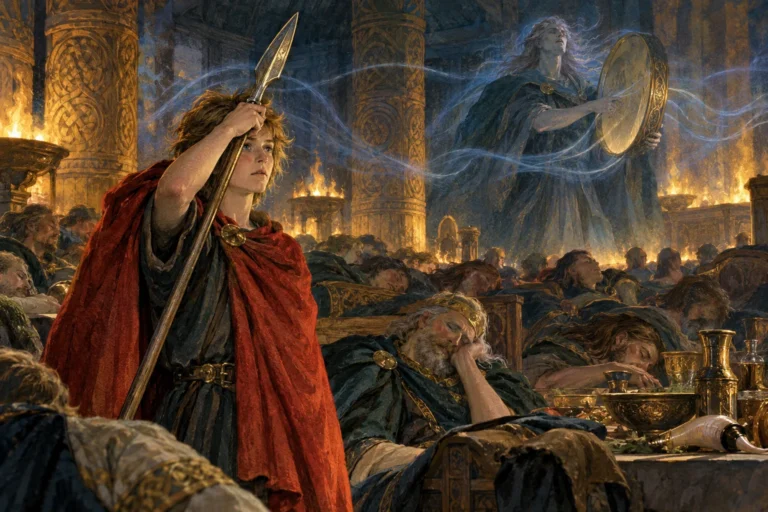
A tall warrior was approaching. It was Goll mac Morna.
They went out to meet him, and the fight began beyond the trap that had overcome the others. Goll struck with such force that one sword-blow killed two sisters, Caemhóg and Cuillenn Redhead. The eldest, Iaran, seized him from behind. He twisted round, wrestled her down and bound her with the straps of a shield.
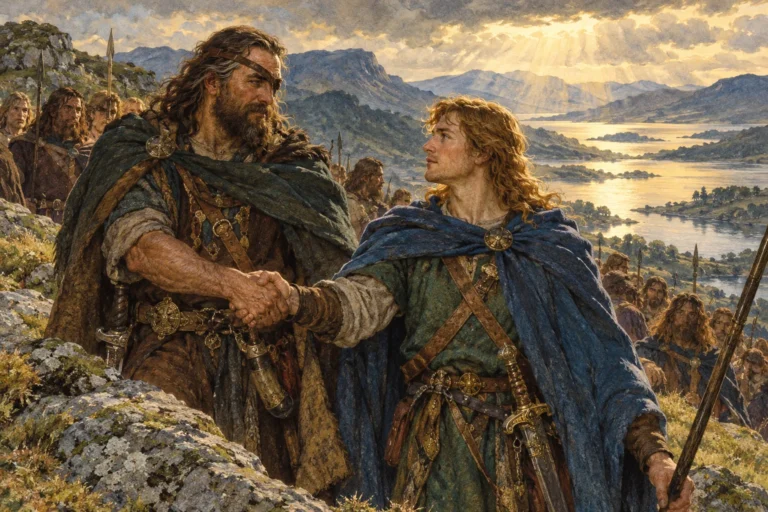
As he prepared to kill her, she appealed to his honour. Would he not rather have his companions alive and unharmed than take her life? She swore to release them. Goll accepted the bargain and accompanied her into the hill.
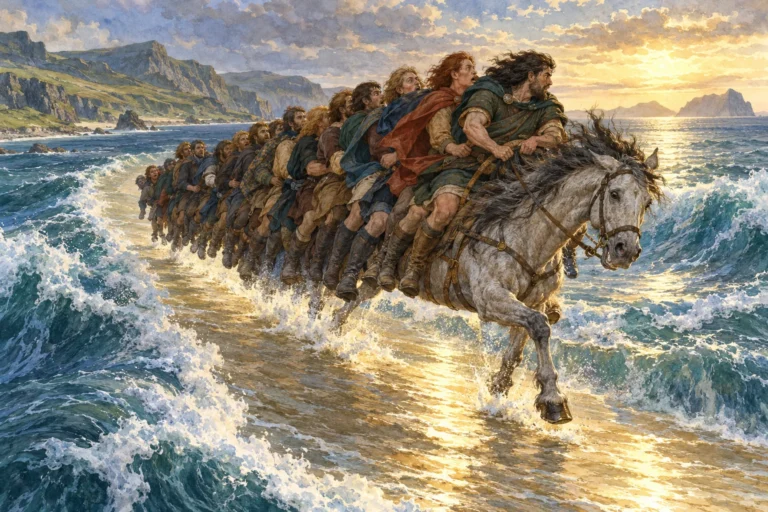
He ordered the poets and learned men freed first, beginning with Fergus Truelips. Fionn, Oisín, the sons of Morna and the rest followed. When the company emerged into daylight, Fergus praised their rescuer.
But the ordeal was not finished. Another daughter of Conarán, Iarnan, arrived armed for vengeance. She demanded single combat. Fionn called on his champions, but even Oisín and Oscar were still unable to face her. Fionn prepared to go himself. Goll intervened: he would take this combat too.
The two fought fiercely until Goll drove his sword through her shield and killed her. Afterwards he burned Conarán’s stronghold and distributed its wealth among the Fianna. Fionn gave him his daughter Caemh in marriage.
The story closes with a darker glance ahead. Their son Fed would himself be killed by the Fianna at seventeen, at that same place. Rescue and marriage had brought the rivals together, but the tale does not promise that their families would live in lasting peace.
Versions and variations
Where the story ends
O’Grady’s translation, §§11–14, continues after the release of the Fianna. Another daughter, Iarnan, challenges them; Goll kills her, burns the stronghold and marries Fionn’s daughter Caemh. The last paragraph anticipates their son’s death. Gregory’s “The Cave of Ceiscoran” ends instead with the release and Fergus’s praise. The fourth sister and the entire marriage aftermath are absent. Because Gregory names Silva Gadelica as her authority, this is a documented shortening in a later retelling, not proof of a separate oral ending.
Who is rescued first?
O’Grady and Gregory both give Goll the striking instruction to free the learned men before Fionn and the other warriors. Stephens’s “The Enchanted Cave of Cesh Corran”, chapter V, lists Fionn, Oisín, Oscar and Conán first instead. Stephens retains the fourth sister, calling her Iarnach, and the marriage offer, but does not recount the burning of the stronghold or Fed’s fate. His final paragraph substitutes a wry reflection on Fionn and Goll’s continuing feud.
Why the trap is set
O’Grady and Gregory explicitly connect Conarán’s anger with the hunt. Stephens says that the ruler dislikes Fionn and sees an opportunity, while admitting the narrator does not know what Fionn has done to him. He also makes Conarán alter the men’s sight so they can enter Faery. That explanation is absent from the corresponding opening of O’Grady’s text. These are useful differences in storytelling, but the three printed accounts are not three independently recorded local testimonies.
Context and evidence
The CELT edition’s source description identifies O’Grady’s Irish witness as British Library Additional 18747, copied around 1800. An old story preserved in a comparatively late manuscript should not be advertised as if this particular copy were an eyewitness or an early medieval artefact. The place association is explicit: the hunt, cave and Otherworld ruler belong to Keshcorran in the narrative. The text does not identify which individual modern cave opening is meant. For the physical landscape and its separately assessed evidence, see Kesh Caves.
Sources for this entry
- Anonymous; edited and translated by Standish Hayes O’Grady, The Enchanted Cave of Keshcorran. Silva Gadelica, vol. II (London: Williams and Norgate, 1892), pp. 343–347; CELT T303021. Complete tale, §§1–15; CELT manuscript and edition metadata. Read source — Principal retelling; directly examined full text. About this book
- Lady Gregory, Gods and Fighting Men. First published 1904; consulted 1905 edition via Project Gutenberg. Part II, Book IV, chapter II, The Cave of Ceiscoran; Notes III. Read source — Shorter literary adaptation; acknowledged source Silva Gadelica. About this book
- James Stephens, Irish Fairy Tales. London: Macmillan, 1920; Project Gutenberg text. The Enchanted Cave of Cesh Corran, chapters I–VI. Read source — Later literary comparison; complete six-chapter text examined. About this book
Research coverage
O’Grady’s full translation, Gregory’s shortened account and Stephens’s literary version have been compared. The Irish manuscript itself and modern recorded local variants have not been collated. No exact cave mouth or modern archaeological feature is assigned to the enchantment.
The Myths · Irish collection · Editorial approach
Further Reading