Fenian Cycle · figure
Goll mac Morna: Rival, Rescuer and Hero of the Fianna
Goll kills Fionn’s father, later serves beside Fionn, and repeatedly saves the Fianna. His stories preserve the difficult bond between family rivalry and loyalty to companions.
Also found as: Goll son of Morna · Gaul Mac Morna · Áed mac Morna · Aed son of Daire
Research reviewed 17 October 2026.
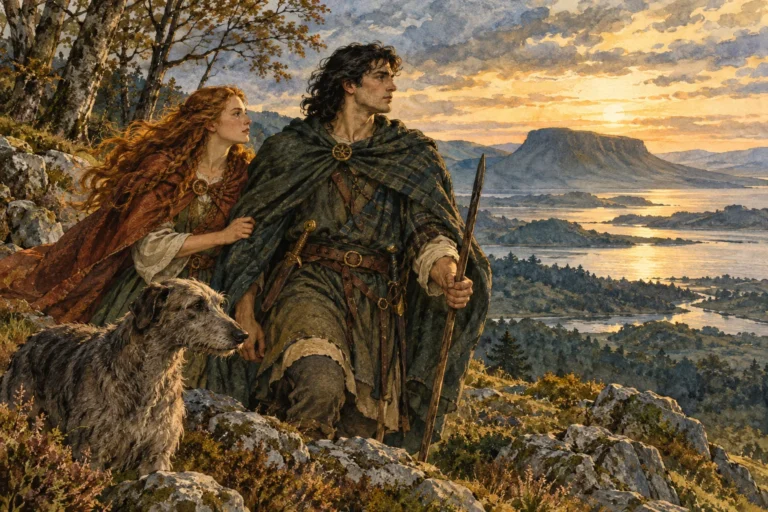
Goll mac Morna is one of the Fenian tradition’s hardest figures to reduce to a single role. He is an enemy inherited from Fionn’s father, an accomplished leader in his own right and, in several adventures, the man whose courage saves the whole company. The tension is already present in The Boyish Exploits of Finn, §§1–3: the text describes both the families’ feud and a later peace.
That account says he was originally Áed. During the battle of Cnucha, Luchet injured one of his eyes; thereafter he was called Goll, explained in Meyer’s translation as “the One-eyed”. Goll killed Luchet and then Cumall, Fionn’s father, taking Cumall’s head and spoils. The battle is fought for leadership of the Fianna. Fionn’s childhood danger consequently grows out of a struggle over power as well as personal revenge. Source: Kuno Meyer’s translation, Ériu 1 (1904), pp. 180–182.
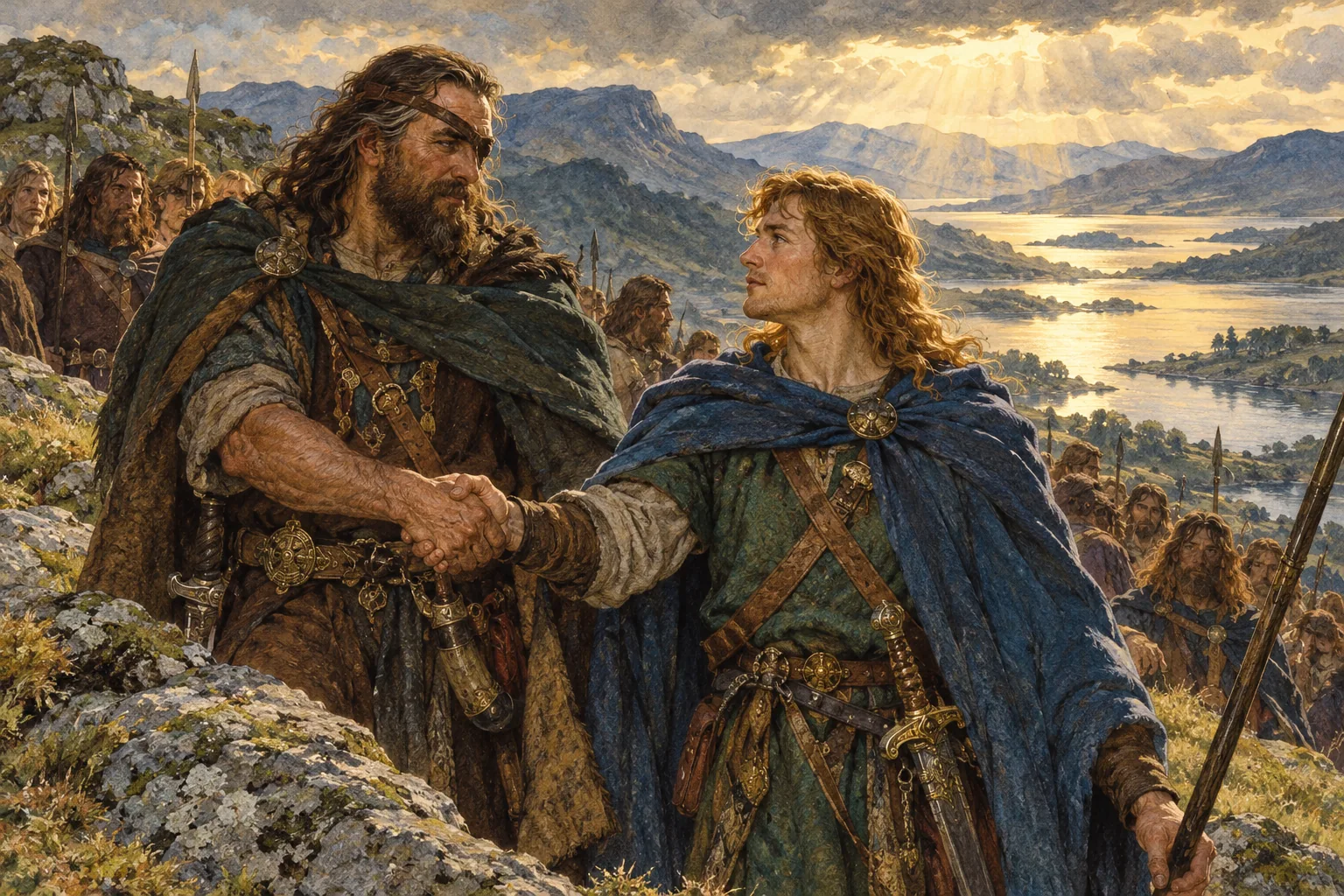
Yet Goll can yield command. In the Aillén story, young Fionn saves Tara and receives the leadership. King Conn offers Goll exile or an accommodation with the new chief. Goll puts his hand in Fionn’s. That gesture matters because it allows former enemies to share later adventures without erasing the quarrel behind them. Source: Acallam na Senórach, §§129–139, O’Grady translation.
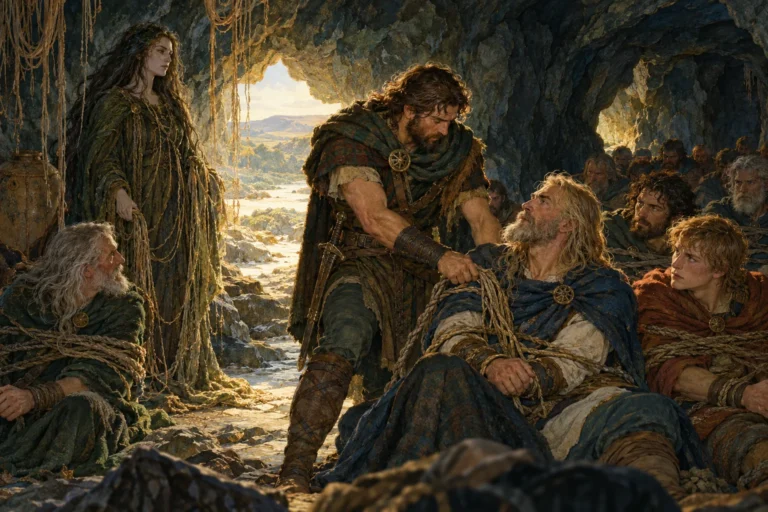
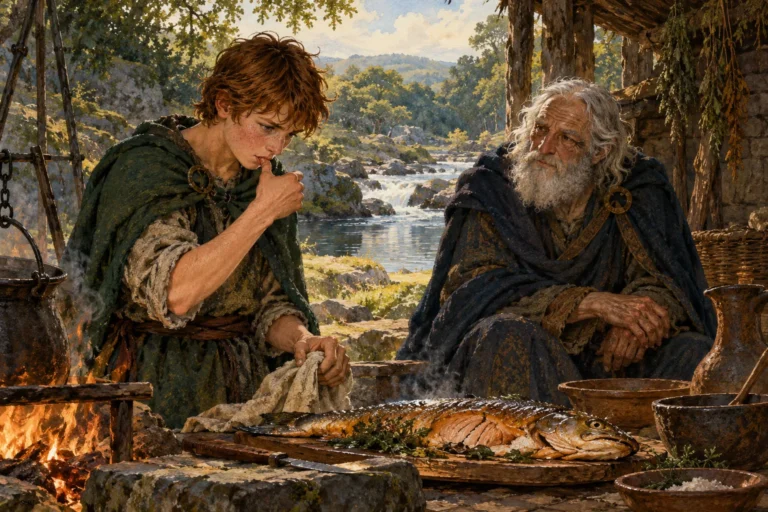
At Kesh, Fionn, Oscar and the others lose their strength through enchanted yarn. Goll arrives outside the spell, defeats two of the women responsible and forces the survivor to release the prisoners. He asks for Fergus and the learned men to be freed first, before Fionn and the remaining warriors. When another challenger arrives, he fights again rather than let the exhausted company face her. The rescue combines formidable violence with an explicit ordering of obligations. Source: O’Grady, §§8–14.
His cooperation with Oscar appears particularly clearly in The Pursuit of the Gilla Decair. Goll allows the younger hero to take a single combat while he attacks the opposing followers. Later they enter Athens disguised as poets to recover Taise. These episodes make him a capable partner, not a permanent antagonist waiting outside Fionn’s story. Source: §§28–30 and 39–40.
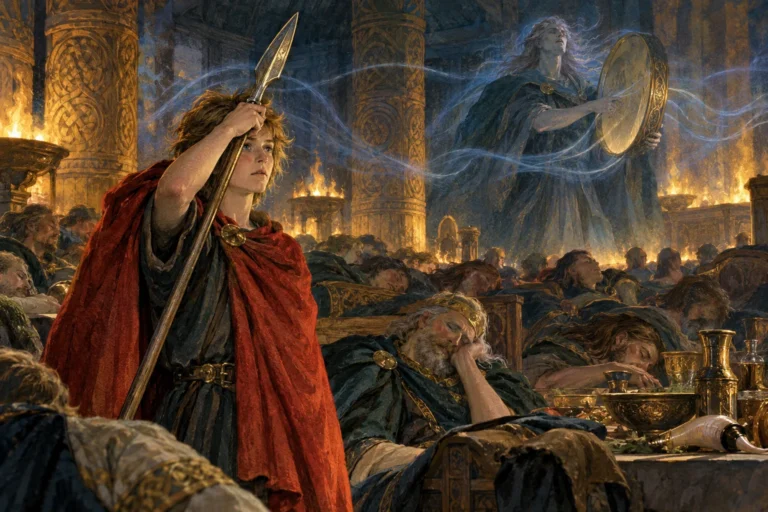
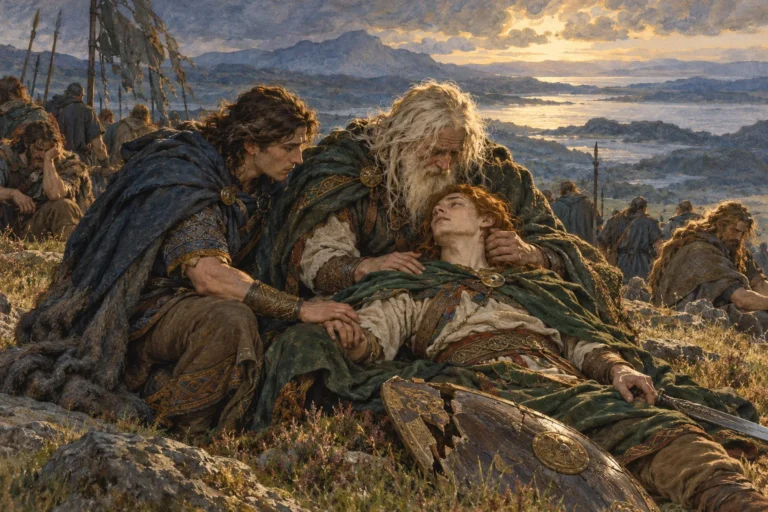
Gregory’s later chapters allow the old conflict to destroy that cooperation. At a feast in Almhuin, Goll’s lavish gift to a poet provokes Fionn to question his foreign tribute. Their argument returns to Cumall’s death; a fight spreads through the hall until poets impose peace. Further violence follows. After Goll kills Fionn’s son Cairell, he retreats to a sea-cave. Surrounded and refusing escape, he dies after twelve days without food or drink. Source: Part II, Book IX, chapters I–II.
A different emotional register survives in the Scottish Gaelic “Praise of Goll”, recorded from Donald MacPhie in Barra in 1860. Here Fionn himself answers a stranger by praising Goll’s generosity, gentle speech and loyalty as well as his martial power. The praise does not cancel the hostile stories. It shows why losing this man could be a loss to the whole heroic world, including those who fought him.
Read Goll through those connected episodes: the killing of Cumall, the hand offered at Tara, the rescue at Kesh and the final feud. Together they reveal shifting relationships; they should not be forced into a fully dated life unsupported by the sources.
Versions and variations
Different emphases in the founding feud. In Meyer’s “Boyish Exploits”, §§1–3, the battle concerns command of the Fianna, Goll receives his eye wound from Luchet, and he kills Cumall. Gregory’s Book IX, chapter I, revisits the death through competing speeches: Garraidh describes a collective attack, while Goll recounts his own exile and revenge. These accounts distribute blame differently. They are not interchangeable reports from a single battle.
Rescuer and patron. O’Grady’s Kesh narrative, §10, gives Goll an unusually precise priority: release the poet and learned men before the leaders. Gregory’s Kesh chapter, Part II, Book IV, chapter II, compresses the rescue. Her later banquet story, however, foregrounds his generosity towards poets, harpists and scholars. The comparison is between a translated romance and a literary selection; Gregory explicitly names Silva Gadelica among her authorities for Kesh.
Fionn’s enemy, Fionn’s praised companion. The Barra “Praise of Goll”, pp. 309–311, makes Fionn describe him as loyal and gentle-spoken. Gregory’s death sequence instead turns that relationship into siege and starvation. Praise poetry and a death narrative have different purposes; their emotional difference need not be repaired by inventing a missing event to reconcile them.
A traceable oral fragment. MacPhie told Hector MacLean that he learned the praise from his uncle Hector MacLaine. Campbell prints thirteen lines and compares them with longer versions in the Dean of Lismore material and later collections. That comparison is itself valuable evidence of transmission, but the earlier books have not been independently collated for this guide. The recorded fragment supplies a named speaker and teacher; the editor’s table supplies research leads, not automatic proof that every text was transmitted unchanged.
Context and evidence
The Goll stories offer a useful check on any account that treats the Fianna as one permanently united family. Their internal loyalties can hold during rescue and fail during disputes over honour, tribute and kin. The texts are evidence for those narrative concerns and for Goll’s place in Irish and Scottish tradition. They do not prove his genealogy or establish that the reported foreign conquests happened.
Sources for this entry
- Anonymous; translated by Kuno Meyer, The Boyish Exploits of Finn. Ériu 1 (1904), pp. 180–190; CELT T303023. §§1–4, pp. 180–182. Read source — Goll’s name, eye wound, Cumall’s death and the feud; 1904 date used after checking volume metadata.
- Anonymous; translated by Standish Hayes O’Grady, Acallam na Senórach. Silva Gadelica, II (1892); UCC Irish Sagas Online. §§129–139, Aillén episode and transfer of command. Read source — Goll’s acceptance of Fionn’s leadership. About this book
- Anonymous; translated by Standish Hayes O’Grady, The Enchanted Cave of Keshcorran. Silva Gadelica, II (1892); CELT T303021. pp. 345–347, §§8–14. Read source — Rescue, priority given to learned men and second combat. About this book
- Anonymous; translated by Standish Hayes O’Grady, The Pursuit of the Gilla Decair and his Horse. Silva Gadelica, II (1892). pp. 305–306 and 309–310, §§28–30 and 39–40. Read source — Partnership with Oscar. About this book
- Lady Gregory, Gods and Fighting Men. 1905 edition; first published 1904. Part II, Book IV, chapter II; Book IX, chapters I–II; Notes III, Authorities. Read source — Compared adaptation, quarrel, patronage and death narrative. About this book
- Donald MacPhie, recorded by Hector MacLean; edited by J. F. Campbell, Popular Tales of the West Highlands, III: LXXIX, The Praise of Goll. Edinburgh: Edmonston and Douglas, 1862; recorded 1 October 1860. pp. 309–311, thirteen-line praise and collector’s note. Read source — Named Scottish oral witness and transmission note. About this book
Research coverage
Connects directly consulted passages rather than claiming a complete biography. Other death traditions, all genealogies, the full Dean of Lismore praise and later oral recordings remain outside this guide. Campbell’s earlier-text comparisons are reported as his comparisons, not as manuscripts independently examined here.
The Myths · Irish collection · Editorial approach
Further Reading