Fenian Cycle · story
The Pursuit of the Gilla Decair
A troublesome stranger and his unlikely horse carry fifteen members of the Fianna out over the sea. Fionn’s rescue becomes a journey through enchanted lands, divided loyalties and a quarrel over compensation.
Also found as: The Pursuit of the Gilla Dacker and His Horse · Tóraighecht in Ghilla Dhecair ocus a chapaill · The Hard Servant · Abartach and the Fianna
Research reviewed 17 October 2026.
Read the story
This retelling follows the Irish prose romance translated by Standish Hayes O’Grady in Silva Gadelica, volume II, pp. 292–311, §§1–44. It retains that version’s fifteen captives and its separate adventure involving Taise.
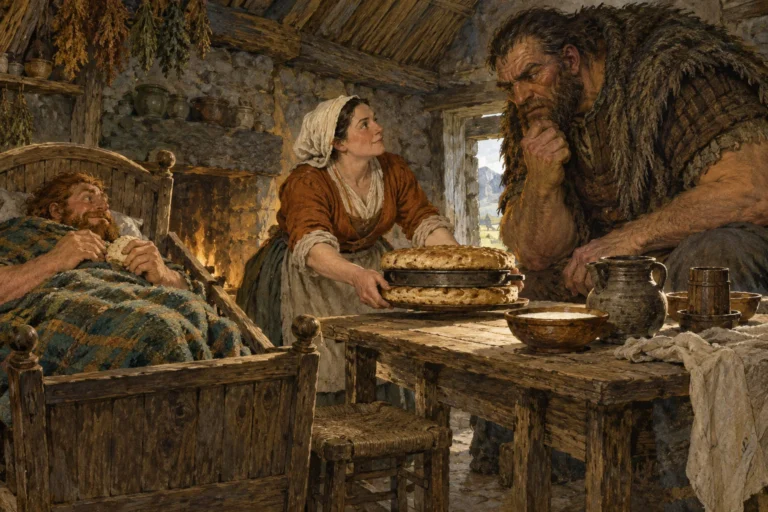
The stranger arrived while Fionn and his companions rested during a hunt in Munster. He was large, ill-tempered and painfully slow. Behind him he dragged a gaunt horse which resisted every tug. He asked to enter Fionn’s service, announcing that he was the Gilla Decair: a servant who found doing anything for his employer exceptionally difficult. He ate enough for a hundred men and disliked sharing even that.
Fionn accepted him. The servant established that a mounted man earned more than a man on foot, then asked permission to release his horse among the Fianna’s animals. As soon as it was free, the miserable-looking creature began attacking them. Conán complained, but the owner refused to act as his own groom.
Conán caught the horse. Fionn suggested he ride it until it had paid for the damage in exhaustion. It would not move. Perhaps, Fionn proposed, it needed a weight equal to its owner’s. Thirteen more men climbed on behind Conán. The horse lay down and stood up again; the company laughed.
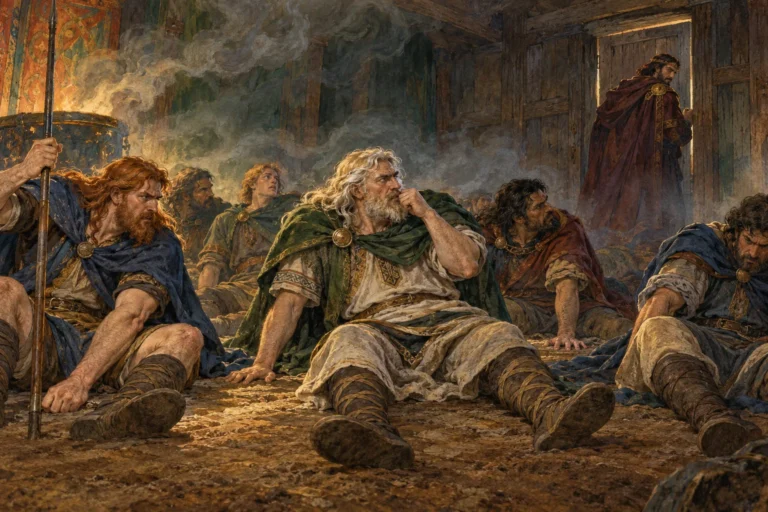
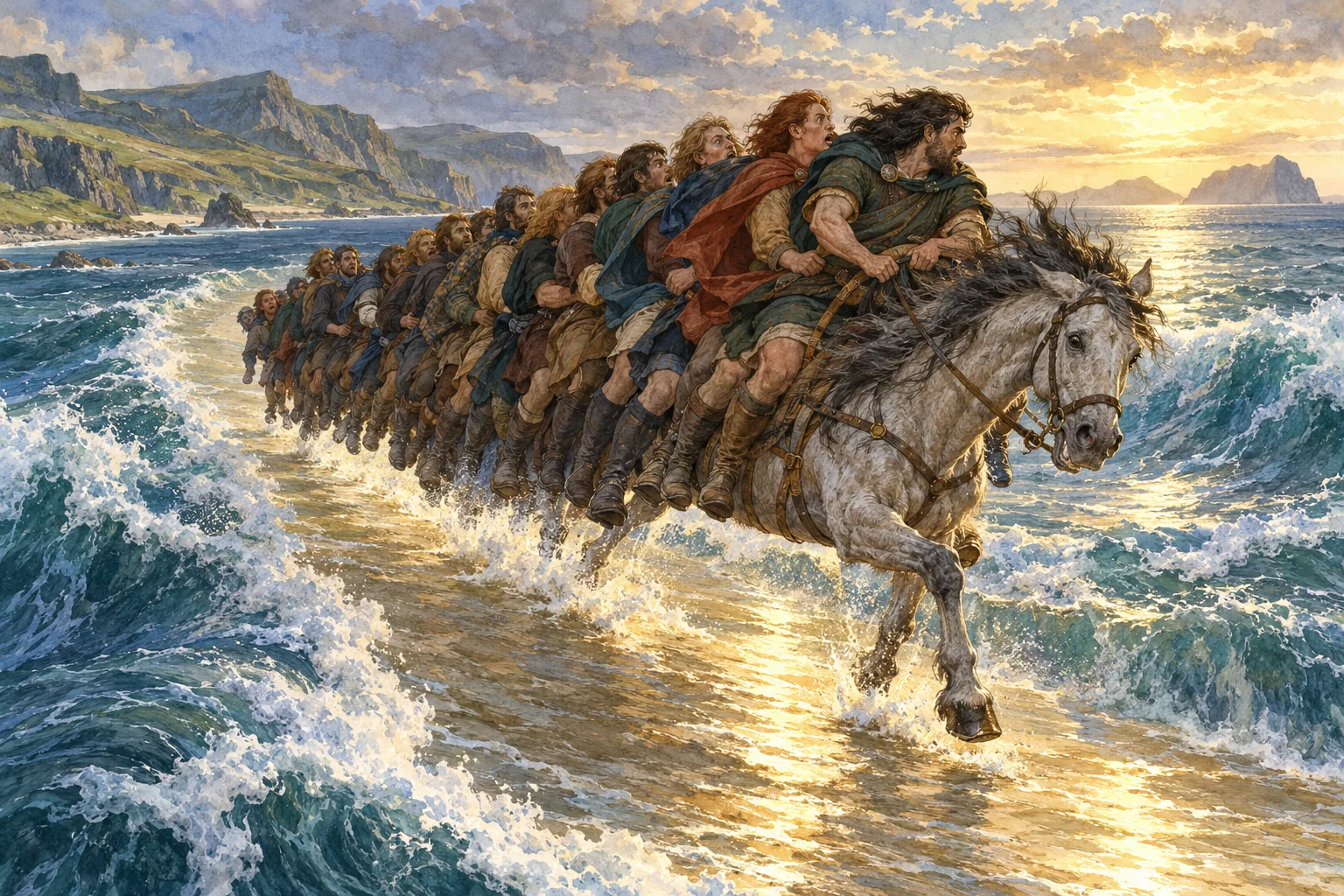
The servant declared himself insulted and walked away. Once over the hill, his weary shuffle became a tremendous sprint. His horse immediately galloped after him. Conán discovered that he could not dismount. Laughter turned to alarm as he shouted for help and bound Fionn to recover them, wherever they might be taken.
The chase reached the coast of western Kerry. Liagan the Swift seized the horse’s tail, hoping to stop it. Instead he too was dragged away. Ahead of the animal the sea seemed to become a sandy road; behind it the waves closed. Fionn now had fifteen missing men and no ship.
Two newcomers offered exactly the skills he needed. One could produce ships with three axe-blows on a sling-stick; the other could track a bird across land or water. Fionn left Oisín to command the Fianna in Ireland and embarked with fifteen companions. After three days they reached a cliff where the trail went upwards and vanished.
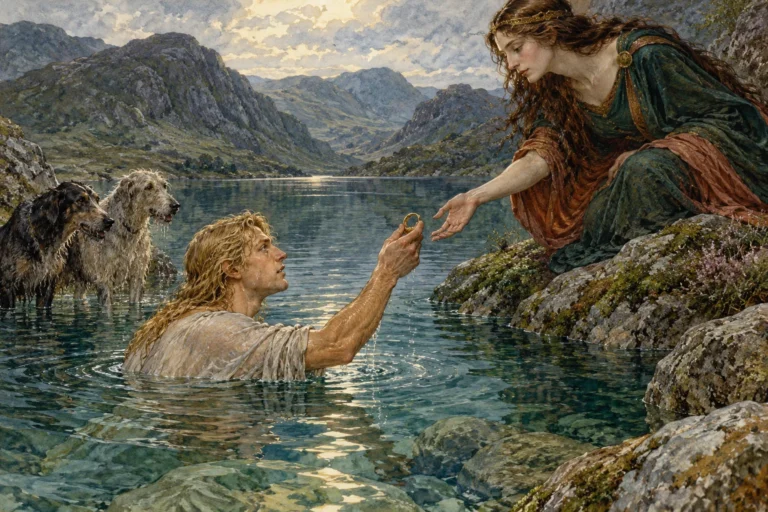
Diarmuid used the magical staves of Manannán to gain the summit. Unable to bring the others up, he explored a wooded country and found a drinking-horn beside a well. He drank despite sensing a prohibition. A furious magician appeared and challenged him. They fought until evening, when the stranger escaped beneath the water.
For three days the combat resumed. At last Diarmuid caught his opponent as he dived and followed him into a country below the well. There the magician’s people attacked. Diarmuid defeated them but was left wounded and exhausted. Another magician found him, took him to a fortress and healed him. His host was the Wizard of Chivalry; his enemy was the ruler of the land beneath the waves.
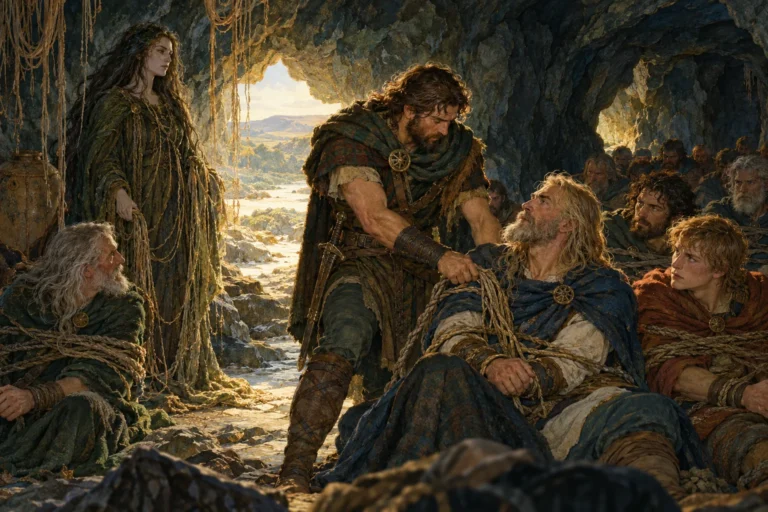
Meanwhile Fionn’s party climbed the cliff using ladders of rope. Following Diarmuid’s traces, they met the king of Sorcha, who had once served Fionn and now welcomed him. Their feast ended with news of invasion. The king of Greece had come to conquer Sorcha, and Fionn undertook its defence.
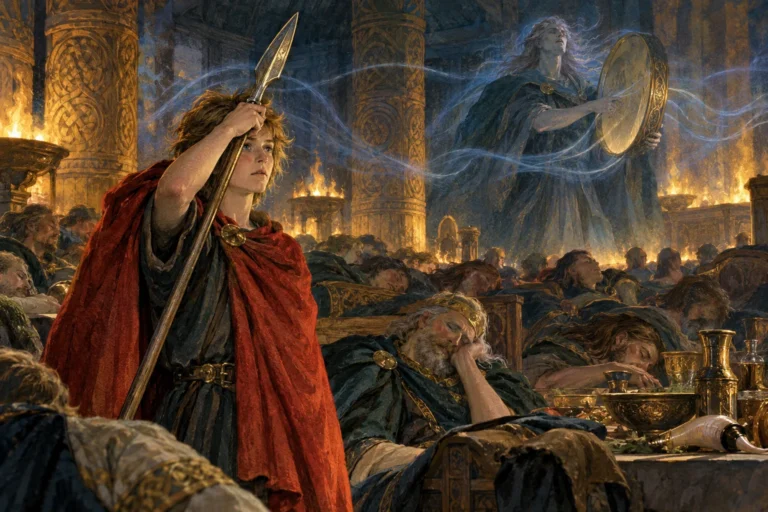
Goll and Oscar defeated one enemy prince and his followers. Other champions fought; Fionn himself killed the Greek king’s son. The prince’s sister Taise already loved Fionn by reputation. She escaped to him, but her father recovered her through a servant whose enchanted branch put the defenders to sleep. The Greek fleet withdrew with her aboard.
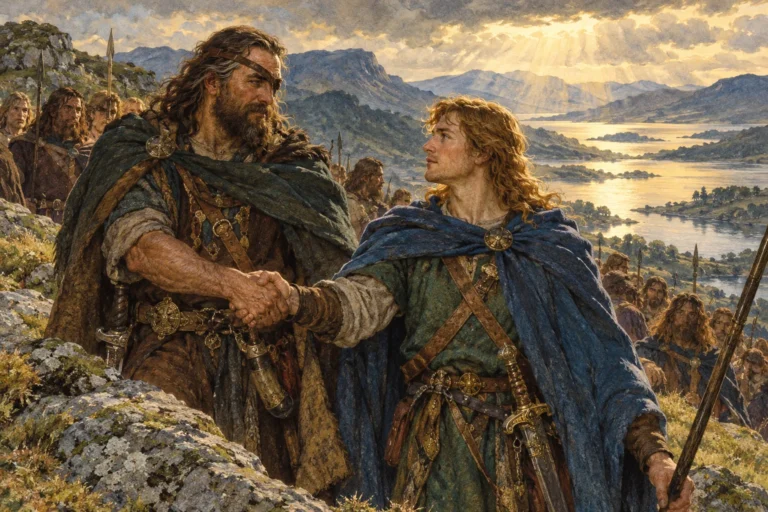
Diarmuid finally rejoined Fionn. His host had discovered the kidnapper’s identity: Abartach, son of Allchad, who had taken the men to the Land of Promise. Fionn sent a party to recover Taise and travelled to demand his companions. Abartach chose restitution over battle and offered hospitality and compensation.
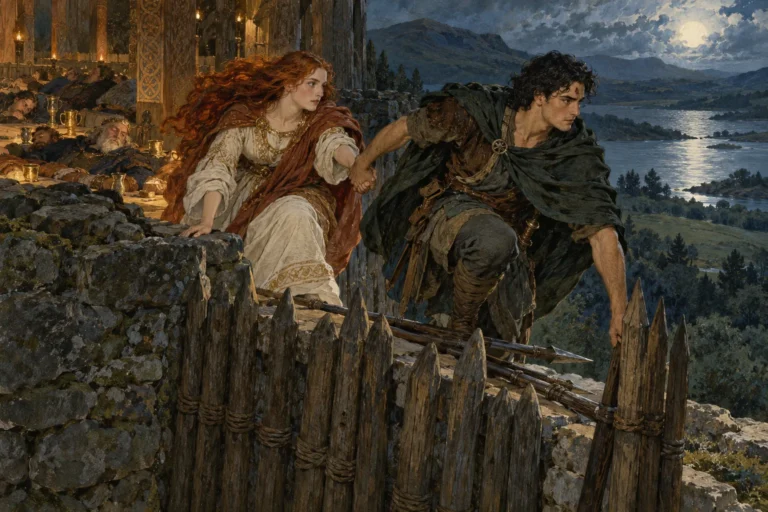
In Athens, Goll and Oscar entered as supposed poets, with Fergus providing the words their disguise required. Taise recognised them and arranged another escape. Soon Fionn’s friends and his beloved were reunited.
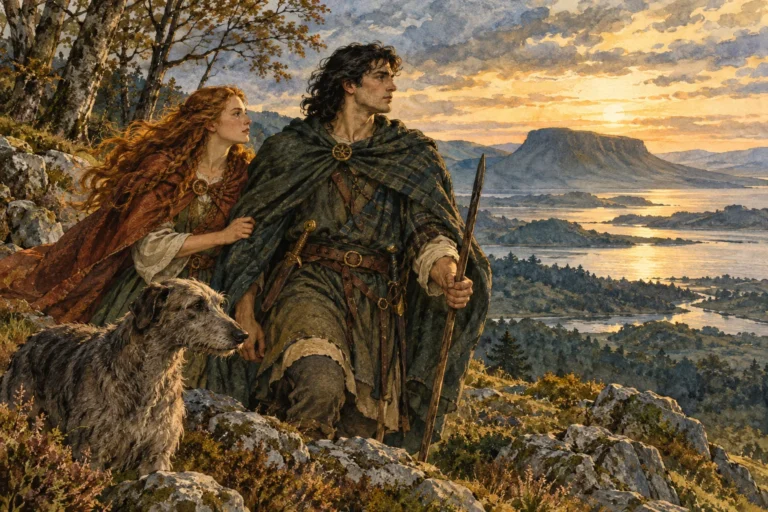
Fionn offset Abartach’s wages against the compensation owed him. Conán insisted on his own payment: fourteen women must endure the horse’s back, and Abartach’s wife must cling to its tail on the journey to Ireland. The bargain repeats the original humiliation on people who had not inflicted it. Back in Kerry, Abartach vanished. Fionn brought Taise home to Almhuin, where their wedding was celebrated.
Versions and variations
Fifteen captives or sixteen. In O’Grady, §§10–13, Conán and thirteen companions ride the horse; Liagan catches its tail, making fifteen captives. Joyce’s “Pursuit of the Gilla Dacker”, pp. 223–273, repeatedly counts sixteen. This is a genuine difference between the printed narratives, rather than a reason to combine their numbers into an unspecified crowd.
Who pays Conán’s compensation? The contrast is sharper at the ending. O’Grady’s §§41–42 specify fourteen women riding and Abartach’s wife at the tail. Joyce substitutes fifteen prominent men, with Abartach himself suffering the tail-dragging, and praises the settlement as repayment in kind. Joyce’s Fionn also waives damages while still promising wages; O’Grady’s Fionn balances one debt against the other. The sources therefore give different versions of both justice and generosity.
The romance inside the rescue. O’Grady retains Taise’s attraction to Fionn, her magical recapture and the expedition to Athens. Joyce omits her story and reduces the war in Sorcha. He expressly admits shortening the battles and removing a long episode in his preface, pp. xiv–xv. His edition names two Irish manuscripts he consulted, copied in 1728 and 1795. These are two translations or adaptations of manuscript tradition, not two independently recorded oral tellings; a manuscript collation is needed to allocate every difference precisely.
Gregory’s further compression. “The Hard Servant”, Part II, Book VI, chapter IV, keeps fifteen captives but says the eventual recovery would take too long to relate. It ends with the servant disappearing into sea-mist. Her Authorities explicitly names Silva Gadelica, so this is an acknowledged adaptation of the O’Grady source, not a third independent witness.
Context and evidence
Ordinary obligations drive extraordinary travel: wages, hospitality, military service and compensation connect the episodes. The strange horse exposes the Fianna’s confidence, while their determination to recover their companions carries them into other people’s conflicts. Athens and Greece appear in this Irish romance, but that does not make its events evidence of an ancient Irish campaign there. The ending also deserves scrutiny: the women demanded by Conán in O’Grady’s text have no recorded consent. Recording that feature preserves the version’s uncomfortable content without endorsing its treatment of them. The Land of Promise and the land beneath the waves are narrative realms, not mapped travel destinations.
Sources for this entry
- Anonymous; translated by Standish Hayes O’Grady, The Pursuit of the Gilla Decair and his Horse. Silva Gadelica, volume II (London: Williams and Norgate, 1892); CELT T303025. pp. 292–311, §§1–44. Read source — Complete main narrative consulted. About this book
- P. W. Joyce, Old Celtic Romances: The Pursuit of the Gilla Dacker and His Horse. 1920 edition; first published 1879. Preface pp. xiv–xv; story chapters I–VIII, pp. 223–273; especially VI–VIII. Read source — Compared adaptation; preface, opening and later episodes consulted. About this book
- Lady Gregory, Gods and Fighting Men: The Hard Servant. 1905 edition; first published 1904. Part II, Book VI, chapter IV; Notes III, Authorities, Part II. Read source — Compared explicitly dependent adaptation; ending and authority note consulted. About this book
Research coverage
The main retelling follows O’Grady, whose full translated prose was read. Joyce’s preface, opening and final episodes and Gregory’s ending/source note were compared. Irish manuscript collation and independent oral recordings remain outstanding; the three published forms are not three independent witnesses.
The Myths · Irish collection · Editorial approach
Further Reading